A periodic table for anomeric centres.

August 6th, 2016

In the last few posts, I have explored the anomeric effect as it occurs at an atom centre X. Here I try to summarise the atoms for which the effect is manifest in crystal structures.

The effect is defined by X bearing two substituents, one of which Z is a centre bearing a “lone pair” of electrons (or two electrons in a π-bond), and another Y in which the X-Y bond has a low-lying acceptor or σ* empty orbital into which the lone pair can be donated. This donation will only occur if the Z-lone pair and the X-Y bond vectors align antiperiplanar. Here is the summary so far.

X Blog entry
B 16601
C 14508,8898
N this one
O 16646
Si 16601
P 16601
S this one

As required of a good periodic table, it has gaps that need completing, in this case X=N and X=S. Firstly N, for which the small molecule below is known (FUHFAP).

FUHFAP

A ωB97XD/Def2-TZVPP calculation[1] yields an electron density distribution, which can be collected into monosynaptic basins using the ELF technique. There are two oxygen lone pairs (17 and 20) that are close to antiperiplanar to the adjacent N-O bond, having E(2) interaction energies obtained using the NBO method of 15.1 and 15.8 kcal/mol, typical of the anomeric range. The basin labelled 13 on X=N1 below is also perfectly aligned antiperiplanar with the adjacent O3-C2 bond, but its E(2) interaction energy is only 7.3 kcal/mol. Thus a strong anomeric interaction on the anomeric atom itself does not seem to occur. The same effect was noted for X=O in the previous post; the explanation remains unidentified.

FUHFAP

With the X=S gap, we have lots of opportunity with polysulfide compounds, a good example of which is the C2-symmetric and helical S8 dianion TEGWAF[2]

TEGWAF

Each of the 8 sulfur atoms exhibits antiperiplanar orientation of an S lone pair with an adjacent S-S acceptor σ* orbital;
1:2-3=23.7 kcal/mol;
2:3-4=18.5;
3:4-8=11.7, 3:2-1=7.4;
4:8-7=11.4, 4:3-2=9.2.

This just surveys the central main group elements, and it is possible that this little mini-periodic table may yet grow.

References

  1. H.S. Rzepa, "C 2 H 7 N 1 O 2", 2016. https://doi.org/10.14469/ch/195294
  2. Rybak, W.K.., Cymbaluk, A.., Skonieczny, J.., and Siczek, M.., "CCDC 880780: Experimental Crystal Structure Determination", 2012. https://doi.org/10.5517/ccykj88

Stereoelectronic effects galore: bis(trifluoromethyl)trioxide.

August 4th, 2016

Here is a little molecule that can be said to be pretty electron rich. There are lots of lone pairs present, and not a few electron-deficient σ-bonds. I thought it might be fun to look at the stereoelectronic interactions set up in this little system.

Trioxide

Known as ZEYDOW in the crystal structure database[1] (this species has a melting point of -138C, and its no trivial matter to measure x-ray diffraction of such a crystal!); a ωB97XD/Def2-TZVPP calculation is used to quantify the electron density [2] and this is then subjected to localisation using the ELF function. The little purple spheres represent so-called monosynaptic electron basins, or lone pairs as we might rather loosely call them (pair is not always an accurate term). 

zeydow

How these “lone pairs” act as electron donors into empty σ* acceptors can be quantified using NBO theory. The following table shows as many as 24 strong interactions (> 10 kcal/mol).  This now augments my previous post on “Anomeric effects at carbon involving lone pairs originating from one or two nitrogens” and represents an example of “Anomeric effects at oxygen involving lone pairs originating from oxygen”.

The final two entries originate from lone pairs on the central oxygen, donating approximately antiperiplanar (~160°) into the O-CF3 antibonds, but with only a low value of the E(2) interaction energy. These two lone pairs are curiously inert.

Lone pair donor σ-acceptor NBO E(2) energy
On F: 16,17,18,19,25,35,36,39,40,41,43,45 C-F 18-20
On F: 26,34,37,39,42,44 C-O 11-18
On O: 27,28,24,33 C-F 13-16
On O: 27,33 C-O 13
On O: 30,31 C-O 3.5

Apart from this curious molecule, there are few other examples of the R-O-O-O-R functional group,[3] but this one did catch my eye,[4] largely because it was retrieved from a search specification of R-O-O-O-R. The central oxygen apparently supports six O-O bonds, as well as three hydrogens. It is nothing of the sort of course. Reading the text reveals it is really three O…H-O bonds, disordered into two equally probable positions. There are no O-O bonds present at all, which reminds us we must always subject structures derived from x-ray crystallography to a chemical reality check.
yocsis

References

  1. K.I. Gobbato, H. Oberhammer, M.F. Klapdor, D. Mootz, W. Poll, S.E. Ulic, and H. Willner, "Bis(trifluoromethyl)trioxide: First Structure of a Straight‐Chain Trioxide", Angewandte Chemie International Edition in English, vol. 34, pp. 2244-2245, 1995. https://doi.org/10.1002/anie.199522441
  2. H.S. Rzepa, "C 2 F 6 O 3", 2016. https://doi.org/10.14469/ch/195291
  3. Pernice, H.., Berkei, M.., Henkel, G.., Willner, H.., Arguello, G.A.., McKee, M.L.., and Webb, T.R.., "CCDC 224327: Experimental Crystal Structure Determination", 2004. https://doi.org/10.5517/cc7jfcj
  4. J.L. Atwood, S.G. Bott, P.C. Junk, and M.T. May, "Liquid clathrate media containing transition metal halocarbonyl anions; formation and crystal structures of [K+ · 18-crown-6][Cr(CO)5Cl], [H3O+ · 18-crown-6][W(CO)5Cl], [H3O+ · 18-crown-6][W(CO)4Cl3], and [H2O · bis-aza-18-crown-6 · (H+)2][W(CO)4Cl3]2", Journal of Organometallic Chemistry, vol. 487, pp. 7-15, 1995. https://doi.org/10.1016/0022-328x(94)05072-j

Managing (open) NMR data: a working example using Mpublish.

August 1st, 2016

In March, I posted from the ACS meeting in San Diego on the topic of Research data: Managing spectroscopy-NMR, and noted a talk by MestreLab Research on how a tool called Mpublish in the forthcoming release of their NMR analysis software Mestrenova could help. With that release now out, the opportunity arose to test the system.

I will start by reminding that NMR data associated with a published article is (or should be) openly free: one should not need a subscription to the journal to access it (although one might in order to find it). Now, NMR data as it emerges from a spectrometer is highly sophisticated, comprising a collection of (sometimes) binary proprietary files containing the measured free induction decays (FID). Turning this raw data into an interpretable NMR spectrum, the visual form of the data that so appeals to human beings, is non trivial. This requires what may be highly sophisticated software and that in turn means that it may be a commercial product. Of course there are also examples of non-commercial open software packages that are best-of-breed; indeed in its early life-cycle MestreNova was known as MESTREC before becoming a commercial product. Could one achieve the benefits of both open and fully functional NMR data with no loss from the original instrument coupled with the ability to apply top-quality software for its analysis in an open manner? This is a demonstration of how Mpublish achieves this.

  1. Invoke the URL data.datacite.org/chemical/x-mnpub/10.14469/hpc/1087 from a browser
  2. This action queries the metadata deposited with DataCite for the doi 10.14469/hpc/1087 and retrieves the first instance of any file associated with that dataset that has the format type chemical/x-mnpub. You can directly view this metadata by invoking just data.datacite.org/10.14469/hpc/1087 where you can find both mnpub and mnova formats listed. A command such as data.datacite.org/chemical/x-mnpub/10.14469/hpc/1087 allows the file retrieval to be incorporated into automated workflows based just on the doi and the media type desired. Note my parenthetical comment above about finding data; here you only need its doi to retrieve it!
  3. The URL above downloads a small text file with the suffix .mnpub which contains in essence two components:

    • A URL pointing directly to an .mnova file at the repository for which the doi has been issued
    • A signature key derived used to verify that the public key of the publisher (the data repository in this instance) was counter-signed by Mestrelab.
  4. If you now download the application program and install it (but for the purpose of this demonstration, ignore any requests to try to license the program. Use it unlicensed) and open the .mnpub file using it, you should get the below.The application program has checked the signature key, and if valid, proceeds to download a full data file (a .mnova file in this case), and to analyze and display it within the program. The data is fully active; it can be manipulated and analysed. Notice in the picture below, the red arrow points to the state of the license, in this case not present.
    mn
  5. It is also possible to apply this procedure to the raw data as it emerges from the (Bruker) spectrometer, and compressed into a .zip archive. The MestreNova software will automatically process the contents by applying various default parameters, although the result may not correspond exactly to that present in e.g. the equivalent .mnova file (which may have had specific parameters applied).

It is my hope that anyone who records NMR data and processes it using software such as MestreNova will now consider using the mechanism above to accompany their submitted articles, rather than just automatically pasting a static image of the spectrum into a PDF file as "supporting information". This is part of what is meant by "managed research data" (RDM).

One cannot help but note that many types of scientific instrument nowadays come with bespoke software for analysing the data they produce. Very often this software is unavailable to anyone who has not purchased the instrument itself. To make the data available to others, the processed data and its visual interpretation often have to be reduced, with much consequent information loss, to a lowest common denominator format such as Acrobat/PDF. Here we see a mechanism for avoiding any such information loss whilst enabling, for that dataset only, the full potential for (re)analysing the data. It will be interesting to see if other examples of this model or its equivalent emerge in the near future.


Anomeric effects at carbon involving lone pairs originating from one or two nitrogens.

July 8th, 2016

The previous post looked at anomeric effects set up on centres such as B, Si or P, and involving two oxygen groups attached to these atoms. Here I vary the attached groups to include either one or two nitrogen atoms.[1]

.aminol-sq

The plot below shows aminols, C(NHR)(OR”). A torsion along either the C-O or C-N bond of ~60° implies that (at two coordinate oxygen or three coordinated nitrogen) there may be a lone pair with a torsion of 180°, which would set up an antiperiplanar alignment between that lone pair and the adjacent C-O or C-N bond (the anomeric effect). The clear hotspot is at angles of ~80°, which does raise the issue of why it deviates from 60°. Only a location of the lone pair centroid (using eg the ELF quantum mechanical technique) would cast light on that. There is a less distinct region for which the C-N torsion is 60° and the C-O torsion 180°, and an even less distinct region for the reverse (C-O torsion is 60° and the C-N torsion 180°). This tends to imply that a nitrogen lone pair is a better donor into a C-O bond than the reverse. Electronegativity suggests this should indeed be so, with the N lone pair less bound by the N nucleus and hence easier to release into a C-Oσ* orbital which is a better acceptor than then equivalent C-Nσ* orbital. aminol This plot is where both heteroatoms are nitrogen (geminal diamines). There are about twice as many examples, resulting in more distinct clustering. The anomeric hotspot is now around 70°  and there are equally populated clusters where only one torsion is ~70°. There is another cluster for which both torsions are 180° (no stereoelectronic alignment of lone pairs) and three small clusters where the torsions are either 180° or 0°. There is finally an intriguing cluster for which both torsions at ~120° (again no stereoelectronics). diamine

Searches like this seem to be good at creating more questions than they answer. Clearly, the origins of the various hotspots need to be investigated, ideally using quantum mechanics to quantify the stereoelectronic interactions involved. So this sort of (ten minute) exercise is very good at raising research project investigations.

References

  1. H. Rzepa, "Anomeric effects at carbon, involving lone pairs originating from one or two nitrogens", 2016. https://doi.org/10.14469/hpc/936

Anomeric effects at boron, silicon and phosphorus.

July 1st, 2016

The anomeric effect occurs at 4-coordinate (sp3) carbon centres carrying two oxygen substituents and involves an alignment of a lone electron pair on one oxygen with the adjacent C-O σ*-bond of the other oxygen. Here I explore whether other centres can exhibit the phenomenon. I start with 4-coordinate boron, using the crystal structure search definition below (along with R < 0.1, no disorder, no errors).[1]anomeric-bo-sq

The result shows two prominent clusters, one with both torsion angles being 180°, and another with both being ~60°. This latter is the one that implies that there must be two lone pairs, one on each oxygen, that are anti-periplanar to the adjacent B-O bond. There are two more diffuse clusters where only one antiperiplanar alignment is seen. So yes, 4-coordinate boron can exhibit an anomeric effect!

anomeric-boThis compares to the carbon-anomeric plot which is shown here for comparison, where the top right cluster of 180° torsions contains proportionately few hits than with boron.

anomeric-coThe next centre is at 4-coordinate silicon. Again three significant clusters are seen; one with two antiperiplanar lone pair alignments with Si-O bonds, and two more with just one such alignment. The previous hotspot for which both measured torsions were 180° is largely absent. So here, the anomeric effect is much stronger. Notice also that whereas the torsions in the region of 60° for the carbon centre lie along a ridge coincident with the diagonal  (bottom left to top right), that for the silicon centre show a ridge running orthogonal to the diagonal. An interesting point to follow up perhaps?anomeric-sio

Since the off-diagonal clusters are relatively prominent, implying just one anomeric interaction, it is of interest to see if this results in any asymmetry in the two Si-O bond lengths. If its present, the effect is small.

anomeric-sio-distances

Finally 4-coordinate group 15 elements. Most of the hits are in fact for P; there are none for N. This shows four clusters; the two on the diagonal show respectively two and no antiperiplanar interactions. The two off-diagonal clusters show just one such orientation. As with  Si, the ridge in the 60° region run orthogonal to the diagonal.

anomeric-gp15-oSo this little exploration shows that the anomeric effect, best known for sugars and at a carbon centre, is in fact more general to the adjacent elements.


References

  1. H. Rzepa, "Anomeric effects at boron, silicon and phosphorus.", 2016. https://doi.org/10.14469/hpc/696

How does an OH or NH group approach an aromatic ring to hydrogen bond with its π-face?

June 22nd, 2016

I previously used data mining of crystal structures to explore the directing influence of substituents on aromatic and heteroatomatic rings. Here I explore, quite literally, a different angle to the hydrogen bonding interactions between a benzene ring and OH or NH groups.

aromatic-pi-query

I start by defining a benzene ring with a centroid. The distance is from that centroid to the H atom of an OH or NH group and the angle is C-centroid-H. To limit the search to approach of the OH or NH group more or less orthogonal to the ring, the absolute value of the torsion between the centroid-H vector and the ring C-C vector is constrained to lie between 70-100° (the other constraints being no disorder, no errors, T < 140K and R < 0.05).[1]

aromatic-pi-HN-140

The above shows the results for NH groups interacting with the aromatic ring. The maximum distance 2.8Å is more or less the van der Waals contact distance between a hydrogen and a carbon and as you can see the contacts "funnel down" to the centroid at < 2.1Å. The shortest distance[2] is for ammonium tetraphenylborate, which you can view in e.g. spacefill mode here[3]

390

The other interesting close contact derives from a protonated pyridine[4], which can in turn be viewed here.[5] The main message from the distribution shown above is that as the distances between the HN and the centroid get shorter, the "trajectory" of approach remains orthogonal to the ring (the angle defined above remains ~90°) and heads towards the centroid of the π-cloud. The hotspot itself (red, ~2.6Å) also lies along this trajectory.

Recollect that when I used such hydrogen bonding to see if crystal structures discriminate between the ortho or meta positions of a ring carrying an electron donating substituent, it was the distance from a HO to the carbon that was measured as the discriminator. So it's a faint surprise to find that with HN, and without the necessary perturbation of an electron donating substituent, the intrinsic preference seems to be for the ring centroid and not any specific carbon atom of the ring.

So how about the OH group? There are in fact rather fewer examples, and so the statistics are a bit less clear-cut. But there is a tantalising suggestion that this time, the trajectory is not ~90° but rather less, implying that the destination is no longer the centroid of the π-cloud but one of the carbon atoms of the ring itself. For those who like to "read between the lines" and spot things that are absent rather than present, you may have asked yourself why I did not use NH probes in my earlier post. Well, it appears that the NH group is less effective at e.g. o/p discrimination than is an OH group.

aromatic-pi-OH-140

I can only speculate as to the origins (real or not) of the difference in behaviour between OH and NH groups towards a phenyl π-face. Perhaps it is simply bias in the CSD database? Or might there be electronic origins? Time to end with that phrase "watch this space".


References

  1. H. Rzepa, "How does an OH or NH group approach an aromatic ring to hydrogen bond with its π-face?", 2016. https://doi.org/10.14469/hpc/673
  2. T. Steiner, and S.A. Mason, "Short N<sup>+</sup>—H...Ph hydrogen bonds in ammonium tetraphenylborate characterized by neutron diffraction", Acta Crystallographica Section B Structural Science, vol. 56, pp. 254-260, 2000. https://doi.org/10.1107/s0108768199012318
  3. Steiner, T.., and Mason, S.A.., "CCDC 144361: Experimental Crystal Structure Determination", 2000. https://doi.org/10.5517/cc4v6tz
  4. O. Danylyuk, B. Leśniewska, K. Suwinska, N. Matoussi, and A.W. Coleman, "Structural Diversity in the Crystalline Complexes of <i>para</i>-Sulfonato-calix[4]arene with Bipyridinium Derivatives", Crystal Growth & Design, vol. 10, pp. 4542-4549, 2010. https://doi.org/10.1021/cg100831c
  5. Danylyuk, O.., Lesniewska, B.., Suwinska, K.., Matoussi, N.., and Coleman, A.W.., "CCDC 819118: Experimental Crystal Structure Determination", 2011. https://doi.org/10.5517/ccwhc5w

Exploring the electrophilic directing influence of heteroaromatic rings using crystal structure data mining.

June 21st, 2016

This is a follow-up to the post on exploring the directing influence of (electron donating) substituents on benzene[1] with the focus on heteroaromatic rings such indoles, pyrroles and group 16 analogues (furans, thiophenes etc).

s-cis-ester1

The search query is shown above (and is available here[2]). As before, the distance is compared from an electrophile, modelled as the hydrogen atom of an OH group, to both the carbon next to the heteroatom (C2) and the C3 carbon. The torsion is defined so as to ensure that the OH group is approaching the π-face of the ring. The other constraints are R < 0.1, no disorder and no errors and normalised H positions.

Firstly, indoles (as above). There are only a few hits, but even so one can see that they all cluster in the top left triangle, where the distance to C2 is always longer than to C3. Indeed, this is the known position for electrophilic substitution of indoles.

s-cis-ester1

The search can be extended by removing the benzo group so as to also include pyrroles. More hits are obtained, and again most of them collect in the top left triangle. The hot spot indicates that the difference in lengths is ~0.3Å in favour of the 3-position, a very similar discrimination to that previously found for benzene groups with an electron donating substituent.

s-cis-ester1

Next, the N atom is replaced by any atom from group 16 of the periodic table (i.e. O, S, etc). The scatter is now in both top left and bottom right triangles, which suggest much weaker discrimination between C2 and C3;  if anything in favour of C2 (often the observed regiospecificities for such compounds).

s-cis-ester1

Finally, pyridines. Only a slight bias towards the C2 position. With pyridines of course, the electrophile in fact first interacts with the nitrogen lone pair in the plane of the molecule, which perturbs the eventual outcome. So this crystallographic method is perhaps a better intrinsic probe than kinetic reactivity.

s-cis-ester1

References

  1. H.S. Rzepa, "Discovering More Chemical Concepts from 3D Chemical Information Searches of Crystal Structure Databases", Journal of Chemical Education, vol. 93, pp. 550-554, 2015. https://doi.org/10.1021/acs.jchemed.5b00346
  2. H. Rzepa, "Search for HO interactions to indoles, pyrroles, furans, and thiophenes", 2016. https://doi.org/10.14469/hpc/665

Why is the carbonyl IR stretch in an ester higher than in a ketone: crystal structure data mining.

June 18th, 2016

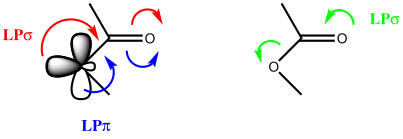
In this post, I pondered upon the C=O infra-red spectroscopic properties of esters, and showed three possible electronic influences:

s-cis-ester1

The red (and blue) arrows imply the C-O bond might shorten and the C=O bond would lengthen; the green the reverse. So time for a search of the crystal structure database as a reality check. The query is as follows:

s-cis-ester1

The response shows the bimodal distribution with as expected the s-cis conformation dominating. There is indeed a hint that for the s-cis, the C-O distance is rather shorter than for the s-trans conformation.

s-cis-ester1

Repeating the search, but specifying that the temperature of data acquisition is < 90K, one gets a much clearer indication of the difference in bond lengths.

s-cis-ester1

This alternative representation shows the C-O and the C=O distances, with red indicating s-trans and blue indicating s-cis conformations (T < 140K). The red dots occupy a bottom right cluster for which the C-O distance is longer and the C=O shorter than the corresponding blue cluster.

s-cis-ester1

Again reducing the temperature of data collection to < 90K shows a rather weak inverse correlation between the two distances for eg the blue dots.

s-cis-ester1

A shame however that this database does not hold IR values for the carbonyl stretches. I am sure correlations must exist, but how to get at them (other than manual collection of data).

A wider look at π-complex metal-alkene (and alkyne) compounds.

June 13th, 2016

Previously, I looked at the historic origins of the so-called π-complex theory of metal-alkene complexes. Here I follow this up with some data mining of the crystal structure database for such structures.
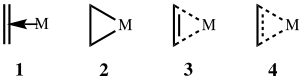
Alkene-metal "π-complexes" have what might be called a representational problem; they do not happily fit into the standard Lewis model of using lines connecting atoms to represent electron pairs. Structure 1 was the original representation used by Dewar intending the meaning of partial back donation from a filled metal orbital to the empty π* of the alkene. At the other extreme these compounds can be called metallacyclopropanes (2) in which only single bonds feature (these can be thought of as representing full back bonding from metal to alkene and full forward bonding from alkene to metal). Representations 3 and 4 are a more fuzzy blend of these, implying some sort of partial bond order for the metal-carbon bonds. Taken together, they imply that the formal bond order of the C-C bond might vary between single to double. Structures 1 and 2 in particular imply that there might be two distinct ways in arranging the bonding and that π-complexes and metallacyclopropanes might therefore be distinct valence-bond isomers, each potentially capable of separate existence.

Why do these representations matter? Well, I am going to mine the crystal structure database for these species to try to see if there is any evidence for a bimodal distribution in the C-C lengths, perhaps indicating evidence of the isomerism suggested above. Such a structural database is indexed against atom-pair connectivity in the first instance and then bond type; one can specify the following types of bond connecting any two atoms: single, double, triple, quadruple, polymeric, delocalised, pi and any. It is not entirely obvious which if any of these types apply to structure 1 (it is not possible to draw a bond ending at the mid-point of another bond using the Conquest structure editor); the dashed lines in structures 3 and 4 could be classed as delocalised, pi, or most generally any. The search query can be constructed thus, where the two carbons carry R which can be either H or C and all four C-R bonds are specified as acyclic (to try to avoid complications by excluding compounds such as cyclic metallacenes). Because representation 1 cannot be constructed in the editor, I am going to specify that each carbon carries four bonds of any type in the first instance. The torsion specified is defined as R-C-C-M and the full queries can be found deposited here.[1]

If the metallacyclopropane representation 2 is defined with explicit single bonds, one gets only 22 hits (no errors, no disorder, R < 0.1). The distribution of C-C bond lengths is shown below. Already one sees a representational problem emerging. A true metallacyclopropane might be expected to show a C-C single bond length, say > ~1.5Å. But only one or two of these examples actually have this value, the most probable value being ~1.4Å.

Using representation 3, one gets 1861 hits, but as before one sees a maximum at ~1.4Å with a tail reaching to both single and double bond values for the C-C distance.

If the C-C bond is also specified as "any", the hits increase to 3948, but the bond length distribution is still very similar, with no sign of any bimodal distribution.

Such a distribution is however found if the torsions between the R-C bond vector and the C-M bond vector are plotted (for all types of bond). A large number of the complexes have a torsion <90°, which suggests that in fact the substituent R is probably interacting with the metal (even though this would lead to formal cyclicity, specifying R-C as acyclic does not detect this interaction). Could this be masking a bimodal distribution in the C-C lengths?

If the previous search is repeated, but this time specifying that all four torsions must lie in the range 90-180° (the range expected for a "classical" alkene-metal complex and selecting only the top right hand side cluster in the plot above) the reduced value of 1051 hits are obtained, but the monomodal distribution remains.

For this last set, here is a plot of the two C-metal bond length, with colour indicating the C-C bond length, indicating the two C-metal bonds are clearly linearly correlated.

One final variation;  the atom on either C can only be H or a 4-coordinate (sp3) carbon; 645 hits. Again, a monomodal distribution centered at 1.4Å.

So this foray through metal alkene complexes suggests that there is a continuum between the formal metallacyclopropane with a C-C single bond and the only slightly perturbed alkene-metal complex with a C=C double bond. Whilst this would not prevent any one of these compounds existing as two distinctly different valence-bond isomers, it makes it very unlikely. I had noted in an earlier post that for molecules of the type RX≡XR (X=Si, Ge, Sn, Pb) that there was indeed a clear bimodal distribution of the X-X lengths evident in the crystal structures (for a relatively small sample number). The structures 1-4 shown at the start of this post are all simply just variations in a continuum and not distinct isomers.

POSTSCRIPT:  I noted above the bimodel distribution in compounds involving formal triple bonds. So I repeated the search above for π-complex metal-alkyne complexes. Specifying an acyclic C-R bond, and any for the CC bond type, one gets the following.

There is now a tantalizing suggestion of two clusters, one at 1.3 and another at 1.4Å. The torsional distribution shows that the latter distance appears to be associated with much smaller torsions, whereas the top right cluster is associated with shorter lengths.

If the torsions are restricted to the range 90-180, then the histogram looses the smaller cluster, and perhaps gains a second cluster at 1.22Å?  As I said, all quite tantalizing!


The tail in all the histograms extends into the 1.1-1.3Å region, which seems unreasonable for a carbon where four bonds are specified. This region probably represents errors in the crystallographic analysis or reporting. But who knows, perhaps some very unusual compounds are lurking there!


References

  1. H. Rzepa, "A wider look at the π-complex theory of metal-alkene compounds.", 2016. https://doi.org/10.14469/hpc/642

A wider look at chlorine trifluoride: crystal structures and data mining.

June 10th, 2016

A while ago, I explored how the 3-coordinate halogen compound ClF3 is conventionally analyzed using VSEPR (valence shell electron pair repulsion theory). Here I (belatedly) look at other such tri-coordinate halogen compounds using known structures gleaned from the crystal structure database (CSD).

The search query specifies 7A as the central atom, defined with just three bonded (non-metallic) atoms. Initially, if no constraint on any cyclicity in the three 7A-NM bonds is made (and with R < 0.1, no errors, no disorder), the following result emerges.

I have plotted the three angle variables using the X/Y axes above and used colour to indicate the third angle (red = ~180°, blue = ~90°). The clusters show that two of the angles are ~90° and only one is ~180°. There is also a set of blue points (~90°) which show a linear correlation and which can be shown to derive from cyclicity, as the plot below reveals when acyclicity is specified for all three NM-7A bonds.

In this distribution, the two clusters for ANG1 or ANG2 of ~180° are small and compact, but the cluster where both ANG1 and ANG2 are ~90° is much more diffuse. Not all of the points in this cluster show as red (ANG3 ~180°); there are a few cyan or blue examples here too; indicating all three angles are in the range 140-90°. This result is not arising from cyclic constraints. 

This wider look at 3-coordinate compounds in group 17 (the halogens) quickly reveals a class of such molecules where all three angles are relatively small. This suggests that a closer look at the bonding in these systems, especially in terms of VSEPR, might be rewarding!

I end with an equivalent search for group 18 (the noble gases). Although the number of examples is small, all show the two small/one large angle so characteristic of chlorine trifluoride itself. 

The above is I think a good example of (big?) data mining, where one is searching for patterns, and if lucky spotting patterns that deviate from the norm to investigate the possibility of new chemical phenomena.[1] It is also interesting to speculate upon the origins of why two of the clusters shown above are small and compact and the third is much more diffuse.

References

  1. H.S. Rzepa, "Discovering More Chemical Concepts from 3D Chemical Information Searches of Crystal Structure Databases", Journal of Chemical Education, vol. 93, pp. 550-554, 2015. https://doi.org/10.1021/acs.jchemed.5b00346