Archive for the ‘Uncategorized’ Category

The mechanism of the Birch reduction. Part 3: reduction of benzene

Tuesday, December 4th, 2012

Birch reduction of benzene itself results in 1,4-cyclohexadiene rather than the more stable (conjugated) 1,3-cyclohexadiene. Why is this?
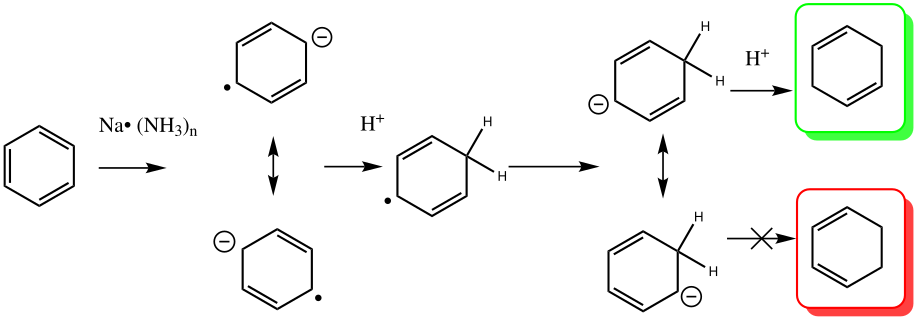
The mechanism, as elaborated in the previous two posts, involves a one-electron transfer from a sodium atom to form the radical anion, which is then protonated in a second step, and this is again reduced to form a pentadienyl anion in the penultimate step.[1] The question now becomes why does this anion protonate to give predominantly the less stable diene product? The answer involves the actual structure of this anion. A calculation at the ωB97XD/6-311+G(d,p)/SCRF=acetonitrile level for the ion pair comprising the cyclohexadienyl anion and a Na(NH3)3+ counterion is shown below.

Structure of the cyclohexadienyl ion pair. Click for 3D.

From this, it appears that the sodium cation is η2 coordinated to each of two relatively localised double bonds (1.37Å), resulting in the negative charge accumulating on just the one carbon (red arrow), this being the carbon that then exclusively receives a final proton. The highest energy (-0.115 au) natural bond orbital (NBO) also emerges as being located on this carbon (the next two highest energy NBOs only come in at -0.303 au, and reside on each of the localised alkene bonds).

The highest energy NBO orbital. Click for 3D.

The molecular electrostatic potential in effect integrates over all the electrons (not just those in the highest orbital), resulting in a function that measures the attractiveness of any point to a proton (red). It too shows that the most attractive region (red) for a proton is again on this carbon.

Molecular electrostatic potential. Click for 3D.

There is even evidence from crystal structures that this sort of motif is possible. Thus the dianion of 1,4-diphenylbenzene (with two Na(thf)3+ counter-ions) reveals[2] this type of coordination.  The buckling seen in the above mono-anion is inhibited by the presence of cations on both sides of the di-anion, but the pattern of short/long bonds seen above also manifests in the crystal structure.

Crystal model. Click for 3D.

So the take home message is that the counter-ion (solvated sodium cations) in the Birch reduction  of benzene itself may coordinate to the anionic intermediates in the reductive process, and the resulting geometry of this ion-pair determines the eventual product of protonation.

References

  1. H.E. Zimmerman, and P.A. Wang, "Regioselectivity of the Birch reduction", Journal of the American Chemical Society, vol. 112, pp. 1280-1281, 1990. https://doi.org/10.1021/ja00159a078
  2. J.H. Noordik, H.M. Doesburg, and P.A.J. Prick, "Structures of the sodium–<i>p</i>-terphenyl ion pairs: disodium terphenylide–tetrahydrofuran (1/6) and disodium diterphenylide terphenyl–1,2-dimethoxyethane (1/6)", Acta Crystallographica Section B Structural Crystallography and Crystal Chemistry, vol. 37, pp. 1659-1663, 1981. https://doi.org/10.1107/s0567740881006833
The mechanism of the Birch reduction. Part 2: a transition state model.

Monday, December 3rd, 2012

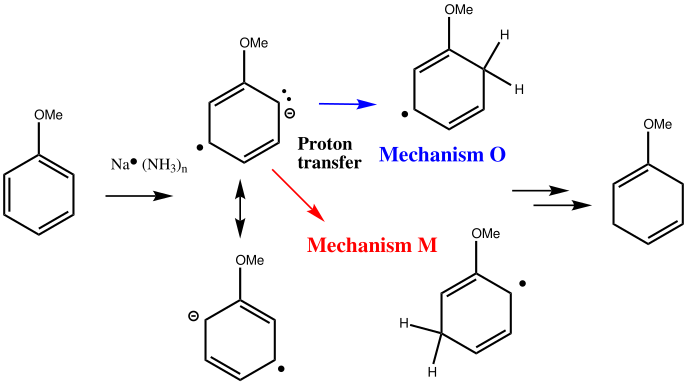
I promised that the follow-up to on the topic of Birch reduction would focus on the proton transfer reaction between the radical anion of anisole and a proton source, as part of analysing whether the mechanistic pathway proceeds O or M.

To add some context, Hammond’s postulate [1] states that “the structure of a transition state resembles that of the species nearest to it in free energy.” If the structure of the transition state for proton transfer above resembles that of the radical anion precursor we would call this an early transition state and it would be a reasonable approximation to infer properties of the reaction from the properties of that radical anion. The previous post explored those properties via the computed molecular electrostatic potential (MEP) and the highest energy NBO (natural bond orbitals, which are used here instead of molecular orbitals). Unfortunately, they did not agree with each other. Remember that Hammond’s postulate dates from 1955, an era when it was not practical to compute the structure of a transition state directly using quantum mechanics (certainly not so for such a complex reaction as that shown above). Indeed, one might argue that such a structure has only become computable in a practical sense very recently! As I showed previously, the radical ion-pair resulting from a 1-electron transfer from sodium to anisole has a dipole moment of ~11.6D, and the reaction is conducted in a solvent of medium polarity. This combination means that one really is obliged to take into account the dielectric of the solvent, and indeed any strong explicit hydrogen bonds that might be present. The codes for doing this have really only recently become robust enough to tackle such an endeavour[2], which might explain why such calculations are not yet abundant, or ubiquitously cited in the text books.

Proton transfer for M mechanism. Click for 3D.

The proton transfer via one M mechanism is shown above. The proton source is ammonia, which is known from experiment to lead to sluggish reactions (the more acidic t-butanol is often added to speed up the reaction), but we can see that the transition state is very late, νi 423.8 cm-1. The N…H bond is largely broken, and the C-H bond is mostly formed. The dipole moment is 7.7D, also different from that of the reactant. Perhaps, knowing this, it is not too surprising that inferences based on Hammond’s postulate as applied to the reactant are not reliable. The value of ΔG298computed from this model is 22.8 kcal/mol, which is on the high-ish side for a reaction to occur readily at room temperatures or below.[3] This nevertheless nicely conforms what we already know, that a more acidic proton donor is needed to achieve a fast reaction.

Proton transfer for O mechanism. Click for 3D.

The proton transfer via one O mechanism is similar, but a tad less “late”. This already raises doubts about application of Hammond’s postulate to this system; one cannot really compare two reactions in which each reactant differs in its resemblance to its transition state. The dipole moment of this alternative transition state is also 7.7D, but the transition imaginary mode is much higher at νi 869 cm-1. The free energy barrier is 21.0, some 1.8 kcal/mol lower than the barrier for the M mechanism. This corresponds to a rate about 21 times faster for O over M (at 298K).

To conclude, we characterise two (of the four) isomeric transition states for protonation of the radical anion intermediate in the Birch reduction of anisole. These two transition states are actually different in several subtle regards, differences which would not have manifested if only the properties of the reactant had been considered. The final word must be that the text books are likely correct on this one, although a little more work is still needed to tidy up loose ends.  

References

  1. G.S. Hammond, "A Correlation of Reaction Rates", Journal of the American Chemical Society, vol. 77, pp. 334-338, 1955. https://doi.org/10.1021/ja01607a027
  2. J. Kong, P.V.R. Schleyer, and H.S. Rzepa, "Successful Computational Modeling of Isobornyl Chloride Ion-Pair Mechanisms", The Journal of Organic Chemistry, vol. 75, pp. 5164-5169, 2010. https://doi.org/10.1021/jo100920e
  3. H.E. Zimmerman, and P.A. Wang, "Regioselectivity of the Birch reduction", Journal of the American Chemical Society, vol. 112, pp. 1280-1281, 1990. https://doi.org/10.1021/ja00159a078

The mechanism of the Birch reduction. Part 1: reduction of anisole.

Saturday, December 1st, 2012

The Birch reduction is a classic method for partially reducing e.g. aryl ethers using electrons (from sodium dissolved in ammonia) as the reductant rather than e.g. dihydrogen. As happens occasionally in chemistry, a long debate broke out over the two alternative mechanisms labelled O (for ortho protonation of the initial radical anion intermediate) or M (for meta protonation). Text books seem to have settled down of late in favour of O. Here I take a look at the issue myself.

Readers of my blog will note that I promote the use of models which are as reasonably complete as one can make them. In this case, if the intermediate is an anion, then I argue that the model should include the positive counter-ion. This is very often simply not included, on the grounds that it “probably does not influence things”. Well, not on this blog! My model is methoxybenzene, a sodium atom solvated by 3NH3 (the reaction itself is done in liquid ammonia with some added t-butanol) and continuum solvent (not ammonia itself, but acetonitrile which has a similar dielectric to liquid ammonia with some added butanol). 

The start point is a solvated sodium atom (loosely) coordinated to anisole (methoxybenzene). The calculation (ωB97XD/6-311+G(d,p)/SCRF=acetonitrile) on this neutral system shows the spin density arising from the single unpaired electron is mostly (0.851) on the sodium, although a little spin density has crept onto the anisole. The dipole moment (12.0D) shows that solvation cannot just be ignored. 

Start point, with select spin densities. Click for 3D

The next stage involves an electron transfer from the sodium to the anisole ring, and indeed the spin densities transfer from the Na to the two ortho- and two meta-positions on the ring (the residual value on Na is -0.02). This suggests that the valence bond representations in the diagram above are incomplete (they imply spin density on only two rather than four carbon atoms). The geometry of the anisole ring now shows bond alternation, with two long bonds (1.45 – 1.46Å) and four short bonds (1.39-1.41Å). This could be viewed as the result of a pseudo-Jahn-Teller distortion resulting from placing an electron into one of the degenerate LUMO molecular orbitals of the benzene-like set. The free energy ΔG298 of this charge-transferred product is 11.1 kcal/mol exothermic compared to the reactant and it has a dipole moment of 11.6D, similar to the precursor despite being an ion pair!

The contact ion-pair resulting from electron transfer. Click for 3D.

I start the analysis of how this species will protonate by inspecting the four highest energy NBOs (natural bond orbitals). Their energies are -0.144, -0.152, -0.167 and -0.167 au. The first of these with the highest energy might be expected to be the most basic. It corresponds to M in the above scheme (below). The next however is O and the last two are the remaining O/M positions.

Highest energy (-0.144) NBO orbital on M. Click for 3D.


Next highest energy (-0.152)  NBO on O. Click for 3D.

Another measure of basicity is the molecular electrostatic potential (a measure of how attractive any point in space is towards a proton). It is shown below (as a green surface) only as the -ve potential (that part that is attractive to a proton). On the face bearing the proton donors (the ammonia groups attached to the Na) there is a clear preference for O (marked with a magenta arrow, but not the same O as predicted by the NBO), but with a slightly smaller basin corresponding to M (again, not the M from the NBO analysis and marked with an orange arrow).

Molecular electrostatic potential (-ve phase). Click for 3D

Viewed from the other side of the anisole ring (and rendered at a higher threshold), the electrostatic potential seems to favour O, but only very slightly over M. There really is not much in it.

Molecular electrostatic potential (-ve phase, other face). Click for 3D.

All these properties are measures of the radical-anion-ion-pair. It is clear these different measures do not agree with one another! What we really need is the transition state for the proton transfer. I will go off and hunt for these. If I find them, I will report back here. And beyond the transition state are the dynamic trajectories for the protonation, which ultimately may be the only way of finally resolving this conundrum. 

A pericyclic dichotomy.

Friday, November 30th, 2012

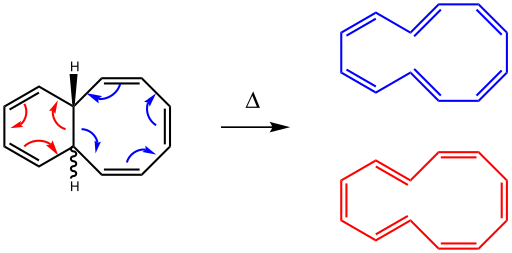
A dichotomy is a division into two mutually exclusive, opposed, or contradictory groups. Consider the reaction below. The bicyclic pentadiene on the left could in principle open on heating to give the monocyclic [12]-annulene (blue or red) via what is called an electrocyclic reaction as either a six (red) or eight (blue) electron process. These two possibilities represent our dichotomy; according to the Woodward-Hoffmann (WH) pericyclic selection rules, they represent contradictory groups. Depending on the (relative) stereochemistry at the ring junctions, if one reaction is allowed by the WH rules, the other must be forbidden, and of course vice-versa. It is a nice challenge to ask students to see if the dichotomy can be reconciled.

I start the process by pondering the relationship between the two forms of the [12]annulene shown on the right. Are the representations shown in red or blue just resonance isomers (analogous to the Kekule forms of benzene), or something else? If the former, then they truly represent the same species; they are just different ways of representing the contributions to the wavefunction, and the dichotomy stands. But if they are in fact different species, then we can start to eliminate the apparent contradiction by stating that the red and the blue arrows actually represent different reactions, leading to different (albeit isomeric) products. In this scenario, the red and blue forms of the [12]-annulene are NOT resonance isomers but distinct valence bond isomers, with a positive energy activation barrier to their interconversion. To find out, let us start with the transition states for both processes:

C2 symmetry Cs symmetry

Transition state for blue arrows. Click for 3D.

Transition state for red arrows. Click for 3D.

  1.  The blue arrows (representing 4n,n=2 electrons) result in a transition state with an axis of symmetry
  2. with the bond forming/cleaving from the bottom face of one terminus of the rhs-conjugated system to the top face of the other terminus, in other words an antarafacial bond, 
  3. with conrotation of the groups at the termini, resulting in
  4. all the bonds in the 8-ring being approximately 1.4Å in length (other than the central bond), whilst those in the 6-ring alternate strongly. The 8-ring is (Möbius) aromatic and the 6-ring is (Möbius) anti-aromatic.
  5. Contrary-wise, the red arrows (representing 4n+2,n=1 electrons) result in a transition state with a plane of symmetry
  6. with the bond forming from the same bottom face of the lhs-conjugated termini, in other words a suprafacial bond, 
  7. with disrotation of the groups at the termini, resulting in 
  8. all the bonds in the 6-ring being approximately 1.4Å in length, whilst those in the 8-ring alternate strongly. The 6-ring is now (Hückel) aromatic and the 8-ring is (Hückel) anti-aromatic.
  9. The transition state with C2 symmetry is in fact 10.1 kcal/mol lower in free energy than the one with Cs symmetry.
So the arrows follow the aromaticity (or vice versa), and this determines the stereochemistry (axis or plane of symmetry) and ultimately the nature of the product of each reaction. Are these annulenes indeed different? Shown below are the final outcomes of following an IRC (intrinsic reaction coordinate) from the transition state of the red and the blue reaction downhill to the [12]-annulenes. Not only is the outcome valence bond isomers, but they are also atropisomers.
Product, C2 (axis) Product, Cs (plane)

So at the end we see that there is no actual dichotomy. The reactions above (red or blue arrows) give different products, with different symmetries, and differently aromatic transition states. But in doing so, they encapsulate the selection rules for pericyclic reactions very nicely indeed. For more details of this, see this citation [1].

References

  1. H.S. Rzepa, "The Aromaticity of Pericyclic Reaction Transition States", Journal of Chemical Education, vol. 84, pp. 1535, 2007. https://doi.org/10.1021/ed084p1535

The regiospecificity of di-imide reduction of an alkene.

Sunday, November 25th, 2012

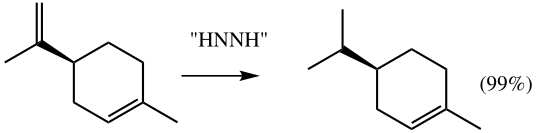
Not a few posts on this blog dissect the mechanisms of well known text-book reactions. But one reaction type where there are few examples on these pages are reductions. These come in three types; using electrons, using a hydride anion and using di-hydrogen. Here I first take a closer look at the third type, and in particular di-hydrogen as delivered from di-imide.

This reagent tends to be specific for terminal (less highly substituted) double bonds[1]. Two ωB97XD/6-311G(d,p) calculations predicts a free energy discrimination of 2.85 kcal/mol for the two double bonds in the system above, which works out as a ratio of 125:1 in favour of the less substituted system. The Wiberg bond orders of the two forming C-H bonds indicate that at the transition state the one to the less substituted terminal carbon is more highly formed (0.234) than the one to the more substituted carbon (0.198). The NICS(0) magnetic index of aromaticity at the ring critical point  (centroid) of the pericyclic participating atoms has a value of -22.2 ppm, which indicates a significant diamagnetic ring current indicative of a (σ-aromatic) transition state. The two transferring hydrogens have predicted “aromatic” shifts of 11.6 and 10.5 ppm.

Transition state for di-hydrogen transfer. Click for 3D.

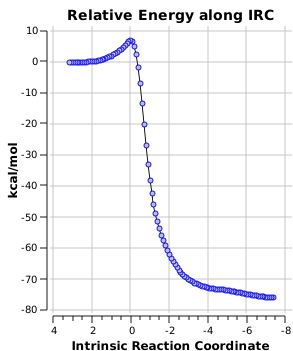
The intrinsic reaction coordinate (IRC) shows two distinct phases:

  1. From IRC 3 to -3, it represents a pericyclic process, involving an (aromatic) transition state in which the six atoms involved are all co-planar.
  2. From IRC -4 however, the newly reduced C-C bond starts to rotate to change the conformation from syn-planar to gauche. This rotation only comes at the very end of the reaction.

No real surprises here then, but it is useful to know that the regiospecificity of such reactions can apparently be well predicted.

References

  1. C. Smit, M.W. Fraaije, and A.J. Minnaard, "Reduction of Carbon−Carbon Double Bonds Using Organocatalytically Generated Diimide", The Journal of Organic Chemistry, vol. 73, pp. 9482-9485, 2008. https://doi.org/10.1021/jo801588d

Secrets revealed for conjugate addition to cyclohexenone using a Cu-alkyl reagent.

Sunday, November 4th, 2012

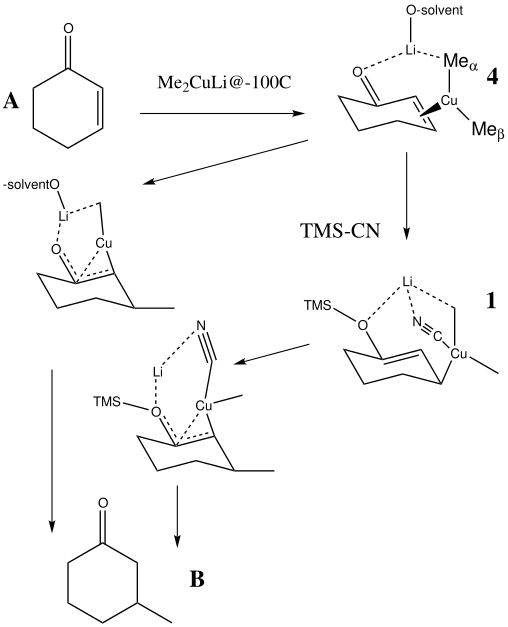
The text books say that cyclohexenone A will react with a Grignard reagent by delivery of an alkyl (anion) to the carbon of the carbonyl (1,2-addition) but if dimethyl lithium cuprate is used, a conjugate 1,4-addition proceeds, to give the product B shown below. The standard explanation is that the alkyl copper is a “soft” nucleophile attacking the soft conjugate carbon, whereas the alkyl magnesium is a “hard” nucleophile attacking the hard carbonyl carbon. Is this the best explanation? 

In 2007, one of those wonderfully simple experiments was done[1]. The dimethyl lithium cuprate reagent (dissolved in THF) was injected into an NMR sample tube at -100°C containing A, and the spectrum measured immediately. The species identified as 4 (the numbering as used in the reference) has two 1H methyl resonances[2] at ~ -0.04 to – 0.23 ppm (assigned to Meβ) and -1.08 to -1.11ppm (assigned to Meα), and the copper coordinates to the alkene as a π-complex. If TMS cyanide is added, 4 is immediately converted to complex 1, in which the π-complex is replaced by a simple C-Cu σ-bond. Compound 4 upon heating gives B, whilst 1 gives the silyl enol ether of B.

How does this match quantum simulation[3]? First, the 1H NMR result for 4 (at the wB97XD/6-31G(d,p)/SCRF=THF level and with the lithium coordinated to an ether solvent) comes out as -1.4 ppm (Meα) and -0.31 ppm (Meβ). The 13C is 76.4 and 60.6 ppm for the vinyl carbons (positions 3 and 4, obs) and 64.5/56.7 (calc). These latter values are affected by spin-orbital coupling to the metal, which can shift the values by up to about 10 ppm[4], but the relative values are also in good agreement. So the reaction must proceed starting from this π-copper complex.

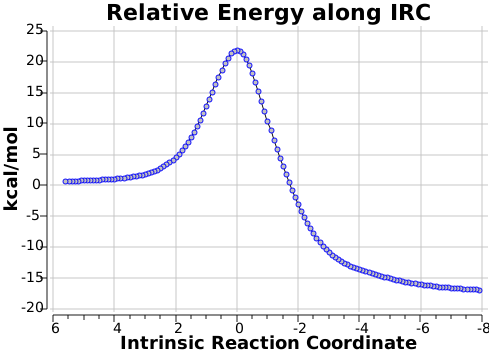
The IRC reveals a concerted transfer of  Meβ to the conjugate 4-position of B, with a reasonable barrier to reaction which indicates that on warming to room temperatures, the complex 4 will readily react. Formally at least, this corresponds to reductive elimination from the Cu(III) species to form a Cu(I) complex (in which however the metal now coordinates to the enol double bond rather than the alkene).

IRC for methyl transfer. Click for 3D transition state.

I will deal with the case of methyl transfer from 1 in a later post. With 4, we can directly see that the origins of conjugate 1,4-addition an α,β-unsaturated ketone are that the Cu reagent forms a π-complex to the alkene, which positions one of the alkyl groups on the metal in the ideal position to attack in conjugate manner. Regarding the different behaviour of the magnesium Grignard reagent, it boils down to asking why it does NOT form a π-complex in this situation (I would note here that Mg-π-complexes are indeed known).

References

  1. S.H. Bertz, S. Cope, M. Murphy, C.A. Ogle, and B.J. Taylor, "Rapid Injection NMR in Mechanistic Organocopper Chemistry. Preparation of the Elusive Copper(III) Intermediate", Journal of the American Chemical Society, vol. 129, pp. 7208-7209, 2007. https://doi.org/10.1021/ja067533d
  2. S.H. Bertz, C.M. Carlin, D.A. Deadwyler, M.D. Murphy, C.A. Ogle, and P.H. Seagle, "Rapid-Injection NMR Study of Iodo- and Cyano-Gilman Reagents with 2-Cyclohexenone:  Observation of π-Complexes and Their Rates of Formation", Journal of the American Chemical Society, vol. 124, pp. 13650-13651, 2002. https://doi.org/10.1021/ja027744s
  3. H. Hu, and J.P. Snyder, "Organocuprate Conjugate Addition:  The Square-Planar “Cu<sup>III</sup>” Intermediate", Journal of the American Chemical Society, vol. 129, pp. 7210-7211, 2007. https://doi.org/10.1021/ja0675346
  4. D.C. Braddock, and H.S. Rzepa, "Structural Reassignment of Obtusallenes V, VI, and VII by GIAO-Based Density Functional Prediction", Journal of Natural Products, vol. 71, pp. 728-730, 2008. https://doi.org/10.1021/np0705918

Secrets of a university tutor. An exercise in mechanistic logic: second dénouement.

Monday, October 29th, 2012

Following on from our first mechanistic reality check, we now need to verify how product A might arise in the mechanism shown below, starting from B.

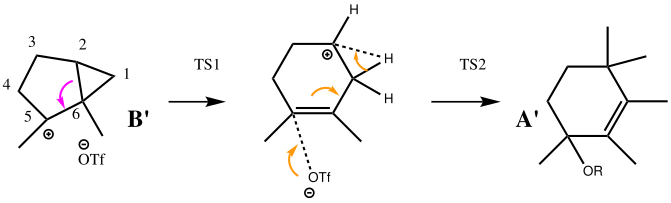
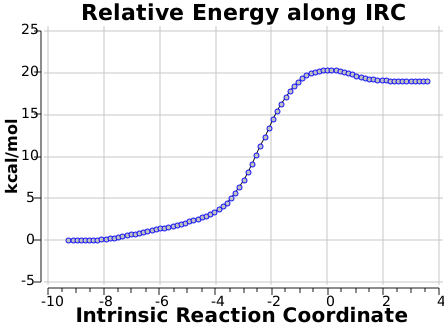
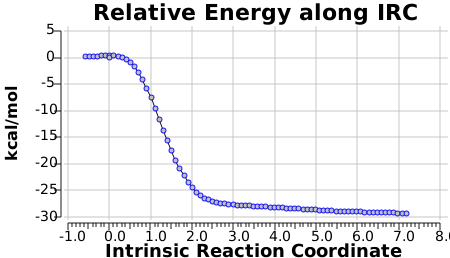
This pathway backtracks the original one in reversing the final arrow of that process (shown in red in previous post and in magenta here for the arrow in reverse), to go uphill in energy to reach the secondary (unstabilised) carbocation. This turns out to be a very shallow minimum, almost merely a ledge on the mountainside. It is not difficult to see how the original pathway down to B’ might have missed this Y-fork (= bifurcation).

Transition state for cyclopropyl ring opening. Click for 3D.

This unstable carbocation does not hang around; the barrier to transfer of a hydrogen (orange arrows) is tiny. This motion completes the formation of the product A.

We have seen here a classical analysis of mechanism in terms of an energy profile that has a separate pathway and associated transition state for each product in a reaction. But one should note that there are increasing claims for reactions whose outcome is determined not by an explicit transition state for each reaction pathway, but where the very dynamics of the system as it exits from a single transition state can result in a bifurcation into two (or indeed more) final products. I would like to suggest that the reaction described here might also be such an example. Thus although the mechanism as shown below shows just the single product B, it might be that only a small diversion from that initial pathway would also result in formation of A, and that there would be no need for the explicit transition states to this species as shown above to be actually visited.

It would finish by noting that all the mechanisms above were studied with inclusion of the triflate counter-ion; indeed the first step could not really be studied without it. The system seems a good candidate for a thorough molecular dynamics exploration;  I have certainly come a long way from an introductory tutorial in organic chemistry!

Secrets of a university tutor. An exercise in mechanistic logic, prequel.

Saturday, October 27th, 2012

The reaction below plays a special role in my career. As a newly appointed researcher (way back now), I was asked to take tutorial groups for organic chemistry as part of my duties. I sat down to devise a suitable challenge for the group, and came upon the following reaction[1]. I wrote it down on page 2 of my tutorial book, which I still have. I continue to use this example in tutorials to this day, some 35 years later.

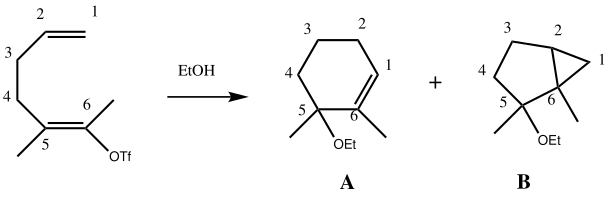
The challenge is to find a mechanistic explanation for the formation of products A and B. It is an exercise largely in perception and logic, with application of some chemical knowledge of carbocations and their (relative) stability.

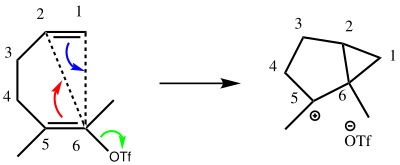
  1. The first stage is to try to map the starting molecule to each of the products, and to do this the relevant atoms are numbered (it can be an arbitrary numbering scheme, but it should be consistent across all three molecules). One perceives that the numbers can be anchored to the two methyl groups present in all three molecules; they do not seem to play a role in the mechanism and we also take an informed guess that they do not migrate relative to each other.
  2. At this point, students normally ask what OTf is. It is in fact triflate, derived from triflic acid or trifluorosulfonic acid; CF3SO2OH. One can digress at this point into a discussion of acidity and pKa values. The essential conclusion that emerges is that it must be a very strong acid since the triflate anion is very highly stabilised by the electronegative groups present. In other words, the C-OTf bond must easily dissociate into triflate anion, leaving behind a carbocation.
  3. The next stage is to prepare a list of all the bond changes that must occur during the mechanism.
    1. The most obvious is to declare that C6-0 cleaving bond in the reactant,
    2. replacing it by formation of C5-O bonds in A and B.
    3. Reduce the bond order of C5-C6 to one.
    4. Increase the bond order of C1-C6 from zero to one to form A.
    5. Increase the bond order of C1-C6 from one to two to form A. Note that we do this in two explicit steps since (with only a few exceptions), bonds rarely change their order by more than one in any distinct mechanistic step.
    6. Reduce the bond order of C2-C1 to one.
    7. The above transforms were all overtly explicit; one sees in the diagram what needs to be done. The next two steps require perception of the implicit information in the diagram. It can take a while to spot that C1 has to lose a hydrogen atom to form A.
    8. And that the hydrogen so removed has to be added to C2 to form A.

    A list for B could be constructed along similar lines.

  4. Now it is time to choreograph these changes. One is helped in these decisions by the knowledge that one cannot, even temporarily, increase the valence of any carbon beyond four, but one can decrease it to three if it becomes a carbocation.
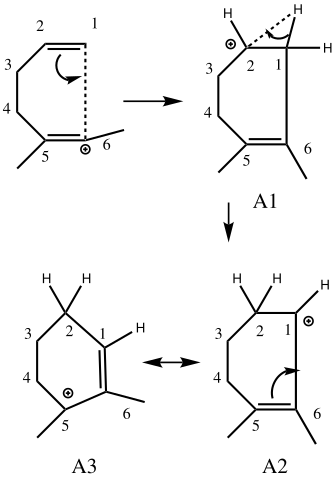
    • One will also spot that the list of eight items above can be grouped into pairs. Thus implementing items 4 and 6 as a pair requires just one arrow to be pushed to form intermediate A1. Item 6 defines the start point for the arrow and item 4 the end point.
    • A digression into carbocation stability is now required to explain the driving force for this arrow. The vinyl cation that is formed by loss of the triflate anion is very unstable. This is because the carbon contributes to the C-OTf bond via an sp2 hybrid orbital. The high s character of this hybrid means that the shared electron pair in this bond is more strongly attracted by the carbon nuclear charge, and hence are less easily lost to form a carbocation than would be the case with e.g. a C(sp3)-O bond. This boils down to stating that a vinyl carbocation is less stable than an alkyl carbocation, and hence that forming the latter from the former will be exothermic.
    • Another pair from the to-do list can be selected, 7 and 8. We must convert two implicit into two explicit hydrogen atoms to do this step. Again, a single electron arrow is required, and we get to A2. The driving force for this step is the conversion of a secondary isolated carbocation into a secondary allylic carbocation, which is resonance stabilised with an adjacent bond.
    • This leaves items 3 and 5, but we use them to illustrate the resonance stabilisation. A2 and A3 are resonance forms, and so we do not use the normal reaction arrow, but use a resonance arrow instead. This resonance form is in fact favoured because it converts a secondary carbocation into the more stable tertiary ion.

At this stage, the sequence can be completed with step 2. I will leave it to you, the reader, to work out the sequence of events required to form B rather than A if you wish.

Over the years, I have confronted groups of students with the reaction scheme shown at the top of this post, and asked them to work out the mechanism. Most look quite petrified, and certainly mystified, at this stage. Shown as at the top, it is indeed an intimidating mechanism. But by breaking it down into small and very simple steps, and then working out the order in which to implement them, most students come away from this exercise thinking it was actually rather easy! 

But I end this post with my real agenda! Is the above sequence actually supported by the “reality check” of quantum mechanics. Is the reaction likely to happen as I have dissected it above? Well, in all the years I have used it as an example of mechanism in organic chemistry, I had never subjected it to this test. In the next post, I will reveal what I discovered when I did so.

References

  1. T.C. Clarke, and R.G. Bergman, "Olefinic cyclization at a vinyl cation center. Inversion preference for intramolecular nucleophilic substitution by a double bond", Journal of the American Chemical Society, vol. 94, pp. 3627-3629, 1972. https://doi.org/10.1021/ja00765a062

Ring-flipping in cyclohexane in a different light

Friday, October 12th, 2012

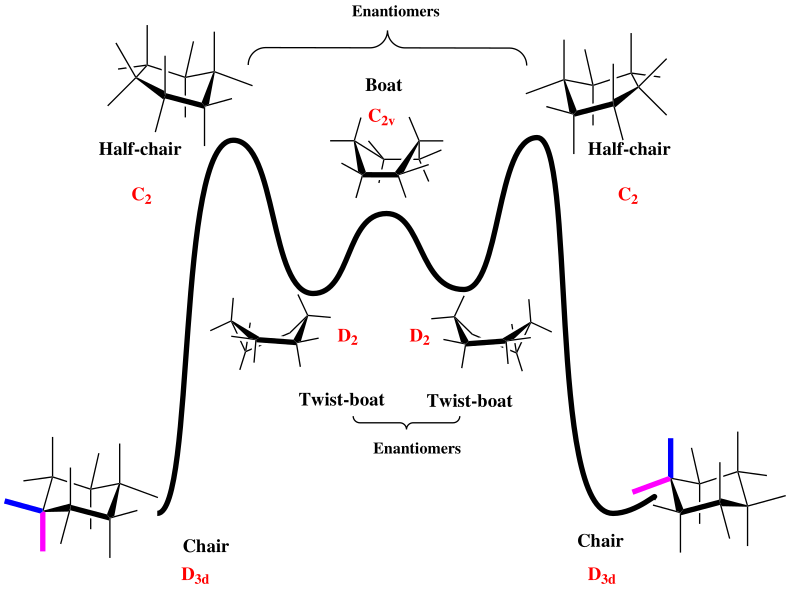
The conformational analysis of cyclohexane is a mainstay of organic chemistry. Is there anything new that can be said about it? Let us start with the diagram below:

This identifies the start of the process as a chair conformation of cyclohexane, with D3d symmetry. I have highlighted a pair of hydrogens attached to the left most carbon atom in blue (equatorial) and magenta (axial). On the right hand side of the diagram this pair has transposed position, with the blue now being axial and the magenta equatorial. The same is true of the other five pairs of methylene hydrogens. We need to identify the pathway by which this happens. The pathway shown above proceeds through a half-chair transition state of C2 symmetry, falling to the first intermediate twist-boat of D2 symmetry before reaching a second transition state of C2v symmetry known as the boat. The whole diagram is mirror-symmetric about this point. The point to note about this diagram is that the species labelled C2 and D2 are dissymetric (chiral), whereas the ones labelled D3d and C2v are not. This means that there are two enantiomeric half-chair transition states, as there are the two twist-boats. This introduction of (di)symmetry does rather change the way we look at the process!

Now let me introduce the intrinsic reaction coordinate (IRC, ωB97XD/6-311G(d,p)/SCRF=cyclohexane), as followed from the half-chair transition state, and connecting the chair and the twist-boat.

View 1 (click to see Chair ) View 2 (click to see Twist-boat)

View 1 is looking down the C2 axis present in the half-chair transition state and both start and end points. View 2 rotates this by 90° along the y-axis, and is again looking down a C2 axis. This axis is present only when the IRC starts at the D3d chair conformation or reaches a D2 twist-boat conformation (becoming one of three at this point). The latter conformation is ~6 kcal/mol higher in energy than the chair. At this twist-boat geometry (shown below), the two hydrogens labelled with blue and magenta appear to be in an identical environment (in other words the axial or equatorial distinction between them is lost at this point). This might appear to be what we need to “flip” the environments of any pair of axial and equatorial hydrogens. But is it sufficient?

At the twist boat above, whilst the chemical environment of the pair of hydrogens identified with blue and magenta arrows is identical, their (pro)chirality is not. Because they both sit in a chiral molecule, their individual relationship to that chirality is said to be pro-chiral. The path shown above, on its own, does not interconvert the (pro)chirality of this pair of hydrogens. To do this, we need to get to the enantiomeric twist-boat conformation shown below, and this is achieved by passing through an achiral transition state of C2v symmetry, in other words a pure boat (see below).

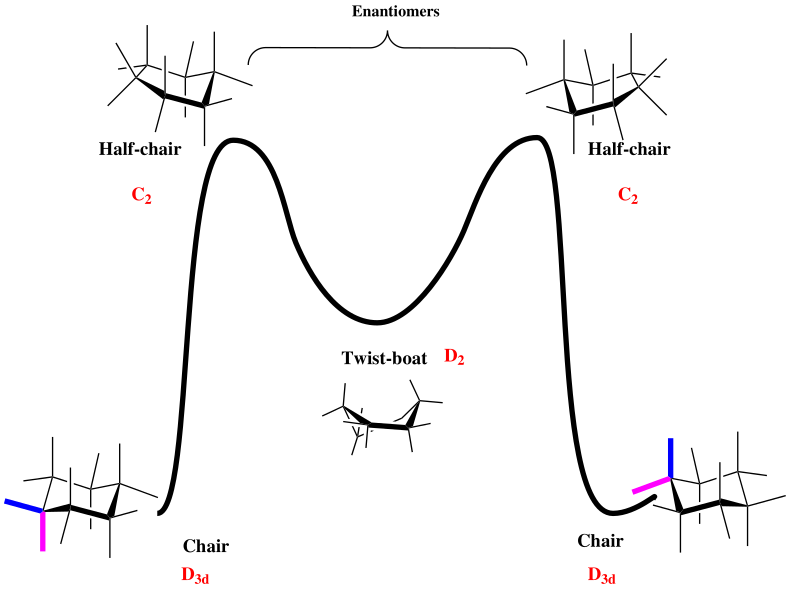
Well, now I pose a question. Is the above route the ONLY way of transposing the axial/equatorial identity of pairs of methylene hydrogens in this molecule? If you check the text books, some will in fact show a different diagram, in which the C2v boat is entirely uninvolved and only one enantiomer of the D2 twist-boat conformations is shown, as below.

These two pathways do differ fundamentally. The first (longer) pathway passes through an achiral boat transition state. The second (shorter) one involves two chiral half-chair transition states connecting a single chiral twist-boat, but implies that there must be two such pathways, each the enantiomer of the other.  I should point out that since these two options share a common transition state, their energies are identical. Which one is the more realistic?  I think only the technique of molecular dynamics, in which the momentum of the trajectories along the path is factored in, will tell us. 


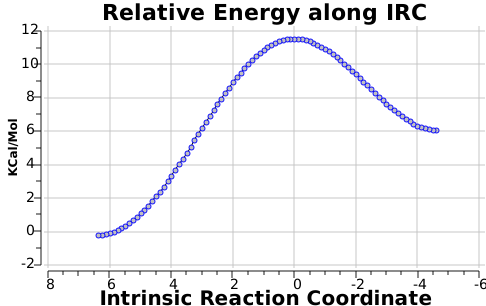
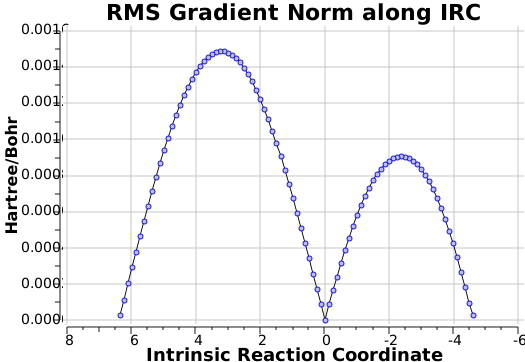
Postscript: The IRC for the enantiomerization of one twist boat into the other via a boat transition state is shown below. The axial-equatorial transpositions can be clearly seen in this view.

Oxime formation from hydroxylamine and ketone. Part 2: Elimination.

Tuesday, September 25th, 2012

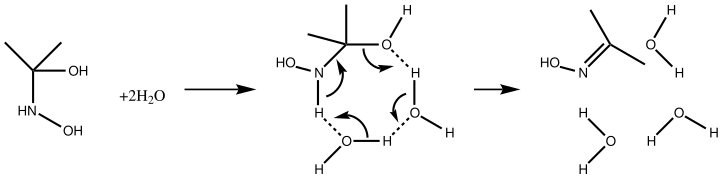
This is the follow-up to the previous post exploring a typical nucleophilic addition-elimination reaction. Here is the elimination step, which as before requires proton transfers. We again adopt a cyclic mechanism to try to avoid the build up of charge separation during those proton movements.

Elimination step to form an oxime. Click for animation of reaction mode.

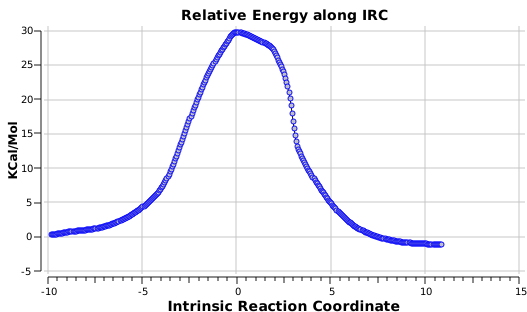
  1. Overall, the transition state for this second stage is 12.1 kcal/mol higher in free energy than the addition step described previously, and some 30 kcal/mol starting from the tetrahedral intermediate. Unlike the first step, where neutral water could participate in a reaction with a low barrier, here neutral water does not do the trick. To reduce the barrier, one probably needs to add e.g. an acid, say HCl to the components. Knowing precisely where to place such an acid is non trivial – I will not reveal an answer now, but will reserve it for a future post.
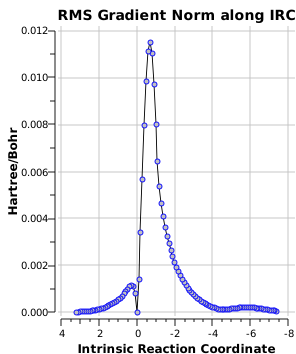
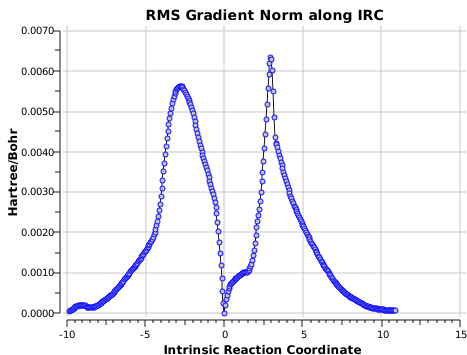
  2. It is worth observing the features (best seen in the gradient norm plot below) in the  IRC. The small feature at  IRC -9  corresponds to rotation of the  C-OH group away from an anomeric conformation to prepare it for accepting a proton.
  3. By IRC -2 (i.e. before the actual transition state is reached), the first proton transfer is well under way from the C-OH group to the first water molecule. The cleavage of the C-OH bond is also starting.
  4. At the transition state (IRC =0.0), this first transfer is almost complete and the second between the two water molecules is starting. The cleavage of the  C-OH bond is largely complete.
  5. By IRC +3,  this second transfer is largely complete and a third from the N-H to the second water is underway.
  6. By IRC +5, the proton transfers are all finished, and the C=N double bond of the oxime is also largely formed.

Well, this particular sequence of events is clearly not the full (or even a partial) answer to the mechanism of the second elimination step for this reaction. We know this because it predicts far too large a barrier. Something is missing from this model, and that something is probably a polarizing group such as HCl. Watch this space.