Posts Tagged ‘search query’

Silyl cations?

Thursday, March 23rd, 2017

It is not only the non-classical norbornyl cation that has proved controversial in the past. A colleague mentioned at lunch (thanks Paul!) that tri-coordinate group 14 cations such as R3Si+ have also had an interesting history.[1] Here I take a brief look at some of these systems.

Their initial characterisations, as with the carbon analogues, was by 29Si NMR. The first (of around 25) crystal structures appeared in 1994 (below) and they continue to fascinate to this day. I decided to focus on searching the Cambridge structure database (CSD), using the search query shown below (NM = non-metal). For a planar system the three angles subtended at the Si would of course total to 360°.

The first such structure, published in 1994[2] is shown in 2D representation below

However, the three angles subtended at the Si are 113, 115 and 114°. Could it be that these types of cation are not planar but pyramidal (a ωB97XD/Def2-TZVPP calculation of SiH3+ certainly gives it as planar). Below is a plot of the three angles:

Ringed in red are two systems where all three angles are ~120° (the ones with red dots). The blue circle contains examples where all three angles are <110°. So I took a closer look at the first of these published[2] and known by the code HAGCIB10 (angles of 113, 115 and 114°). The Si appears to be connected to a toluene present in the crystals via an Si-C bond (blue arrow). If correct, that would account for the angles around Si being <120° and indeed closer to tetrahedral, but it would also mean that the species was actually an arenium cation, otherwise known as a “Wheland intermediate”. That extra bond means that it is not a tri-coordinate silicon, but a four-coordinate silicon and that perhaps the indexing in the CSD needs correcting (as was done here).

Looking further, quite a few of the 25 examples contain so-called “N-heterocyclic carbene” ligands, as below (DOI for 3D model: 10.5517/CC12FWM0[3]).

Again one might question the location of the formal +ve charge. Perhaps it might instead reside on the nitrogen as per below, in which case we again do not have a true tri-coordinate silicon cation for systems with such ligands.

This cannot be the whole story, although I would note that Si=C bonds can contain pyramidalised Si. The bonding clearly needs more investigation! 

Very probably each of the 25 examples identified by this search as a silylium or silyl cation has its own story to tell. But in unravelling these stories, one should always perhaps take the 2D representations shown in both the CSD and the original publications with a pinch of salt until other possibly better representations such as the one above are excluded.

References

  1. J.B. Lambert, Y. Zhao, H. Wu, W.C. Tse, and B. Kuhlmann, "The Allyl Leaving Group Approach to Tricoordinate Silyl, Germyl, and Stannyl Cations", Journal of the American Chemical Society, vol. 121, pp. 5001-5008, 1999. https://doi.org/10.1021/ja990389u
  2. J.B. Lambert, S. Zhang, and S.M. Ciro, "Silyl Cations in the Solid and in Solution", Organometallics, vol. 13, pp. 2430-2443, 1994. https://doi.org/10.1021/om00018a041
  3. T. Agou, N. Hayakawa, T. Sasamori, T. Matsuo, D. Hashizume, and N. Tokitoh, "Reactions of Diaryldibromodisilenes with N‐Heterocyclic Carbenes: Formation of Formal Bis‐NHC Adducts of Silyliumylidene Cations", Chemistry – A European Journal, vol. 20, pp. 9246-9249, 2014. https://doi.org/10.1002/chem.201403083

Stable "unstable" molecules: a crystallographic survey of cyclobutadienes and cyclo-octatetraenes.

Sunday, March 5th, 2017

Cyclobutadiene is one of those small iconic molecules, the transience and instability of which was explained theoretically long before it was actually detected in 1965.[1] Given that instability, I was intrigued as to how many crystal structures might have been reported for this ring system, along with the rather more stable congener cyclo-octatetraene. Here is what I found.

The Conquest search query shown (with no disorder, no errors and R < 0.1 also specified). 

There are 23 instances (February 2017 database; see DOI: 10.14469/hpc/2231 for search query) of the supposedly unstable cyclobutadiene motif!

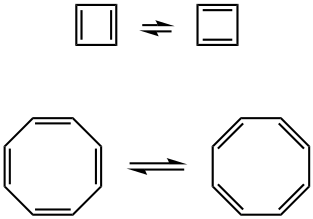
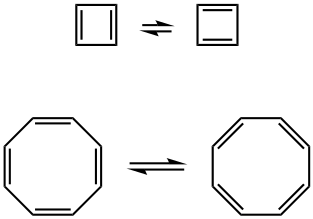
The three clusters deserve explanations. The orange cluster reveals a long C-C bond (rather longer than normal C-C bonds), accompanied by short C=C bonds, as indicated by the valence bond form shown below. Take particular note that the arrow connecting the two forms is NOT a resonance arrow but an equilibrium arrow. The “bond shifting” is not fast but slow, allowing long and short bonds to be measured in a crystal structure.

The rather larger blue cluster exhibits much more equal bonds. These arise from the presence of “push-pull” substituents on the ring which serve to delocalise the unfavourable cyclobutadiene ring and hence decrease the unfavourable anti-aromaticity. A typical example is shown below (EACBUT):

The small red cluster shows a long C=C bond and a short C-C bond! I have commented previously on apparently abnormally long C=C bonds, which in fact all turned out to be errors, and I suspect the same is true here. The bond orders in the indexing in the CSD data base have probably been mis-assigned, as per below for GANBII;

The Conquest search query is shown (with no disorder, no errors and R < 0.1 specified) for the 8-ring, which further specifies a torsion angle about a C-C bond to determine how planar the ring might be.

The “normal” cluster in the top left exhibits long C-C bonds and short C=C bonds. The colour code indicates how planar the ring is (red-blue spectrum = twisted ⇒ planar). The majority of examples are twisted about the C-C bond(s), but there are a few interesting examples that are not, as shown by the blue dots. There are only a few “bond-equalised” examples in the centre; perhaps “push-pull” induced equalisation is more difficult or perhaps few examples have been made?

The members of the red cluster in the bottom right all reveal short “C-C” bonds and long “C=C” bonds. Intriguingly they all also have low values of the torsion about one C-C bond (although not always about all four C-C bonds). A typical example (BAQVUK, DOI: 10.5517/CC4GWWB ) is shown below. These all need careful inspection and possibly reversal of the C-C and C=C indexing.

It was interesting to discover how many crystalline examples of this archetypal “unstable” cyclobutadiene motif have been made, and the means by which some of them at least have been stabilized. In the more abundant cyclo-octatetraene system, I learnt that one has to be cautious about blindly accepting the bond order designations in the database. Perhaps we might learn here that some of these have indeed been re-assigned in the next release of the database.

References

  1. L. Watts, J.D. Fitzpatrick, and R. Pettit, "Cyclobutadiene", Journal of the American Chemical Society, vol. 87, pp. 3253-3254, 1965. https://doi.org/10.1021/ja01092a049

Stable “unstable” molecules: a crystallographic survey of cyclobutadienes and cyclo-octatetraenes.

Sunday, March 5th, 2017

Cyclobutadiene is one of those small iconic molecules, the transience and instability of which was explained theoretically long before it was actually detected in 1965.[1] Given that instability, I was intrigued as to how many crystal structures might have been reported for this ring system, along with the rather more stable congener cyclo-octatetraene. Here is what I found.

The Conquest search query shown (with no disorder, no errors and R < 0.1 also specified). 

There are 23 instances (February 2017 database; see DOI: 10.14469/hpc/2231 for search query) of the supposedly unstable cyclobutadiene motif!

The three clusters deserve explanations. The orange cluster reveals a long C-C bond (rather longer than normal C-C bonds), accompanied by short C=C bonds, as indicated by the valence bond form shown below. Take particular note that the arrow connecting the two forms is NOT a resonance arrow but an equilibrium arrow. The “bond shifting” is not fast but slow, allowing long and short bonds to be measured in a crystal structure.

The rather larger blue cluster exhibits much more equal bonds. These arise from the presence of “push-pull” substituents on the ring which serve to delocalise the unfavourable cyclobutadiene ring and hence decrease the unfavourable anti-aromaticity. A typical example is shown below (EACBUT):

The small red cluster shows a long C=C bond and a short C-C bond! I have commented previously on apparently abnormally long C=C bonds, which in fact all turned out to be errors, and I suspect the same is true here. The bond orders in the indexing in the CSD data base have probably been mis-assigned, as per below for GANBII;

The Conquest search query is shown (with no disorder, no errors and R < 0.1 specified) for the 8-ring, which further specifies a torsion angle about a C-C bond to determine how planar the ring might be.

The “normal” cluster in the top left exhibits long C-C bonds and short C=C bonds. The colour code indicates how planar the ring is (red-blue spectrum = twisted ⇒ planar). The majority of examples are twisted about the C-C bond(s), but there are a few interesting examples that are not, as shown by the blue dots. There are only a few “bond-equalised” examples in the centre; perhaps “push-pull” induced equalisation is more difficult or perhaps few examples have been made?

The members of the red cluster in the bottom right all reveal short “C-C” bonds and long “C=C” bonds. Intriguingly they all also have low values of the torsion about one C-C bond (although not always about all four C-C bonds). A typical example (BAQVUK, DOI: 10.5517/CC4GWWB ) is shown below. These all need careful inspection and possibly reversal of the C-C and C=C indexing.

It was interesting to discover how many crystalline examples of this archetypal “unstable” cyclobutadiene motif have been made, and the means by which some of them at least have been stabilized. In the more abundant cyclo-octatetraene system, I learnt that one has to be cautious about blindly accepting the bond order designations in the database. Perhaps we might learn here that some of these have indeed been re-assigned in the next release of the database.

References

  1. L. Watts, J.D. Fitzpatrick, and R. Pettit, "Cyclobutadiene", Journal of the American Chemical Society, vol. 87, pp. 3253-3254, 1965. https://doi.org/10.1021/ja01092a049

Molecules of the year? Pnictogen chains and 16 coordinate Cs.

Monday, December 19th, 2016

I am completing my survey of the vote for molecule of the year candidates, which this year seems focused on chemical records of one type or another.

The first article[1] reports striving towards creating a molecule covering a complete column of the period table. In this case, group 7, containing N, P, As, Sb, Bi and Mc. Only the first four of these were incorporated, although the prospects of extending this to five seem good (and to six extremely unlikely).  The structure of this pnictogen chain is referenced here: DOI: 10.5517/CCDC.CSD.CC1LHPJ9 and I have demurred from a calculation.

The second article[2] relates to what might be called hypercoordination, and the achievement of what is felt is a maximum value of 16 to a single metal. I thought I might approach this one by searching the Cambridge structure database (CSD) by specifying any metal with a coordination number 16 as the search query. However, I was foiled in this query because the search software (Conquest) allows a maximum value of only 15! So instead I list the total number of hits retrieved for coordination numbers of 10-15: 25224, 4753, 8856, 2492, 839, 348 respectively.  

These totals have to be taken with some caution; the coordination number of what may often be very weak interactions may be often determined by human chemical perception rather than hard and fast rules. Nevertheless, the assignment of 348 molecules to having a coordination number of 15 is still a remarkably high number. If I can persuade CCDC to allow searches with 16, who knows what other candidates might emerge to rival this one, DOI: CCDC.CSD.CC1KFCQ2

The final candidate[3] is the only one where no measured coordinates are reported, with the title “Preparation of an ion with the highest calculated proton affinity: ortho-diethynylbenzene dianion”. There high level theoretical and computational modelling is reported to which I cannot add anything useful.

The common theme emerging of my review is that most of the candidates have crystal structures to which I have been able to occasionally add some computed quantum mechanical properties to try to tease out some other aspects of their character. It is also nice to be able to cite a persistent identifier (DOI) that leads directly to the 3D coordinates for the structures. My first ever post to this blog in 2008 addressed one solution on how such immediacy might be achieved and it is nice to see this now as a mainstream aspect of chemical publishing.

References

  1. A. Hinz, A. Schulz, and A. Villinger, "Synthesis of a Molecule with Four Different Adjacent Pnictogens", Chemistry – A European Journal, vol. 22, pp. 12266-12269, 2016. https://doi.org/10.1002/chem.201601916
  2. D. Pollak, R. Goddard, and K. Pörschke, "Cs[H<sub>2</sub>NB<sub>2</sub>(C<sub>6</sub>F<sub>5</sub>)<sub>6</sub>] Featuring an Unequivocal 16-Coordinate Cation", Journal of the American Chemical Society, vol. 138, pp. 9444-9451, 2016. https://doi.org/10.1021/jacs.6b02590
  3. B.L.J. Poad, N.D. Reed, C.S. Hansen, A.J. Trevitt, S.J. Blanksby, E.G. Mackay, M.S. Sherburn, B. Chan, and L. Radom, "Preparation of an ion with the highest calculated proton affinity: ortho-diethynylbenzene dianion", Chemical Science, vol. 7, pp. 6245-6250, 2016. https://doi.org/10.1039/c6sc01726f

Molecule of the year? "CrN123", a molecule with three different types of Cr-N bond.

Friday, December 16th, 2016

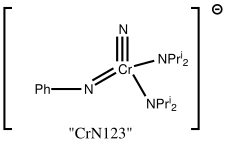
Here is a third candidate for the C&EN “molecule of the year” vote. This one was shortlisted because it is the first example of a metal-nitrogen complex exhibiting single, double and triple bonds from different nitrogens to the same metal[1] (XUZLUB has a 3D display available at DOI: 10.5517/CC1JYY6M). Since no calculation of its molecular properties was reported, I annotate some here.

Firstly, the 14N spectra were recorded, and so it is of interest to see if the chemical shifts reported can be replicated using calculation (ωB97XD/Def2-TZVPP/SCRF=thf). The method selected is not in the least “optimised” for this nucleus; it is often the case that various permutations of functional and basis set must be probed for the best combination for any particular nucleus. Another limitation of the calculation is that it has been done without the (rather large) counterion in place; a full model should certainly include this. The shifts below are referenced with respect to the internal N≡N signal reported at 310 ppm. The calculations have DOI: 10.14469/hpc/1980 (N2) and 10.14469/hpc/1983 (CrN123).

Nucleus N-Cr N=Cr N≡Cr
N(obs,thf), ppm 214 560 963
N(calc,thf), ppm 213;223 558 1093

The match is reasonable for three nitrogens; less so for the Cr≡N variety (DOI: 10.14469/hpc/1982) but no doubt could be improved by playing with the method as noted above and probably also correcting for spin-orbit coupling perturbations of the N nucleus by the Cr nucleus. The 14N shifts of quite a number of other intermediates in the synthesis of this molecule are reported and having a method to hand which can be used to check if the structural assignment matches that calculated for it is always useful. 

Next, I have a look at the nature of the Cr-N bonds themselves. The observed lengths are Cr-N: 1.863 (1.862) 1.881 (1.873); Cr=N 1.736 (1.714); Cr≡N 1.556 (1.518)Å. Calculated values in parentheses. To put this into context, I show CSD (Cambridge structure database) searches (search query DOI:10.14469/hpc/1981) for the three types of CrN bond. Firstly the triple bond (65 examples) which reveals the most probable value of ~1.54Å. This matches fairly well with the above values.

Next, Cr=N (50 examples) with a most probable value of 1.65Å. The value reported for CrN123 (1.736Å) is quite a bit longer for this bond. Again a caveat; the searches specified the bond type exactly, and this does then depend very much on how each entry in the CSD was indexed, by humans perceiving the structure and assigning the bond type on the basis of their expert chemical knowledge. It is quite likely that these integer assignments are at best informed estimates and at worst poor guesses. 

Finally, Cr-N (1398 examples) with the most probable value of 2.07Å which is a fair bit longer than the two values for CrN123. There are relatively few examples in the region of 1.87Å, which is where the CrN123 values come.

If one repeats this search, but limiting the N atom to carrying two carbons as well as a bond to Cr (as in NPri2) one gets the surprise of a bimodal (perhaps even trimodal) distribution, with an additional cluster at lengths of 1.82Å, in closer agreement with CrN123. Again I remind of the caveat that “single” bonds are often assigned by human curators on the basis of perceived chemistry. It would nevertheless be interesting to tunnel down to the possible explanation of this bimodal feature.

These comparisons suggest that in CrN123, the three types of bond are not isolated but may be interacting electronically in a complex manner to increase the bond order of the nominal Cr-NR2 “single” bonds (Cr=N(+)R2) whilst decreasing that of the nominal Cr=N “double” bond. 

Try try to quantify the bond properties a bit more, I tried the ELF basin population technique. ELF (electron localization function) is one method of partitioning the electron density in the molecule into well defined regions or basins (which we call bonds). The results (DOI: 10.14469/hpc/1984) came out Cr-N 4.05 and 4.01e, each comprising two basins which is often typical of a bond with significant π character. The integration for a single bond is of course 2.0. The Cr=N bond was 5.07e in two basins and that for the Cr≡N 3.26e (far removed from ~6.0 in a triple bond). The valence shell total is 16.4e. These values could be said to be “challenging”, perhaps hinting that the bonding and electron density distribution in this molecule is not quite what it seems. Certainly worth a more detailed look with other methods of bond partitioning.

Well, with M123 synthesized, are there any prospects of a M1234 complex being discovered? (quadruple bonds to N HAVE been suggested!).

References

  1. E.P. Beaumier, B.S. Billow, A.K. Singh, S.M. Biros, and A.L. Odom, "A complex with nitrogen single, double, and triple bonds to the same chromium atom: synthesis, structure, and reactivity", Chemical Science, vol. 7, pp. 2532-2536, 2016. https://doi.org/10.1039/c5sc04608d

Molecule of the year? “CrN123”, a molecule with three different types of Cr-N bond.

Friday, December 16th, 2016

Here is a third candidate for the C&EN “molecule of the year” vote. This one was shortlisted because it is the first example of a metal-nitrogen complex exhibiting single, double and triple bonds from different nitrogens to the same metal[1] (XUZLUB has a 3D display available at DOI: 10.5517/CC1JYY6M). Since no calculation of its molecular properties was reported, I annotate some here.

Firstly, the 14N spectra were recorded, and so it is of interest to see if the chemical shifts reported can be replicated using calculation (ωB97XD/Def2-TZVPP/SCRF=thf). The method selected is not in the least “optimised” for this nucleus; it is often the case that various permutations of functional and basis set must be probed for the best combination for any particular nucleus. Another limitation of the calculation is that it has been done without the (rather large) counterion in place; a full model should certainly include this. The shifts below are referenced with respect to the internal N≡N signal reported at 310 ppm. The calculations have DOI: 10.14469/hpc/1980 (N2) and 10.14469/hpc/1983 (CrN123).

Nucleus N-Cr N=Cr N≡Cr
N(obs,thf), ppm 214 560 963
N(calc,thf), ppm 213;223 558 1093

The match is reasonable for three nitrogens; less so for the Cr≡N variety (DOI: 10.14469/hpc/1982) but no doubt could be improved by playing with the method as noted above and probably also correcting for spin-orbit coupling perturbations of the N nucleus by the Cr nucleus. The 14N shifts of quite a number of other intermediates in the synthesis of this molecule are reported and having a method to hand which can be used to check if the structural assignment matches that calculated for it is always useful. 

Next, I have a look at the nature of the Cr-N bonds themselves. The observed lengths are Cr-N: 1.863 (1.862) 1.881 (1.873); Cr=N 1.736 (1.714); Cr≡N 1.556 (1.518)Å. Calculated values in parentheses. To put this into context, I show CSD (Cambridge structure database) searches (search query DOI:10.14469/hpc/1981) for the three types of CrN bond. Firstly the triple bond (65 examples) which reveals the most probable value of ~1.54Å. This matches fairly well with the above values.

Next, Cr=N (50 examples) with a most probable value of 1.65Å. The value reported for CrN123 (1.736Å) is quite a bit longer for this bond. Again a caveat; the searches specified the bond type exactly, and this does then depend very much on how each entry in the CSD was indexed, by humans perceiving the structure and assigning the bond type on the basis of their expert chemical knowledge. It is quite likely that these integer assignments are at best informed estimates and at worst poor guesses. 

Finally, Cr-N (1398 examples) with the most probable value of 2.07Å which is a fair bit longer than the two values for CrN123. There are relatively few examples in the region of 1.87Å, which is where the CrN123 values come.

If one repeats this search, but limiting the N atom to carrying two carbons as well as a bond to Cr (as in NPri2) one gets the surprise of a bimodal (perhaps even trimodal) distribution, with an additional cluster at lengths of 1.82Å, in closer agreement with CrN123. Again I remind of the caveat that “single” bonds are often assigned by human curators on the basis of perceived chemistry. It would nevertheless be interesting to tunnel down to the possible explanation of this bimodal feature.

These comparisons suggest that in CrN123, the three types of bond are not isolated but may be interacting electronically in a complex manner to increase the bond order of the nominal Cr-NR2 “single” bonds (Cr=N(+)R2) whilst decreasing that of the nominal Cr=N “double” bond. 

Try try to quantify the bond properties a bit more, I tried the ELF basin population technique. ELF (electron localization function) is one method of partitioning the electron density in the molecule into well defined regions or basins (which we call bonds). The results (DOI: 10.14469/hpc/1984) came out Cr-N 4.05 and 4.01e, each comprising two basins which is often typical of a bond with significant π character. The integration for a single bond is of course 2.0. The Cr=N bond was 5.07e in two basins and that for the Cr≡N 3.26e (far removed from ~6.0 in a triple bond). The valence shell total is 16.4e. These values could be said to be “challenging”, perhaps hinting that the bonding and electron density distribution in this molecule is not quite what it seems. Certainly worth a more detailed look with other methods of bond partitioning.

Well, with M123 synthesized, are there any prospects of a M1234 complex being discovered? (quadruple bonds to N HAVE been suggested!).

References

  1. E.P. Beaumier, B.S. Billow, A.K. Singh, S.M. Biros, and A.L. Odom, "A complex with nitrogen single, double, and triple bonds to the same chromium atom: synthesis, structure, and reactivity", Chemical Science, vol. 7, pp. 2532-2536, 2016. https://doi.org/10.1039/c5sc04608d

Long C=C bonds.

Thursday, December 1st, 2016

Following on from a search for long C-C bonds, here is the same repeated for C=C double bonds.

sq

The query restricts the search to each carbon having just two non-metallic substituents. To avoid conjugation with these, they each are 4-coordinated; the carbons themselves are three-coordinated. Further constraints are the usual no disorder, no errors and R < 0.1 and the C=C distance > 1.4Å (the standard value is ~1.32-1.34Å). The search query is deposited as DOI: 10.14469/hpc/1959[1]

c_c

The apparent longest example is LIRVEN, DOI: 10.5517/CC4R2MK[2] with a value of 1.589Å, longer than most C-C single bonds! Closer inspection reveals the presence of lithium cations, and so the molecule bearing the C=C bond must sustain two negative charges. So this apparent C=C bond is in fact anionic, with one electron going into each of the π* orbitals, thus lengthening the CC bond. Not a true example of a neutral C=C bond[3] but it now becomes interesting for what its spin state might be. Is it a biradical or a triplet for example? One to be investigated further I fancy! Another example of this type is QUKCEE[4]

10-5517cc4r2mk-lirven

This next FAZWIM has a C=C length of 1.546Å. It is an old structure (1986), and comes without attached hydrogen atoms. Although drawn with no hydrogens on the central C=C bond, the length suggests this molecule is simply mis-assigned.fazwin-diag fazwim

The final example I will highlight is pretty ordinary looking and published in 2016 as a private communication; ALOVOO, DOI: 10.5517/CCDC.CSD.CC1LJSWS[5] with a C=C length of 1.443Å. Again no obvious reason for the bond to be longer than normal.‡†

10-5517ccdc-csd-cc1ljsws-alovoo

In hunting for such unusual deviations from the norm, the most obvious explanation is normally some anomaly in the crystallographic analysis. Although the CSD (crystal structure database) is a very heavily curated resource, it seems unlikely that each deposition would be carefully inspected for its chemistry, and this must be our task here. But such anomalies can themselves point to interesting or unusual chemistry, which in  turn can be subjected to quantum computation to see if either the unusual value can be replicated or other reasons identified.  In this case, this exercise can been conducted by a human, but one can easily envisage the entire process being automated on a far larger scale.  The future?


In fact the stoichiometry shows each “double bond” is actually a di-anion, with two electrons entering each of the the π* orbitals.

A calculation on the singlet state for the structure as drawn (ωB97XD/Def2-TZVPP, DOI: 10.14469/hpc/1960) gives a bond length of 1.342Å, i.e. that expected for a double bond. The triplet state is similar in energy, but with a much longer central bond length of 1.476Å, DOI: 10.14469/hpc/1962 but the geometry at the carbons is planar and not bent as shown above. The quintet state is 1.45Å and is again planar, doi 10.14469/hpc/1963. So calculations on FAZWIM strongly suggest the structure as shown is an error.

‡†The computed value is 1.324Å, perfectly normal. DOI: 10.14469/hpc/1966[6]

References

  1. H. Rzepa, "Long C=C bonds", 2016. https://doi.org/10.14469/hpc/1959
  2. Matsuo, T.., Watanabe, H.., Ichinohe, M.., and Sekiguchi, A.., "CCDC 141348: Experimental Crystal Structure Determination", 2000. https://doi.org/10.5517/cc4r2mk
  3. T. Matsuo, H. Watanabe, M. Ichinohe, and A. Sekiguchi, "Reduction of the 1,4,5,8-tetrasila-1,4,5,8-tetrahydroanthracene derivative with lithium metal. Isolation and characterization of the tetralithium salt of a tetraanion, and observation of an Si–H⋯Li+ interaction", Inorganic Chemistry Communications, vol. 2, pp. 510-512, 1999. https://doi.org/10.1016/s1387-7003(99)00136-7
  4. T. Matsuo, H. Watanabe, and A. Sekiguchi, "A Novel Tetralithium Salt of a Tetraanion and a Dilithium Salt of a Dianion, Formed by the Reduction of the Tetrasilylethylene Moiety. Synthesis, Characterization, and Observation of an Si-H···Li+ Interaction", Bulletin of the Chemical Society of Japan, vol. 73, pp. 1461-1467, 2000. https://doi.org/10.1246/bcsj.73.1461
  5. M.E. Light, S. Bain, and J. Kilburn, "CCDC 1475906: Experimental Crystal Structure Determination", 2016. https://doi.org/10.5517/ccdc.csd.cc1ljsws
  6. H. Rzepa, "ALOVOO", 2016. https://doi.org/10.14469/hpc/1966

Long C-C bonds.

Wednesday, November 30th, 2016

In an earlier post, I searched for small C-C-C angles, finding one example that was also accompanied by an apparently exceptionally long C-C bond (2.18Å). But this arose from highly unusual bonding giving rise not to a single bond order but one closer to one half! How long can a “normal” (i.e single) C-C bond get, a question which has long fascinated chemists.

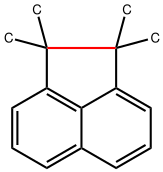
A naive search of the CSD is not as straightforward as it seems. Using the simple sub-structure R3C-CR3 as the search query gives LIRPEI, DOI: 10.5517/CCQ043Y[1] an apparently unexceptional molecule with a very exceptional C-C distance of 1.87Å. With long bonds one has to be ultra-careful to look at the crystallographic analysis before drawing any conclusions. One class of molecule where this has been done by many groups is the system shown below (red = long bond), with 47 entries and for which the longest C-C bond emerges with the value of 1.79Å[2]


long-bonds

long-cc

You can view this structure at DOI: 10.5517/CCS0R6Q[3] and the authors go to some pains to assure us that it is still a closed shell single bond, and not a biradical. That does seem to be the current record holder, but of course we are only talking here about molecules whose crystal structure has been determined.

I will end with an open question; how SHORT could a “single” C-C bond get? Here, a search of the CSD is entirely dominated by crystallographic artefacts, and I am not sure what the value might be. 

References

  1. Zhang, Jian., Chen, Shumei., Valle, H.., Wong, M.., Austria, C.., Cruz, M.., and Bu, Xianhui., "CCDC 655529: Experimental Crystal Structure Determination", 2008. https://doi.org/10.5517/ccq043y
  2. T. Takeda, H. Kawai, R. Herges, E. Mucke, Y. Sawai, K. Murakoshi, K. Fujiwara, and T. Suzuki, "Negligible diradical character for the ultralong C–C bond in 1,1,2,2-tetraarylpyracene derivatives at room temperature", Tetrahedron Letters, vol. 50, pp. 3693-3697, 2009. https://doi.org/10.1016/j.tetlet.2009.03.202
  3. Takeda, T.., Kawai, H.., Herges, R.., Mucke, E.., Sawai, Y.., Murakoshi, K.., Fujiwara, K.., and Suzuki, T.., "CCDC 715703: Experimental Crystal Structure Determination", 2010. https://doi.org/10.5517/ccs0r6q

Exploring the electrophilic directing influence of heteroaromatic rings using crystal structure data mining.

Tuesday, June 21st, 2016

This is a follow-up to the post on exploring the directing influence of (electron donating) substituents on benzene[1] with the focus on heteroaromatic rings such indoles, pyrroles and group 16 analogues (furans, thiophenes etc).

s-cis-ester1

The search query is shown above (and is available here[2]). As before, the distance is compared from an electrophile, modelled as the hydrogen atom of an OH group, to both the carbon next to the heteroatom (C2) and the C3 carbon. The torsion is defined so as to ensure that the OH group is approaching the π-face of the ring. The other constraints are R < 0.1, no disorder and no errors and normalised H positions.

Firstly, indoles (as above). There are only a few hits, but even so one can see that they all cluster in the top left triangle, where the distance to C2 is always longer than to C3. Indeed, this is the known position for electrophilic substitution of indoles.

s-cis-ester1

The search can be extended by removing the benzo group so as to also include pyrroles. More hits are obtained, and again most of them collect in the top left triangle. The hot spot indicates that the difference in lengths is ~0.3Å in favour of the 3-position, a very similar discrimination to that previously found for benzene groups with an electron donating substituent.

s-cis-ester1

Next, the N atom is replaced by any atom from group 16 of the periodic table (i.e. O, S, etc). The scatter is now in both top left and bottom right triangles, which suggest much weaker discrimination between C2 and C3;  if anything in favour of C2 (often the observed regiospecificities for such compounds).

s-cis-ester1

Finally, pyridines. Only a slight bias towards the C2 position. With pyridines of course, the electrophile in fact first interacts with the nitrogen lone pair in the plane of the molecule, which perturbs the eventual outcome. So this crystallographic method is perhaps a better intrinsic probe than kinetic reactivity.

s-cis-ester1

References

  1. H.S. Rzepa, "Discovering More Chemical Concepts from 3D Chemical Information Searches of Crystal Structure Databases", Journal of Chemical Education, vol. 93, pp. 550-554, 2015. https://doi.org/10.1021/acs.jchemed.5b00346
  2. H. Rzepa, "Search for HO interactions to indoles, pyrroles, furans, and thiophenes", 2016. https://doi.org/10.14469/hpc/665

A wider look at π-complex metal-alkene (and alkyne) compounds.

Monday, June 13th, 2016

Previously, I looked at the historic origins of the so-called π-complex theory of metal-alkene complexes. Here I follow this up with some data mining of the crystal structure database for such structures.

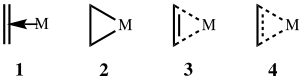
Alkene-metal "π-complexes" have what might be called a representational problem; they do not happily fit into the standard Lewis model of using lines connecting atoms to represent electron pairs. Structure 1 was the original representation used by Dewar intending the meaning of partial back donation from a filled metal orbital to the empty π* of the alkene. At the other extreme these compounds can be called metallacyclopropanes (2) in which only single bonds feature (these can be thought of as representing full back bonding from metal to alkene and full forward bonding from alkene to metal). Representations 3 and 4 are a more fuzzy blend of these, implying some sort of partial bond order for the metal-carbon bonds. Taken together, they imply that the formal bond order of the C-C bond might vary between single to double. Structures 1 and 2 in particular imply that there might be two distinct ways in arranging the bonding and that π-complexes and metallacyclopropanes might therefore be distinct valence-bond isomers, each potentially capable of separate existence.

Why do these representations matter? Well, I am going to mine the crystal structure database for these species to try to see if there is any evidence for a bimodal distribution in the C-C lengths, perhaps indicating evidence of the isomerism suggested above. Such a structural database is indexed against atom-pair connectivity in the first instance and then bond type; one can specify the following types of bond connecting any two atoms: single, double, triple, quadruple, polymeric, delocalised, pi and any. It is not entirely obvious which if any of these types apply to structure 1 (it is not possible to draw a bond ending at the mid-point of another bond using the Conquest structure editor); the dashed lines in structures 3 and 4 could be classed as delocalised, pi, or most generally any. The search query can be constructed thus, where the two carbons carry R which can be either H or C and all four C-R bonds are specified as acyclic (to try to avoid complications by excluding compounds such as cyclic metallacenes). Because representation 1 cannot be constructed in the editor, I am going to specify that each carbon carries four bonds of any type in the first instance. The torsion specified is defined as R-C-C-M and the full queries can be found deposited here.[1]

If the metallacyclopropane representation 2 is defined with explicit single bonds, one gets only 22 hits (no errors, no disorder, R < 0.1). The distribution of C-C bond lengths is shown below. Already one sees a representational problem emerging. A true metallacyclopropane might be expected to show a C-C single bond length, say > ~1.5Å. But only one or two of these examples actually have this value, the most probable value being ~1.4Å.

Using representation 3, one gets 1861 hits, but as before one sees a maximum at ~1.4Å with a tail reaching to both single and double bond values for the C-C distance.

If the C-C bond is also specified as "any", the hits increase to 3948, but the bond length distribution is still very similar, with no sign of any bimodal distribution.

Such a distribution is however found if the torsions between the R-C bond vector and the C-M bond vector are plotted (for all types of bond). A large number of the complexes have a torsion <90°, which suggests that in fact the substituent R is probably interacting with the metal (even though this would lead to formal cyclicity, specifying R-C as acyclic does not detect this interaction). Could this be masking a bimodal distribution in the C-C lengths?

If the previous search is repeated, but this time specifying that all four torsions must lie in the range 90-180° (the range expected for a "classical" alkene-metal complex and selecting only the top right hand side cluster in the plot above) the reduced value of 1051 hits are obtained, but the monomodal distribution remains.

For this last set, here is a plot of the two C-metal bond length, with colour indicating the C-C bond length, indicating the two C-metal bonds are clearly linearly correlated.

One final variation;  the atom on either C can only be H or a 4-coordinate (sp3) carbon; 645 hits. Again, a monomodal distribution centered at 1.4Å.

So this foray through metal alkene complexes suggests that there is a continuum between the formal metallacyclopropane with a C-C single bond and the only slightly perturbed alkene-metal complex with a C=C double bond. Whilst this would not prevent any one of these compounds existing as two distinctly different valence-bond isomers, it makes it very unlikely. I had noted in an earlier post that for molecules of the type RX≡XR (X=Si, Ge, Sn, Pb) that there was indeed a clear bimodal distribution of the X-X lengths evident in the crystal structures (for a relatively small sample number). The structures 1-4 shown at the start of this post are all simply just variations in a continuum and not distinct isomers.

POSTSCRIPT:  I noted above the bimodel distribution in compounds involving formal triple bonds. So I repeated the search above for π-complex metal-alkyne complexes. Specifying an acyclic C-R bond, and any for the CC bond type, one gets the following.

There is now a tantalizing suggestion of two clusters, one at 1.3 and another at 1.4Å. The torsional distribution shows that the latter distance appears to be associated with much smaller torsions, whereas the top right cluster is associated with shorter lengths.

If the torsions are restricted to the range 90-180, then the histogram looses the smaller cluster, and perhaps gains a second cluster at 1.22Å?  As I said, all quite tantalizing!


The tail in all the histograms extends into the 1.1-1.3Å region, which seems unreasonable for a carbon where four bonds are specified. This region probably represents errors in the crystallographic analysis or reporting. But who knows, perhaps some very unusual compounds are lurking there!


References

  1. H. Rzepa, "A wider look at the π-complex theory of metal-alkene compounds.", 2016. https://doi.org/10.14469/hpc/642