December 24th, 2016
The previous posts produced discussion about the dipole moments of highly polar molecules. Here to produce some reference points for further discussion I look at the dipole moment of glycine, the classic zwitterion (an internal ion-pair).
Dielectric relaxation studies of glycine–water mixtures yield values that range from 15.7D[1] to 11.9D[2] although these have to be derived using various approximations and assumptions for up to 4 independent Debye processes. Before proceeding to calculations, I looked at the properties of ionized amino acids in the solid state, using the following search query for the Cambridge structure database (CSD).

The distance measures hydrogen bonds to the carboxylate oxygens and the torsion their orientation. The O…H hydrogen bond distances vary between 1.7-1.85Å, which are short. The orientation of the hydrogen bond can be to the in-plane oxygen “σ-lone pair” (torsion 0 or 180°) and also an out-of-plane ~π form (torsion ~60-90°).

In aqueous solution, it is normally assumed that glycine sustains five such strong H-bonds (three to the H3N+ group and two[3] to the carboxylate anion), forming a polarised “salt bridge” across the ion-pair. Two model types were subjected to calculation using ωB97XD/Def2-TZVPP/SCRF=water. Aqueous glycine without any added explicit water molecules yields a dipole moment of 12.9D (DOI: 10.14469/hpc/2000), which is within the range noted above.‡

The solvated form is shown below, in one specific conformation of the three studied (ωB97XD/Def2-TZVPP/SCRF=water). The calculated O…H hydrogen bond lengths fall into the range revealed from crystal structures. The calculated dipole moments range from 12.6 (DOI: 10.14469/hpc/2007), 15.3 (DOI: 10.14469/hpc/2006) and 14.9D (DOI: 10.14469/hpc/2005), which is a modest increase over the model with no explicit water molecules. The actual dipole is of course a Boltzmann average over these and other as yet unexplored conformations, as well as other values for the number of water molecules.

Given the difficulties in interpreting the dipole moment of a complex Debye system such as hydrated glycine, the agreement between the limited range of solvated models and the measured values seems reasonable, and provides at least some measure of “calibration” for the polar molecules commented on previously.
‡Optimized with the solvent field on. If a vacuum model is used, the proton transfers from the N to the O.
References
- M.W. Aaron, and E.H. Grant, "Dielectric relaxation of glycine in water", Transactions of the Faraday Society, vol. 59, pp. 85, 1963. https://doi.org/10.1039/tf9635900085
- T. Sato, R. Buchner, Å. Fernandez, A. Chiba, and W. Kunz, "Dielectric relaxation spectroscopy of aqueous amino acid solutions: dynamics and interactions in aqueous glycine", Journal of Molecular Liquids, vol. 117, pp. 93-98, 2005. https://doi.org/10.1016/j.molliq.2004.08.001
- T. Shikata, "Dielectric Relaxation Behavior of Glycine Betaine in Aqueous Solution", The Journal of Physical Chemistry A, vol. 106, pp. 7664-7670, 2002. https://doi.org/10.1021/jp020957j
Tags: aqueous solution, Chemical polarity, Chemistry, dielectric, Dipole, Electric dipole moment, Electromagnetism, Magnetism, Moment, Nature, Physical quantities, Physics, Potential theory, zwitterion
Posted in crystal_structure_mining, Interesting chemistry | 1 Comment »
December 21st, 2016
A project fork is defined (in computing) as creating a distinct and separate strand from an existing (coding) project. Here I apply the principle to the polar azulene 4 explored in an earlier post, taking m-benzyne as a lower homologue of azulene as my starting point.
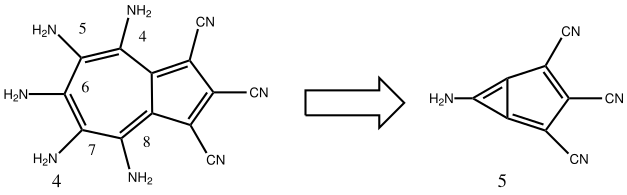
m-Benzyne is a less stable 1,3 isomer of o-benzyne (1,2-dehydrobenzene), and is often represented as a 1,3-biradical of 1,3-dehydrobenzene. But, could it be stabilized with cyano and amino groups as shown in 5 above? Here the idea is that charge transfer from the 3-ring to the 5-ring will create a lower homologue of azulene (a well known molecule), with the 3-ring a 4n+2 π-electron aromatic (n=0) and the five ring similarly so (n=1).
I start with the computed (wB97XD/Def2-TZVPP/SCRF=thf) structure of m-benzyne itself, as a closed shell molecule (DOI: 10.14469/hpc/1995). The C-C bond connecting the two rings is long (with a biradical tendency) and hence the conjugation is restricted to the outer periphery. The dipole moment is 0.51D (the dipole vector as shown in blue has the expected direction of polarity).

Now compare this to the substituted version 5; the bond lengths are all more characteristic of aromatic values and most significantly the central bond is as well (DOI: 10.14469/hpc/1996). The dipole moment is augmented thirty fold to 14.6D, which would rank alongside that reported for the most polar neutral molecule.

So I suggest this is substituted “m-benzyne” well worth trying to make and one very much unlikely to have any dispute about the nature of its wavefunction, i.e. biradical or closed shell.
Tags: Aryne, Azulene, Chemical polarity, Chemistry, Dipole, Extreme umpolung
Posted in Interesting chemistry | 4 Comments »
December 21st, 2016
A project fork is defined (in computing) as creating a distinct and separate strand from an existing (coding) project. Here I apply the principle to the polar azulene 4 explored in an earlier post, taking m-benzyne as a lower homologue of azulene as my starting point.
m-Benzyne is a less stable 1,3 isomer of o-benzyne (1,2-dehydrobenzene), and is often represented as a 1,3-biradical of 1,3-dehydrobenzene. But, could it be stabilized with cyano and amino groups as shown in 5 above? Here the idea is that charge transfer from the 3-ring to the 5-ring will create a lower homologue of azulene (a well known molecule), with the 3-ring a 4n+2 π-electron aromatic (n=0) and the five ring similarly so (n=1).
I start with the computed (wB97XD/Def2-TZVPP/SCRF=thf) structure of m-benzyne itself, as a closed shell molecule (DOI: 10.14469/hpc/1995). The C-C bond connecting the two rings is long (with a biradical tendency) and hence the conjugation is restricted to the outer periphery. The dipole moment is 0.51D (the dipole vector as shown in blue has the expected direction of polarity).
Now compare this to the substituted version 5; the bond lengths are all more characteristic of aromatic values and most significantly the central bond is as well (DOI: 10.14469/hpc/1996). The dipole moment is augmented thirty fold to 14.6D, which would rank alongside that reported for the most polar neutral molecule.
So I suggest this is substituted “m-benzyne” well worth trying to make and one very much unlikely to have any dispute about the nature of its wavefunction, i.e. biradical or closed shell.
Tags: Aryne, Azulene, Chemical polarity, Chemistry, Dipole, Extreme umpolung
Posted in Interesting chemistry | 4 Comments »
December 19th, 2016
I am completing my survey of the vote for molecule of the year candidates, which this year seems focused on chemical records of one type or another.
The first article[1] reports striving towards creating a molecule covering a complete column of the period table. In this case, group 7, containing N, P, As, Sb, Bi and Mc. Only the first four of these were incorporated, although the prospects of extending this to five seem good (and to six extremely unlikely). The structure of this pnictogen chain is referenced here: DOI: 10.5517/CCDC.CSD.CC1LHPJ9 and I have demurred from a calculation.
The second article[2] relates to what might be called hypercoordination, and the achievement of what is felt is a maximum value of 16 to a single metal. I thought I might approach this one by searching the Cambridge structure database (CSD) by specifying any metal with a coordination number 16 as the search query. However, I was foiled in this query because the search software (Conquest) allows a maximum value of only 15! So instead I list the total number of hits retrieved for coordination numbers of 10-15: 25224, 4753, 8856, 2492, 839, 348 respectively.
These totals have to be taken with some caution; the coordination number of what may often be very weak interactions may be often determined by human chemical perception rather than hard and fast rules. Nevertheless, the assignment of 348 molecules to having a coordination number of 15 is still a remarkably high number. If I can persuade CCDC to allow searches with 16, who knows what other candidates might emerge to rival this one, DOI: CCDC.CSD.CC1KFCQ2
The final candidate[3] is the only one where no measured coordinates are reported, with the title “Preparation of an ion with the highest calculated proton affinity: ortho-diethynylbenzene dianion”. There high level theoretical and computational modelling is reported to which I cannot add anything useful.
The common theme emerging of my review is that most of the candidates have crystal structures to which I have been able to occasionally add some computed quantum mechanical properties to try to tease out some other aspects of their character. It is also nice to be able to cite a persistent identifier (DOI) that leads directly to the 3D coordinates for the structures. My first ever post to this blog in 2008 addressed one solution on how such immediacy might be achieved and it is nice to see this now as a mainstream aspect of chemical publishing.
References
- A. Hinz, A. Schulz, and A. Villinger, "Synthesis of a Molecule with Four Different Adjacent Pnictogens", Chemistry – A European Journal, vol. 22, pp. 12266-12269, 2016. https://doi.org/10.1002/chem.201601916
- D. Pollak, R. Goddard, and K. Pörschke, "Cs[H<sub>2</sub>NB<sub>2</sub>(C<sub>6</sub>F<sub>5</sub>)<sub>6</sub>] Featuring an Unequivocal 16-Coordinate Cation", Journal of the American Chemical Society, vol. 138, pp. 9444-9451, 2016. https://doi.org/10.1021/jacs.6b02590
- B.L.J. Poad, N.D. Reed, C.S. Hansen, A.J. Trevitt, S.J. Blanksby, E.G. Mackay, M.S. Sherburn, B. Chan, and L. Radom, "Preparation of an ion with the highest calculated proton affinity: ortho-diethynylbenzene dianion", Chemical Science, vol. 7, pp. 6245-6250, 2016. https://doi.org/10.1039/c6sc01726f
Tags: chemical publishing, chemical records, human chemical perception, Matter, metal, Molecule, Nature, search query, search software, Voting
Posted in crystal_structure_mining, Interesting chemistry | 2 Comments »
December 18th, 2016
This, the fourth candidate provided by C&EN for a vote for the molecule of the year as discussed here, lays claim to the World’s most polar neutral molecule (system 1 shown below).[1] Here I explore a strategy for extending that record.
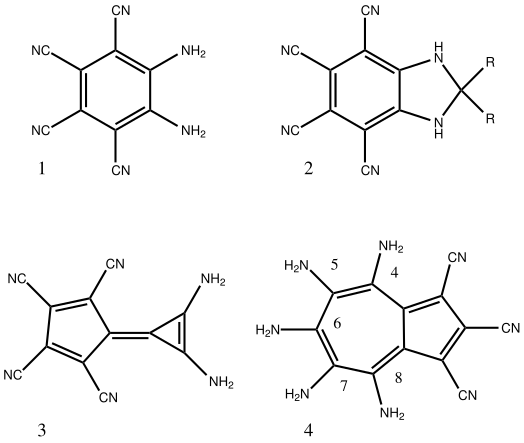
The claim for 1 (3 in [1]) is on the basis of its measured dipole moment which is 14.1± 0.7D in THF. This is qualified by the note that the dipole moment might be exalted by complex formation with dimethyl acetamide; the authors report a calculated smaller dipole moment of 9.6D (B3LYP/aug-cc-pVTZ) for the isolated molecule.
Inspection of 1 suggests that it is impossible for both the amino groups to be co-planar with the benzene ring due to steric clashes between the H…H atoms and that they must be twisted to avoid this. If so, the conjugation with the ring would be reduced and so would the charge transfer from the amino groups to the cyano groups (the phenomenon responsible for the polarity). I re-optimised the molecule myself (ωB97XD/Def2-TZVPP/SCRF=THF) and it has C2 symmetry, with both amino groups rotated to avoid those steric H…H clashes (DOI: 10.14469/hpc/1989). The calculated dipole moment (the basis set is a bit better‡ than in [1] and also the geometry is re-optimised in the solvent field) is 13.6D, which is rather closer to the measured value. An alternative explanation for the original mis-match between theory and experiment of 4.5D could be simply the lower quality basis set‡ used in the calculation and no modelled geometric relaxation in the thf solvent field.

The NC bond lengths shown above will be used as a probe to reveal the extent of conjugation. I tried 2 (R=H), a method of avoiding the steric clash and allowing both amino groups to fully conjugate (DOI: 10.14469/hpc/1987). Note how the amino CN bond length contracts by 0.017Å, whereas the o-cyano CN lengths also contract slightly. The calculated dipole moment for this variation is 16.1D, which seems a rational outcome of increasing the conjugation. However, measured dipole mment values of 10.9 and 12.2D are reported for 2 (5a, R=Me and 5b C7H16) respectively.[1] This is surprising given that these systems avoid any NH…HN steric clash and should therefore allow better conjugation and hence an increased dipole moment. Perhaps it is these molecules rather than 1 where the measured dipole moment is perturbed by other effects?

Inspired by these molecules, I thought: why not start with a base aromatic ring that was already polar and sprinkle amino and cyano groups around it? Thus 3 and 4 above. The latter is derived from azulene, which is well-known to have a noticeable dipole moment of its own, with the five ring carrying excess charge to aspire to 6π-electron aromaticity and the seven ring losing charge to again create a 6π-aromatic ring. The cyano and amino groups would serve to stabilize those respective charges.
Firstly 4: Amino groups on the azulene 5,7 positions twist out of plane and do not conjugate (long NC bonds) but all the remaining groups show effective conjugation (DOI: 10.14469/hpc/1988). So one could probably dispense with 5,7-amino substitution. The calculated dipole moment is 21.4D, which elevates the previous value significantly.

Seven 2- or 3-substituted cyanoazulenes are known in the CSD (Cambridge structure database) and likewise seven 4, 6 or 8 nitrogen substituted derivatives are known. So it should be possible to combine these two groups onto an azulene ring.
Finally 3, where the amino CN bonds are even shorter, indicating increased stabilization of the cyclopropenium cation ring formed by charge transfer (DOI: 10.14469/hpc/1990). The amino groups no longer clash sterically. The central CC bond (nominally a double bond) is lengthened considerably to facilitate the charge transfer between rings and hence mutual aromatization, the five 5-ring bonds are 1.405Å (typical aromatic values) and the 3-ring 1.367-1.38Å (again aromatic values). This candidate has a dipole moment of 21.7D, despite its smaller size decreasing the separation of the charges and hence the moment.

If the function of a molecule of the year is to inspire ideas in others, this one has certainly achieved its purpose! Now for the syntheses!
‡Anionic systems always benefit from better basis sets, much more so than neutral or cationic molecules.
References
- J. Wudarczyk, G. Papamokos, V. Margaritis, D. Schollmeyer, F. Hinkel, M. Baumgarten, G. Floudas, and K. Müllen, "Hexasubstituted Benzenes with Ultrastrong Dipole Moments", Angewandte Chemie International Edition, vol. 55, pp. 3220-3223, 2016. https://doi.org/10.1002/anie.201508249
Tags: Approval voting, Voting
Posted in Interesting chemistry | 14 Comments »
December 16th, 2016
Here is a third candidate for the C&EN “molecule of the year” vote. This one was shortlisted because it is the first example of a metal-nitrogen complex exhibiting single, double and triple bonds from different nitrogens to the same metal[1] (XUZLUB has a 3D display available at DOI: 10.5517/CC1JYY6M). Since no calculation of its molecular properties was reported, I annotate some here.
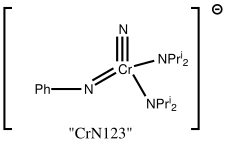
Firstly, the 14N spectra were recorded, and so it is of interest to see if the chemical shifts reported can be replicated using calculation (ωB97XD/Def2-TZVPP/SCRF=thf). The method selected is not in the least “optimised” for this nucleus; it is often the case that various permutations of functional and basis set must be probed for the best combination for any particular nucleus. Another limitation of the calculation is that it has been done without the (rather large) counterion in place; a full model should certainly include this. The shifts below are referenced with respect to the internal N≡N signal reported at 310 ppm. The calculations have DOI: 10.14469/hpc/1980 (N2) and 10.14469/hpc/1983 (CrN123).
| Nucleus |
N-Cr |
N=Cr |
N≡Cr |
| N(obs,thf), ppm |
214 |
560 |
963 |
| N(calc,thf), ppm |
213;223 |
558 |
1093 |
The match is reasonable for three nitrogens; less so for the Cr≡N variety (DOI: 10.14469/hpc/1982) but no doubt could be improved by playing with the method as noted above and probably also correcting for spin-orbit coupling perturbations of the N nucleus by the Cr nucleus. The 14N shifts of quite a number of other intermediates in the synthesis of this molecule are reported and having a method to hand which can be used to check if the structural assignment matches that calculated for it is always useful.
Next, I have a look at the nature of the Cr-N bonds themselves. The observed lengths are Cr-N: 1.863 (1.862) 1.881 (1.873); Cr=N 1.736 (1.714); Cr≡N 1.556 (1.518)Å. Calculated values in parentheses. To put this into context, I show CSD (Cambridge structure database) searches (search query DOI:10.14469/hpc/1981) for the three types of CrN bond. Firstly the triple bond (65 examples) which reveals the most probable value of ~1.54Å. This matches fairly well with the above values.

Next, Cr=N (50 examples) with a most probable value of 1.65Å. The value reported for CrN123 (1.736Å) is quite a bit longer for this bond. Again a caveat; the searches specified the bond type exactly, and this does then depend very much on how each entry in the CSD was indexed, by humans perceiving the structure and assigning the bond type on the basis of their expert chemical knowledge. It is quite likely that these integer assignments are at best informed estimates and at worst poor guesses.

Finally, Cr-N (1398 examples) with the most probable value of 2.07Å which is a fair bit longer than the two values for CrN123. There are relatively few examples in the region of 1.87Å, which is where the CrN123 values come.

If one repeats this search, but limiting the N atom to carrying two carbons as well as a bond to Cr (as in NPri2) one gets the surprise of a bimodal (perhaps even trimodal) distribution, with an additional cluster at lengths of 1.82Å, in closer agreement with CrN123. Again I remind of the caveat that “single” bonds are often assigned by human curators on the basis of perceived chemistry. It would nevertheless be interesting to tunnel down to the possible explanation of this bimodal feature.

These comparisons suggest that in CrN123, the three types of bond are not isolated but may be interacting electronically in a complex manner to increase the bond order of the nominal Cr-NR2 “single” bonds (Cr=N(+)R2) whilst decreasing that of the nominal Cr=N “double” bond.
Try try to quantify the bond properties a bit more, I tried the ELF basin population technique. ELF (electron localization function) is one method of partitioning the electron density in the molecule into well defined regions or basins (which we call bonds). The results (DOI: 10.14469/hpc/1984) came out Cr-N 4.05 and 4.01e, each comprising two basins which is often typical of a bond with significant π character. The integration for a single bond is of course 2.0. The Cr=N bond was 5.07e in two basins and that for the Cr≡N 3.26e (far removed from ~6.0 in a triple bond). The valence shell total is 16.4e. These values could be said to be “challenging”, perhaps hinting that the bonding and electron density distribution in this molecule is not quite what it seems. Certainly worth a more detailed look with other methods of bond partitioning.
Well, with M123 synthesized, are there any prospects of a M1234 complex being discovered? (quadruple bonds to N HAVE been suggested!).
References
- E.P. Beaumier, B.S. Billow, A.K. Singh, S.M. Biros, and A.L. Odom, "A complex with nitrogen single, double, and triple bonds to the same chromium atom: synthesis, structure, and reactivity", Chemical Science, vol. 7, pp. 2532-2536, 2016. https://doi.org/10.1039/c5sc04608d
Tags: 10.14469, chemical shifts, expert chemical knowledge, metal, metal-nitrogen complex exhibiting single, search query
Posted in crystal_structure_mining, Interesting chemistry | 10 Comments »
December 16th, 2016
Here is a third candidate for the C&EN “molecule of the year” vote. This one was shortlisted because it is the first example of a metal-nitrogen complex exhibiting single, double and triple bonds from different nitrogens to the same metal[1] (XUZLUB has a 3D display available at DOI: 10.5517/CC1JYY6M). Since no calculation of its molecular properties was reported, I annotate some here.
Firstly, the 14N spectra were recorded, and so it is of interest to see if the chemical shifts reported can be replicated using calculation (ωB97XD/Def2-TZVPP/SCRF=thf). The method selected is not in the least “optimised” for this nucleus; it is often the case that various permutations of functional and basis set must be probed for the best combination for any particular nucleus. Another limitation of the calculation is that it has been done without the (rather large) counterion in place; a full model should certainly include this. The shifts below are referenced with respect to the internal N≡N signal reported at 310 ppm. The calculations have DOI: 10.14469/hpc/1980 (N2) and 10.14469/hpc/1983 (CrN123).
| Nucleus |
N-Cr |
N=Cr |
N≡Cr |
| N(obs,thf), ppm |
214 |
560 |
963 |
| N(calc,thf), ppm |
213;223 |
558 |
1093 |
The match is reasonable for three nitrogens; less so for the Cr≡N variety (DOI: 10.14469/hpc/1982) but no doubt could be improved by playing with the method as noted above and probably also correcting for spin-orbit coupling perturbations of the N nucleus by the Cr nucleus. The 14N shifts of quite a number of other intermediates in the synthesis of this molecule are reported and having a method to hand which can be used to check if the structural assignment matches that calculated for it is always useful.
Next, I have a look at the nature of the Cr-N bonds themselves. The observed lengths are Cr-N: 1.863 (1.862) 1.881 (1.873); Cr=N 1.736 (1.714); Cr≡N 1.556 (1.518)Å. Calculated values in parentheses. To put this into context, I show CSD (Cambridge structure database) searches (search query DOI:10.14469/hpc/1981) for the three types of CrN bond. Firstly the triple bond (65 examples) which reveals the most probable value of ~1.54Å. This matches fairly well with the above values.
Next, Cr=N (50 examples) with a most probable value of 1.65Å. The value reported for CrN123 (1.736Å) is quite a bit longer for this bond. Again a caveat; the searches specified the bond type exactly, and this does then depend very much on how each entry in the CSD was indexed, by humans perceiving the structure and assigning the bond type on the basis of their expert chemical knowledge. It is quite likely that these integer assignments are at best informed estimates and at worst poor guesses.
Finally, Cr-N (1398 examples) with the most probable value of 2.07Å which is a fair bit longer than the two values for CrN123. There are relatively few examples in the region of 1.87Å, which is where the CrN123 values come.
If one repeats this search, but limiting the N atom to carrying two carbons as well as a bond to Cr (as in NPri2) one gets the surprise of a bimodal (perhaps even trimodal) distribution, with an additional cluster at lengths of 1.82Å, in closer agreement with CrN123. Again I remind of the caveat that “single” bonds are often assigned by human curators on the basis of perceived chemistry. It would nevertheless be interesting to tunnel down to the possible explanation of this bimodal feature.
These comparisons suggest that in CrN123, the three types of bond are not isolated but may be interacting electronically in a complex manner to increase the bond order of the nominal Cr-NR2 “single” bonds (Cr=N(+)R2) whilst decreasing that of the nominal Cr=N “double” bond.
Try try to quantify the bond properties a bit more, I tried the ELF basin population technique. ELF (electron localization function) is one method of partitioning the electron density in the molecule into well defined regions or basins (which we call bonds). The results (DOI: 10.14469/hpc/1984) came out Cr-N 4.05 and 4.01e, each comprising two basins which is often typical of a bond with significant π character. The integration for a single bond is of course 2.0. The Cr=N bond was 5.07e in two basins and that for the Cr≡N 3.26e (far removed from ~6.0 in a triple bond). The valence shell total is 16.4e. These values could be said to be “challenging”, perhaps hinting that the bonding and electron density distribution in this molecule is not quite what it seems. Certainly worth a more detailed look with other methods of bond partitioning.
Well, with M123 synthesized, are there any prospects of a M1234 complex being discovered? (quadruple bonds to N HAVE been suggested!).
References
- E.P. Beaumier, B.S. Billow, A.K. Singh, S.M. Biros, and A.L. Odom, "A complex with nitrogen single, double, and triple bonds to the same chromium atom: synthesis, structure, and reactivity", Chemical Science, vol. 7, pp. 2532-2536, 2016. https://doi.org/10.1039/c5sc04608d
Tags: 10.14469, chemical shifts, expert chemical knowledge, metal, metal-nitrogen complex exhibiting single, search query
Posted in crystal_structure_mining, Interesting chemistry | 10 Comments »
December 12th, 2016
Chemical and engineering news (C&EN) is asking people to vote for their molecule of the year from six highlighted candidates. This reminded me of the history of internet-based “molecules of the moment“. It is thought that the concept originated in December 1995 here at Imperial and in January 1996 at Bristol University by Paul May and we were joined by Karl Harrison at Oxford shortly thereafter. Quite a few more such sites followed this concept, differentiated by their time intervals of weeks, months or years. The genre is well suited for internet display because of plugins or “helpers” such as Rasmol, Chime, Jmol and now JSmol which allow the three dimensions of molecular structures to be explored by the reader. Here I discuss a second candidate from the C&EN list; a ferrocene-based Ferris wheel[1],[2] (DOI for 3D model: 10.5517/CCDC.CSD.CC1JPKYQ) originating from research carried out at Imperial by Tim Albrecht, Nick Long and colleagues.

The chemical interest was the redox chemistry of the six metal centres, and the interactions between these centres, expressed more succinctly as “do the iron centres talk to each other?”. The suggestion was that the charges in the molecules originating from oxidation move between ferrocene centres at a rate that is fast compared to the electrochemical timescale. An analogy is drawn to the nanoscale and uniformly charged conductive rings.
I was interested to compare this system with any similar Fe compounds that might also be known in the CSD (Cambridge structure database). Here are some that I found:
- CEFDOG[3] with two cyclic ferrocene units with both neutral Fe and Fe(+) present
- EZEVIO[4], 3D: 10.5517/CC805N2 with Fe and Ge as the metals.
- FULVFE[5] from 1969 with two Fe centres.
- PETTUD and PETVAL[6] with two Fe centres.
- PETVEP and PETVIT[6] with Fe and Zr centres
- URAFUQ and URAGAX (3D: 10.5517/CCDC.CSD.CC1JPKZR), the system shown above.
- VOKXOI[7] with one Fe and one Fe+.
- VOKXUO[7] with one Fe and one Co+.
- WOJDOQ[8], 3D : 10.5517/CC133PGC from 2014 with three Fe units.
- ZECTOQ[9] with one Fe and one Th.
Returning to the communication between ferrocene units, the six-unit ferris wheel noted above has four sets differentiated from the other two in the solid state, although in solution by NMR they are all seen as equalised by exchange. The twist angle between four pairs is ~47° (C-C distance 1.471Å) and for the other two it is ~18° (C-C distance 1.466Å) which allows a fair measure of π-π conjugation to operate between the rings. Contrast this with the smaller WOJDOQ[10], where the torsions between the rings are closer to 80° (C-C distance 1.486Å) thus inhibiting π-π conjugation. It would certainly be interesting to compare e.g. the cyclic voltammetry for these two species to see if electronic communication between the rings is affected by this structural difference.
WOJDOQ
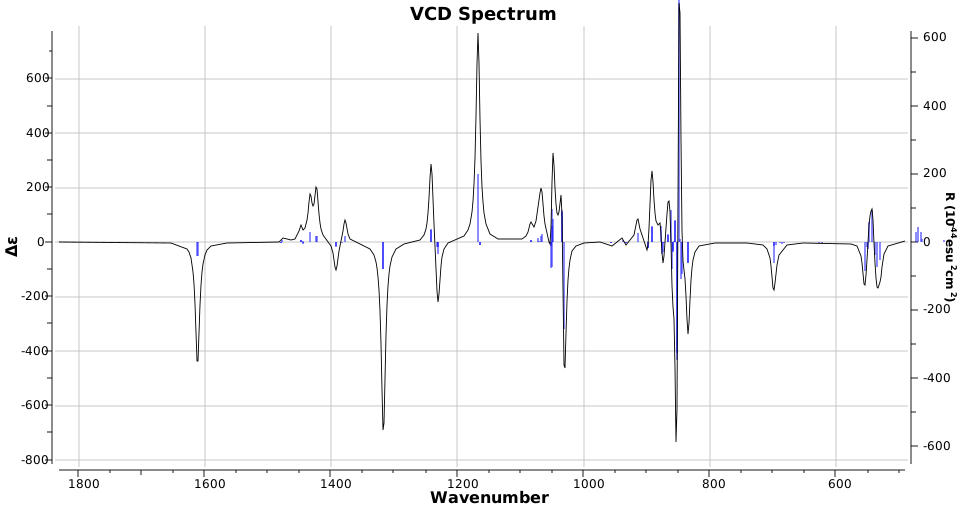
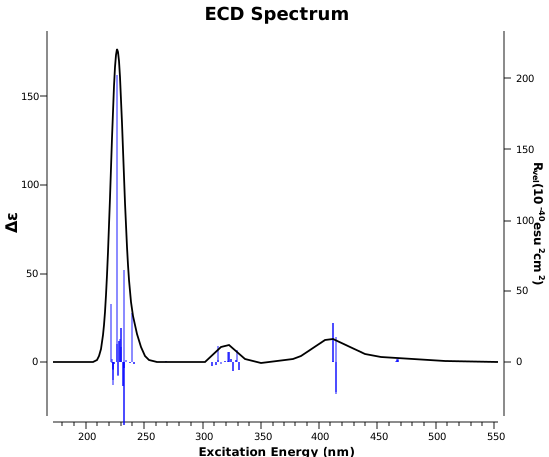
In regard to the D3-symmetric WOJDOQ[10], this is of course chiral and here its chiroptical properties intrigue,‡ along with questions of whether the two enantiomers are configurationally stable at room temperatures. If so, perchance they might be capable of acting as asymmetric catalysts?
Finally I speculate whether these sorts of rings can be constructed as Möbius strips or perhaps even as trefoil knots. It is certainly nice to see new molecules that spark all sorts of interesting new ideas!
‡The calculated optical rotation of WOJDOQ (TPSSh/6-311G(d,p)/SCRF=dichloromethane) is 427° at 800 nm and 1077° at 589 nm (doi: 10.14469/hpc/1971); the VCD (ωB97XD/6-311G(d,p)/SCRF=dcm) is shown below (doi: 10.14469/hpc/1970);
the ECD (doi: 10.14469/hpc/1972 ):
References
- M.S. Inkpen, S. Scheerer, M. Linseis, A.J.P. White, R.F. Winter, T. Albrecht, and N.J. Long, "Oligomeric ferrocene rings", Nature Chemistry, vol. 8, pp. 825-830, 2016. https://doi.org/10.1038/nchem.2553
- Inkpen, Michael S.., Scheerer, Stefan., Linseis, Michael., White, Andrew J.P.., Winter, Rainer F.., Albrecht, Tim., and Long, Nicholas J.., "CCDC 1420914: Experimental Crystal Structure Determination", 2016. https://doi.org/10.5517/ccdc.csd.cc1jpkyq
- M. Hillman, and A. Kvick, "Structural consequences of oxidation of ferrocene derivatives. 1. [0.0]Ferrocenophanium picrate hemihydroquinone", Organometallics, vol. 2, pp. 1780-1785, 1983. https://doi.org/10.1021/om50006a013
- M. Joudat, A. Castel, F. Delpech, P. Rivière, A. Mcheik, H. Gornitzka, S. Massou, and A. Sournia-Saquet, "Synthesis, Structures, and Reactivity of Mono- and Bis(ferrocenyl)-Substituted Group 14 Metallocenes", Organometallics, vol. 23, pp. 3147-3152, 2004. https://doi.org/10.1021/om0400393
- M.R. Churchill, and J. Wormald, "Crystal and molecular structure of bis(fulvalene)diiron", Inorganic Chemistry, vol. 8, pp. 1970-1974, 1969. https://doi.org/10.1021/ic50079a030
- P. Scott, U. Rief, J. Diebold, and H.H. Brintzinger, "ansa-Metallocene derivatives. 28. Homo- and heterobimetallic bis(fulvalene) complexes from bis(cyclopentadienyl)- and bis(indenyl)-substituted ferrocenes", Organometallics, vol. 12, pp. 3094-3101, 1993. https://doi.org/10.1021/om00032a036
- P. Brüggeller, P. Jaitner, and H. Schottenberger, "Kristallographische Gegenüberstellung der Monokationen von Bis(fulvalen)dieisien und Bis(fulvalen) eisen-cobalt mit identischem Gegenion (PF6−)", Journal of Organometallic Chemistry, vol. 417, pp. C53-C58, 1991. https://doi.org/10.1016/0022-328x(91)80206-y
- R. Shekurov, V. Miluykov, O. Kataeva, A. Tufatullin, and O. Sinyashin, "Crystal structure of cyclic tris(ferrocene-1,1′-diyl)", Acta Crystallographica Section E Structure Reports Online, vol. 70, pp. m318-m319, 2014. https://doi.org/10.1107/s1600536814017346
- P. Scott, and P.B. Hitchcock, "Synthesis, structure and electrochemistry of the first fulvalene derivative of an actinide", Journal of Organometallic Chemistry, vol. 497, pp. C1-C3, 1995. https://doi.org/10.1016/0022-328x(95)00108-3
Tags: American Chemical Society, Bristol University, Chemical & Engineering News, Chemistry, Engineering, internet display, Karl Harrison, metal centres, Nick Long, Paul May, Tim Albrecht
Posted in crystal_structure_mining, Interesting chemistry | 2 Comments »
December 1st, 2016
Following on from a search for long C-C bonds, here is the same repeated for C=C double bonds.

The query restricts the search to each carbon having just two non-metallic substituents. To avoid conjugation with these, they each are 4-coordinated; the carbons themselves are three-coordinated. Further constraints are the usual no disorder, no errors and R < 0.1 and the C=C distance > 1.4Å (the standard value is ~1.32-1.34Å). The search query is deposited as DOI: 10.14469/hpc/1959[1]

The apparent longest example is LIRVEN, DOI: 10.5517/CC4R2MK[2] with a value of 1.589Å, longer than most C-C single bonds! Closer inspection reveals the presence of lithium cations, and so the molecule bearing the C=C bond must sustain two negative charges. So this apparent C=C bond is in fact anionic, with one electron going into each of the π* orbitals, thus lengthening the CC bond.‡ Not a true example of a neutral C=C bond[3] but it now becomes interesting for what its spin state might be. Is it a biradical or a triplet for example? One to be investigated further I fancy! Another example of this type is QUKCEE[4]

This next FAZWIM has a C=C length of 1.546Å. It is an old structure (1986), and comes without attached hydrogen atoms. Although drawn with no hydrogens on the central C=C bond, the length suggests this molecule is simply mis-assigned.†

The final example I will highlight is pretty ordinary looking and published in 2016 as a private communication; ALOVOO, DOI: 10.5517/CCDC.CSD.CC1LJSWS[5] with a C=C length of 1.443Å. Again no obvious reason for the bond to be longer than normal.‡†

In hunting for such unusual deviations from the norm, the most obvious explanation is normally some anomaly in the crystallographic analysis. Although the CSD (crystal structure database) is a very heavily curated resource, it seems unlikely that each deposition would be carefully inspected for its chemistry, and this must be our task here. But such anomalies can themselves point to interesting or unusual chemistry, which in turn can be subjected to quantum computation to see if either the unusual value can be replicated or other reasons identified. In this case, this exercise can been conducted by a human, but one can easily envisage the entire process being automated on a far larger scale. The future?
‡ In fact the stoichiometry shows each “double bond” is actually a di-anion, with two electrons entering each of the the π* orbitals.
†A calculation on the singlet state for the structure as drawn (ωB97XD/Def2-TZVPP, DOI: 10.14469/hpc/1960) gives a bond length of 1.342Å, i.e. that expected for a double bond. The triplet state is similar in energy, but with a much longer central bond length of 1.476Å, DOI: 10.14469/hpc/1962 but the geometry at the carbons is planar and not bent as shown above. The quintet state is 1.45Å and is again planar, doi 10.14469/hpc/1963. So calculations on FAZWIM strongly suggest the structure as shown is an error.
‡†The computed value is 1.324Å, perfectly normal. DOI: 10.14469/hpc/1966[6]
References
- H. Rzepa, "Long C=C bonds", 2016. https://doi.org/10.14469/hpc/1959
- Matsuo, T.., Watanabe, H.., Ichinohe, M.., and Sekiguchi, A.., "CCDC 141348: Experimental Crystal Structure Determination", 2000. https://doi.org/10.5517/cc4r2mk
- T. Matsuo, H. Watanabe, M. Ichinohe, and A. Sekiguchi, "Reduction of the 1,4,5,8-tetrasila-1,4,5,8-tetrahydroanthracene derivative with lithium metal. Isolation and characterization of the tetralithium salt of a tetraanion, and observation of an Si–H⋯Li+ interaction", Inorganic Chemistry Communications, vol. 2, pp. 510-512, 1999. https://doi.org/10.1016/s1387-7003(99)00136-7
- T. Matsuo, H. Watanabe, and A. Sekiguchi, "A Novel Tetralithium Salt of a Tetraanion and a Dilithium Salt of a Dianion, Formed by the Reduction of the Tetrasilylethylene Moiety. Synthesis, Characterization, and Observation of an Si-H···Li+ Interaction", Bulletin of the Chemical Society of Japan, vol. 73, pp. 1461-1467, 2000. https://doi.org/10.1246/bcsj.73.1461
- M.E. Light, S. Bain, and J. Kilburn, "CCDC 1475906: Experimental Crystal Structure Determination", 2016. https://doi.org/10.5517/ccdc.csd.cc1ljsws
- H. Rzepa, "ALOVOO", 2016. https://doi.org/10.14469/hpc/1966
Tags: Chemical bond, chemical bonding, Chemical nomenclature, Chemistry, Conjugated system, double bond, energy, Nature, Nonmetal, Organic chemistry, Physical organic chemistry, search query, Substituent
Posted in crystal_structure_mining, Interesting chemistry | 2 Comments »
November 30th, 2016
In an earlier post, I searched for small C-C-C angles, finding one example that was also accompanied by an apparently exceptionally long C-C bond (2.18Å). But this arose from highly unusual bonding giving rise not to a single bond order but one closer to one half! How long can a “normal” (i.e single) C-C bond get, a question which has long fascinated chemists.
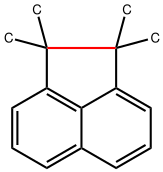
A naive search of the CSD is not as straightforward as it seems. Using the simple sub-structure R3C-CR3 as the search query gives LIRPEI, DOI: 10.5517/CCQ043Y[1] an apparently unexceptional molecule with a very exceptional C-C distance of 1.87Å. With long bonds one has to be ultra-careful to look at the crystallographic analysis before drawing any conclusions. One class of molecule where this has been done by many groups is the system shown below (red = long bond), with 47 entries and for which the longest C-C bond emerges with the value of 1.79Å[2]

You can view this structure at DOI: 10.5517/CCS0R6Q[3] and the authors go to some pains to assure us that it is still a closed shell single bond, and not a biradical. That does seem to be the current record holder, but of course we are only talking here about molecules whose crystal structure has been determined.
I will end with an open question; how SHORT could a “single” C-C bond get? Here, a search of the CSD is entirely dominated by crystallographic artefacts, and I am not sure what the value might be.
References
- Zhang, Jian., Chen, Shumei., Valle, H.., Wong, M.., Austria, C.., Cruz, M.., and Bu, Xianhui., "CCDC 655529: Experimental Crystal Structure Determination", 2008. https://doi.org/10.5517/ccq043y
- T. Takeda, H. Kawai, R. Herges, E. Mucke, Y. Sawai, K. Murakoshi, K. Fujiwara, and T. Suzuki, "Negligible diradical character for the ultralong C–C bond in 1,1,2,2-tetraarylpyracene derivatives at room temperature", Tetrahedron Letters, vol. 50, pp. 3693-3697, 2009. https://doi.org/10.1016/j.tetlet.2009.03.202
- Takeda, T.., Kawai, H.., Herges, R.., Mucke, E.., Sawai, Y.., Murakoshi, K.., Fujiwara, K.., and Suzuki, T.., "CCDC 715703: Experimental Crystal Structure Determination", 2010. https://doi.org/10.5517/ccs0r6q
Tags: Aviation, Bond order, Carbon–carbon bond, Chemical bond, chemical bonding, naive search, search query, single bond
Posted in crystal_structure_mining, Interesting chemistry | No Comments »