February 14th, 2017
I analysed the bonding in chlorine trifluoride a few years back in terms of VSEPR theory. I noticed that several searches on this topic which led people to this post also included a query about the differences between it and the bromine analogue. For those who posed this question, here is an equivalent analysis.
The calculation is done at the same level as before (ωB97XD/6-311++D(d,p)) for consistency (DOI: 10.14469/hpc/2160)

Click for 3D
- Basins 8 and 9 have electron populations of 2.33e (2.07e for the chlorine analogue) with an angle subtended at Br of 159°. The greater electron population and hence electron pair repulsion has the effect of increasing the angle compared to Cl (154°). The coordination is even more square pyramidal than with Cl.
- Basin 7 has a population of 0.73e, this time less than Cl (0.87e).
- Basins 11 and 12 are 0.82e. With Cl, this single basin was replaced by a pair of split basins, each pair summing to 0.91e (the same effect happens with F-F). The angle 4-2-3 is 172° (174° for Cl) which suggests a slightly increased 2-electron-3-centre interaction between e.g. atoms 1-4 or 1-3 compared to Cl.
- The total basin count surrounding the Br is therefore 7.03e, compared to 6.84e with Cl, which suggests Br is slightly more electronegative in this context than Cl.
Bromine has a habit of springing surprises, but not so much in this example.
Tags: Bromine, Bromine trifluoride, Chemical elements, Chemistry, Chlorine, Fluorides, Halogens, Interhalogen compounds, Matter, Oxidizing agents, VSEPR theory
Posted in Interesting chemistry | 1 Comment »
February 11th, 2017
On February 6th I was alerted to this intriguing article[1] by a phone call, made 55 minutes before the article embargo was due to be released. Gizmodo wanted to know if I could provide an (almost)† instant‡ quote. After a few days, this report of a stable compound of helium and sodium still seems impressive to me and I now impart a few more thoughts here.
The discovery originates from 17 authors based in 17 different institutions, an impressive illustration of global science and cooperation. I illustrate with this diagram, to be found not in the main article body but in its supporting information and for which the caption reads:

Computed charge density (eÅ-3) of Na2He at 300 GPa, plotted in the [110] plane of the conventional cell. The color bar gives the scale.
The nuclei carry of course the greatest charge density, but the density labelled “2e” is not nuclear-centered. This is typical of species known as electrides, where positive cations are associated with just electrons acting as the counter-anion and about which there was an extensive debate earlier on this blog. There is much discussion in the article[1] about the essential role of the He atoms in bringing about the formation of such an electride, an effect that is summarised in a second diagram also found in the supporting information:

I found myself thinking that it would be great to have the first diagram represented as a movie, evolving as the pressure is increased from say ambient to 300 GPa, and presumably showing the “2e” feature (which means diamagnetic electrons) forming as the pressure increases. Would their evolution be abrupt (a step change) or gradual as the pressure increases and the interatomic distances all decrease? As I understand it, this chemical phenomenon is due not so much to the usual coulombic attraction between positive nuclei and negative charge density from the electronic wavefunction leading to e.g. covalent bonds, but to electron repulsions induced by decreasing nuclear separations resulting in electride-like ionisation and hence electron localisation into the “interstitial cavities” of the lattice. Without pressure, you would just have sodium and helium atoms!
The urge to obtain this intriguing electronic wavefunction for myself now appeared (wavefunctions are rarely if ever included in supporting information). To do this you must have atom coordinates available, But such data was not to be found in the supporting information. It was eventually tracked down (by a crystallographer; thanks Andrew!) to the caption in Figure 2.

However, you probably do need to be a crystallographer to convert this data into a set of coordinates. This was done and is here deposited as a CIF file for you to play with if you wish (DOI:10.14469/hpc/2154)[2]. I have reduced the packing of the unit cell obtained from this CIF file (198 atoms) to just 60 and you can enjoy them by clicking on the diagram below. I should point out that if one uses a program that can recognise the periodic lattice such as Crystal (used in the article discussed here), there is no need to make such reductions, but in this instance I wanted to use a program such as Gaussian in discrete (non-periodic) mode, for which the calculation (B3LYP/Def2-SVPD) has DOI: 10.14469/hpc/2156[3] and where you can also find a wavefunction file to play with if you wish.

Click for 3D model
An ELF analysis for this non-periodic wavefunction looks as below. The ELF basins labelled “2e” located in the centre of the cube show an integrated electron population of ~1.9e and correspond to the localised electron pairs noted in the article above.

Click for 3D
The basins on the boundaries of this non-periodic unit show reduced integrations (red arrows below, 0.08 – 1.7e) and are artefacts of the non-periodic approximation introduced.

The ionization into an electride is brought about by the close proximity of the atoms as induced by high pressure. Releasing the pressure would allow the ionized electrons to re-attach themselves to the valence shell of the sodium atoms, thus destroying the unique properties of the system. It is certainly true that this system challenges our normal concepts of what a molecule is. The presence of He is essential and yet its electrons are hardly involved in the re-organised wavefunction. I cannot wait for more examples to be discovered!
†To meet the 55 minute deadline, I was given about 15 minutes thinking time!
‡Instant responses on social media now seem a sine qua non of the political world, so why not the scientific one?!
References
- X. Dong, A.R. Oganov, A.F. Goncharov, E. Stavrou, S. Lobanov, G. Saleh, G. Qian, Q. Zhu, C. Gatti, V.L. Deringer, R. Dronskowski, X. Zhou, V.B. Prakapenka, Z. Konôpková, I.A. Popov, A.I. Boldyrev, and H. Wang, "A stable compound of helium and sodium at high pressure", Nature Chemistry, vol. 9, pp. 440-445, 2017. https://doi.org/10.1038/nchem.2716
- H. Rzepa, "Na2He: a stable compound of helium and sodium at high pressure.", 2017. https://doi.org/10.14469/hpc/2154
- H. Rzepa, "He20Na40", 2017. https://doi.org/10.14469/hpc/2156
Tags: 10.1038, Atom, Chemical elements, chemical phenomenon, Chemistry, Company: P. Acucar-CBD, Electride, Electron, Food Retail & Distribution - NEC, helium, Hydrogen, Matter, Oxygen, Physics, social media
Posted in Bond slam, crystal_structure_mining, Interesting chemistry | 11 Comments »
February 10th, 2017
The book of the title has recently appeared giving a rich and detailed view over 417 pages, four appendices and 24 pages of photographs of how a university chemistry department in the UK came into being in 1845 and its subsequent history of discoveries, Nobel prizes and much more. If you have ever wondered what goes on in an academic department, populated by and large by very bright and clever personalities and occasionally some highly eccentric ones, then go dip into this book.
Here you will learn that starting in 1845, the department had 26 enrolled students, each paying a fee to attend lectures and to do experiments in the laboratories. You may observe the changes in laboratory practices over the years, and wonder how many of those early students survived their experiences and lived into old age. The book centres around the people in the department, with many anecdotes and stories about life in such a department, some of the stories about chemistry and some not! The chemistry these people discovered and recorded in journals can be quickly accessed using the (short) DOIs provided for many of the entries in the bibliography.
Few academic departments can have been documented in such detail. Indeed one must wonder whether the wealth of written material available to the authors, Hannah Gay and Bill Griffith, during this period will be matched by the much more evanescent electronic records that have become prevalent since. Email was introduced into the department around 1987 and I suspect almost all that record has now vanished permanently. I would not envy the task of anyone faced with updating this history from 2001-2050!
An aspect that is much harder to document is the daily routines of the undergraduate students. The book has a wealth of information about the practical laboratories and the instruments and apparatus found in the department, but a little less about the changing face of the lectures and associated written materials, the tutorials and problems classes and student’s own interactions with the professors, once the core (academic) activities and experiences of an undergraduate. Nowadays one may well find sessions on entrepreneurship instead of a problems class, or a flipped classroom replacing the lecture.
My own undergraduate stay in the department was from 1968-1971 and I might append some of those memories to this post in the future. If anyone reading this has their own evocative recollections of being a chemistry undergraduate, either at Imperial or elsewhere, can I invite you to share them here!
Tags: 2001-2050, Alfred Nobel, Bill Griffith, Country: United Kingdom, Education, Entertainment/Culture, Hannah Gay, Nobel Prize
Posted in Historical | 6 Comments »
February 9th, 2017
The title refers to an upcoming symposium on the topic on 22-24 May, 2017. I quote here some of the issues tabled for discussion:
- Which data do we want to save, how and why and how long?
- What really needs to be reproducible?
- Are current reporting standards being used sufficiently?
- Are the current procedures for depositing data too onerous for scientists?
- Will technology, through increasing automation, fix most of the problems?
- Is bureaucracy killing creativity in science?
- Have we got a reproducibility crisis?
- If we save and share data routinely, what is the future of the publication?
- Are funding agencies causing science to be too short term in their quest for value for money?
- Are chemists repeating too many experiments?
- What can chemistry learn from other areas and what can they learn from chemistry?
For more information, visit www.beilstein-institut.de/en/symposia/open-science. If you have your own questions, or indeed comments at this stage, do append them as a comment. I don’t know what “social media” will be used to allow people to participate (science by Twitter feed?) and whether recordings will be made, but after the event I will update here with any further interesting news.
Tags: Contact Details, Social Media & Networking, Symposium, Technology/Internet, Will technology
Posted in Chemical IT, General | 1 Comment »
February 2nd, 2017
Almost exactly 20 years ago, I started what can be regarded as the precursor to this blog. As part of a celebration of this anniversary, I revisited the page to see whether any of it had withstood the test of time. Here I recount what I discovered.
The site itself is at www.ch.ic.ac.uk/motm/perkin.html and has the title “Mauveine: The First Industrial Organic Fine-Chemical” It was an application of an earlier experiment[1] to which we gave the title “Hyperactive Molecules and the World-Wide-Web Information System“. The term hyperactive was supposed to be a play on hyperlinking to the active 3D models of molecules built using their 3D coordinates. The word has another, more negative, association with food additives such as tartrazine – which can induce hyperactivity in children – and we soon discontinued the association. This page was cast as a story about a molecule local to me in two contexts; the first being that the discoverer of mauveine, W. H. Perkin, had been a student at what is now the chemistry department at Imperial College. The second was the realization that where we lived in west London was just down the road from Perkin’s manufacturing factory. Armed with (one of the first) digital cameras, a Kodak DC25, I took some pictures of the location and added them later to the web page. The page also included two sets of 3D coordinates for mauveine itself and alizarin, another dyestuff associated with the factory. These were “activated” using HTML to make use of the then very new Chime browser plugin; hence the term hyperactive molecule.
This first effort, written in December 1995, soon needed revision in several ways. I note that I had maintained the site in 1998, 2001, 2004 and 2006. This took the form of three postscripts to add further chemical context and more recent developments and in replacing the original Chime code for Java code to support the new Jmol software (Chime itself had been discontinued, probably around 2001 or possibly 2004). With the passage of a further ten years, I now noticed that the hyperactive molecules were no longer working; the original Jmol applet was no longer considered secure by modern browsers and hence deactivated. So I replaced this old code with the latest version (14.7.5 as JmolAppletSigned.jar) and this simple fix has restored the functionality. The coordinates themselves were invoked using the HTML applet tag, which amazingly still works (the applet tag had replaced an earlier one, which I think might have been embed?). A modern invocation would be by using e.g. the JSmol Javascript based tool and so perhaps at some stage this code will indeed need further revision when the Java-based applet is permanently disabled.

You may also notice that the 3D coordinates are obtained from an XML document, where they are encoded using CML (chemical markup language[2]), which is another expression from the family that HTML itself comes from. That form may well last rather longer than earlier formats – still commonly used now – such as .pdb or .mol (for an MDL molfile).
Less successful was the attempt to include buttons which could be used to annotate the structures with highlights. These buttons no longer work and will have to be entirely replaced in the future at some stage.

The final part of the maintenance (which I had probably also done with the earlier versions) was to re-validate the HTML code. Checking that a web page has valid HTML was always a behind-the-scenes activity which I remember doing when constructing the ECTOC conferences also back in 1995 and doing so probably does prolong the longevity of a web page. This requires “tools-of-the-trade” and I use now (and indeed did also back in 1995 or so) an industrial strength HTML editor called BBedit. To this is added an HTML validation tool, the installation of which is described at https://wiki.ch.ic.ac.uk/wiki/index.php?title=It:html5 I re-ran this again† and so this 2017 version should be valid for a little while longer at least. The page itself now has not just a URL but a persistent version called a DOI (digital object identifier), which is 10.14469/hpc/2133[3]. In theory at least, even if the web server hosting the page itself becomes defunct, the page could – if moved – be found simply from its DOI. The present URL-based hyperlink of course is tied to the server and would not work if the server stopped serving.
To complete this revisitation, I can add here a recent result‡. Back in 1995, I had obtained the 3D coordinates of mauveine using molecular modelling software (MOPAC) together with a 2D structure drawing package (ChemDraw) because no crystal structure was available. Well, in 2015 such structures were finally published.[4] Twenty years on from the original “hyperactive” models, their crystal structures can be obtained from their assigned DOI, much in the same manner as is done for journal articles: Try DOI: 10.5517/CC1JLGK4[5] or DOI: 10.5517/CC1JLGL5[6].
At some stage, web archaeology might become a fashionable pursuit. Twenty year old Web pages are actually not that common and it would be of interest to chart their gradual decay as security becomes more important and standards evolve and mature. One might hope that at the age of 100, they could still be readable (or certainly rescuable). During this period, the technology used to display 3D models within a web page has certainly changed considerably and may well still do so in the future. Perhaps I will revisit this page in 2037 to see how things have changed!
†The old code can still be seen at www.ch.ic.ac.uk/motm/perkin-old.html
‡It should really be postscript 4.
References
- O. Casher, G.K. Chandramohan, M.J. Hargreaves, C. Leach, P. Murray-Rust, H.S. Rzepa, R. Sayle, and B.J. Whitaker, "Hyperactive molecules and the World-Wide-Web information system", Journal of the Chemical Society, Perkin Transactions 2, pp. 7, 1995. https://doi.org/10.1039/p29950000007
- P. Murray-Rust, and H.S. Rzepa, "Chemical Markup, XML, and the Worldwide Web. 1. Basic Principles", Journal of Chemical Information and Computer Sciences, vol. 39, pp. 928-942, 1999. https://doi.org/10.1021/ci990052b
- H. Rzepa, "Molecule of the month: Mauveine.", Imperial College London, 2017. https://doi.org/10.14469/hpc/2133
- M.J. Plater, W.T.A. Harrison, and H.S. Rzepa, "Syntheses and Structures of Pseudo-Mauveine Picrate and 3-Phenylamino-5-(2-Methylphenyl)-7-Amino-8-Methylphenazinium Picrate Ethanol Mono-Solvate: The First Crystal Structures of a Mauveine Chromophore and a Synthetic Derivative", Journal of Chemical Research, vol. 39, pp. 711-718, 2015. https://doi.org/10.3184/174751915x14474318419130
- Plater, M. John., Harrison, William T. A.., and Rzepa, Henry S.., "CCDC 1417926: Experimental Crystal Structure Determination", 2016. https://doi.org/10.5517/cc1jlgk4
- Plater, M. John., Harrison, William T. A.., and Rzepa, Henry S.., "CCDC 1417927: Experimental Crystal Structure Determination", 2016. https://doi.org/10.5517/cc1jlgl5
Tags: 10.5517, Advertising & Marketing - NEC, chemical context, chemical markup language, City: London, Commercial REITs - NEC, Company: Chime, Company: Eastman Kodak, Company: First Industrial, digital cameras, Digital Object Identifier, food additives, HTML, Imperial College, industrial strength HTML editor, Java, JavaScript, manufacturing factory, mauveine using molecular modelling software, Person Attributes, Photographic Equipment, Technology/Internet, validation tool, Web, web archaeology, web server, XML, year old Web pages
Posted in Chemical IT, Historical | 1 Comment »
January 20th, 2017
The story so far. Inspired by the report of the most polar neutral compound yet made, I suggested some candidates based on the azulene ring system that if made might be even more polar. This then led to considering a smaller π-analogue of azulene, m-benzyne. Here I ponder how a derivative of this molecule might be made, using computational profiling as one reality check.
One reaction as envisaged is to prepare the penta-substituted benzene as shown below.
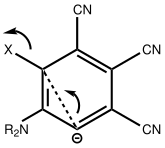
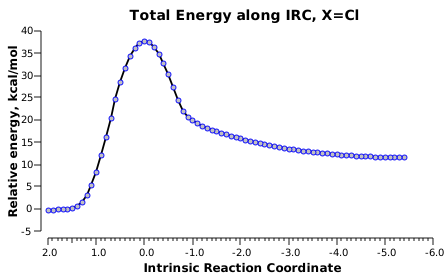
Abstraction of the proton using strong base might result in 1,3-elimination of the leaving group X to form the m-benzyne. For the substituent X=Cl, a ωB97XD/Def2-TZVPP/SCRF=thf calculation (DOI: 10.14469/hpc/2057) of the reaction profile shows a relatively large barrier to elimination, with an endothermic product.

A better leaving group might be X=OTf. Unlike, X=Cl, this reaction is nicely exoenergic (ΔΔG -10.6 kcal/mol) with an accessible activation free energy of 22.5 kcal/mol (DOI: 10.14469/hpc/2066, 10.14469/hpc/2123, 10.14469/hpc/2096)

Perhaps then this, the smaller homologue of azulene, might indeed be capable of synthesis?
Tags: accessible activation free energy, Aryne, Azulenes, endothermic product
Posted in Interesting chemistry, reaction mechanism | 2 Comments »
January 20th, 2017
This is one of those posts of a molecule whose very structure is interesting enough to merit a picture and a 3D model. The study[1] reports a molecular knot with the remarkable number of eight crossings.

The DOI for the 3D model is 10.5517/CCDC.CSD.CC1M85Y0 (or click on the image above). Such topology intersects with work we did a few years back on high-order crossings in fully conjugated π-systems[2], which were then illustrated[3] with hypothetical charged higher order annulenes exhibiting linking numbers Lk of up to 6π. A fully π-conjugated system, also with a linking number in the π-framework of 6π but in the form of a trefoil braid was even suggested on this blog, with a common feature of a central templating atom (a cation rather than an anion). Another example of a previously reported pentadecanuclear manganese metallacycle[4] was also assigned a linking number of 6π.
The molecule above is not completely π-conjugated around the braid and so special properties related to aromaticity and associated ring currents resulting from the topology of the cyclic conjugation[5] are not expected to accrue in the eight-crossing molecular braid[1]. We might also look forward to examples of the characterisation of braids with an odd-number of crossings such as trefoils, pentafoils, heptafoils, etc, as associated with the name Möbius.
References
- J.J. Danon, A. Krüger, D.A. Leigh, J. Lemonnier, A.J. Stephens, I.J. Vitorica-Yrezabal, and S.L. Woltering, "Braiding a molecular knot with eight crossings", Science, vol. 355, pp. 159-162, 2017. https://doi.org/10.1126/science.aal1619
- S.M. Rappaport, and H.S. Rzepa, "Intrinsically Chiral Aromaticity. Rules Incorporating Linking Number, Twist, and Writhe for Higher-Twist Möbius Annulenes", Journal of the American Chemical Society, vol. 130, pp. 7613-7619, 2008. https://doi.org/10.1021/ja710438j
- C.S. Wannere, H.S. Rzepa, B.C. Rinderspacher, A. Paul, C.S.M. Allan, H.F. Schaefer, and P.V.R. Schleyer, "The Geometry and Electronic Topology of Higher-Order Charged Möbius Annulenes", The Journal of Physical Chemistry A, vol. 113, pp. 11619-11629, 2009. https://doi.org/10.1021/jp902176a
- H.S. Rzepa, "Linking Number Analysis of a Pentadecanuclear Metallamacrocycle: A Möbius-Craig System Revealed", Inorganic Chemistry, vol. 47, pp. 8932-8934, 2008. https://doi.org/10.1021/ic800987f
- P.L. Ayers, R.J. Boyd, P. Bultinck, M. Caffarel, R. Carbó-Dorca, M. Causá, J. Cioslowski, J. Contreras-Garcia, D.L. Cooper, P. Coppens, C. Gatti, S. Grabowsky, P. Lazzeretti, P. Macchi, Ã. Martín Pendás, P.L. Popelier, K. Ruedenberg, H. Rzepa, A. Savin, A. Sax, W.E. Schwarz, S. Shahbazian, B. Silvi, M. Solà, and V. Tsirelson, "Six questions on topology in theoretical chemistry", Computational and Theoretical Chemistry, vol. 1053, pp. 2-16, 2015. https://doi.org/10.1016/j.comptc.2014.09.028
Tags: Cheminformatics, Chemistry, Drug discovery, Education, Matter, Molecule, Nature, spectroscopy, Structure validation, π-systems
Posted in Interesting chemistry | 3 Comments »
January 2nd, 2017
Here is an inside peek at another one of Derek Lowe’s 250 milestones in chemistry, the polymorphism of Ritonavir.[1] The story in a nutshell concerns one of a pharma company’s worst nightmares; a drug which has been successfully brought to market unexpectedly “changes” after a few years on market to a less effective form (or to use the drug term, formulation). This can happen via a phenomenon known as polymorphism, where the crystalline structure of a molecule can have more than one form. In this case, form I was formulated into soluble tablets for oral intake. During later manufacturing, a new less-soluble form appeared and “within weeks this new polymorph began to appear throughout both the bulk drug and formulation areas“[1]
The structure of the original form I is shown below (3D DOI: 10.5517/CCRVC75). The compound has three HN-CO peptide linkages, all of which are in the stereoelectronically favoured s-cis form, with a dihedral angle of 180° across the H-N and C=O vectors.

Click for 3D
To show how favourable this s-cis form is, here is a search of the Cambridge structural database for acyclic HN-C=O bonds; of the ~8200 examples, only 5 have an s-trans torsion of ~180°. It is I feel statistically not entirely correct to convert this ratio of K=1640 to a free energy, but if one does, then at 298K, RTlnK works out to 4.4 kcal/mol. Note also that two compounds show an angle of ~90° (artefacts?).

The new type-II form that emerged has only two s-cis peptide linkages, and the third has isomerised to this higher energy s-trans form (3D DOI: 10.5517/CCRVC97)

Click for 3D
This has various knock-on effects on the conformation of the actual molecule itself.
- The cis-trans isomerisation of a peptide or amide bond is a relatively high energy process, since the C=N bond order is higher than 1. For example, in the 1H NMR spectrum of N,N-dimethyl formamide at room temperature, one can famously observe two methyl resonances and it is only at higher temperatures that the two signals coalesce due to more rapid rotation about the C=N bond.
- A pedant might query whether this isomerism is correctly termed a conformational or a configurational change? High-energy rotations that result in cis/trans isomerisms are normally referred to as a configurational changes, whereas low energy rotations about e.g. single bonds are known as conformational changes (thus the conformational changes in cyclohexane). There is a grey region such as this one, where the boundary between the two terms is encountered.
- This isomerism has the knock-on effect of inducing a much lower energy rotation of a C-C single bond (on the left hand side of the representations above), rotating from a dihedral angle of +193 in form I to +51 in form II.
- More minor affects are seen in the conformation of the central benzyl group and the S/N heterocyclic ring on the right hand side.
- All these low energy conformational effects occur because a better hydrogen bonding network can then be set up in the crystal lattice, something not easily predictable from the diagrams of the single molecules shown above.
- Overall, the free energy of the lattice is lower, despite the higher energy of the s-trans peptide bond.
- Clearly, the dynamics of crystallisation initially favoured form I (despite the higher energy of the crystallised outcome), but if a tiny seed of form II is present (or perhaps other impurities) this can dramatically (but unpredictably) change these crystallisation dynamics.
I suspect that since 1998 when this story unfolded, all new drugs in which one or more s-cis peptide bonds are present have caused anxiety. In the system above for example, one might ask whether cis/trans isomerisation of instead either of the other two peptide bonds present might have similar results? Or hypothesize whether inhibiting the associated rotation of the C-C single bond noted above by appropriate “tethering” might prevent form I from converting to form II. Since 1998, I am sure trying to predict the solid form of an organic molecule from its isolated structure using computational methods has dramatically increased, although I have not found in SciFinder any reported instances of such modelling for Ritonavir itself.[2] Perhaps, if such a method were found, it might be too commercially valuable to share?
References
- J. Bauer, S. Spanton, R. Henry, J. Quick, W. Dziki, W. Porter, and J. Morris, "Ritonavir: An Extraordinary Example of Conformational Polymorphism", Pharmaceutical Research, vol. 18, pp. 859-866, 2001. https://doi.org/10.1023/a:1011052932607
- S.R. Chemburkar, J. Bauer, K. Deming, H. Spiwek, K. Patel, J. Morris, R. Henry, S. Spanton, W. Dziki, W. Porter, J. Quick, P. Bauer, J. Donaubauer, B.A. Narayanan, M. Soldani, D. Riley, and K. McFarland, "Dealing with the Impact of Ritonavir Polymorphs on the Late Stages of Bulk Drug Process Development", Organic Process Research & Development, vol. 4, pp. 413-417, 2000. https://doi.org/10.1021/op000023y
Tags: Carbamates, Chemistry, Derek Lowe, free energy, high energy process, High-energy rotations, higher energy, higher energy s-trans form, hydrogen bonding network, later manufacturing, Lipid polymorphism, low energy conformational effects, low energy rotations, lower energy rotation, Peek, Polymorphism, Protease inhibitors, Ritonavir, RTT, SN, Software engineering, Thiazoles, Ureas
Posted in Interesting chemistry | No Comments »
December 31st, 2016
My holiday reading has been Derek Lowe’s excellent Chemistry Book setting out 250 milestones in chemistry, organised by year. An entry for 1920 entitled hydrogen bonding seemed worth exploring in more detail here.
As with many historical concepts, it can often take a few years to coalesce into something we would readily recognise today, and hydrogen bonds are no exception. Wikipedia is another source of the history and it cites a 1912 article as the origin of the term in relation to the solvation of amines[1] but also notes that the better known setting of water occurs later in 1920.[2] Here I try to capture the essence of the concept with a few diagrams taken from these two articles.
Firstly “The state of amines in aqueous solution“[1] which is mostly concerned with the measurement of ionization constants of primary, secondary and tertiary amines. It boils down to the below:


and the connection to ionization is laid out as:


Since in 1912, Lewis’ electron pair theory of the covalent bond had not yet emerged, the authors use the terms “strong union” and “weak union”, and of course it is the “weak union” that we now know of as the hydrogen bond. Some other comments about this seminal diagram:
- The article contains the very explicit and modern term stereochemical, which is used in a manner that suggests it was already common.‡ But there is only a hint at most that the nitrogen atoms might be tetrahedral, or that the “weak union” between (what we now think of as the lone pair on) the nitrogen and the hydrogen of the water is directional.
- The second weak union between the tetramethyl ammonium (which we now describe as a cation) and the hydroxide (now described as an anion; both terms are however implied by the description strong electrolyte) is probably not what we would now call a hydrogen bond, more an intimate ion-pair.
The second article in 1920 on water itself[2] is post-Lewis, but perhaps applied in a manner which we would not entirely agree with nowadays. Thus dinitrogen, N≡N is shown as below with just a single connecting bond.

Then we get the interaction between ammonia and water,† analogous to the example shown above:

and for water itself:♠

which in each case shows the central hydrogen having what we now call a valence shell of four electrons,♣ and hence more equivalent to the “strong unions” above. This shows that in 1920 chemists were rapidly adopting Lewis’ representations, but not always entirely successfully.
On balance, I think the 1912 article sets out the modern concept of a hydrogen bond representing a weak union to a hydrogen rather better than the Latimer and Rodebush attempt (at least diagrammatically).
‡Stereochemical notation is discussed in this post, and it dates from the 1930s.
†The modern take is explored here, in which the equilibrium set up between a “weak union” between ammonia and water (the weak electrolyte) and an isomeric “strong union” which represents ionization into an ammonium hydroxide ion-pair (the strong electrolyte) is favoured for the former by ΔG ~6 kcal/mol.
♠The equilibrium between a “weak union” of two water molecules and the fully ionized strong union of hydronium hydroxide favours the former by ΔG ~23 kcal/mol.
♣ This 1920 representation does imply symmetry for the hydrogen, being ~equally disposed between the two oxygens. We now know that such symmetric hydrogen bonding is not unusual (see this post for how to fine-tune a hydrogen bond into this situation) but rather than requiring four electrons as implied in the diagram above, it is now better described as a three-centre-two-electron bond instead.
References
- T.S. Moore, and T.F. Winmill, "CLXXVII.—The state of amines in aqueous solution", J. Chem. Soc., Trans., vol. 101, pp. 1635-1676, 1912. https://doi.org/10.1039/ct9120101635
- W.M. Latimer, and W.H. Rodebush, "POLARITY AND IONIZATION FROM THE STANDPOINT OF THE LEWIS THEORY OF VALENCE.", Journal of the American Chemical Society, vol. 42, pp. 1419-1433, 1920. https://doi.org/10.1021/ja01452a015
Tags: 10.1021, aqueous solution, Chemical bond, chemical bonding, Chemistry, Derek Lowe, Hydrogen, Hydrogen bond, Intermolecular forces, Lowe's, Nature, Supramolecular chemistry
Posted in Historical | 2 Comments »
December 31st, 2016
My holiday reading has been Derek Lowe’s excellent Chemistry Book setting out 250 milestones in chemistry, organised by year. An entry for 1920 entitled hydrogen bonding seemed worth exploring in more detail here.
As with many historical concepts, it can often take a few years to coalesce into something we would readily recognise today, and hydrogen bonds are no exception. Wikipedia is another source of the history and it cites a 1912 article as the origin of the term in relation to the solvation of amines[1] but also notes that the better known setting of water occurs later in 1920.[2] Here I try to capture the essence of the concept with a few diagrams taken from these two articles.
Firstly “The state of amines in aqueous solution“[1] which is mostly concerned with the measurement of ionization constants of primary, secondary and tertiary amines. It boils down to the below:


and the connection to ionization is laid out as:


Since in 1912, Lewis’ electron pair theory of the covalent bond had not yet emerged, the authors use the terms “strong union” and “weak union”, and of course it is the “weak union” that we now know of as the hydrogen bond. Some other comments about this seminal diagram:
- The article contains the very explicit and modern term stereochemical, which is used in a manner that suggests it was already common.‡ But there is only a hint at most that the nitrogen atoms might be tetrahedral, or that the “weak union” between (what we now think of as the lone pair on) the nitrogen and the hydrogen of the water is directional.
- The second weak union between the tetramethyl ammonium (which we now describe as a cation) and the hydroxide (now described as an anion; both terms are however implied by the description strong electrolyte) is probably not what we would now call a hydrogen bond, more an intimate ion-pair.
The second article in 1920 on water itself[2] is post-Lewis, but perhaps applied in a manner which we would not entirely agree with nowadays. Thus dinitrogen, N≡N is shown as below with just a single connecting bond.

Then we get the interaction between ammonia and water,† analogous to the example shown above:

and for water itself:♠

which in each case shows the central hydrogen having what we now call a valence shell of four electrons,♣ and hence more equivalent to the “strong unions” above. This shows that in 1920 chemists were rapidly adopting Lewis’ representations, but not always entirely successfully.
On balance, I think the 1912 article sets out the modern concept of a hydrogen bond representing a weak union to a hydrogen rather better than the Latimer and Rodebush attempt (at least diagrammatically).
‡Stereochemical notation is discussed in this post, and it dates from the 1930s.
†The modern take is explored here, in which the equilibrium set up between a “weak union” between ammonia and water (the weak electrolyte) and an isomeric “strong union” which represents ionization into an ammonium hydroxide ion-pair (the strong electrolyte) is favoured for the former by ΔG ~6 kcal/mol.
♠The equilibrium between a “weak union” of two water molecules and the fully ionized strong union of hydronium hydroxide favours the former by ΔG ~23 kcal/mol.
♣ This 1920 representation does imply symmetry for the hydrogen, being ~equally disposed between the two oxygens. We now know that such symmetric hydrogen bonding is not unusual (see this post for how to fine-tune a hydrogen bond into this situation) but rather than requiring four electrons as implied in the diagram above, it is now better described as a three-centre-two-electron bond instead.
References
- T.S. Moore, and T.F. Winmill, "CLXXVII.—The state of amines in aqueous solution", J. Chem. Soc., Trans., vol. 101, pp. 1635-1676, 1912. https://doi.org/10.1039/ct9120101635
- W.M. Latimer, and W.H. Rodebush, "POLARITY AND IONIZATION FROM THE STANDPOINT OF THE LEWIS THEORY OF VALENCE.", Journal of the American Chemical Society, vol. 42, pp. 1419-1433, 1920. https://doi.org/10.1021/ja01452a015
Tags: 10.1021, aqueous solution, Chemical bond, chemical bonding, Chemistry, Derek Lowe, Hydrogen, Hydrogen bond, Intermolecular forces, Lowe's, Nature, Supramolecular chemistry
Posted in Historical | 2 Comments »