November 25th, 2016
Another conference, a Cambridge satellite meeting of OpenCon, and I quote here its mission: “OpenCon is a platform for the next generation to learn about Open Access, Open Education, and Open Data, develop critical skills, and catalyze action toward a more open system of research and education” targeted at students and early career academic professionals. But they do allow a few “late career” professionals to attend as well!
I could only attend the morning session, for which the keynote speaker was Erin McKiernan The presentation was entitled How open science helps researchers succeed, presented as an exploration of an article written by Erin and colleagues with the same name and published in eLife[1] Erin has created a support page at http://whyopenresearch.org to augment the presentation and it’s well worth a visit.
One striking point made was the assertion that Open publications get more citations!

As with many metrics of the impacts of the science publication processes, a citation itself lacks the context of why it was made (see this post for further discussion), but the expectation is that a citation is “good”. From my perspective as a chemist, I did wonder why molecular science was missing from the graphic above. Do open chemistry publications also get more citations?
Which brings me to another point made during the talk, the increasingly controversial aspect of (journal) impact factors and the pressure placed on early career researchers to publish only in those with “high” impact factors, and for their careers to be assessed at least in part based on these and the anticipated “h-index”. The audience was indeed encouraged to go visit http://www.ascb.org/Dora/ (Declaration on Research Assessment, or Putting science into the assessment of research). Have you signed it yet?
Another manifestation of the modern trend to analyse impact metrics is the site Impactstory.org. This is a scripted resource that starts from your ORCID identifier and (optionally) your Twitter account (yes, apparently Tweets matter!) to derive a more complex alternative metric of a individual’s impacts. I had not tried this one before and so I submitted my ORCID and my Twitter account, and watched as the system went off to http://orcid.scopusfeedback.com (Scopus is an Elsevier product) to attempt to create my profile. It ground for quite a while, reporting initially that I had no publications! This was followed by an unexpected error; I did not get my impact back! But this experiment served to highlight one aspect that was discussed at the meeting; data and other research objects. The graphic above refers only to the citation of journal articles, it does not yet include the citation of data. However ORCID DOES include data and research objects as works. And because the granularity of my data and research objects is very fine (one molecule = one work), I have quite a few. In fact ~200,000! ORCID gets to about 8000 before it gives up. I suspect http://orcid.scopusfeedback.com queries ORCID, gets back ~8000 entries and crashes. No doubt the programmer tasked with implementing this resource did not anticipate that any individual could accumulate 8000+ entries! Or probably factor in that the vast majority of these would of course not be journal articles but data. If the site gets back to me about the crash I experienced, I will update here.
Simon Deakin was the next speaker with (open) data as the focus and the worries many researchers have in being scooped by others who have re-used your open data without proper attributions. The discussion teased out that if data is properly deposited, it will indeed have full associated metadata and in particular a date stamp that could help protect an author’s interests.
It was really good to meet so many early career researchers who espouse the open ethos. Perhaps, in 20 years time, another graphic akin to the one above might demonstrate that open researchers get more promotions!
References
- E.C. McKiernan, P.E. Bourne, C.T. Brown, S. Buck, A. Kenall, J. Lin, D. McDougall, B.A. Nosek, K. Ram, C.K. Soderberg, J.R. Spies, K. Thaney, A. Updegrove, K.H. Woo, and T. Yarkoni, "How open science helps researchers succeed", eLife, vol. 5, 2016. https://doi.org/10.7554/elife.16800
Tags: Academia, author, chemist, City: Cambridge, Company: Twitter, ELife, Erin McKiernan, keynote speaker, Max Planck Society, programmer, Simon Deakin, Social Media & Networking, speaker, Technology/Internet, Wellcome Trust
Posted in Chemical IT, General | 3 Comments »
November 14th, 2016
Chloroform, often in the deuterated form CDCl3, is a very common solvent for NMR and other types of spectroscopy. Quantum mechanics is increasingly used to calculate such spectra to aid assignment and the solvent is here normally simulated as a continuum rather than by explicit inclusion of one or more chloroform molecules. But what are the features of the hydrogen bonds that form from chloroform to other acceptors? Here I do a quick search for the common characteristics of such interactions.
- This first search (R < 0.05, no errors, no disorder) is for interactions from the CH… O, and is a plot of that distance against the angle subtended at the oxygen.

Note that there are not that many crystalline examples. The “hotspot” is at a distance of ~2.3Å, but real examples down to 1.9Å exist. The angle subtended at the oxygen is close to 120° (the angle subtended at the hydrogen is always close to 180°). The plot below constrains the search to data collected below 140K to reduce the thermal noise in the measurements, with the hotspot shortening slightly to 2.2Å. 
- The next search is for interactions to N rather than O (T < 140K). There are rather fewer hits, but again with similar features.

- Finally, an attempt to see if there is a correlation between the C-H length and the H…O length.

This has odd characteristics, which suggests that in most cases the C-H distance is not measured from the diffraction data but simply “idealised” (and which therefore renders this plot meaningless). Unless its been added recently, it is not possible to specify in the search how the hydrogen positions have been refined, if at all and hence to restrict the search only to those structures where the C-H distance is meaningful.
In the last ten years or so, great progress has been made in assigning experimental spectra with the help of quantum calculations. This is true of chemical shifts in NMR, but especially so for chiroptical measurements such as ORP, ECD and VCD. Given that explicit hydrogen bonds can introduce anisotropy into the otherwise isotropic solvent continuum, it might be worth including perhaps one chloroform molecule into these calculations, especially if the CH…O distance is <2Å (which suggests it is fairly strong). If nothing else, chloroform is rather big and might exert effects based on dispersion attractions or steric repulsions as well as the H-bonding.
Tags: chemical shifts, Chloroform, Deuterated chloroform, Deuterated methanol, Hydrogen bond, Nuclear magnetic resonance, spectroscopy
Posted in crystal_structure_mining | 5 Comments »
November 10th, 2016
This is sent from the Pidapalooza event in Reykjavik, Iceland, and is a short collection of notable things I learnt or which attracted my attention.
Firstly, what IS PIDapalooza[1]? Well, it’s all about persistent identifiers, but don’t let that put you off! Another way of putting it is that it’s a way of finding things scientific on the Web. Not just publications, but conferences, social media, teaching, research datasets, infrastructure, grants, organizations, instruments, scientific objects and samples and no doubt much more. These (will) live in an inter-connected eco-system, and so the idea goes, will become an integral part of how a scientist accumulates and disseminates information nowadays. Yes, the conference itself has its own PID: 10.5438/11.0001 and the individual talks will also appear as both a collection and with their own PID in the near future.
- The first example comes from WikiData, a collection of carefully curated data, from which can be dynamically assembled say a periodic table of the elements. All the data here is included from other objects, and everything is referenced by its PID. Since it’s all assembled from data, if say the name of element 118 is assigned, then it will automatically be absorbed into this presentation.
- This next example proved highly contentious, but is included here anyway. It is templated PIDs, as in http://doi.org/10.5446/12780#t=00:20.00:27 which allows navigation to a particular part of an object referenced by the PID. In this case a time code for a movie, but it might be say an active site in a protein, or a key atom or group in a molecular complex for example. This might never happen (for reasons only the computer scientists currently understand!) but it does show one way in which the humble DOI might evolve.
- http://typeregistry.org exists for registering data types. It has almost no chemistry at the moment, but perhaps it should have!
- There was a great deal about ORCIDs, and the ways in which uses of this particular PID are evolving. For example, the next big effort is to use the ORCID system for organisations. You will find my ORCID at the top of this post.
- PIDs are also being mooted for instruments. The idea is that instrumental capabilities, settings, calibration etc are often an integral part of the data acquisition for a project. So if data is generated using such a device, why not quote its PID in any derived article so that others can more easily replicate a particular experiment in their own laboratory.
- A quote by one of the speakers was attributed to Bill Gates around 1997 “We need banking. We don’t need banks anymore” (think how this might apply to 2016. Was he correct?). This was followed by straw men such as: “We need publications. We don’t need publishers anymore”. Or “We need archiving. We don’t need libraries anymore”. Just like Gates’ own quote, the reality is of course far more complex.
- And PID fatigue; I hope you are not getting too much of that at the moment.
There are lots more I have learnt which I need to fix/enhance/address in our own experiments in the use of PIDs in chemistry, so I have better get on with it now!
References
- ORCID., DataCite., Crossref., and California Digital Library., "PIDapalooza 2016", 2016. https://doi.org/10.5438/11.0001
Tags: active site, Bill Gates, City: Reykjavik, Country: Iceland, scientist, social media, Technology/Internet
Posted in Chemical IT | 1 Comment »
November 1st, 2016
I am now inverting the previous question by asking what is the largest angle subtended at a chain of three connected 4-coordinate carbon atoms? Let’s see if further interesting chemistry can be unearthed.
Specifying only angles > 130°, the following distribution is obtained.

- Note the maximum at ~138°. This is typical of that found in spiro-cyclopropanes, although I have not checked if other kinds of compound can also sustain this angle.
- There appear to be a few examples at 180° but these appear to be simple errors in the crystal coordinates.
- The first real example occurs at 166°[1] and contains an almost hemispherical carbon atom, doi: 10.5517/CCZBB2P [2]

- A second example is a sprung spiro-cyclopropane [3] in which the large angle is maintained without the help of a metal.

- This latter example suggests that a structural modification as shown below might take the angle to almost 180° (calc. ωB97XD/Def2-TZVPP = 177.2°[4]).

It is remarkable how much the standard angle subtended at four-coordinate carbon (109.47°) can be opened. It makes one wonder whether something approaching 180° is achievable, and what the properties of such a molecule might be.
References
- V. González-López, M.A. Leyva, and M.J. Rosales-Hoz, "Coupling of acetylene molecules on ruthenium clusters, involving cleavage of C–Si bonds in the alkyne and coordination of a phenyl ring of a SiPh3 group", Dalton Transactions, vol. 42, pp. 5401, 2013. https://doi.org/10.1039/c3dt32335h
- Gonzalez-Lopez, V.., Leyva, M.A.., and Rosales-Hoz, M.J.., "CCDC 903652: Experimental Crystal Structure Determination", 2013. https://doi.org/10.5517/cczbb2p
- R. Boese, D. Blaeser, K. Gomann, and U.H. Brinker, "Spiropentane as a tensile spring", Journal of the American Chemical Society, vol. 111, pp. 1501-1503, 1989. https://doi.org/10.1021/ja00186a058
- H. Rzepa, "VAJHAP", 2016. https://doi.org/10.14469/hpc/1861
Tags: Angle, metal, Subtended angle
Posted in crystal_structure_mining, Interesting chemistry | 1 Comment »
October 31st, 2016
Is asking a question such as “what is the smallest angle subtended at a chain of three connected 4-coordinate carbon atoms” just seeking another chemical record, or could it unearth interesting chemistry?
A simple search of the Cambridge structure database for a chain of three carbons, each bearing four substituents (sp3 hybridized in normal paralance) reveals the following distribution:

The value 60° is of course a three-membered cyclopropane ring. The tail of the distribution is very small, and there are a few small outliers with values of < 54°. Most of the time such outliers are in fact simple errors, but here we see that they are in fact semibullvalenes, of the type shown below, with the small angle subtended at the central of the three carbon atoms coloured in red.

In this diagram I have added my own semantic interpretation of what is going on. Let me itemise this:
- These molecules can undergo very rapid [3,3] sigmatropic rearrangements, shifting a σ-bond away from the 3-ring to create another such ring.
- This process elongates one of the C-C bonds and of neccessity this reduces the angle at the associated carbon.
- I have drawn two types of arrow connecting the two structures. The first is an equilibrium arrow, which implies a transition state connecting the two species. This transition state will have equal bond lengths for the forming/breaking C-C bond, and the transition state will have a rate constant which is slower than the time taken for one molecular vibration (~10-15s)
- It is also possible however that the second arrow is the correct one, and this implies an electronic resonance rather than a nuclear motion. This would have a rate constant comensurate with electron dynamics (~10-18 s) rather than nuclear vibrations.
What does x-ray crystallography measure? Well the diffraction of photons by electrons. In order to obtain a diffraction pattern, enough photons have to be diffracted to be measured, and even with most modern instruments this still takes minutes or hours. During this period, all the various nuclear positions encountered as a result of vibrations or equilibria are sampled. So if the rate constant for the [3,3] sigmatropic rearrangement is fast, x-ray diffraction will measure the average of the two sets of nuclear positions, which can be distinguished only with some difficulty (if at all) from the structure implied instead by electronic resonance.
If the equilibrium arrow applies, then the small angles of <54° are merely the average of the normal value for a 3-membered ring and a smaller value for a structure where one of the C-C bonds has been removed. In my opening sentence, I noted that the three carbon carbon atoms had to be connected in a chain. This is no longer true; the goalposts have been moved (a lot)!
If its an electron resonance, then the three carbon atoms are still connected, albeit one of the two C-C bonds is no longer a single bond but rather weaker and hence longer. The goalposts have merely been slightly shifted!
A calculation (B3LYP/Def2-TZVPP+D3 dispersion, doi: 10.14469/hpc/1850, [1]) of the structure KUZFUE [2] shows the C2-symmetric species shown below, with an elongated C-C bond and hence a reduced C-C-C angle, as being a true minimum (a resonance) rather than a transition state (an equilibrium). The vibration which shortens one C-C bond and lengthens the other has the real calculated wavenumber 244 cm-1.‡ But the boundary between the two possibilities (often referred to as the boundary between a single and a double minimum in a potential energy surface) is notoriously difficult to capture using calculations.

How could experiment definitively settle the issue? Well, the SLAC beam is a unique instrument. Its source of X-rays is so intense that you can get an analysable diffraction pattern from a crystal on a timescale so short that during this period no nuclear motions occur (not even vibrations). Those nuclear positions capture the true equilibrium positions of the atoms in the molecule. Now, how does one get beam time on the SLAC?
‡ Click on the image above to see an animation of this normal mode. If you are running the macOS Safari browser, make sure Preferences/Security/Plug-in settings/Java has the site ch.ic.ac.uk or ch.imperial.ac.uk set to on. If you do not do this, the somewhat unhelpful message You do not have Java applets enabled in your web browser, or your browser is blocking this applet. will appear. Note also that new system installations might tend to switch these settings to off.
References
- H. Rzepa, "CAZFUE", 2016. https://doi.org/10.14469/hpc/1850
- L.M. Jackman, A. Benesi, A. Mayer, H. Quast, E.M. Peters, K. Peters, and H.G. Von Schnering, "The Cope rearrangement of 1,5-dimethylsemibullvalene-2,6- and 3,7-dicarbonitriles in the solid state", Journal of the American Chemical Society, vol. 111, pp. 1512-1513, 1989. https://doi.org/10.1021/ja00186a064
Tags: animation, Bicyclic molecule, chemical record, Chemistry, City: Cambridge, Cycloalkane, Cyclopropanes, Java, Molecular geometry, Organic chemistry, potential energy surface, Safari, Web browser, X-ray
Posted in crystal_structure_mining, reaction mechanism | 7 Comments »
October 16th, 2016
After sixty years of searching, the first non-templated double helical carbon-free inorganic molecular structure has been reported.[1] That is so neat that I thought to load the 3D coordinates here for you to interact with and then to explore the prospect of using these coordinates to add some value with e.g. some chiroptical calculations.
I cannot really show you a diagram at this stage, since the article is not gold open access (OA) and hence is copyright protected as © 2016 WILEY-VCH Verlag GmbH & Co. KGaA, Weinheim. So to progress I have to get the 3D coordinates, which as data cannot be copyrighted and from these generate my own diagram. How did I go about getting this data and how FAIR (Findable, Accessible, Interoperable, Reusable) did I find it? Here I list the actions I went through.
- Go to the article[1] via its “landing page” and there I (as a human) navigated to the supporting information. Could automated software have done this I wonder if it were not familiar with the journal?
- There I found a PDF file and two MP4 movies. I know movies are unlikely to contain FAIR data, so I try the former. On pages 16-17 you find the space group, cell dimensions and fractional atomic coordinates. Its not really formatted to be “I” (copying/pasting out of PDF can be a challenge) and you have to be familiar with what is a specialised format (neither A nor really R then) and some knowledge of appropriate crystallographic software or procedure to convert Table S1 and S2 into an inter-operable format such as CIF (crystallographic interchange format).
- The main article does have the following statement: Further details of the crystal structure investigation(s) may be obtained from the Fachinformationszentrum Karlsruhe, 76344 Eggenstein-Leopoldshafen (Germany), on quoting the depository number CSD-430054. Do they want you to write them a letter?
- Well, a bit of Googling reveals https://www.fiz-karlsruhe.de/en/leistungen/kristallographie/kristallstrukturdepot/order-form-request-for-deposited-data.html as the required online link (why could that not be shortened and included in the article?)
- This form has not quite yet caught up with modern journal practice. The form stipulates a page number is apparently mandatory, but although this article is fully published, it is too new to have one. I wrote “not assigned yet” and hoped for the best; a “clever” non-human script might always decide the data type of this response is wrong and reject the request! There is no field for the article DOI, which is really all the information that is needed. I pasted that into the “volume number” and again crossed my fingers.
- Two days later, whilst awaiting a response to the above, I revisited Table S1/S2 but now armed with a sample CIF file for the space group P 2/c and using a text editor, inserted into it the values found in these tables (~15 minutes). The result is shown below.
[jsmol caption=’SnIP as a helical polymer’ fileurl=’https://www.rzepa.net/blog/wp-content/uploads/2016/10/SnIP.mol’ id=’a3′ commands=’=spin 3;’ debug=’false’]
This double helix is not of the complementary type found in DNA but a concentric one. The inner helix of a chain of P atoms is enclosed by the outer helix (winding in the same sense, anticlockwise as shown above) of a Sn-I-Sn-I chain. Click on the diagram above to load the 3D coordinates and inspect this for yourself.
The article reporting this structure[1] is full of fascinating insights into this new material. Time will no doubt tell whether it has exploitable properties. Meanwhile, when the CIF file arrives from my query above, I will make it available here as properly FAIR data.
References
- D. Pfister, K. Schäfer, C. Ott, B. Gerke, R. Pöttgen, O. Janka, M. Baumgartner, A. Efimova, A. Hohmann, P. Schmidt, S. Venkatachalam, L. van Wüllen, U. Schürmann, L. Kienle, V. Duppel, E. Parzinger, B. Miller, J. Becker, A. Holleitner, R. Weihrich, and T. Nilges, "Inorganic Double Helices in Semiconducting SnIP", Advanced Materials, vol. 28, pp. 9783-9791, 2016. https://doi.org/10.1002/adma.201603135
Tags: Chemical IT
Posted in Chemical IT, crystal_structure_mining | 2 Comments »
October 13th, 2016
Chemists are as fond of records as any, although I doubt you will find many chemical ones in the Guinness world records list. Polytriangulanes chase how many cyclopropyl 3-rings can be joined via a vertex. Steve Bachrach on his blog reports some recent work by Peter Schreiner and colleagues[1] and the record for catenation of such rings appears to be 15. This led me to think about some other common atoms and groups. Here I have searched for crystal structures only; there may be examples of course for which no such data has been reported.
- For the halogens F and Cl it is 3.
- But for Br, believe it or not it reaches the heady value of 24, doi: 10.5517/CC14K0PD[2]
- For iodine it is effectively infinite, as noted in my earlier post.
- For oxygen it is 3; there are none with four consecutive oxygens.
- For sulfur, a ring of twelve is known[3] and for Se ~11[4]
- For nitrogen it may surprise to learn it reaches 6 if the connecting bonds are all single. A typical example can be seen at doi: 10.5517/CCZCR35[5] It reaches 10 if any kind of N-N bond is allowed. doi: 10.5517/CCYVNZD
- For phosphorus, 16 is not uncommon 10.5517/CC1JWTQY [6] but the record may be 21.
- The alkyne group C≡C, reaches 10 (20 carbon atoms), doi: 10.5517/CCSGR98 [7]
- The carbonyl group (C=O) can form a ring of six such groups 10.5517/CC9JR6R[8]
Such records are probably very uncompetitive; I doubt any researchers set out to extend the count. Most of the above are probably simply unexpected discoveries. My favourite is the bromine example; this element so often surprises.
References
- W.D. Allen, H. Quanz, and P.R. Schreiner, "Polytriangulane", Journal of Chemical Theory and Computation, vol. 12, pp. 4707-4716, 2016. https://doi.org/10.1021/acs.jctc.6b00669
- Easton, Max E.., Ward, Antony J.., Hudson, Toby., Turner, Peter., Masters, Anthony F.., and Maschmeyer, Thomas., "CCDC 1059043: Experimental Crystal Structure Determination", 2015. https://doi.org/10.5517/cc14k0pd
- J. Steidel, R. Steudel, and A. Kutoglu, "Röntgenstrukturanalysen von Cyclododekaschwefel (S<sub>12</sub>) und Cyclododekaschwefel‐1‐Kohlendisulfid (S<sub>12</sub> · CS<sub>2</sub>) [1]", Zeitschrift für anorganische und allgemeine Chemie, vol. 476, pp. 171-178, 1981. https://doi.org/10.1002/zaac.19814760520
- M.G. Kanatzidis, and S.P. Huang, "Unanticipated redox transformations in gold polyselenides. Isolation and characterization of diselenobis(tetraselenido)diaurate(2-) and undecaselenido(2-)", Inorganic Chemistry, vol. 28, pp. 4667-4669, 1989. https://doi.org/10.1021/ic00325a026
- Klapotke, T.M.., Petermayer, C.., Piercey, D.G.., and Stierstorfer, J.., "CCDC 905017: Experimental Crystal Structure Determination", 2013. https://doi.org/10.5517/cczcr35
- Dragulescu-Andrasi, Alina., Miller, L. Zane., Chen, Banghao., McQuade, D. Tyler., and Shatruk, Michael., "CCDC 1426921: Experimental Crystal Structure Determination", 2016. https://doi.org/10.5517/cc1jwtqy
- Chalifoux, W.A.., McDonald, R.., Ferguson, M.J.., and Tykwinski, R.R.., "CCDC 729160: Experimental Crystal Structure Determination", 2010. https://doi.org/10.5517/ccsgr98
- Abrahams, B.F.., Haywood, M.G.., and Robson, R.., "CCDC 284214: Experimental Crystal Structure Determination", 2006. https://doi.org/10.5517/cc9jr6r
Posted in crystal_structure_mining | 3 Comments »
October 9th, 2016
Previously, a mechanistic twist to the oxidation of imines using peracid had emerged. Time to see how substituents respond to this mechanism.
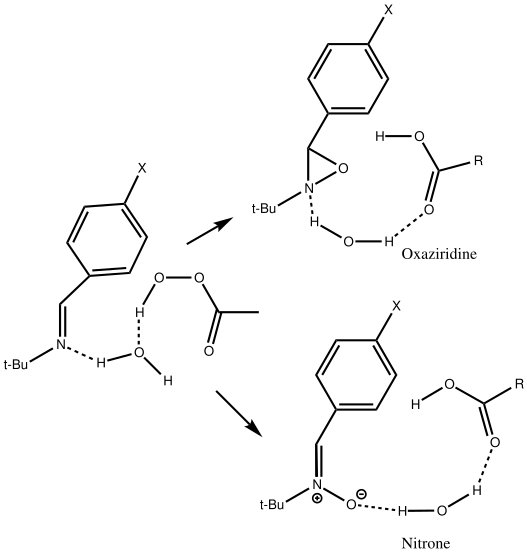
With X = NO2 100% oxaziridine and no nitrone is obtained experimentally; with X = NMe2 , the population is inverted with nitrone as the dominant product at 78%.[1] Calculations (ωB97XD/Def2-TZVPP/SCRF=dichloromethane), data collection DOI: 10.14469/hpc/1743[2] are summarised in the table. The initial model employs the simpler peracetic acid as oxidant (R=Me) and we see here a computed preference of 4.2 kcal/mol for oxiziridine when the aryl substituent X = NO2 (a ratio of 1024:1 in its favour) but reduced to 1.4 kcal/mol when X = NMe2. This hardly changes when the acid is changed from ethanoic to mCPBA (meta-chloroperbenzoic acid), the oxidant actually used in the experiments.
| Substituents |
π |
σ |
| R=Me, X=NO2 |
-4.2 |
0.0 |
| R=Me, X=NMe2 |
-1.4 |
0.0 |
| R=m-Cl-phenyl, X=NO2 |
-4.1 |
0.0 |
| R=m-Cl-phenyl, X=NMe2 |
-1.3 |
0.0 |
You can see from the transition state structures that π attack is helped by stacking between the aryl face of the m-chloroperbenzoic acid and the aryl group on the imine, whereas σ is not.


These results show that our proposed mechanism can reproduce the selectivity for formation of oxaziridine when the aryl group bears X=NO2 but misses the mark of predicting nitrone formation when X=NMe2. Experimentally nitrone is favoured by ΔΔG298 0.75 kcal/mol, whereas the calculation disfavours this by -1.3 kcal/mol. Is this discrepancy enough to sink this mechanistic model? Or might yet another variation on the mechanism, such shifting the proton from peracid to the X=NMe2 do the trick?
What I have tried to show here is how one can iterate towards a realistic mechanism by gradually refining the models so that more and more experimental observations are correctly predicted. Sometimes of course, it might be the experiment itself that has to be repeated and refined, although we have not quite reached that point yet with this example.
References
- D.R. Boyd, P.B. Coulter, N.D. Sharma, W. Jennings, and V.E. Wilson, "Normal, abnormal and pseudo-abnormal reaction pathways for the imine-peroxyacid reaction", Tetrahedron Letters, vol. 26, pp. 1673-1676, 1985. https://doi.org/10.1016/s0040-4039(00)98582-4
- H. Rzepa, "Ï or Ï nucleophilic reactivity of imines", 2016. https://doi.org/10.14469/hpc/1743
Tags: Functional groups, Imine, Nitrone, NME2, Oxaziridine
Posted in reaction mechanism | No Comments »
October 4th, 2016
Peter Murray-Rust and I are delighted to announce that the 2016 award of the Bradley-Mason prize for open chemistry goes to Jan Szopinski (UG) and Clyde Fare (PG).
Jan’s open chemistry derives from a final year project looking at why atom charges derived from quantum chemical calculation of the electronic density represent chemical information well, but the electrostatic potential (ESP) generated from these charges is very poor and conversely charges derived from the computed electrostatic potential are incommensurate with chemical information (such as the electronegativity of atoms). He has developed a Python program called ‘repESP’ in which ‘compromise’ charges are generated which attempt to reconcile the physical world-view (fitting the ESP) with chemical insight provided by NPA (Natural Population Analysis). Jan was the main driver to making his code open source, “opening his supervisor’s eyes” to the various flavours of open source licences. To ensure that all subsequent improvements to the program remain available to anyone, the source code has been released under a ‘copyleft’ licence (GPL v3) and is maintained by Jan on GitHub, where Jan looks forward to helping new users and collaborating with contributors.
Clyde has made various contributions to opensource chemistry over the period of his PhD, with the focus mainly on utilities to improve quantum chemical research and the enhancement of a popular machine learning library with a method that has been successful in chemometrics, creation of an opensource channel for teaching chemists programming and data analysis and creation of a tool to help encourage open sourcing software development. Cclib is the most popular library for parsing quantum chemical data from output files and Clyde has contributed patches for the Atomic simulation environment which enables control of quantum chemical codes from a unified python interface. He was responsible for the construction of a computational chemistry electronic notebook published to github and which is now under active development by others as well. This aims to encapsulate computation chemical research projects, both for the sake of reproducibility and for the sake of organising and keeping track of quantum chemical research. Alongside this platform he created an enhanced Gaussian calculator for the Atomic Simulation Environment that enables automatic construction of ONIOM input files, also now under active development. He also made contributions to scikit learn, the most popular python machine learning framework, implementing a kernel for Kernel Ridge Regression that has become the most successful kernel for regression over molecular properties. He was part of the team that won the 2014 sustainable software conference prize for creation of the opensource healthchecker software as part of Sustain. He has argued for opensource as a platform for teaching resources and created the Imperial Chemistry github user account, which is now run by the department. Materials for the Imperial Chemistry Data Analysis and Programming workshops implemented as Python Notebooks are now available through this account and continue under active development.
Criteria for the award will include judging the submission on its immediate accessibility via public web sites, what is visible and re-usable in this way and of evidence of either community formation/engagement or re-use of materials by people other than the proposer.
Tags: Analytical chemistry, chemical information, chemical insight, Cheminformatics, Chemistry, Chemometrics, Clyde Fare, Company: GitHub, computation chemical research projects, computational chemistry, computing, Cross-platform software, driver, GitHub, Jan Szopinski, machine learning, open sourcing software development, opensource healthchecker software, Peter Murray-Rust, public web sites, Python, quantum chemical calculation, quantum chemical codes, quantum chemical data, quantum chemical research, Quotation, Server & Database Software, simulation, Software, supervisor, sustainable software conference prize, Technology/Internet
Posted in Bradley-Mason Prize for Open Chemistry | No Comments »
September 28th, 2016
The story so far. Imines react with a peracid to form either a nitrone (σ-nucleophile) or an oxaziridine (π-nucleophile).[1] The balance between the two is on an experimental knife-edge, being strongly influenced by substituents on the imine. Modelling these reactions using the “normal” mechanism for peracid oxidation did not reproduce this knife-edge, with ΔΔG (π-σ) 16.2 kcal/mol being rather too far from a fine balance.
There are two general reasons why computational modelling using quantum mechanics may not match experimental outcome. Until perhaps 10 or so years ago, the culprits may often have been the approximations necessary to apply the theory, as bounded by the limitations of the CPU power of the then available computers to evaluate the associated equations. Nowadays, an equally likely explanation is that the molecular model for which these equations are solved is either wrong or maybe just incomplete. For an organic reaction, these models are initially set out by “arrow pushing” a possible mechanistic pathway. Such speculations have been a common feature of most new articles reporting the outcome of reaction experiments for perhaps 60 years now. It is now more common (but by no means universal) to augment this with a computational reality check. So previously, when I applied a reality check on the “standard” epoxidation mechanism, it did not pass the test.
So time to revise the mechanism, as per below. The difference is that the model includes an extra water molecule to facilitate proton transfers, with the imine now being protonated by the peracid to form a zwitterion, which collapses to an addition product and it is this species that rearranges to the final oxaziridine. Free energies relative to the reactant 1 are shown in red below.‡

The IRC for 2 (TS) is shown below, being a proton transfer mediated by the transfer agent (water in this case, but it could be also peracid or eventually the product acid) to form a ion-pair.

4 (TS) shows the collapse of the ion-pair to form an addition product across the imine.

6 (TS, below) is the most interesting and also the high point on the free-energy pathway (i.e. the rate determining step). The addition product cyclises to an oxaziridine as induced by the nitrogen lone pair helping to evict the acetate anion. This is followed at IRC ~7 by a transfer of the N-H proton back to the carboxylic acid, again using water as a transfer agent with the whole being part of a concerted but asynchronous mechanistic step.


Crucially, 6 (TS) is 23.4 kcal/mol below the oxaziridination transition state modelled without a prior proton transfer[2],[3] and even 7.6 kcal/mol below the transition state for nitrone formation.[4],[5]
So the original mechanism is now replaced by an alternative, which really only differs in the timing of how the acidic proton attached to the peracid responds to the process. By getting actively involved prior to the crucial reaction with the nitrogen lone pair of the imine, this proton enables a lower energy route to be established. We are now ready for the next “reality check” on these mechanisms, which are the effects of substituents on the imine. If these can be replicated, we can then really start to claim that computation has put the mechanism of this reaction onto a firmer footing than that based just on “arrow-pushing”.
‡Calculations (ωB97XD/Def2-TZVPP/SCRF=dichloromethane) for the species above are archived as a collection at DOI: 10.14469/hpc/1704[6] and individually at 1[7], 2 (TS)[8], 3[9], 4 (TS)[10], [11], 5[12], 6 (TS)[13],[14], 7[15].
References
- D.R. Boyd, P.B. Coulter, N.D. Sharma, W. Jennings, and V.E. Wilson, "Normal, abnormal and pseudo-abnormal reaction pathways for the imine-peroxyacid reaction", Tetrahedron Letters, vol. 26, pp. 1673-1676, 1985. https://doi.org/10.1016/s0040-4039(00)98582-4
- H. Rzepa, "Imine + peracetic acid, Ï attack + H2O, TS.", 2016. https://doi.org/10.14469/hpc/1698
- H. Rzepa, "Imine + peracetic acid, pi attack + H2O, TS. IRC", 2016. https://doi.org/10.14469/hpc/1701
- H. Rzepa, "Imine + peracetic acid,N attack + H2O, TS", 2016. https://doi.org/10.14469/hpc/1697
- H. Rzepa, "Imine + peracetic acid,N attack + H2O, TS IRC", 2016. https://doi.org/10.14469/hpc/1702
- H. Rzepa, "Imine + peracetic acid, pi attack zwitterion + H2O reactant", 2016. https://doi.org/10.14469/hpc/1695
- H. Rzepa, "Imine + peracetic acid, Ï attack zwitterion + H2O", 2016. https://doi.org/10.14469/hpc/1703
- H. Rzepa, "Imine + peracetic acid, Ï attack zwitterion + H2O intermediate", 2016. https://doi.org/10.14469/hpc/1696
- H. Rzepa, "Imine + peracetic acid, pi attack zwitterion + H2O IRC => C-O formation TS", 2016. https://doi.org/10.14469/hpc/1692
- H. Rzepa, "Imine + peracetic acid, pi attack zwitterion + H2O IRC => C-O formation TS IRC", 2016. https://doi.org/10.14469/hpc/1700
- H. Rzepa, "Imine + peracetic acid, pi attack zwitterion + H2O TS IRC, addition int", 2016. https://doi.org/10.14469/hpc/1690
- H. Rzepa, "Imine + peracetic acid, pi attack zwitterion + H2O TS", 2016. https://doi.org/10.14469/hpc/1694
- H. Rzepa, "Imine + peracetic acid, Ï attack zwitterion + H2O TS IRC", 2016. https://doi.org/10.14469/hpc/1693
- H. Rzepa, "Imine + peracetic acid, pi attack zwitterion + H2O TS IRC, oxaziridine product", 2016. https://doi.org/10.14469/hpc/1691
Tags: addition product, free-energy pathway, Functional groups, Imine, Nitrone, Nucleophile, Organic chemistry, Oxaziridine
Posted in reaction mechanism | No Comments »