Posts Tagged ‘Chemistry’
Tuesday, December 26th, 2017
Recollect the suggestion that diazomethane has hypervalent character[1]. When I looked into this, I came to the conclusion that it probably was mildly hypervalent, but on carbon and not nitrogen. Here I try some variations with substituents to see what light if any this casts.
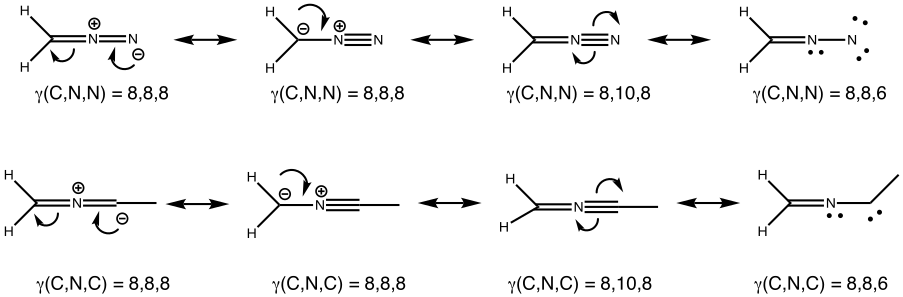
I have expanded the resonance forms of diazomethane by one structure from those shown in the previous two posts (a form by the way not considered in the original article[1]) to include a nitrene. This takes us back to an earlier suggestion on this blog that HC≡S≡CH is not a stable species but a higher order saddle point which distorts down to a bis-carbene, together with the suggestion that hypervalent triple bonds have the option of converting four of the six electrons into two carbene lone pairs, replacing the triple bond with a single bond. This in turn harks back to G. N. Lewis’ 101 year old idea for acetylene itself!
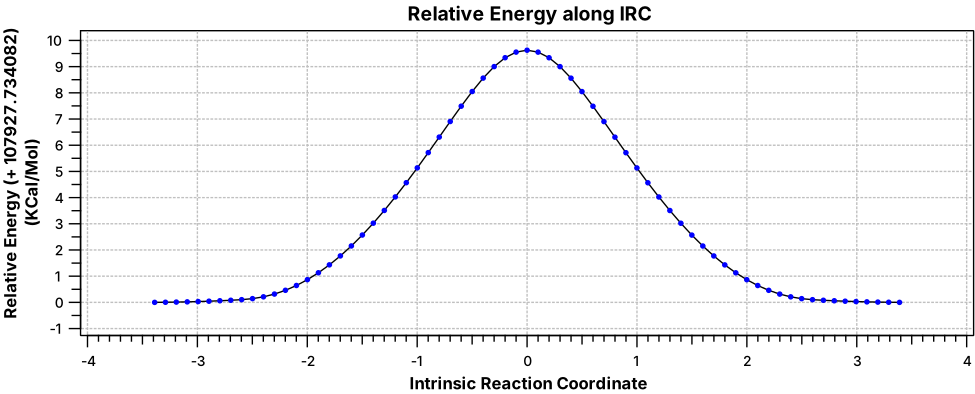
To explore this mode, I start by replacing the terminal ≡N in diazomethane with a ≡C-Me group, which cannot absorb electrons into lone-pairs in the manner that nitrogen can. A ωB97XD/Def2-TZVPP calculation‡ reveals that the linear form is a transition state for interconversion into a carbene. The IRC for the process (below) shows this carbene is ~10 kcal/mol lower than the linear “hypervalent” form.
NBO analysis of this transition state reveals a similar orbital pattern to diazomethane itself, including a non-bonding orbital on the H2C carbon. The Wiberg carbon bond indices are 3.6764 and N 3.6454 and the bond orders C=N 1.1390 and N=CMe 1.6192.

ELF analysis of this transition state reveals the presence of two non-bonding pairs on the carbon atoms either side of the nitrogen but unshared with it, with populations of 1.19e and 1.37e (DFT). That nitrogen really does not like excess electrons! The four atoms C,N,C,C have ELF valence basins totalling 8.00, 6.94, 7.69 and 7.92e (DFT) or 8.07, 7.07 and 7.61e (CASSCF), suggesting that unlike diazomethane itself, the octet-excess induced hypervalence on carbon is slightly decreased.


Pumping even more electrons in by replacing the ≡C-Me group with ≡C-NH2 does not increase any hypervalence, but does induce more electrons to reside in “lone pairs”. Of the four atoms along the chain, three have “lone pairs” associated with them, a total of 4.83e that do not contribute to bonds (valence).

An electron withdrawing ≡C-CN group replacing the ≡C-NH2 reverses the effect of the latter, but this linear species is still a transition state for carbon isomerisation:

Finally, combining all we have learnt by adding in nitro groups on the first carbon. This is no longer a transition state but now a stable species; the sum of the ELF basin integrations around the carbon on the left reaches 8.95e, slightly higher than the dinitro-diazomethane discussed in the previous post. The numerical Wiberg atom bond indices are C 3.8713, N 3.6898, C 3.8503, C 3.9958 and N 3.0288 for the atoms along the chain, with the first nitrogen the “least-valent”.
So we see that “hypervalence”, or at least “octet-excess”, which is not exactly the same as hypervalence since it includes contributions from non-bonding electrons, is balanced on a knife-edge. Trying to increase the octet-excess by pumping electrons in turns the system into a transition state for carbene formation. Octet-excess is seen as a metastable property, to be relieved by geometric distortions where possible or localization of electrons into non-bonding lone pairs. And I remind yet again that no evidence has manifested in calculations of the molecules above that the central nitrogen of these diazomethane-like systems has any propensity for octet or valence-excess as implied by the formula C=N≡X.[1]
‡FAIR data for all calculations is available at DOI: 10.14469/hpc/3476
References
- M.C. Durrant, "A quantitative definition of hypervalency", Chemical Science, vol. 6, pp. 6614-6623, 2015. https://doi.org/10.1039/c5sc02076j
Tags:chemical bonding, Chemistry, diazo, Diazo compounds, Diazomethane, diazomethane-like systems, Functional groups, Hypervalent molecule, Molecular geometry, Organic chemistry, Recollects
Posted in Hypervalency | 8 Comments »
Tuesday, December 26th, 2017
Recollect the suggestion that diazomethane has hypervalent character[1]. When I looked into this, I came to the conclusion that it probably was mildly hypervalent, but on carbon and not nitrogen. Here I try some variations with substituents to see what light if any this casts.

I have expanded the resonance forms of diazomethane by one structure from those shown in the previous two posts (a form by the way not considered in the original article[1]) to include a nitrene. This takes us back to an earlier suggestion on this blog that HC≡S≡CH is not a stable species but a higher order saddle point which distorts down to a bis-carbene, together with the suggestion that hypervalent triple bonds have the option of converting four of the six electrons into two carbene lone pairs, replacing the triple bond with a single bond. This in turn harks back to G. N. Lewis’ 101 year old idea for acetylene itself!
To explore this mode, I start by replacing the terminal ≡N in diazomethane with a ≡C-Me group, which cannot absorb electrons into lone-pairs in the manner that nitrogen can. A ωB97XD/Def2-TZVPP calculation‡ reveals that the linear form is a transition state for interconversion into a carbene. The IRC for the process (below) shows this carbene is ~10 kcal/mol lower than the linear “hypervalent” form.

NBO analysis of this transition state reveals a similar orbital pattern to diazomethane itself, including a non-bonding orbital on the H2C carbon. The Wiberg carbon bond indices are 3.6764 and N 3.6454 and the bond orders C=N 1.1390 and N=CMe 1.6192.

ELF analysis of this transition state reveals the presence of two non-bonding pairs on the carbon atoms either side of the nitrogen but unshared with it, with populations of 1.19e and 1.37e (DFT). That nitrogen really does not like excess electrons! The four atoms C,N,C,C have ELF valence basins totalling 8.00, 6.94, 7.69 and 7.92e (DFT) or 8.07, 7.07 and 7.61e (CASSCF), suggesting that unlike diazomethane itself, the octet-excess induced hypervalence on carbon is slightly decreased.
Pumping even more electrons in by replacing the ≡C-Me group with ≡C-NH2 does not increase any hypervalence, but does induce more electrons to reside in “lone pairs”. Of the four atoms along the chain, three have “lone pairs” associated with them, a total of 4.83e that do not contribute to bonds (valence).
An electron withdrawing ≡C-CN group replacing the ≡C-NH2 reverses the effect of the latter, but this linear species is still a transition state for carbon isomerisation:
Finally, combining all we have learnt by adding in nitro groups on the first carbon. This is no longer a transition state but now a stable species; the sum of the ELF basin integrations around the carbon on the left reaches 8.95e, slightly higher than the dinitro-diazomethane discussed in the previous post. The numerical Wiberg atom bond indices are C 3.8713, N 3.6898, C 3.8503, C 3.9958 and N 3.0288 for the atoms along the chain, with the first nitrogen the “least-valent”.
So we see that “hypervalence”, or at least “octet-excess”, which is not exactly the same as hypervalence since it includes contributions from non-bonding electrons, is balanced on a knife-edge. Trying to increase the octet-excess by pumping electrons in turns the system into a transition state for carbene formation. Octet-excess is seen as a metastable property, to be relieved by geometric distortions where possible or localization of electrons into non-bonding lone pairs. And I remind yet again that no evidence has manifested in calculations of the molecules above that the central nitrogen of these diazomethane-like systems has any propensity for octet or valence-excess as implied by the formula C=N≡X.[1]
‡FAIR data for all calculations is available at DOI: 10.14469/hpc/3476
References
- M.C. Durrant, "A quantitative definition of hypervalency", Chemical Science, vol. 6, pp. 6614-6623, 2015. https://doi.org/10.1039/c5sc02076j
Tags:chemical bonding, Chemistry, diazo, Diazo compounds, Diazomethane, diazomethane-like systems, Functional groups, Hypervalent molecule, Molecular geometry, Organic chemistry, Recollects
Posted in Hypervalency | 8 Comments »
Sunday, December 17th, 2017
Alkalides are anionic alkali compounds containing e.g. sodide (Na–), kalide (K–), rubidide (Rb–) or caeside (Cs–). Around 90 examples can be found in the Cambridge structure database (see DOI: 10.14469/hpc/3453 for the search query and results). So what about the ammonium analogue, ammonide (NH4–)? A quick search of Scifinder drew a blank! So here I take a look at this intriguingly simple little molecule.‡
It can be formed by adding two electrons to the ammonium cation; NH4+ + 2e ↠ NH4–. One might be encouraged to do this since the LUMO (lowest unoccupied molecular orbital, below) of the ammonium cation has A1 symmetry and so can accept two electrons without the penalty of Jahn-Teller distortions. These electrons will apparently expand the valence electron “octet” around the nitrogen from 8 to 10; a hypervalent species then?
So what are the (calculated) properties of NH4–? The energy of the now HOMO (highest occupied molecular orbital) at the ωB97XD/Def2-TZVPPD/solvent=water level is -3.6eV, a respectable electron affinity (the additional electrons are said to be bound). More insight can be obtained from the NBO analysis, which produces localized versions of the molecular orbitals. There are four equivalent NBOs, one of which is shown below.

Each is bonding along one H-N bond, mildly anti-bonding along the other three N-H bonds, but again bonding in the H-H regions! This matches the observations made earlier that when more electrons are pumped into normally valent main group molecules, they will occupy the antibonding levels. This is accompanied by a reduction in the bond orders associated with the central atom. In this case, the N-H bond orders are reduced from 0.79 to 0.602 and the total bond index at the nitrogen is reduced from 3.16 to 2.408. The bond index at hydrogen is at first sight increased from 0.79 to a surprising 1.0003, but this is explained because the H-H bond orders are 0.1328 (three for each H), which brings the H index up to 1.0. The N-H vibration (A1 symmetric) is 3466 cm-1 for NH4+ which is reduced to 2659 for NH4–.†
So it appears that adding two electrons to the ammonium cation induces H-H bonding! More insight can be obtained from an ELF analysis of the electron density basins.

The above shows four attractors (as they are called) centered at the hydrogen nuclei, with 2.053e each (4*2.053 = 8.212e). The remaining ~2e are located in basins (green) centered at two different types of attractors. One is along the axis of each N-H bond and exo to it (0.316e) and the other sits on top of any set of three hydrogens (0.103e), 1.68e in total. The value of the ELF function at the attractor is shown above. You should realize that ELF=1.0 corresponds to perfectly localized electrons (for which the kinetic energy density is zero) and ELF=0.5 would correspond to a free-electron gas. The ELF value of e.g. 0.77 is getting close to an electron gas, and in fact corresponds to what we call an electride.

So, the nitrogen valence shell electron octet is not actually exceeded! The additional two electrons in ammonide sit beyond the nitrogen, in H-H regions. Whether or not it is a viable species for detection remains to be established, but even its computed bonding properties have proved interesting and it deserves to join the alkalide family.
Postscript
Ammonide exists in a shallow well in the potential energy surface, shown below, with the dissociation to ammonia and hydride anion being exothermic.
The intrinsic reaction coordinate shows one interesting feature at IRC ~-1.1 which corresponds to repulsion between the hydride and the lone pair of the nitrogen atom resulting in inversion of configuration during the latter stages of the IRC.


‡FAIR data collection; 10.14469/hpc/3455. †Perhaps unsurprisingly, these values are somewhat basis set dependent. Thus a ωB97XD/Def2-QZVPPD/Water calculation gives the following values: bond index at N, 1.998, N-H bond index, 0.4995, H-H bond index 0.1689, H bond index 1.0062, total Rydberg population, 0.2738, ν(A1) 2686 cm-1. The ELF basins are H, 2.039, exo-basins 0.282 and 0.141 (total 1.692). The improved basis set better describes the diffuse regions beyond the N-H bonds.
Tags:Alkalide, Ammonium, Anions, Atomic physics, Chemistry, electron gas, energy, free-electron gas, Jahn-Teller, kinetic energy density, Matter, Nitrogen, potential energy surface, search query
Posted in Hypervalency | 2 Comments »
Monday, November 27th, 2017
Previously: “Non-polar” species such as SeMe6, SMe6, ClMe3, ClMe5 all revealed interesting properties for the Se-C, S-C or Cl-C “single” bonds. The latter two examples in particular hinted at internal structures for these single bonds, as manifested by two ELF basins for some of the bonds. Here I take a look at the related molecule where a formal double bond between carbon and the central sulfur atom replacing the single-bond might also hint at octet expansions and hypervalence.

Starting with X=Y=Z=CH2,‡ the calculated (ωB97Xd/Def2-TZVPP) geometry has an interesting chiral D3-symmetric form. The density based ELF-basin centroids are shown below, with each formal C=S π-double bond represented by two ELF basins above and below the C-S axis and with each pair of ELF basins being twisted by 48° with respect to the other two pairs. The total valence shell count around the S is 10.98e and the octet is “expanded” (by ~3e).

The orbital-based NBO approach indicates little utilisation of higher (Rydberg) atomic orbital shells (S: [core]3S(1.13)3p(3.35)3d(0.11)4p(0.02); C: [core]2S(1.15)2p(3.77)3p(0.01)3d(0.01) ). Each S-C bond has a Wiberg bond order of 1.36 (significantly less than a double bond), and the central S has an overall bond index of 4.102. There is a real mis-match between the orbital partitioning (2*1.36 = 2.72e) and the ELF partitioning (2*1.83 = 3.66e) into the S-C bonds. The former indicates that ~two of the twelve valence electrons are entering into anti-bonding orbitals to reduce the total bond index from a possible six to just four, but that they still contribute to the electron-density based ELF disynaptic C-S basins. To cast light on this behaviour, successively one to three of the CH2 groups can be replaced by O.

For each “S=O” bond, we find the ELF basin population more or less halves and electrons instead populate the non-bonding O “lone pairs”. The S-C ELF populations in contrast remain approximately constant. These species therefore have “double” S=C bonds but just “single” S-O bonds. The Rydberg population increases slightly; S: [core]3S(1.06)3p(2.95)3d(0.16)4p(0.02)) and the S bond index is 4.18 for one oxygen and S: [core]3S(0.99)3p(2.67)3d(0.19)4p(0.02) and S bond index 4.16 for two oxygens.

Sulfur trioxide (below) seems best represented by S-O rather than S=O bonds. The Rydberg population is S: [core]3S(0.91)3p(2.41)3d(0.21)4p(0.03) and the S bond index is 4.32.

Just for good measure sulfur trisulfide S(S)3 shows rather lower lone pair population because of course it is less electronegative than oxygen, and hence has a slightly greater S-S ELF basin population. Rydberg, S: [core]3S(1.43)3p(3.73)3d(0.21)4p(0.03) and central S bond index 4.04.

It seems molecules where the electrons in a valence shell exceed the “octet” are only too happy to let the excess electrons leak out into adjacent electronegative atoms as lone pairs, where they are no longer classified as “shared”. Trimethylene-λ6-sulfane does not have this option and the excess electrons remain in the region of the valence shell, but here they do not contribute to augmenting the bond index at the central atom. In this specific interpretation, the octet is exceeded, but hypervalence is not induced. It is a slippery concept; one where general agreement about its properties may indeed be difficult to achieve!
‡The FAIR data DOI collection for this post is 10.14469/hpc/3316.
Tags:Chemical bond, chemical bonding, Chemical polarity, Chemistry, double bond, Hypervalent molecule, Nature, single bond, Tetravalence, Valence
Posted in Hypervalency | No Comments »
Monday, November 20th, 2017
Following on from discussing octet expansion in species such as SeMe6, ClMe3 and ClMe5, I felt impelled to return to SF6, often used as an icon for hypervalence.
With this molecule we have twelve electrons to partition, six from sulfur and one each from six fluorines (the other six electrons on each F are presumed to form three sets of lone pairs). Recollect the two ways of dealing with them:
- To place them in pairs firstly into bonding MOs formed from using a 3s/3p valence atomic orbital basis on the S and a 2s/2p AO basis on F and to place any remaining electron pairs into antibonding orbitals constructed from the same basis. This would tend to reduce individual S-F bond orders.
- To place four pairs into bonding MOs and the remaining two pairs into MOs constructed using higher or Rydberg valence shells on S. This would tend to increase S-F bond orders by forming hyperbonds.
I will start with (delocalized) molecular orbitals (FAIR data DOI: 10.14469/hpc/3283). The HOMO (highest occupied MO) and the next 16 are in fact various variations of orbitals which can be regarded as fluorine lone pairs. The first of interest to us is the A1g-symmetric HOMO-17, which certainly looks as if it is antibonding along the six F-S bonds. But the heavy delocalization of the MOs makes it really difficult to comment on bonding/antibonding character.

So next, the more localized NBO orbitals (FAIR Data DOI: 10.14469/hpc/3284), which tends to “collect” the wavefunction into localized regions of bonds and lone pairs. There are twelve equivalent F lone pairs of the following type:
Next the remaining six F lone pairs, which are oriented axially along the S-F bonds. They have distinct S-F anti-bonding character.
Finally six S-F bonding pairs (“acorn” orbitals). But note that whilst they are bonding along one S-F bond, they are mildly antibonding along the opposing S-F bond. 
The Rydberg occupancy is S:[core]3S(0.98)3p(2.13)3d(0.24)4p(0.03)4f(0.01) and F: [core]2S(1.91)2p(5.51)3d(0.01), which gives a total Rydberg occupancy of 0.35177e. Adding up these effects, the NBO analysis tells us that the individual S-F bond orders are 0.7213. Six times this gives the Wiberg bond index at sulfur: 4.3276. This is close to the value of 4 expected from utilising an atomic orbital basis of one 2s and three 2p AOs on sulfur. One can think of this in another way.
- Start with a valence shell of twelve electrons to form six two-electron S-F bonds. The sulfur would have a bond index of six. Then promote either two electrons into fully antibonding orbitals (5-1=4) or four into non-bonding orbitals (F lone pairs) or possibly intermediate solutions, thus reducing the sulfur bond index by ~two bonds to give a bond index of four. Since the antibonding orbitals in this case are not fully antibonding, the bond index emerges a bit higher at 4.3276, a value also augmented by 0.35177/2 = 0.175885 due to Rydberg occupancy.
- One might usefully then ask if a bond index for sulfur of ≥ 4 can be usefully described as “hypervalent sulfur“? As usual in bonding theory, we need a reference state for non-hypervalent sulfur. If this is taken as two valencies, with a bond index of two, then this molecule is definitely hypervalent. If you assume that you can only construct the equivalent of four two-electron bonds using just a 3s1/3p3 atomic orbital basis, then it is merely mildly hypervalent; the four two-electron bonds are then distributed of course across six S-F regions, or 0.667 bonds per S-F region. The value of 0.7213 actually calculated is exalted by contributions in part from Rydberg orbitals.
What about the octet? 6*0.7213*2 = 8.66e, a mildly expanded octet. I am now going to use the ELF method as an alternative counting procedure. This is based not on orbitals but on the electron density (a more direct experimental observable than orbitals). Six disynaptic basins are located totalling 6.5e. The remainder of the electrons populate the F lone pairs shown below as four distinct monosynaptic basins per F. This is an artefact of the resolution of the cube of ELF values and how the basin centroids are located. These are in fact circular and not point ELF attractors, forming a circular ELF torus around each fluorine.

So, ELF suggests that the sulfur “octet” is not exceeded and in this form of analysis the compound is merely hypercoordinate. In contrast the orbital-based approach indicates mild hypervalency in which the total bond index at S modestly exceeds 4. If you regard the normal valency of sulfur to be two, this is clearly hypervalent. But no substantial octet-expansion beyond the modest Rydberg type is needed to rationalise this species and certainly not up to twelve!
Tags:chemical bonding, Chemistry, Hypervalent molecules, Octet, Sulfur hexafluoride
Posted in Hypervalency | 7 Comments »
Sunday, November 12th, 2017
A few years back, I took a look at the valence-shell electron pair repulsion approach to the geometry of chlorine trifluoride, ClF3 using so-called ELF basins to locate centroids for both the covalent F-Cl bond electrons and the chlorine lone-pair electrons. Whereas the original VSEPR theory talks about five “electron pairs” totalling an octet-busting ten electrons surrounding chlorine, the electron density-based ELF approach located only ~6.8e surrounding the central chlorine and no “octet-busting”. The remaining electrons occupied fluorine lone pairs rather than the shared Cl-F regions. Here I take a look at ClMe3, as induced by the analysis of SeMe6.
The difference between ClF3 and ClMe3 is that octet-excess electrons (two in this case) in the former can relocate into fluorine lone pairs by occupying in effect anti-bonding orbitals and hence end up not contributing to the central atom valence shell.‡ With ClMe3 the methyl groups cannot apparently sustain such lone pairs, at least not distinct from the Cl-C bond region. So might we get an octet-busting example with this molecule? A ClMe3 calculation (ωb97xd/6-311++g(d,p)) reveals a molecule with all real vibrational modes (i.e. a minimum, FAIR data DOI: 10.14469/hpc/3241) and ELF (FAIR data DOI 10.14469/hpc/3242)† basins as shown below:

Density-derived approach: Two of the C-Cl bonds each exhibit two ELF basins; one disynaptic basin (0.94e) and one monosynaptic basin (0.20e) closer to the chlorine. The former pair integrate to 1.88e, density which largely arises from carbon (natural charge -0.84) and which contribute to a total integration for these carbons of 7.17e. The latter pair contributes to a total chlorine integration of 7.19e. The angle subtended at chlorine for the two 2.68e “lone pair” basins is 141°. Thus an inner, octet-compliant, valence-shell for chlorine is revealed, plus an expanded-octet outer one into which the two additional electrons go. The latter contribute to forming an octet-compliant carbon valence shell, but may be considered as not contributing to the valence shell of the other atom of the pair, the chlorine. An endo lone-pair rather than the more usual exo lone-pair if you will. These results reveal that the molecular feature we know as a (single) “bond” may in fact have more complex inner structures or zones, something we do not normally consider bonds as having. In this model, these zones are not invariably considered as shared between both the atoms comprising the bond.
Orbital-derived approach: NBO analysis (FAIR data DOI: 10.14469/hpc/3241) reveals the chlorine electronic configuration as [core]3S(1.83)3p(4.67)4S(0.01)3d(0.03)5p(0.02,) showing very little population of the Rydberg shells (4s, 3d, 5p) occurs (0.13e in total). This method of partitioning the electrons allocates a chlorine Wiberg bond index of 2.00 and the methyl carbon bond index of 3.83. If the regular valence of Cl is taken as 1, then the central chlorine can be regarded as non-Rydberg hypervalent (the electrons in the 0.94e basins are taken as contributing to the chlorine bond index).
The carbon-halogen bond internal structures simplify for Br (DOI: 10.14469/hpc/3248, 10.14469/hpc/3250) and I (DOI: 10.14469/hpc/3249, 10.14469/hpc/3247); for each only a single ELF basin is located and the NBO Br and I bond indices are respectively 2.10 and 2.1. This is not due to incursion of Rydberg hypervalence (Br: [core]4S(1.83)4p(4.46)5S(0.02)4d(0.03)6p( 0.01); I: [core]5S(1.82)5p(4.29)6S(0.02)5d(0.02)6p(0.01) ) but of a merging of the carbon and halogen valence basin such that the ELF contributions to each cannot be deconvoluted. In each case the NBO bond indices of ~2 suggest hypervalency for the halogen.


What have we learnt? That the shared electron (covalent) bond can have complex internal features, such as two discrete basins for the apparently shared electrons. How one partitions these electrons can influence the value one obtains for the total shared electron count and hence whether the octet is retained or expanded for main group elements such as the halogens. And finally, that hypervalence and hyper-coordination are related in the orbital model at least. Thus along the series MenI (n= coordination number 1,3,5,7), the values of the Wiberg bond index at the halogen progress as 1.0, 2.1, 3.1 (DOI: 10.14469/hpc/3236) and 4.01 (DOI: 10.14469/hpc/3238), or one extra atom bond index per electron pair. Given this, it seems useful to retain the distinction between the terms hypervalence and hyper-coordination, but also recognize that we still may have much to learn about the former.
‡See the previous post on SeMe6 for a more detailed discussion.
† The FAIR Data accompanying this blog post is organised in a new way here. All the calculations are collected together with an over-arching DOI: 10.14469/hpc/3252 associated with this post, with individual entries accessible directly using the DOIs given above. The post itself has a DOI: 10.14469/hpc/3255 and the two identifiers are associated with each-other via their respective metadata. A set of standards (https://jats.nlm.nih.gov) with implementation guidelines for e.g. repositories, authors and publishers-editors are expected in the future to establish infra-structures for cross-linking narratives/stories with the data on which they are based.
Tags:Chemical bond, chemical bonding, Chemistry, Chlorine, Covalent bond, Lone pair, Oxidizing agents, Quantum chemistry, Stereochemistry, Valence, VSEPR theory
Posted in Chemical IT, Hypervalency | 5 Comments »
Tuesday, October 24th, 2017
An N-B single bond is iso-electronic to a C-C single bond, as per below. So here is a simple question: what form does the distribution of the lengths of these two bonds take, as obtained from crystal structures?
 The Conquest search query is very simple (no disorder, no errors).
When applied to the Cambridge structure database (CSD) the following two distributions are obtained. That for carbon is pretty symmetric with the peak at ~1.53Å but with rather faster decay in the region >1.6Å compared with the region <1.46Å (the latter may be caused by hyperconjugation shortening the C-C bond).

In contrast, the iso-electronic N-B distribution is more asymmetric about the peak of 1.56Å, exhibiting a long tail beyond 1.63Å, up to a value of 1.825Å.

The molecule with that longest N-B bond (1.825Å) is shown below; UWOHUK, Data DOI: 10.5517/ccwcwlp. This by the way is no crystal artefact; a calculation (ωB97XD/6-311G(d,p), Data DOI: 10.14469/hpc/3202) gives a calculated length of 1.81Å, with a N-B bond order of 0.48.
Stretching a C-C bond heterolytically requires charge separation (a relatively unfavourable process) and likewise homolytic stretching would tend to form a biradical, in effect an excited state and again not favourable. In contrast, elongating the N-B bond reduces (at least formally) any charge separation and allows this heteronuclear pair to sustain (single) bond lengths over the much wider range of ~0.4Å without requiring biradical formation.
One might wonder what other single-bonded atoms pairs give such unusually large spans in their bond length distributions.
Tags:bond, Bond valence method, Chemical bond, chemical bonding, Chemistry, Covalent bond, crystal structure, Nature, Quantum chemistry, search query
Posted in crystal_structure_mining | 3 Comments »
Thursday, September 21st, 2017
A recent article reports, amongst other topics, a computationally modelled reaction involving the capture of molecular hydrogen using a substituted borane (X=N, Y=C).[1] The mechanism involves an initial equilibrium between React and Int1, followed by capture of the hydrogen by Int1 to form a 5-coordinate borane intermediate (Int2 below, as per Figure 11).‡ This was followed by assistance from a proximate basic nitrogen to complete the hydrogen capture via a TS involving H-H cleavage. The forward free energy barrier to capture was ~11 kcal/mol and ~4 kcal/mol in the reverse direction (relative to the species labelled Int1), both suitably low for reversible hydrogen capture. Here I explore a simple variation to this fascinating reaction.∞

This variation involves transposing X and Y such that Y=N+ and X=C– to form a carbon ylide such that X=C becomes much more nucleophilic than the original nitrogen nucleophile. An animation of the full IRC† (intrinsic reaction coordinate computed at ωB97XD/cc-pvtz; FAIR data doi: 10.14469/hpc/2704) is shown below.

The profile shows that the reaction is concerted between the species labelled React and Prod; no sign of Int1 and Int2!
- The region IRC -12 to -5 involves B-C bond cleavage. Because the C is so very nucleophilic, the 4-ring species labelled React becomes very stable and opening it requires a high barrier.
- Between IRC -5 and 0, the BH2 group rotates, losing its original interaction with the C to slowly create an empty acceptor orbital on the boron which can then interact with the incoming hydrogen.
- At IRC= 0 (the transition state) the hydrogen has been captured by the boron to form a 5-coordinate species, in a manoeuvre that reminds one of the orbital capture of satellites by planets on their way to the outer reaches of the solar system. If the barrier to this capture is computed from IRC= -4 (the region of Int2) it is very much lower than the original system[1], again a reflection of the higher nucleophilicity of X=C–.
- The fly past continues until IRC= +7, at which point one end of the bound hydrogen has become suitably orientated to interact with the nucleophilic carbon via lone-pair donation into the acceptor H-H σ* orbital, thus helping to break it.
- By IRC= +9, the H-H cleavage is complete.
- By IRC= +13 the reaction has reached Prod, being overall ~ -12 kcal/mol exothermic.
- The overall thermochemistry is dominated by the potent carbon nucleophile in the reactant, which in turn makes this modification entirely useless for the purposes of a hydrogen-capture system!


The evolution of the dipole moment along the IRC shows very non-linear behaviour (such plots are rarely shown in most published IRC analyses; they should be!), ending of course with the ionic zwitterion that is the imminium borohydride Prod. Indeed the entire reaction coordinate is an unusually vivid example of a non-least motion path!

This simple atom transposition has given us a very instructive exercise in reaction paths, by-passing entirely both Int1 and Int2 (making them hidden intermediates), and converting React → Prod into a concerted reaction. It would be great to probe this convoluted journey using reaction dynamics!
∞Archived as DOI: 10.14469/hpc/3096
‡ Such a species can be seen as a hidden intermediate in the mechanism of reduction of a carboxylic acid by diborane.
†None were shown in the original study.[1]
References
- L. Li, M. Lei, Y. Xie, H.F. Schaefer, B. Chen, and R. Hoffmann, "Stabilizing a different cyclooctatetraene stereoisomer", Proceedings of the National Academy of Sciences, vol. 114, pp. 9803-9808, 2017. https://doi.org/10.1073/pnas.1709586114
Tags:Ammonia borane, animation, Boranes, Chemistry, Cleaning Services, Company: React Group, free energy barrier, Hydroboration, Hydrogen, Matter
Posted in reaction mechanism | 1 Comment »
Saturday, September 16th, 2017
Early in 2011, I wrote about how the diatomic molecule Be2 might be persuaded to improve upon its normal unbound state (bond order ~zero) by a double electronic excitation to a strongly bound species. I yesterday updated this post with further suggestions and one of these inspired this follow-up.
The standard molecular orbital diagram for Be2 below shows two electrons in both the 2s Σg and Σu levels, the first being considered bonding and the second antibonding. By exciting the two electrons from the Σu into the Πu MO to form a triplet, one converts one antibonding occupancy into two bonding occupancies, in the process changing the total formal bond order from zero to two.

The triplet excited state of diberyllium
You can see the results of my playing with these ideas both in my appended comments to the original post and the table below. This shows that the calculated bond order for the excited triplet state of Be2 is actually closer to 1.50 rather than to two, but definitely not zero!
The games above represent isoelectronic substitutions and here I try one more, namely that Li22- is isoelectronic with Be2. Unlike the latter, there is no need to force an electronic excitation (ωB97XD/Def2-QZVPPD/SCRF=water) to achieve the required occupancies with Li22-.
| System |
Wiberg bond order |
Bond length |
FAIR Data |
| Li22- triplet |
1.501 |
2.381 |
10.14469/hpc/3087 |
I also checked what crystal structures could tell us about Li-Li bonds and it seems 2.38Å is about as short as they get. 
At this point, the NBO analysis of the Li22- localised orbitals alerted me to another feature, which is that the Rydberg occupancy amounted to 2.18e. This in turn reminded me of the previous post which dealt with such occupancy in another small molecule, CH3F2-, but here the Rydberg occupancy involved the 3s/3p AOs of the carbon and the fluorine. With Li22- triplet, it is of the lithium 2p AO (2.18e) and only a tiny occupancy of 3d (0.03). By definition, for alkali metals such as Li the normal valence shell is just 2s, whereas 2p occupancy is considered a Rydberg state; a hypervalent state if you will. So Li22- triplet has a Li-Li hyper-bond!‡ Of course, by this definition most Li compounds are then hypervalent, since many have populated 2p shells.
Even if use of the term hyper-bond to describe Li22- triplet is rather artificial, this example does reveal the games one can play with the first row elements Li-B (see table above). Given that most introductory text books on bonding normally only explain the diatomics formed from N-Ne (occasionally including C), I might suggest that these earlier elements are equally instructive and fun to play with.
‡ This species is 36.0 kcal/mol higher in free energy than two separated Li– anions.
Tags:Be-Be double bond, Be-Be triple bond, Chemical bond, Chemistry, Cs-Cs double bond, Diatomic molecule, free energy, General chemistry, K-K double bond, Li-Li double bond, Molecular geometry, Oxygen, Province/State: Be2, Quantum chemistry, Rb-Rb double bond, Stereochemistry
Posted in Interesting chemistry | 3 Comments »
Saturday, September 16th, 2017
Early in 2011, I wrote about how the diatomic molecule Be2 might be persuaded to improve upon its normal unbound state (bond order ~zero) by a double electronic excitation to a strongly bound species. I yesterday updated this post with further suggestions and one of these inspired this follow-up.
The standard molecular orbital diagram for Be2 below shows two electrons in both the 2s Σg and Σu levels, the first being considered bonding and the second antibonding. By exciting the two electrons from the Σu into the Πu MO to form a triplet, one converts one antibonding occupancy into two bonding occupancies, in the process changing the total formal bond order from zero to two.
The triplet excited state of diberyllium
You can see the results of my playing with these ideas both in my appended comments to the original post and the table below. This shows that the calculated bond order for the excited triplet state of Be2 is actually closer to 1.50 rather than to two, but definitely not zero!
The games above represent isoelectronic substitutions and here I try one more, namely that Li22- is isoelectronic with Be2. Unlike the latter, there is no need to force an electronic excitation (ωB97XD/Def2-QZVPPD/SCRF=water) to achieve the required occupancies with Li22-.
| System |
Wiberg bond order |
Bond length |
FAIR Data |
| Li22- triplet |
1.501 |
2.381 |
10.14469/hpc/3087 |
I also checked what crystal structures could tell us about Li-Li bonds and it seems 2.38Å is about as short as they get. 
At this point, the NBO analysis of the Li22- localised orbitals alerted me to another feature, which is that the Rydberg occupancy amounted to 2.18e. This in turn reminded me of the previous post which dealt with such occupancy in another small molecule, CH3F2-, but here the Rydberg occupancy involved the 3s/3p AOs of the carbon and the fluorine. With Li22- triplet, it is of the lithium 2p AO (2.18e) and only a tiny occupancy of 3d (0.03). By definition, for alkali metals such as Li the normal valence shell is just 2s, whereas 2p occupancy is considered a Rydberg state; a hypervalent state if you will. So Li22- triplet has a Li-Li hyper-bond!‡ Of course, by this definition most Li compounds are then hypervalent, since many have populated 2p shells.
Even if use of the term hyper-bond to describe Li22- triplet is rather artificial, this example does reveal the games one can play with the first row elements Li-B (see table above). Given that most introductory text books on bonding normally only explain the diatomics formed from N-Ne (occasionally including C), I might suggest that these earlier elements are equally instructive and fun to play with.
‡ This species is 36.0 kcal/mol higher in free energy than two separated Li– anions.
Tags:Be-Be double bond, Be-Be triple bond, Chemical bond, Chemistry, Cs-Cs double bond, Diatomic molecule, free energy, General chemistry, K-K double bond, Li-Li double bond, Molecular geometry, Oxygen, Province/State: Be2, Quantum chemistry, Rb-Rb double bond, Stereochemistry
Posted in Interesting chemistry | 3 Comments »
