Posts Tagged ‘Chemistry’
Saturday, December 31st, 2016
My holiday reading has been Derek Lowe’s excellent Chemistry Book setting out 250 milestones in chemistry, organised by year. An entry for 1920 entitled hydrogen bonding seemed worth exploring in more detail here.
As with many historical concepts, it can often take a few years to coalesce into something we would readily recognise today, and hydrogen bonds are no exception. Wikipedia is another source of the history and it cites a 1912 article as the origin of the term in relation to the solvation of amines[1] but also notes that the better known setting of water occurs later in 1920.[2] Here I try to capture the essence of the concept with a few diagrams taken from these two articles.
Firstly “The state of amines in aqueous solution“[1] which is mostly concerned with the measurement of ionization constants of primary, secondary and tertiary amines. It boils down to the below:


and the connection to ionization is laid out as:


Since in 1912, Lewis’ electron pair theory of the covalent bond had not yet emerged, the authors use the terms “strong union” and “weak union”, and of course it is the “weak union” that we now know of as the hydrogen bond. Some other comments about this seminal diagram:
- The article contains the very explicit and modern term stereochemical, which is used in a manner that suggests it was already common.‡ But there is only a hint at most that the nitrogen atoms might be tetrahedral, or that the “weak union” between (what we now think of as the lone pair on) the nitrogen and the hydrogen of the water is directional.
- The second weak union between the tetramethyl ammonium (which we now describe as a cation) and the hydroxide (now described as an anion; both terms are however implied by the description strong electrolyte) is probably not what we would now call a hydrogen bond, more an intimate ion-pair.
The second article in 1920 on water itself[2] is post-Lewis, but perhaps applied in a manner which we would not entirely agree with nowadays. Thus dinitrogen, N≡N is shown as below with just a single connecting bond.

Then we get the interaction between ammonia and water,† analogous to the example shown above:

and for water itself:♠

which in each case shows the central hydrogen having what we now call a valence shell of four electrons,♣ and hence more equivalent to the “strong unions” above. This shows that in 1920 chemists were rapidly adopting Lewis’ representations, but not always entirely successfully.
On balance, I think the 1912 article sets out the modern concept of a hydrogen bond representing a weak union to a hydrogen rather better than the Latimer and Rodebush attempt (at least diagrammatically).
‡Stereochemical notation is discussed in this post, and it dates from the 1930s.
†The modern take is explored here, in which the equilibrium set up between a “weak union” between ammonia and water (the weak electrolyte) and an isomeric “strong union” which represents ionization into an ammonium hydroxide ion-pair (the strong electrolyte) is favoured for the former by ΔG ~6 kcal/mol.
♠The equilibrium between a “weak union” of two water molecules and the fully ionized strong union of hydronium hydroxide favours the former by ΔG ~23 kcal/mol.
♣ This 1920 representation does imply symmetry for the hydrogen, being ~equally disposed between the two oxygens. We now know that such symmetric hydrogen bonding is not unusual (see this post for how to fine-tune a hydrogen bond into this situation) but rather than requiring four electrons as implied in the diagram above, it is now better described as a three-centre-two-electron bond instead.
References
- T.S. Moore, and T.F. Winmill, "CLXXVII.—The state of amines in aqueous solution", J. Chem. Soc., Trans., vol. 101, pp. 1635-1676, 1912. https://doi.org/10.1039/ct9120101635
- W.M. Latimer, and W.H. Rodebush, "POLARITY AND IONIZATION FROM THE STANDPOINT OF THE LEWIS THEORY OF VALENCE.", Journal of the American Chemical Society, vol. 42, pp. 1419-1433, 1920. https://doi.org/10.1021/ja01452a015
Tags:10.1021, aqueous solution, Chemical bond, chemical bonding, Chemistry, Derek Lowe, Hydrogen, Hydrogen bond, Intermolecular forces, Lowe's, Nature, Supramolecular chemistry
Posted in Historical | 2 Comments »
Saturday, December 31st, 2016
My holiday reading has been Derek Lowe’s excellent Chemistry Book setting out 250 milestones in chemistry, organised by year. An entry for 1920 entitled hydrogen bonding seemed worth exploring in more detail here.
As with many historical concepts, it can often take a few years to coalesce into something we would readily recognise today, and hydrogen bonds are no exception. Wikipedia is another source of the history and it cites a 1912 article as the origin of the term in relation to the solvation of amines[1] but also notes that the better known setting of water occurs later in 1920.[2] Here I try to capture the essence of the concept with a few diagrams taken from these two articles.
Firstly “The state of amines in aqueous solution“[1] which is mostly concerned with the measurement of ionization constants of primary, secondary and tertiary amines. It boils down to the below:


and the connection to ionization is laid out as:


Since in 1912, Lewis’ electron pair theory of the covalent bond had not yet emerged, the authors use the terms “strong union” and “weak union”, and of course it is the “weak union” that we now know of as the hydrogen bond. Some other comments about this seminal diagram:
- The article contains the very explicit and modern term stereochemical, which is used in a manner that suggests it was already common.‡ But there is only a hint at most that the nitrogen atoms might be tetrahedral, or that the “weak union” between (what we now think of as the lone pair on) the nitrogen and the hydrogen of the water is directional.
- The second weak union between the tetramethyl ammonium (which we now describe as a cation) and the hydroxide (now described as an anion; both terms are however implied by the description strong electrolyte) is probably not what we would now call a hydrogen bond, more an intimate ion-pair.
The second article in 1920 on water itself[2] is post-Lewis, but perhaps applied in a manner which we would not entirely agree with nowadays. Thus dinitrogen, N≡N is shown as below with just a single connecting bond.

Then we get the interaction between ammonia and water,† analogous to the example shown above:

and for water itself:♠

which in each case shows the central hydrogen having what we now call a valence shell of four electrons,♣ and hence more equivalent to the “strong unions” above. This shows that in 1920 chemists were rapidly adopting Lewis’ representations, but not always entirely successfully.
On balance, I think the 1912 article sets out the modern concept of a hydrogen bond representing a weak union to a hydrogen rather better than the Latimer and Rodebush attempt (at least diagrammatically).
‡Stereochemical notation is discussed in this post, and it dates from the 1930s.
†The modern take is explored here, in which the equilibrium set up between a “weak union” between ammonia and water (the weak electrolyte) and an isomeric “strong union” which represents ionization into an ammonium hydroxide ion-pair (the strong electrolyte) is favoured for the former by ΔG ~6 kcal/mol.
♠The equilibrium between a “weak union” of two water molecules and the fully ionized strong union of hydronium hydroxide favours the former by ΔG ~23 kcal/mol.
♣ This 1920 representation does imply symmetry for the hydrogen, being ~equally disposed between the two oxygens. We now know that such symmetric hydrogen bonding is not unusual (see this post for how to fine-tune a hydrogen bond into this situation) but rather than requiring four electrons as implied in the diagram above, it is now better described as a three-centre-two-electron bond instead.
References
- T.S. Moore, and T.F. Winmill, "CLXXVII.—The state of amines in aqueous solution", J. Chem. Soc., Trans., vol. 101, pp. 1635-1676, 1912. https://doi.org/10.1039/ct9120101635
- W.M. Latimer, and W.H. Rodebush, "POLARITY AND IONIZATION FROM THE STANDPOINT OF THE LEWIS THEORY OF VALENCE.", Journal of the American Chemical Society, vol. 42, pp. 1419-1433, 1920. https://doi.org/10.1021/ja01452a015
Tags:10.1021, aqueous solution, Chemical bond, chemical bonding, Chemistry, Derek Lowe, Hydrogen, Hydrogen bond, Intermolecular forces, Lowe's, Nature, Supramolecular chemistry
Posted in Historical | 2 Comments »
Saturday, December 24th, 2016
The previous posts produced discussion about the dipole moments of highly polar molecules. Here to produce some reference points for further discussion I look at the dipole moment of glycine, the classic zwitterion (an internal ion-pair).
Dielectric relaxation studies of glycine–water mixtures yield values that range from 15.7D[1] to 11.9D[2] although these have to be derived using various approximations and assumptions for up to 4 independent Debye processes. Before proceeding to calculations, I looked at the properties of ionized amino acids in the solid state, using the following search query for the Cambridge structure database (CSD).

The distance measures hydrogen bonds to the carboxylate oxygens and the torsion their orientation. The O…H hydrogen bond distances vary between 1.7-1.85Å, which are short. The orientation of the hydrogen bond can be to the in-plane oxygen “σ-lone pair” (torsion 0 or 180°) and also an out-of-plane ~π form (torsion ~60-90°).

In aqueous solution, it is normally assumed that glycine sustains five such strong H-bonds (three to the H3N+ group and two[3] to the carboxylate anion), forming a polarised “salt bridge” across the ion-pair. Two model types were subjected to calculation using ωB97XD/Def2-TZVPP/SCRF=water. Aqueous glycine without any added explicit water molecules yields a dipole moment of 12.9D (DOI: 10.14469/hpc/2000), which is within the range noted above.‡

The solvated form is shown below, in one specific conformation of the three studied (ωB97XD/Def2-TZVPP/SCRF=water). The calculated O…H hydrogen bond lengths fall into the range revealed from crystal structures. The calculated dipole moments range from 12.6 (DOI: 10.14469/hpc/2007), 15.3 (DOI: 10.14469/hpc/2006) and 14.9D (DOI: 10.14469/hpc/2005), which is a modest increase over the model with no explicit water molecules. The actual dipole is of course a Boltzmann average over these and other as yet unexplored conformations, as well as other values for the number of water molecules.

Given the difficulties in interpreting the dipole moment of a complex Debye system such as hydrated glycine, the agreement between the limited range of solvated models and the measured values seems reasonable, and provides at least some measure of “calibration” for the polar molecules commented on previously.
‡Optimized with the solvent field on. If a vacuum model is used, the proton transfers from the N to the O.
References
- M.W. Aaron, and E.H. Grant, "Dielectric relaxation of glycine in water", Transactions of the Faraday Society, vol. 59, pp. 85, 1963. https://doi.org/10.1039/tf9635900085
- T. Sato, R. Buchner, Å. Fernandez, A. Chiba, and W. Kunz, "Dielectric relaxation spectroscopy of aqueous amino acid solutions: dynamics and interactions in aqueous glycine", Journal of Molecular Liquids, vol. 117, pp. 93-98, 2005. https://doi.org/10.1016/j.molliq.2004.08.001
- T. Shikata, "Dielectric Relaxation Behavior of Glycine Betaine in Aqueous Solution", The Journal of Physical Chemistry A, vol. 106, pp. 7664-7670, 2002. https://doi.org/10.1021/jp020957j
Tags:aqueous solution, Chemical polarity, Chemistry, dielectric, Dipole, Electric dipole moment, Electromagnetism, Magnetism, Moment, Nature, Physical quantities, Physics, Potential theory, zwitterion
Posted in crystal_structure_mining, Interesting chemistry | 1 Comment »
Wednesday, December 21st, 2016
A project fork is defined (in computing) as creating a distinct and separate strand from an existing (coding) project. Here I apply the principle to the polar azulene 4 explored in an earlier post, taking m-benzyne as a lower homologue of azulene as my starting point.
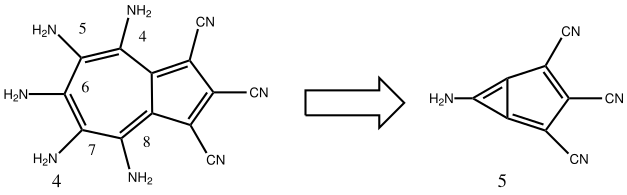
m-Benzyne is a less stable 1,3 isomer of o-benzyne (1,2-dehydrobenzene), and is often represented as a 1,3-biradical of 1,3-dehydrobenzene. But, could it be stabilized with cyano and amino groups as shown in 5 above? Here the idea is that charge transfer from the 3-ring to the 5-ring will create a lower homologue of azulene (a well known molecule), with the 3-ring a 4n+2 π-electron aromatic (n=0) and the five ring similarly so (n=1).
I start with the computed (wB97XD/Def2-TZVPP/SCRF=thf) structure of m-benzyne itself, as a closed shell molecule (DOI: 10.14469/hpc/1995). The C-C bond connecting the two rings is long (with a biradical tendency) and hence the conjugation is restricted to the outer periphery. The dipole moment is 0.51D (the dipole vector as shown in blue has the expected direction of polarity).

Now compare this to the substituted version 5; the bond lengths are all more characteristic of aromatic values and most significantly the central bond is as well (DOI: 10.14469/hpc/1996). The dipole moment is augmented thirty fold to 14.6D, which would rank alongside that reported for the most polar neutral molecule.

So I suggest this is substituted “m-benzyne” well worth trying to make and one very much unlikely to have any dispute about the nature of its wavefunction, i.e. biradical or closed shell.
Tags:Aryne, Azulene, Chemical polarity, Chemistry, Dipole, Extreme umpolung
Posted in Interesting chemistry | 4 Comments »
Wednesday, December 21st, 2016
A project fork is defined (in computing) as creating a distinct and separate strand from an existing (coding) project. Here I apply the principle to the polar azulene 4 explored in an earlier post, taking m-benzyne as a lower homologue of azulene as my starting point.
m-Benzyne is a less stable 1,3 isomer of o-benzyne (1,2-dehydrobenzene), and is often represented as a 1,3-biradical of 1,3-dehydrobenzene. But, could it be stabilized with cyano and amino groups as shown in 5 above? Here the idea is that charge transfer from the 3-ring to the 5-ring will create a lower homologue of azulene (a well known molecule), with the 3-ring a 4n+2 π-electron aromatic (n=0) and the five ring similarly so (n=1).
I start with the computed (wB97XD/Def2-TZVPP/SCRF=thf) structure of m-benzyne itself, as a closed shell molecule (DOI: 10.14469/hpc/1995). The C-C bond connecting the two rings is long (with a biradical tendency) and hence the conjugation is restricted to the outer periphery. The dipole moment is 0.51D (the dipole vector as shown in blue has the expected direction of polarity).
Now compare this to the substituted version 5; the bond lengths are all more characteristic of aromatic values and most significantly the central bond is as well (DOI: 10.14469/hpc/1996). The dipole moment is augmented thirty fold to 14.6D, which would rank alongside that reported for the most polar neutral molecule.
So I suggest this is substituted “m-benzyne” well worth trying to make and one very much unlikely to have any dispute about the nature of its wavefunction, i.e. biradical or closed shell.
Tags:Aryne, Azulene, Chemical polarity, Chemistry, Dipole, Extreme umpolung
Posted in Interesting chemistry | 4 Comments »
Monday, December 12th, 2016
Chemical and engineering news (C&EN) is asking people to vote for their molecule of the year from six highlighted candidates. This reminded me of the history of internet-based “molecules of the moment“. It is thought that the concept originated in December 1995 here at Imperial and in January 1996 at Bristol University by Paul May and we were joined by Karl Harrison at Oxford shortly thereafter. Quite a few more such sites followed this concept, differentiated by their time intervals of weeks, months or years. The genre is well suited for internet display because of plugins or “helpers” such as Rasmol, Chime, Jmol and now JSmol which allow the three dimensions of molecular structures to be explored by the reader. Here I discuss a second candidate from the C&EN list; a ferrocene-based Ferris wheel[1],[2] (DOI for 3D model: 10.5517/CCDC.CSD.CC1JPKYQ) originating from research carried out at Imperial by Tim Albrecht, Nick Long and colleagues.

The chemical interest was the redox chemistry of the six metal centres, and the interactions between these centres, expressed more succinctly as “do the iron centres talk to each other?”. The suggestion was that the charges in the molecules originating from oxidation move between ferrocene centres at a rate that is fast compared to the electrochemical timescale. An analogy is drawn to the nanoscale and uniformly charged conductive rings.
I was interested to compare this system with any similar Fe compounds that might also be known in the CSD (Cambridge structure database). Here are some that I found:
- CEFDOG[3] with two cyclic ferrocene units with both neutral Fe and Fe(+) present
- EZEVIO[4], 3D: 10.5517/CC805N2 with Fe and Ge as the metals.
- FULVFE[5] from 1969 with two Fe centres.
- PETTUD and PETVAL[6] with two Fe centres.
- PETVEP and PETVIT[6] with Fe and Zr centres
- URAFUQ and URAGAX (3D: 10.5517/CCDC.CSD.CC1JPKZR), the system shown above.
- VOKXOI[7] with one Fe and one Fe+.
- VOKXUO[7] with one Fe and one Co+.
- WOJDOQ[8], 3D : 10.5517/CC133PGC from 2014 with three Fe units.
- ZECTOQ[9] with one Fe and one Th.
Returning to the communication between ferrocene units, the six-unit ferris wheel noted above has four sets differentiated from the other two in the solid state, although in solution by NMR they are all seen as equalised by exchange. The twist angle between four pairs is ~47° (C-C distance 1.471Å) and for the other two it is ~18° (C-C distance 1.466Å) which allows a fair measure of π-π conjugation to operate between the rings. Contrast this with the smaller WOJDOQ[10], where the torsions between the rings are closer to 80° (C-C distance 1.486Å) thus inhibiting π-π conjugation. It would certainly be interesting to compare e.g. the cyclic voltammetry for these two species to see if electronic communication between the rings is affected by this structural difference.
WOJDOQ
In regard to the D3-symmetric WOJDOQ[10], this is of course chiral and here its chiroptical properties intrigue,‡ along with questions of whether the two enantiomers are configurationally stable at room temperatures. If so, perchance they might be capable of acting as asymmetric catalysts?
Finally I speculate whether these sorts of rings can be constructed as Möbius strips or perhaps even as trefoil knots. It is certainly nice to see new molecules that spark all sorts of interesting new ideas!
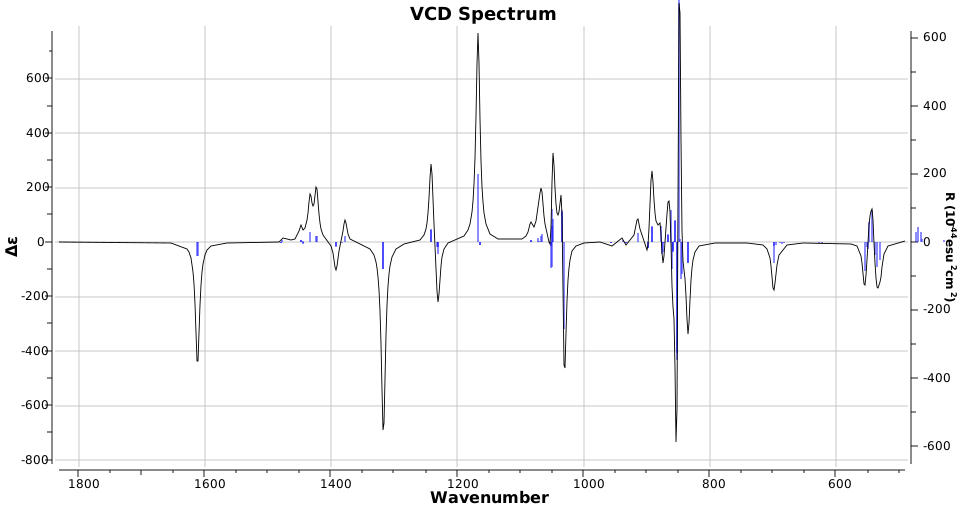
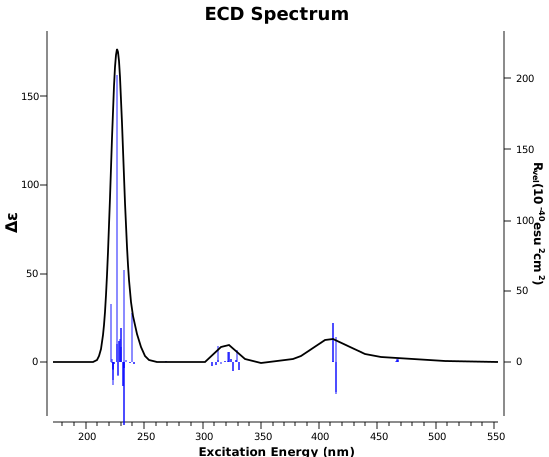
‡The calculated optical rotation of WOJDOQ (TPSSh/6-311G(d,p)/SCRF=dichloromethane) is 427° at 800 nm and 1077° at 589 nm (doi: 10.14469/hpc/1971); the VCD (ωB97XD/6-311G(d,p)/SCRF=dcm) is shown below (doi: 10.14469/hpc/1970);
the ECD (doi: 10.14469/hpc/1972 ):
References
- M.S. Inkpen, S. Scheerer, M. Linseis, A.J.P. White, R.F. Winter, T. Albrecht, and N.J. Long, "Oligomeric ferrocene rings", Nature Chemistry, vol. 8, pp. 825-830, 2016. https://doi.org/10.1038/nchem.2553
- Inkpen, Michael S.., Scheerer, Stefan., Linseis, Michael., White, Andrew J.P.., Winter, Rainer F.., Albrecht, Tim., and Long, Nicholas J.., "CCDC 1420914: Experimental Crystal Structure Determination", 2016. https://doi.org/10.5517/ccdc.csd.cc1jpkyq
- M. Hillman, and A. Kvick, "Structural consequences of oxidation of ferrocene derivatives. 1. [0.0]Ferrocenophanium picrate hemihydroquinone", Organometallics, vol. 2, pp. 1780-1785, 1983. https://doi.org/10.1021/om50006a013
- M. Joudat, A. Castel, F. Delpech, P. Rivière, A. Mcheik, H. Gornitzka, S. Massou, and A. Sournia-Saquet, "Synthesis, Structures, and Reactivity of Mono- and Bis(ferrocenyl)-Substituted Group 14 Metallocenes", Organometallics, vol. 23, pp. 3147-3152, 2004. https://doi.org/10.1021/om0400393
- M.R. Churchill, and J. Wormald, "Crystal and molecular structure of bis(fulvalene)diiron", Inorganic Chemistry, vol. 8, pp. 1970-1974, 1969. https://doi.org/10.1021/ic50079a030
- P. Scott, U. Rief, J. Diebold, and H.H. Brintzinger, "ansa-Metallocene derivatives. 28. Homo- and heterobimetallic bis(fulvalene) complexes from bis(cyclopentadienyl)- and bis(indenyl)-substituted ferrocenes", Organometallics, vol. 12, pp. 3094-3101, 1993. https://doi.org/10.1021/om00032a036
- P. Brüggeller, P. Jaitner, and H. Schottenberger, "Kristallographische Gegenüberstellung der Monokationen von Bis(fulvalen)dieisien und Bis(fulvalen) eisen-cobalt mit identischem Gegenion (PF6−)", Journal of Organometallic Chemistry, vol. 417, pp. C53-C58, 1991. https://doi.org/10.1016/0022-328x(91)80206-y
- R. Shekurov, V. Miluykov, O. Kataeva, A. Tufatullin, and O. Sinyashin, "Crystal structure of cyclic tris(ferrocene-1,1′-diyl)", Acta Crystallographica Section E Structure Reports Online, vol. 70, pp. m318-m319, 2014. https://doi.org/10.1107/s1600536814017346
- P. Scott, and P.B. Hitchcock, "Synthesis, structure and electrochemistry of the first fulvalene derivative of an actinide", Journal of Organometallic Chemistry, vol. 497, pp. C1-C3, 1995. https://doi.org/10.1016/0022-328x(95)00108-3
Tags:American Chemical Society, Bristol University, Chemical & Engineering News, Chemistry, Engineering, internet display, Karl Harrison, metal centres, Nick Long, Paul May, Tim Albrecht
Posted in crystal_structure_mining, Interesting chemistry | 2 Comments »
Thursday, December 1st, 2016
Following on from a search for long C-C bonds, here is the same repeated for C=C double bonds.

The query restricts the search to each carbon having just two non-metallic substituents. To avoid conjugation with these, they each are 4-coordinated; the carbons themselves are three-coordinated. Further constraints are the usual no disorder, no errors and R < 0.1 and the C=C distance > 1.4Å (the standard value is ~1.32-1.34Å). The search query is deposited as DOI: 10.14469/hpc/1959[1]

The apparent longest example is LIRVEN, DOI: 10.5517/CC4R2MK[2] with a value of 1.589Å, longer than most C-C single bonds! Closer inspection reveals the presence of lithium cations, and so the molecule bearing the C=C bond must sustain two negative charges. So this apparent C=C bond is in fact anionic, with one electron going into each of the π* orbitals, thus lengthening the CC bond.‡ Not a true example of a neutral C=C bond[3] but it now becomes interesting for what its spin state might be. Is it a biradical or a triplet for example? One to be investigated further I fancy! Another example of this type is QUKCEE[4]

This next FAZWIM has a C=C length of 1.546Å. It is an old structure (1986), and comes without attached hydrogen atoms. Although drawn with no hydrogens on the central C=C bond, the length suggests this molecule is simply mis-assigned.†

The final example I will highlight is pretty ordinary looking and published in 2016 as a private communication; ALOVOO, DOI: 10.5517/CCDC.CSD.CC1LJSWS[5] with a C=C length of 1.443Å. Again no obvious reason for the bond to be longer than normal.‡†

In hunting for such unusual deviations from the norm, the most obvious explanation is normally some anomaly in the crystallographic analysis. Although the CSD (crystal structure database) is a very heavily curated resource, it seems unlikely that each deposition would be carefully inspected for its chemistry, and this must be our task here. But such anomalies can themselves point to interesting or unusual chemistry, which in turn can be subjected to quantum computation to see if either the unusual value can be replicated or other reasons identified. In this case, this exercise can been conducted by a human, but one can easily envisage the entire process being automated on a far larger scale. The future?
‡ In fact the stoichiometry shows each “double bond” is actually a di-anion, with two electrons entering each of the the π* orbitals.
†A calculation on the singlet state for the structure as drawn (ωB97XD/Def2-TZVPP, DOI: 10.14469/hpc/1960) gives a bond length of 1.342Å, i.e. that expected for a double bond. The triplet state is similar in energy, but with a much longer central bond length of 1.476Å, DOI: 10.14469/hpc/1962 but the geometry at the carbons is planar and not bent as shown above. The quintet state is 1.45Å and is again planar, doi 10.14469/hpc/1963. So calculations on FAZWIM strongly suggest the structure as shown is an error.
‡†The computed value is 1.324Å, perfectly normal. DOI: 10.14469/hpc/1966[6]
References
- H. Rzepa, "Long C=C bonds", 2016. https://doi.org/10.14469/hpc/1959
- Matsuo, T.., Watanabe, H.., Ichinohe, M.., and Sekiguchi, A.., "CCDC 141348: Experimental Crystal Structure Determination", 2000. https://doi.org/10.5517/cc4r2mk
- T. Matsuo, H. Watanabe, M. Ichinohe, and A. Sekiguchi, "Reduction of the 1,4,5,8-tetrasila-1,4,5,8-tetrahydroanthracene derivative with lithium metal. Isolation and characterization of the tetralithium salt of a tetraanion, and observation of an Si–H⋯Li+ interaction", Inorganic Chemistry Communications, vol. 2, pp. 510-512, 1999. https://doi.org/10.1016/s1387-7003(99)00136-7
- T. Matsuo, H. Watanabe, and A. Sekiguchi, "A Novel Tetralithium Salt of a Tetraanion and a Dilithium Salt of a Dianion, Formed by the Reduction of the Tetrasilylethylene Moiety. Synthesis, Characterization, and Observation of an Si-H···Li+ Interaction", Bulletin of the Chemical Society of Japan, vol. 73, pp. 1461-1467, 2000. https://doi.org/10.1246/bcsj.73.1461
- M.E. Light, S. Bain, and J. Kilburn, "CCDC 1475906: Experimental Crystal Structure Determination", 2016. https://doi.org/10.5517/ccdc.csd.cc1ljsws
- H. Rzepa, "ALOVOO", 2016. https://doi.org/10.14469/hpc/1966
Tags:Chemical bond, chemical bonding, Chemical nomenclature, Chemistry, Conjugated system, double bond, energy, Nature, Nonmetal, Organic chemistry, Physical organic chemistry, search query, Substituent
Posted in crystal_structure_mining, Interesting chemistry | 2 Comments »
Monday, October 31st, 2016
Is asking a question such as “what is the smallest angle subtended at a chain of three connected 4-coordinate carbon atoms” just seeking another chemical record, or could it unearth interesting chemistry?
A simple search of the Cambridge structure database for a chain of three carbons, each bearing four substituents (sp3 hybridized in normal paralance) reveals the following distribution:

The value 60° is of course a three-membered cyclopropane ring. The tail of the distribution is very small, and there are a few small outliers with values of < 54°. Most of the time such outliers are in fact simple errors, but here we see that they are in fact semibullvalenes, of the type shown below, with the small angle subtended at the central of the three carbon atoms coloured in red.

In this diagram I have added my own semantic interpretation of what is going on. Let me itemise this:
- These molecules can undergo very rapid [3,3] sigmatropic rearrangements, shifting a σ-bond away from the 3-ring to create another such ring.
- This process elongates one of the C-C bonds and of neccessity this reduces the angle at the associated carbon.
- I have drawn two types of arrow connecting the two structures. The first is an equilibrium arrow, which implies a transition state connecting the two species. This transition state will have equal bond lengths for the forming/breaking C-C bond, and the transition state will have a rate constant which is slower than the time taken for one molecular vibration (~10-15s)
- It is also possible however that the second arrow is the correct one, and this implies an electronic resonance rather than a nuclear motion. This would have a rate constant comensurate with electron dynamics (~10-18 s) rather than nuclear vibrations.
What does x-ray crystallography measure? Well the diffraction of photons by electrons. In order to obtain a diffraction pattern, enough photons have to be diffracted to be measured, and even with most modern instruments this still takes minutes or hours. During this period, all the various nuclear positions encountered as a result of vibrations or equilibria are sampled. So if the rate constant for the [3,3] sigmatropic rearrangement is fast, x-ray diffraction will measure the average of the two sets of nuclear positions, which can be distinguished only with some difficulty (if at all) from the structure implied instead by electronic resonance.
If the equilibrium arrow applies, then the small angles of <54° are merely the average of the normal value for a 3-membered ring and a smaller value for a structure where one of the C-C bonds has been removed. In my opening sentence, I noted that the three carbon carbon atoms had to be connected in a chain. This is no longer true; the goalposts have been moved (a lot)!
If its an electron resonance, then the three carbon atoms are still connected, albeit one of the two C-C bonds is no longer a single bond but rather weaker and hence longer. The goalposts have merely been slightly shifted!
A calculation (B3LYP/Def2-TZVPP+D3 dispersion, doi: 10.14469/hpc/1850, [1]) of the structure KUZFUE [2] shows the C2-symmetric species shown below, with an elongated C-C bond and hence a reduced C-C-C angle, as being a true minimum (a resonance) rather than a transition state (an equilibrium). The vibration which shortens one C-C bond and lengthens the other has the real calculated wavenumber 244 cm-1.‡ But the boundary between the two possibilities (often referred to as the boundary between a single and a double minimum in a potential energy surface) is notoriously difficult to capture using calculations.

How could experiment definitively settle the issue? Well, the SLAC beam is a unique instrument. Its source of X-rays is so intense that you can get an analysable diffraction pattern from a crystal on a timescale so short that during this period no nuclear motions occur (not even vibrations). Those nuclear positions capture the true equilibrium positions of the atoms in the molecule. Now, how does one get beam time on the SLAC?
‡ Click on the image above to see an animation of this normal mode. If you are running the macOS Safari browser, make sure Preferences/Security/Plug-in settings/Java has the site ch.ic.ac.uk or ch.imperial.ac.uk set to on. If you do not do this, the somewhat unhelpful message You do not have Java applets enabled in your web browser, or your browser is blocking this applet. will appear. Note also that new system installations might tend to switch these settings to off.
References
- H. Rzepa, "CAZFUE", 2016. https://doi.org/10.14469/hpc/1850
- L.M. Jackman, A. Benesi, A. Mayer, H. Quast, E.M. Peters, K. Peters, and H.G. Von Schnering, "The Cope rearrangement of 1,5-dimethylsemibullvalene-2,6- and 3,7-dicarbonitriles in the solid state", Journal of the American Chemical Society, vol. 111, pp. 1512-1513, 1989. https://doi.org/10.1021/ja00186a064
Tags:animation, Bicyclic molecule, chemical record, Chemistry, City: Cambridge, Cycloalkane, Cyclopropanes, Java, Molecular geometry, Organic chemistry, potential energy surface, Safari, Web browser, X-ray
Posted in crystal_structure_mining, reaction mechanism | 7 Comments »
Tuesday, October 4th, 2016
Peter Murray-Rust and I are delighted to announce that the 2016 award of the Bradley-Mason prize for open chemistry goes to Jan Szopinski (UG) and Clyde Fare (PG).
Jan’s open chemistry derives from a final year project looking at why atom charges derived from quantum chemical calculation of the electronic density represent chemical information well, but the electrostatic potential (ESP) generated from these charges is very poor and conversely charges derived from the computed electrostatic potential are incommensurate with chemical information (such as the electronegativity of atoms). He has developed a Python program called ‘repESP’ in which ‘compromise’ charges are generated which attempt to reconcile the physical world-view (fitting the ESP) with chemical insight provided by NPA (Natural Population Analysis). Jan was the main driver to making his code open source, “opening his supervisor’s eyes” to the various flavours of open source licences. To ensure that all subsequent improvements to the program remain available to anyone, the source code has been released under a ‘copyleft’ licence (GPL v3) and is maintained by Jan on GitHub, where Jan looks forward to helping new users and collaborating with contributors.
Clyde has made various contributions to opensource chemistry over the period of his PhD, with the focus mainly on utilities to improve quantum chemical research and the enhancement of a popular machine learning library with a method that has been successful in chemometrics, creation of an opensource channel for teaching chemists programming and data analysis and creation of a tool to help encourage open sourcing software development. Cclib is the most popular library for parsing quantum chemical data from output files and Clyde has contributed patches for the Atomic simulation environment which enables control of quantum chemical codes from a unified python interface. He was responsible for the construction of a computational chemistry electronic notebook published to github and which is now under active development by others as well. This aims to encapsulate computation chemical research projects, both for the sake of reproducibility and for the sake of organising and keeping track of quantum chemical research. Alongside this platform he created an enhanced Gaussian calculator for the Atomic Simulation Environment that enables automatic construction of ONIOM input files, also now under active development. He also made contributions to scikit learn, the most popular python machine learning framework, implementing a kernel for Kernel Ridge Regression that has become the most successful kernel for regression over molecular properties. He was part of the team that won the 2014 sustainable software conference prize for creation of the opensource healthchecker software as part of Sustain. He has argued for opensource as a platform for teaching resources and created the Imperial Chemistry github user account, which is now run by the department. Materials for the Imperial Chemistry Data Analysis and Programming workshops implemented as Python Notebooks are now available through this account and continue under active development.
Criteria for the award will include judging the submission on its immediate accessibility via public web sites, what is visible and re-usable in this way and of evidence of either community formation/engagement or re-use of materials by people other than the proposer.
Tags:Analytical chemistry, chemical information, chemical insight, Cheminformatics, Chemistry, Chemometrics, Clyde Fare, Company: GitHub, computation chemical research projects, computational chemistry, computing, Cross-platform software, driver, GitHub, Jan Szopinski, machine learning, open sourcing software development, opensource healthchecker software, Peter Murray-Rust, public web sites, Python, quantum chemical calculation, quantum chemical codes, quantum chemical data, quantum chemical research, Quotation, Server & Database Software, simulation, Software, supervisor, sustainable software conference prize, Technology/Internet
Posted in Bradley-Mason Prize for Open Chemistry | No Comments »
Thursday, September 22nd, 2016
Compounds with O-O bonds often have weird properties. For example, artemisinin, which has some fascinating stereoelectronics. Here is another such, recently in the news and known as HMTD (hexamethylene triperoxide diamine). The crystal structure was reported some time ago[1] and the article included an inspection of the computed wavefunction. However this did not look at the potential stereoelectronics in this species, which I now address here.

A ωB97XD/Def2-TZVPP calculation[2] can be analysed for the NBO-derived interaction terms. This identifies an electron donor (normally a bond or a lone pair) and its E(2) perturbation energy interaction with an acceptor (normally an empty σ* antibond). Here we are interested in the interaction between the nitrogen “lone pair” and the adjacent C-O σ* antibond, of which there are six in the molecule due to the D3 symmetry. E(2) is ~22.4 kcal/mol, which is a large effect (the equivalent value for the so-called anomeric interaction between an oxygen lone pair and a C-O antibond is ~18 kcal/mol). The effect of donation into the empty C-O σ* antibond is to weaken it, unless the effect is balanced by a reciprocal interaction in the opposing direction, which is often the case in sugar-derived anomeric effects. Sugars of course are thermally relatively stable. In the case of HMTD, the reverse effect would be an oxygen Lp donating into the N-C σ* antibond and this has the value of 14.5 kcal/mol. Since the two are not balanced, this presumably contributes to the very unstable nature of this molecule.
An alternative way of looking at what the electrons are up to is ELF, a function based on the electron density which identifies the centroids of electron basins. The red arrows point to the four basins associated with the nitrogen “lone pair” (mostly the dumb-bell-shaped p-atomic orbital, hence four basins), and the integration being 3.2e for each nitrogen. This is a rather odd number for a “lone pair”. There is undoubtedly something unusual about this wavefunction which has yet to be identified.

Finally, I ask how common the N(sp3)-C(sp3)-O-O structure motif might be? In fact the Cambridge structure database has 81 entries! The scatterplot below includes 51 of them (no disorder, no errors, R<0.05). No clear-cut conclusions emerge from these statistics, except just a hint that as the C-O distance gets longer, the N-C distance might get shorter and that shorter N-C lengths are associated with shorter O-O lengths.

References
- A. Wierzbicki, E.A. Salter, E.A. Cioffi, and E.D. Stevens, "Density Functional Theory and X-ray Investigations of P- and M-Hexamethylene Triperoxide Diamine and Its Dialdehyde Derivative", The Journal of Physical Chemistry A, vol. 105, pp. 8763-8768, 2001. https://doi.org/10.1021/jp0123841
- H. Rzepa, "HMTD Hexamethylenetriperoxidediamine D3 NBO", 2016. https://doi.org/10.14469/hpc/1663
Tags:Amines, Artemisinin, Chemistry, Functional groups, Hexamethylene triperoxide diamine, Organic chemistry, Organic peroxides, Peroxide, perturbation energy interaction, Stereoelectronics
Posted in Interesting chemistry | 1 Comment »