Posts Tagged ‘G/RT’

Chemistry in an attosecond.

Friday, November 4th, 2011

An attosecond is 10-18s. The chemistry that takes place on this timescale is called electron dynamics. For example, it is the time taken for an electron to traverse the 1s orbit in a hydrogen atom. And chemists are starting to manipulate electrons (and hence chemistry) on this timescale; for example a recent article (DOI: 10.1021/ja206193t) describes how to control the electrons in benzene using attosecond laser pulses.
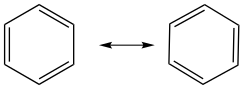
The diagram above is famously attributed to Kekulé, and we now teach that this diagram represents resonance structures. This term implies electron (rather than nuclear) dynamics, which results in us only being able to observe an averaged structure with six equivalent C-C bonds. Kekulé himself (see this review) could have no way of knowing what the timescale was that his representation implied, but he certainly must have thought it was fast. What is rarely mentioned in textbooks however is how fast it actually is. If the timescale were to be less then say a nanosecond (10-9s) then we would classify such a process not as a resonance but as a valence isomerism. This does implicate nuclear motions, and such would be the appropriate description for the isomerism of say cyclo-octatetraene, which is famously slow enough to observe by NMR (see 10.1039/P29920001951). If the timescale were to be a femtosecond (10-15s) this would correspond to molecular vibrations, and benzene indeed has an observable normal vibrational mode that corresponds more or less to the representation above (the hydrogens also wag a bit). This mode even has a name, the Kekulé mode. But even this is not fast enough for the intent of the diagram above, which describes what the electrons (and not any moving nuclei) are up to.

The article I mentioned at the start, by Inga Ulusoy and Mathias Nest probes exactly this aspect at the attosecond timescale. More particularly, they look into how to shape an ultra-short laser pulse to excite the electrons into excited states of benzene. This act destroys the aromaticity of the molecule, and changes the electron dynamics in the process. I should quote them here: “We have shown that by controlling the electron dynamics we can selectively switch benzene into nonaromatic target states. These target states exhibit an ultra-fast bidirectional electron circulation around the ring system.”

This is the chemistry in (a few) attosecond(s) that I titled this blog. Whilst the article noted here is theoretical, there seems little doubt that experimental studies of chemistry in an attosecond will became more common, and who knows what surprises await us. Exciting times (sorry about the pun).

I would conclude by mentioning the other extreme, chemistry in an exasecond (1018s). This happens to correspond more or less to the age of the universe! As it happens, it is not that difficult to come up with chemical processes that occur on this timescale. Any (unimolecular) process that has a free energy barrier larger than that inferred using e.g. the equation Ln k/T = 23.76 – ΔG/RT would fit. An example might be the half life for the enantiomerisation of alanine (left to its own devices, and not interfered with by e.g. catalysts).

Rate enhancement of the Diels-Alder reaction inside a cavity

Saturday, October 30th, 2010

Reactions in cavities can adopt quite different characteristics from those in solvents. Thus first example of the catalysis of the Diels-Alder reaction inside an organic scaffold was reported by Endo, Koike, Sawaki, Hayashida, Masuda, and Aoyama (DOI: 10.1021/ja964198s), where the reaction shown below is speeded up very greatly in the presence of a crystalline lattice of the anthracene derivative shown below.

A Diels-Alder reaction. Click for animation.

Organic scaffold based on an anthracene derivative. Click for crystal structure.

Its difficult to be precise about how much faster, since the kinetics depend on reorganisation of the scaffold, the actual reaction kinetics, and diffusion of the products in and out of the cavity. It does however mean that a poor solution reaction (reflux, many hours, modest yield) can be accomplished in an hour or so at room temperature in high yield.

Some idea of what is going on can be probed using calculation. Because the host and the guest interact though van der Waals or dispersion forces, a new breed of density functional theory which takes these into account is used (ωB97XD). The basic assemblage comprises the reactants shown below, enclosed in a cage formed by four of the anthracene units. A total of 236 atoms. This is a pretty challenging size for a full-blown quantum mechanical calculation. Here, its been done using a reasonable basis set, 6-31G(d) and with a continuum solvation model applied (dichloromethane). If you are interested in this sort of thing, that is 2292 basis functions.  I started the calculations in mid September, and its taken more than six weeks to optimise (on 8-processor computers).

Firstly, the results for a control calculation in dichloromethane. The energies of activation of the two isolated reactants coming together at the transition state are calculated as:
ΔG298 29.5, ΔH 15.5, T.ΔS  -13.98 kcal mol-1 (ΔS -46.9 cal K-1mol-1)

which are of course the various contributions to the equation ΔG = ΔH – T.ΔS. Note in particular how the last term increases the free energy barrier by ~14 kcal mol-1! Using the equation Ln k/T = 23.76 – ΔG/RT, one can estimate a rate constant of ~4 x 10⁻⁶ hour-1 at 298K (i.e. very slow at room temperatures). If the unfavourable -T.ΔS term is ignored (ΔG = ΔH), the rate constant increases to ~9 x 10⁴ hour-1 at 298K (i.e. fast), quite a difference. What about the values when the reactants and transition state are surrounded by the host?

ΔG298 20.0, ΔH 16.5, T.ΔS -3.49 kcal mol-1 (ΔS -11.7 cal K-1 mol-1)

The key difference is that the last term is now  much smaller, this reduces the free energy of activation and the estimated rate constant at 298K is now ~ 0.01 s-1 (42.5 hour-1).  This magnitude of rate constant corresponds to a reasonably fast reaction at room temperatures.

Transition state for  Diels Alder inside a cavity. Click for 3D.

This post demonstrates that the fascinating area of supermolecular chemistry can be just as amenable to computational exploration as the more conventional reaction.