Archive for the ‘Uncategorized’ Category

Woodward's symmetry considerations applied to electrocyclic reactions.

Monday, May 20th, 2013

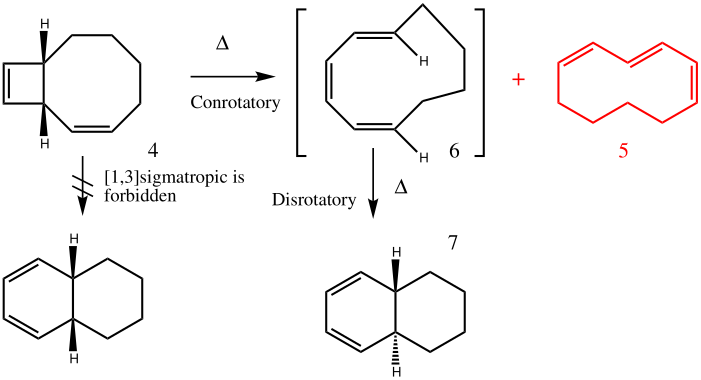
Sometimes the originators of seminal theories in chemistry write a personal and anecdotal account of their work. Niels Bohr[1] was one such and four decades later Robert Woodward wrote “The conservation of orbital symmetry” (Chem. Soc. Special Publications (Aromaticity), 1967, 21, 217-249; it is not online and so no doi can be given). Much interesting chemistry is described there, but (like Bohr in his article), Woodward lists no citations at the end, merely giving attributions by name. Thus the following chemistry (p 236 of this article) is attributed to a Professor Fonken, and goes as follows (excluding the structure in red):
wood

A search of the literature reveals only one published article describing this reaction[2] by Dauben and Haubrich, published some 21 years after Woodward’s description (we might surmise that Gerhard Fonken never published his own results). In fact this more recent study was primarily concerned with 193-nm photochemical transforms (they conclude that “the Woodward-Hoffmann rules of orbital symmetry are not followed”) but you also find that the thermal outcome of heating 4 is a 3:2 mixture of compounds 5 and 6, and that only 6 goes on to give the final product 7. It does look like a classic and uncomplicated example of Woodward-Hoffmann rules.

 So let us subject this system to the “reality check”. The transform of 4 → 5 rotates the two termini of the cleaving bond in a direction that produces the stereoisomer 5, with a trans alkene straddled by two cis-alkenes[3]. The two carbon atoms that define the termini of the newly formed hexatriene are ~ 4.7Å apart; too far to be able to close to form 7.

 4 → 5  4 → 6
8 8

But with any electrocyclic reaction, two directions of rotation are always possible, and it is a rotation in the other direction that gives 4 → 6[4], ending up with a hexatriene with the trans-alkene at one end and not the middle (for which the free energy of activation is 3.1 kcal/mol higher in energy). Now the two termini of the hexatriene end up ~3.0Å apart, much more amenable to forming a bond between them to form 7.

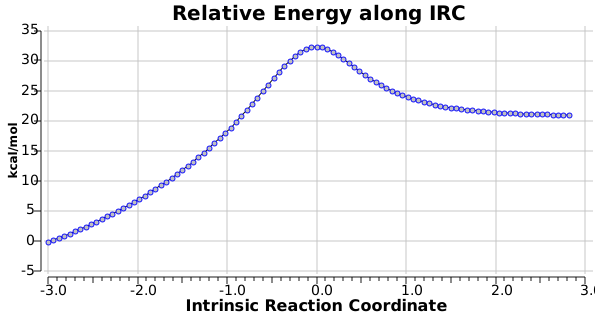
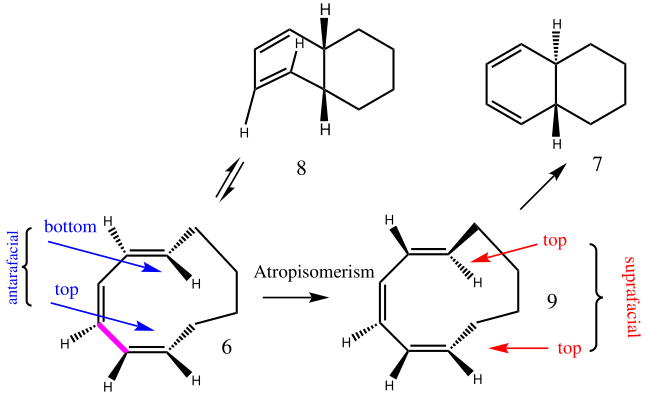
It is at this point that the apparently uncomplicated nature of this example starts to unravel. If one starts from the 3.0Å end-point of the above reaction coordinate and systematically contracts the bond between these two termini, a transition state is found leading not to 7 but to the (endothermic) isomer 8.[5]This form has a six-membered ring with a trans-alkene motif (which explains why it is so endothermic). 
wood1
6 ↠ 8
8 wood2

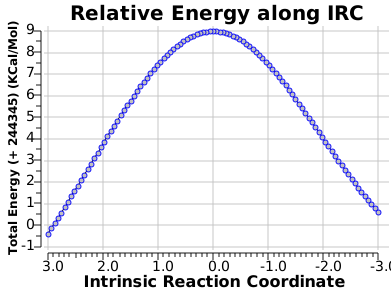
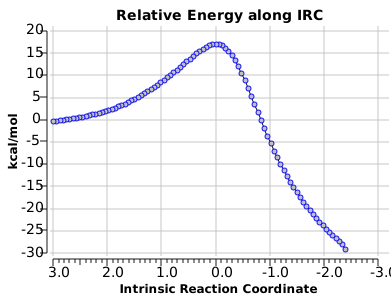
Before discussing the implications of this transition state, I illustrate another isomerism that 6 can undertake; a low-barrier atropisomerism[6] to form 9, followed by another reaction with a relatively low barrier, 9 ↠  7[7]to give the product that Woodward gives in his essay.

6 ↠ 9
6-atrop 6-atrop
9 ↠ 7
9to7a 9to7a

 We can now analyse the two transformations 6 ↠ 8 and 9 ↠  7. The first involves antarafacial bond formation (blue arrows) at the termini and an accompanying 180° twisting about the magenta bond which creates a second antarafacial component[8]. So this is a thermally allowed six-electron (4n+2) electrocyclisation with a double-Möbius twist[9]. The second reaction is a more conventional purely suprafacial version[10] (red arrows) of the type Woodward was certainly thinking of; it is 18.0 kcal/mol lower in free energy than the first (the transition state for 6 ↠ 9 is 10.8 kcal/mol lower than that for 9 ↠ 7).

I hope that this detailed exploration of what seems like a pretty simple example at first sight shows how applying a “reality-check” of computational quantum mechanics can cast (some unexpected?) new light on an old problem. We may of course speculate on how to inhibit the pathway 6 ↠ 9 ↠ 7 to allow only 6 ↠ 8 to proceed (the reverse barrier from 8 is quite low, so 8 would have to be trapped at very low temperatures). 

References

  1. N. Bohr, "Der Bau der Atome und die physikalischen und chemischen Eigenschaften der Elemente", Zeitschrift f�r Physik, vol. 9, pp. 1-67, 1922. https://doi.org/10.1007/bf01326955
  2. W.G. Dauben, and J.E. Haubrich, "The 193-nm photochemistry of some fused-ring cyclobutenes. Absence of orbital symmetry control", The Journal of Organic Chemistry, vol. 53, pp. 600-606, 1988. https://doi.org/10.1021/jo00238a023
  3. H.S. Rzepa, "Gaussian Job Archive for C10H14", 2013. https://doi.org/10.6084/m9.figshare.704833
  4. H.S. Rzepa, "Gaussian Job Archive for C10H14", 2013. https://doi.org/10.6084/m9.figshare.704834
  5. H.S. Rzepa, "Gaussian Job Archive for C10H14", 2013. https://doi.org/10.6084/m9.figshare.704755
  6. H.S. Rzepa, "Gaussian Job Archive for C10H14", 2013. https://doi.org/10.6084/m9.figshare.704754
  7. H.S. Rzepa, "Gaussian Job Archive for C10H14", 2013. https://doi.org/10.6084/m9.figshare.704844
  8. H.S. Rzepa, "Gaussian Job Archive for C10H14", 2013. https://doi.org/10.6084/m9.figshare.704841
  9. H.S. Rzepa, "Double-twist Möbius aromaticity in a 4n+ 2 electron electrocyclic reaction", Chemical Communications, pp. 5220, 2005. https://doi.org/10.1039/b510508k
  10. H.S. Rzepa, "Gaussian Job Archive for C10H14", 2013. https://doi.org/10.6084/m9.figshare.704995
Transition states for the (base) catalysed ring opening of propene epoxide.

Wednesday, May 8th, 2013

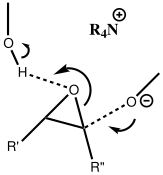
The previous post described how the acid catalysed ring opening of propene epoxide by an alcohol (methanol) is preceded by pre-protonation of the epoxide oxygen to form a “hidden intermediate” on the concerted intrinsic reaction pathway to ring opening. Here I take a look at the mechanism where a strong base is present, modelled by tetramethyl ammonium methoxide (R4N+.OMe), for the two isomers R=Me; R’=Me, R”=H and R’=H, R”=Me.

pe-base

As noted before[1], with alkoxide the dominant product is R’=Me, R”=H. A ωB97XD/6-311G(d,p)/SCRF=methanol) calculation of ΔΔG298 for the transition state for the process indeed favours this outcome, by 1.3 kcal/mol.[2],[3] This corresponds to ~90:10 for R’=Me, R”=H/R’=H, R”=Me. The barrier in this case is significantly smaller (~8 kcal/mol) than was observed for the route catalysed by trifluoracetic acid (~13 kcal/mol). From this emerges a possible explanation for the odd result I noted in the previous post; namely that the transition state ΔΔG for the pure water catalysed reaction was 1.7 kcal/mol lower for the formation of 2-alkoxy-1-propanol than for 1-alkoxy-2-propanol (i.e. of R’=H, R”=Me vs R’=Me, R”=H), whereas experiment showed the dominant product was the latter. But the pure water bimolecular rate contains contributions not only from water acting as catalyst but also from the background [H+] and [HO] rates as well (pKa methanol ~ 15.5, pKa water ~ 15.7). Of these three bimolecular rates, it is clear that the fastest is going to be the HO catalysed one, and so it seems likely that the experimental result in pure water actually arises from catalysis by the [HO] term and not by [H2O] itself.

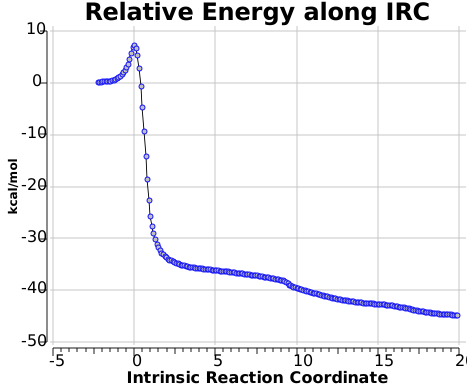
The next task is to show how realistic the conventional “arrow pushing” for the reaction (shown above) actually is. Remember how, with acid catalysis, an IRC showed a proton transfer preceding the transition state. In contrast, the pure water mediated reaction showed no such pre-transfer, and instead revealed a hidden zwitterionic or ion-pair like intermediate occurring only AFTER the transition state. The MeO catalysed reaction is similar, except of course that with the above models ion-pairs are present both at the start and end of the reaction, with the possibility of a third hidden ion pair occurring somewhere along the reaction pathway. The reactant ion pair of course does have to morph into the product ion pair by virtue of a proton transfer, and this occurs AFTER the transition state is passed, not before.

  R’=Me, R”=H R’=H, R”=Me
ΔΔG  0.0 +1.3

IRC

animation

 pe-base-obs  pe-base

IRC

energies

 pe-base-obs pe-base

IRC

Grad

 pe-base-obsG pe-baseG
doi: [4] [5]

 The post-transition state proton transfer occurs driven by the need to minimise the charge separation in the ion-pair; a contact ion-pair is always likely to be more stable than a separated ion pair. For R’=H, R”=Me, a primary alkoxide is the initial product. This is relatively unstable, and so quite quickly (at about IRC 2.5) the system proceeds to acquire a proton from the adjacent methanol to reform a contact ion-pair. For R’=Me, R”=H, a secondary alkoxide is formed, which proves somewhat tardier in acquiring that proton, at IRC 9.5 in fact! Up to that point of course, the secondary alkoxide anion is a “hidden intermediate“, albeit very much on the verge of becoming a proper intermediate.
This third post on the topic I think ties up some of the loose ends, and seems to cast some interesting new light on what, at face value, seems a very simple organic reaction. There is, I think, still much to learn about such “simple” reactions.


References

  1. H.C. Chitwood, and B.T. Freure, "The Reaction of Propylene Oxide with Alcohols", Journal of the American Chemical Society, vol. 68, pp. 680-683, 1946. https://doi.org/10.1021/ja01208a047
  2. H.S. Rzepa, "Gaussian Job Archive for C9H25NO3", 2013. https://doi.org/10.6084/m9.figshare.698066
  3. H.S. Rzepa, "Gaussian Job Archive for C9H25NO3", 2013. https://doi.org/10.6084/m9.figshare.698172
  4. H.S. Rzepa, "Gaussian Job Archive for C9H25NO3", 2013. https://doi.org/10.6084/m9.figshare.700641
  5. H.S. Rzepa, "Gaussian Job Archive for C9H25NO3", 2013. https://doi.org/10.6084/m9.figshare.700652

The mechanism of ester hydrolysis via alkyl oxygen cleavage under a quantum microscope

Tuesday, April 2nd, 2013

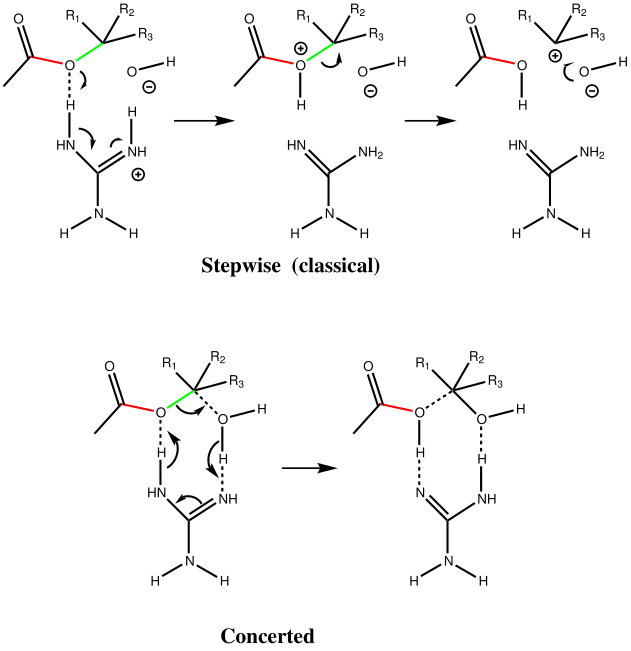
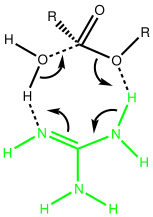
My previous dissection of the mechanism for ester hydrolysis dealt with the acyl-oxygen cleavage route (red bond). There is a much rarer[1] alternative: alkyl-oxygen cleavage (green bond) which I now place under the microscope.

alkyl-ester

Here, guanidine is used as a general acid/base, which results in a reasonable activation barrier for the hydrolysis (using pure water as the catalyst led to high barriers). What I will call the classical stepwise route is shown above, with charge-separated structures in abundance (particularly at the allyl group, where the possibility of forming a carbocation at this centre is central to the mechanism). My philosophy here is to allow quantum mechanics to decide whether to separate charge or not (in effect, only it is allowed decisions about where electrons are). So one can start with a concerted mechanism in which no formal charges are separated, and by subjecting them to wB97XD/6-311G(d,p)/SCRF=water calculation, decide where and if charges develop.

There are two distinct possibilities; hydrolysis with either retention or inversion of configuration at the alkyl group. The results for the transition states are shown below, with the analogous energy for acyl-oxygen cleavage shown for comparison.

Relative energies for hydrolysis of Alkyl acetate
R Acyl-oxygen Alkyl O,inversion Alkyl-O,retention
all H 0.0 15.3 42.5
Me 0.0 16.6 35.0
Me,Me 0.0 16.3 18.2
Me,Me,Me 0.0 16.4 (14.4)  ?

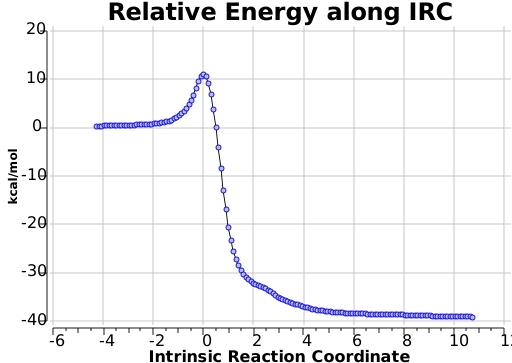
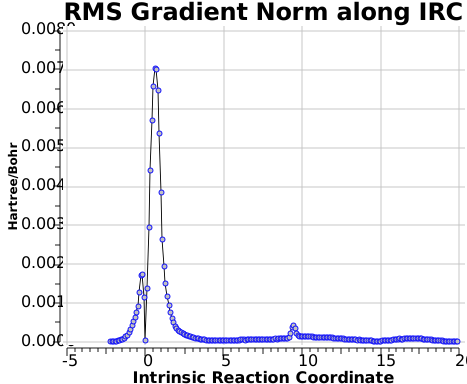
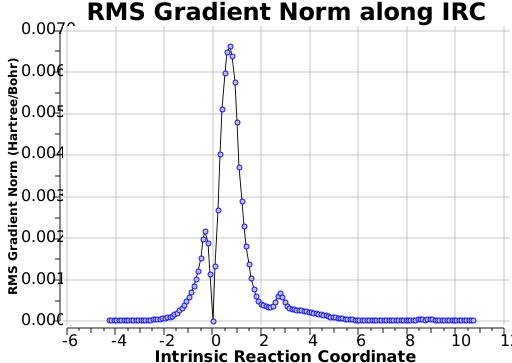
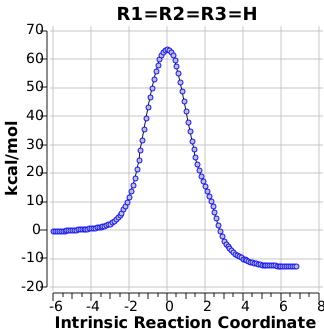
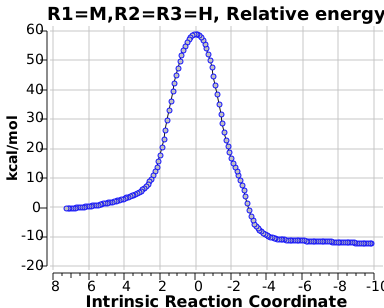
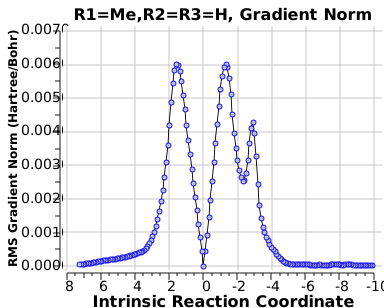
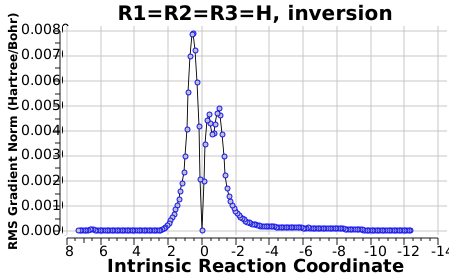
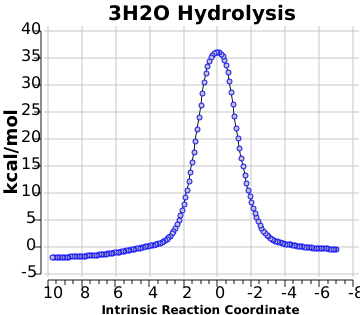
For R1=R2=R3=H and R1=Me,R2=R3=H proceeding with retention of configuration. The IRCs are as below, which reveal a “hidden intermediate” feature (visible as a dip in the gradient norm), which corresponds to a charge-separated zwitterionic intermediate immediately preceding the proton transfer. In other words, the non-charge-separated cyclic/concerted mechanism shown above is “interrupted” by charge separation in a hidden way during, and in an explicit way at the final stage, preferring finally to form the ionic ion-pair rather than neutral acetic acid and guanidine.

alkylg[2] alkylg
alkylMe[3] alkylMe
alkylMeG

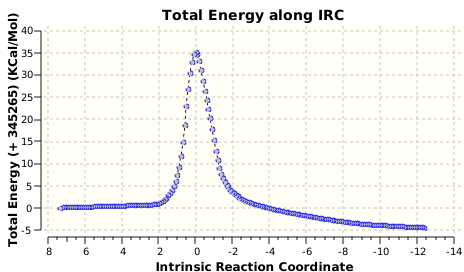
For R1=R2=Me, R3=H, we have a change. The C-O bond lengths at the solvolysing methyl increase as the substitution at this carbon increases, e.g. 2.2Å (R=H) → 2.4Å (R1=Me) as the transition state becomes more carbocation like. With increasing carbocationic character, the acidity of the adjacent C-H group increases, until with R1=R2=Me, R3=H it has become acidic enough to be abstracted by any close-by base (in this instance, guanidine). Experimentally, the aqueous hydrolysis of t-butyl acetate is known to proceed with alkyl-oxygen cleavage[1]. In the computational model, the solvolysis mechanism has been intercepted by an elimination mechanism: the two potential surfaces under these circumstances are very close and they merge to ensure a different outcome of the reaction. You can see this effect below;

alkylG-Me2

Click for 3D.

The reaction barrier also drops as the degree of substitution at the migrating carbon increases. At time of writing, no TS had been located for R1=R2=R3 (? in table above) but as you can see the trend could easily take it below the energy for acyl oxygen hydrolysis.

A much lower energy route however is apparently available for the alkyl-oxygen solvolysis route. For R1=R2=R3=H, it proceeds much more favourably with inversion of configuration, an intramolecular Sn2 solvolysis in fact.

alkylg-inva alkylg-inva
alkylg-invg

That for R1=R2=R3 shows a qualitative difference, in resembling the mechanism for Sn1 solvolysis of t-butyl chloride in water. In this case the bond O-C bond labelled 2.3 is cleaving, whilst the C-O bond labelled 3.1 has not yet started to form; an apparently classical Sn1 solvolysis. But take a look at the two atoms labelled [1] and [2]; this C-H bond is also set up to be abstracted by an adjacent base (the carboxylate), and indeed an IRC shows the formation of butene (not solvolysis) to be the final outcome. 

Click for 3D.

Click for 3D.

Unlike the mechanism involving retention of configuration, the barrier for the inversion route does not change much as the substitution at the carbon increases, remaining above the acyl-oxygen solvolysis for even the t-butyl ester (R1=R2=R3=Me). 

To summarise what we might have learnt. Firstly, the mechanism of the apparently simple hydrolysis of alkyl esters of ethanoic (acetic) acid suddenly got much more complicated. It might seem that solvolysis of the O-alkyl bond can proceed with either inversion or retention of configuration at the alkyl carbon; if the latter then the barrier seems to decrease as the stabilisation of the carbocation at this carbon increases. But for both retention and inversion, the mechanistic pathway can easily be subverted by a different reaction involving the formation of an alkene.

One starts to suspect that the model I am using here to study this reaction may be either the wrong kind, or certainly incomplete. In the absence of any explicit water (merely a continuum model acting on its behalf), it seems more basic molecules bound in by hydrogen bonds (guanidine or carboxylate) can take over by acting as bases and abstracting hydrogens from a H-C bond adjacent to the carbocationic centre. In order to redirect the mechanism onto the solvolysis pathway, one probably needs to have a few more explicit water molecules hanging around (so to speak) so as to quickly intercept the forming carbocation, before it can release its proton to the base. In other words, one needs to set up a more statistical model, in which the probability of the desired outcome is in part determined by the probability of having a favourable molecule adjacent to the reacting centre. Who would have thought such a basic prototype for organic chemistry could be so tricky to pin down in a computational model! 

References

  1. C.A. Bunton, and J.L. Wood, "Tracer studies on ester hydrolysis. Part II. The acid hydrolysis of tert.-butyl acetate", Journal of the Chemical Society (Resumed), pp. 1522, 1955. https://doi.org/10.1039/jr9550001522
  2. H.S. Rzepa, "Gaussian Job Archive for C4H13N3O3", 2013. https://doi.org/10.6084/m9.figshare.663603
  3. H.S. Rzepa, "Gaussian Job Archive for C5H15N3O3", 2013. https://doi.org/10.6084/m9.figshare.663619

A sideways look at the mechanism of ester hydrolysis.

Friday, March 29th, 2013

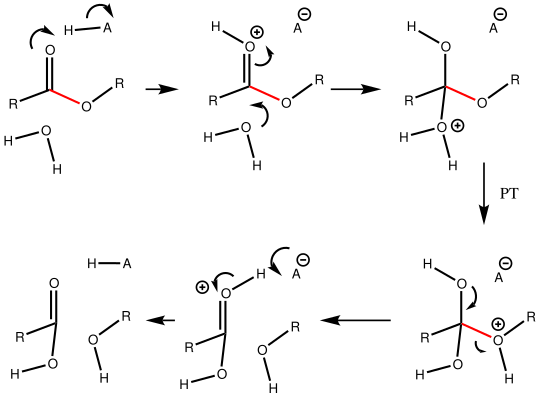
The mechanism of ester hydrolysis is a staple of examination questions in organic chemistry. To get a good grade, one might have to reproduce something like the below. Here, I subject that answer to a reality check.

actyl

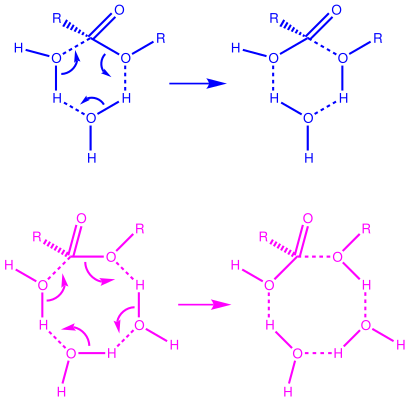
In this scheme, HA is a general acid, R=Me, and the net result is to break what is called the acyl-oxygen bond (red). The mechanism is actually incomplete, since the label PT designates a proton-transfer (the mechanism for which is left somewhat undefined). Additionally, a lot of charges come and go and five steps or so are involved. So a student might be tempted to “fast-track” the whole process. Below I show two such fast-tracks (I prefer to say simplifications):

acetyl-ester1

In the blue mechanism, the role of HA is actually played by one water molecule, and a second water is assisting the PT step (a far more thorough analysis of the mechanism can be found in this reference[1]). The reaction is bimolecular in ester and the HA (=water in this case). The third water would make it a termolecular reaction overall, but if the reaction takes place in water itself than [H2O] would be constant. It would correspond to what the text books call AAC2 since we consider one molecule as an acid HA. But, one could look at it differently and consider the second water as a nucleophile generated by concurrent deprotonation (by the first water). This would make it a BAC2 type. It turns out that if one makes the mechanism cyclic, the AAC2 and BAC2 annihilate each other in effect to create a single (peri)cyclic mechanism (which has no well known name, but might be referred to as the co-operative pathway). Such a mechanism can be extended using a third water molecule (magenta diagram); I will come to the reason for including that presently.

Why would one want to even consider such mechanisms? Because, if you look carefully, you will see no charges! Charge separation (= large dipole moment) takes energy. It is normally thought that this energy is more than compensated for by additional solvation (a process which is implicit rather than explicitly shown in text-book diagrams). But if you do not generate charge separation, you might not need that solvation energy. I will turn to quantum mechanics to try to decide what might be viable (I hesitate to use the term “going on”). 

A ωB97XD/6-311G(d,p)/SCRF=water model (in which solvation is approximately included as a continuum model) calculation yields the following for the blue mechanism.

acyl-ester[2] acyl-ester
  1. Points to note are that it is concerted, in other words the quantum mechanics tells us that all the bonds CAN make and break in a single concerted process within a single kinetic step.
  2. The mechanism has an uncanny resemblance to the nucleophilic aromatic substitution I reported a couple of posts ago! It resembles an Sn2 displacement at an sp2 centre. Such juxtaposition of these two mechanisms is also not found in text-books. Recollect that with such aromatic substitution, it was possible to get both cncerted and stepwise mechanisms, depending on the substituents. Perhaps the same might be possible here?
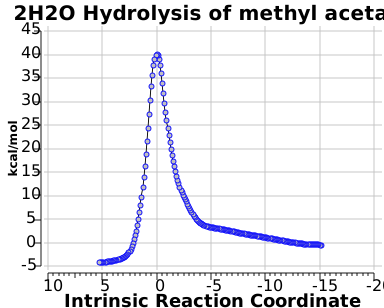
  3. However, the energy barrier for the process with the substituents shown above (~45 kcal/mol) is rather too high (the experimental value is estimated as >22 kcal/mol[1]). There may be at least three reasons for this;
    • (a) a better solvation model would be needed to lower the energy,
    • (b) the angles subtended at the transferring protons are strained (they optimally should be linear) and
    • (c) water is a very poor general acid (or base)!

But as an answer in an examination, would the blue mechanism actually be wrong? You will have to ask the instructor setting the question how they might respond to that, although these authors[1] certainly conclude that such a concerted mechanism is the more “correct”, at least for hydrolysis in water without added acid or base.

Point  (b) above can be addressed by adding another water molecule, as per the magenta mechanism so as to enlarge the ring and reduce the angular strain. But before I present the results, I need to “normalise” the system by ALSO adding one (solvating) water molecule to the blue route, as below, so that we can directly compare the energies of the blue and magenta pathways.

Click for  3D.

Click for 3D.

The result is a larger ring where the angular strain is clearly reduced. There is an entropic penalty for introducing that third water molecule, but despite this the free energy comes out 5.5 kcal/mol lower, and the activation barrier is also lower (~37 kcal/mol, still rather higher than experiment). It has been reported that incorporation of a 4th water molecule further improves matters[1].

acetyl3H2Oa[3]  acetyl3H2Oa

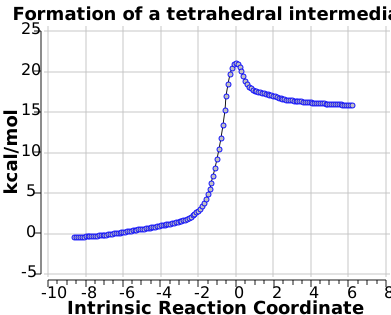
We can also address both points (b) and (c) above by replacing HA=H2O by HA=guanidiniumH+ (green), a better general acid. This polar modification introduces the ability for the system to better sustain charge separations, and indeed the initial product is now an ion pair tetrahedral intermediate (methoxide anion and guanidinium cation) carrying a dipole moment of 14.5D, an increase over the value for the transition state with three waters, 9.7D. The barrier (~21 kcal/mol) has gone in the opposite direction, decreasing significantly compared to the water catalysed reaction. The tetrahedral intermediate sits in an energy well of ~4 kcal/mol.

acetyl-ester2

acet-g[4] acet-g

A second transition state exiting the tetrahedral intermediate has a free energy barrier[5] about 2.5 kcal/ol lower than the one entering it.

Click for  3D.

Click for 3D.

What might we have learnt? That ester hydrolysis using pure water could proceed through a cyclic and concerted transition state, involving three (or perhaps more) water molecules passing a proton baton along the chain, and in the process avoiding any large build up of charge separation. Replace two of these waters with say guanidine as a general acid/conjugate base capable of conjugatively stabilising charge-separated species and the mechanism changes to a stepwise reaction involving a dipolar tetrahedral intermediate sitting in a relatively shallow energy well.

Not possibly a picture that we might expect a student sitting an introductory examination in organic chemistry to reflect in its entirety, but also one that perhaps the text-books might start to hint at? Or: at some stage, armed  merely with a “smart watch-cum-supercomputer”, a student taking such an exam might respond by performing the calculations described here as their submitted answer? Well, not for a year or two perhaps. But it has to be said that everything you see in this post was performed over less than two days of elapsed time, so these “reality checks” are not that time-consuming. Whether you choose to believe them or not of course is another matter.

References

  1. Z. Shi, Y. Hsieh, N. Weinberg, and S. Wolfe, "The neutral hydrolysis of methyl acetate — Part 2. Is there a tetrahedral intermediate?", Canadian Journal of Chemistry, vol. 87, pp. 544-555, 2009. https://doi.org/10.1139/v09-011
  2. H.S. Rzepa, "Gaussian Job Archive for C3H10O4", 2013. https://doi.org/10.6084/m9.figshare.661351
  3. H.S. Rzepa, "Gaussian Job Archive for C3H12O5", 2013. https://doi.org/10.6084/m9.figshare.661789
  4. H.S. Rzepa, "Gaussian Job Archive for C4H13N3O3", 2013. https://doi.org/10.6084/m9.figshare.661791
  5. H.S. Rzepa, "Gaussian Job Archive for C4H13N3O3", 2013. https://doi.org/10.6084/m9.figshare.661799

Secrets of a university tutor: conformational analysis and NMR spectroscopy.

Sunday, February 3rd, 2013

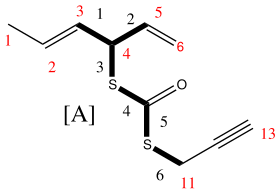
In a previous post, I set out how to show how one can reduce a 1H NMR spectrum to the structure [A] below. I speculated how a further test could be applied to this structure; back predicting its spectrum using just quantum mechanics. Overkill I know, but how well might the two match?

4nmr

  1. The process must start by considering the conformational possibilities of [A]. Each will have a different predicted spectrum. There are six rotatable bonds in the system, which if each bond has up to three rotamers would be 729 conformations potentially possible. A nightmare to explore (but do-able if you really needed to). I will try to reduce this by searching for the most probable for each bond (which may not of course lead to the final best conformation).
  2. Bonds 1 and 2 can be subjected to a search of the Cambridge database. The search criteria are the same as described in this post. The most probable dihedral angle around this type of bond is ± 110°.C=C-C-S
  3. Bond 3 has few entries, but they show as:O=C-S-C
  4. Bonds 4/5 are also the one that controls the conformation of esters, and is known as S-cis. All examples show the lone pair on the sulfur as anti to the axis of the C=O bond.SCC=O
  5. Bond 6 has just two conformations, anti and gauche.CC-C-S
  6. We have reduced the possible 729 to just two, which are then subjected to a ωB97XD/6-311G(d,p)/SCRF=chloroform calculation. Some faith in this combination can be obtained by inspecting the (remarkably accurate) result obtained for a Matryoshka doll. A suitable model can be invoked using a keyword NMR(mixed.spinspin). The method recovers at least a proportion of the effects on conformation induced by the weak dispersion forces present. The prediction comes in two forms:
    1. The magnetic shieldings relative to TMS (chemical shifts). One might expect these to be predicted with an error of around 0.3ppm, but if the actual NMR population comprises more than one rotamer, then one does need to take the Boltzmann average. For this molecule, predicting how the magnetic anisotropy induced from the double or triple bonds will perturb the chemical shifts will depend critically on the conformation of the molecule. In other words, this is actually a pretty challenging system to get right! 
    2. The spin-spin couplings. These have an expected predictability of ~1 Hz. 
  7. The calculation comes up with essentially identical free energies for the two selected conformations:
    Anti (0.1) Gauche (0.0)
    14-a Click for  3D
  8. The experimental spectrum was δ 1.70 (3H,d,6Hz), 2.23 (1H, t, 3Hz), 3.73 (2H, d, 3Hz), 4.84 (1H, dd, 7,8Hz), 5.15 (1H, d, 10Hz), 5.27 (1H, d, 17Hz), 5.51 (1H, dd, 8,16.5 Hz), 5.77 (1H, dq, 6,16.5 Hz), 5.88 (1H, ddd, 7,10,17Hz). 
  9. To compare with the computed one, firstly I note that the values for the three hydrogens of the methyl group have to be averaged over both conformations. The predicted chemical shifts are shown below. For the anti conformation, they all come within about 0.3ppm of the measured value.
    Chemical shifts
    Proton Expt anti Gauche
    1  1.70  1.68  1.66
    2  5.77  6.15  6.17
    3  5.51  5.76  5.76
    4  4.84  4.66  4.76
    5  5.88  6.15  6.19
    6  5.15  5.59  5.58
    6  5.27  5.76  5.84
    11  3.73  3.40  3.01
    11  3.73  3.49  3.01
    13  2.23  2.19  2.05
  10. The spin-spin couplings are shown below. Several differ by about 3Hz, but most are better. Notice how the sign of the coupling from H-11 to H-13 is identified as negative, and how the methylene group at C-11 is identified as slightly diastereotopic (from the presence of the chiral centre). The 2JHH coupling is not detected in the (first order) measured spectrum.
    Couplings, Hz
    Proton Expt anti Gauche
    1 6 6.6 6.6
    2 6,16.5 6.6,13.6 6.6,13.6
    3 16.5,8 13.6,9.2 13.6,9.2
    4 8,7 9.2,10.2 9.2,10.2
    5 7,10,17 10.2,10.4,15.4 10.210.4,15.4
    6 10 10.4 10.4
    6 17 15.4 15.4
    11 ±3 -15.5,-3.7,-3.7 -17.3,-3.5,-3.3
    11 ±3 -3.7,-3.7 -3.5
    13 ±3 -3.7, -3.7 -3.3

We might conclude from this analysis that the match between the measured spectrum of [A] and that calculated entirely from quantum mechanical principles is pretty good. We may be reasonably confident that the conformations we have identified are realistic. Of course, if we want to be sure there is none better, then the few hundred other possible conformations would have to be calculated. I am not about to try!

Secrets of a university tutor: unravelling a mechanism using spectroscopy.

Thursday, January 31st, 2013

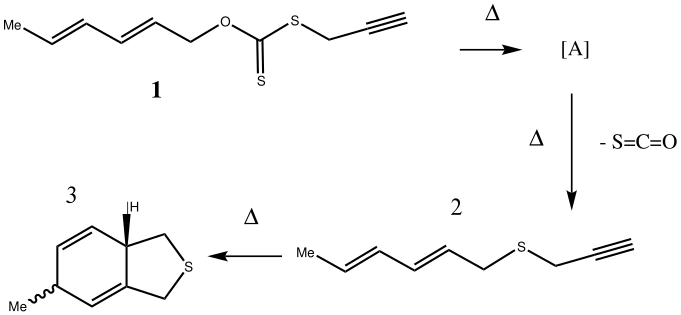
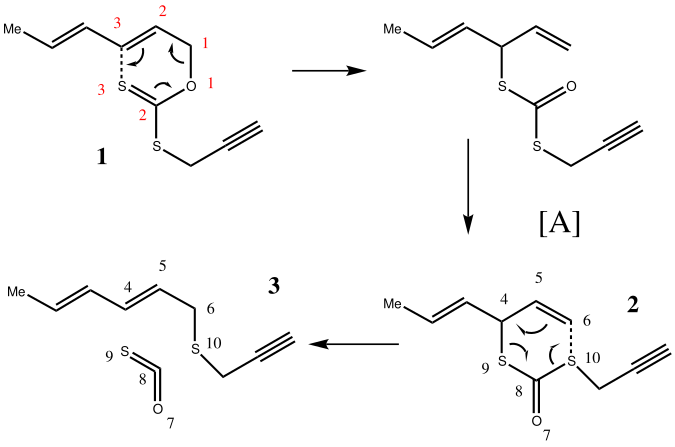
It is always rewarding when one comes across a problem in chemistry that can be solved using a continuous stream of rules and logical inferences from them. The example below[1] is one I have been using as a tutor in organic chemistry for a few years now, and I share it here. It takes around 50 minutes to unravel with students.

14

The narrative is that attempted preparation of 1 resulted instead in a mysterious compound [A], which when heated extruded S=C=O to give 2, and upon further heating gave 3. The challenge is to identify [A] with the help of the spectroscopic information provided, to infer the mechanism of its formation and further to suggest what the stereochemistry of the methyl group in 3 might be.

The 1H NMR of [A] is set out below for future reference: δ 1.70 (3H,d,6Hz), 2.23 (1H, t, 3Hz), 3.73 (2H, d, 3Hz), 4.84 (1H, dd, 7,8Hz), 5.15 (1H, d, 10Hz), 5.27 (1H, d, 17Hz), 5.51 (1H, dd, 8,16.5 Hz), 5.77 (1H, dq, 6,16.5 Hz), 5.88 (1H, ddd, 7,10,17Hz). 

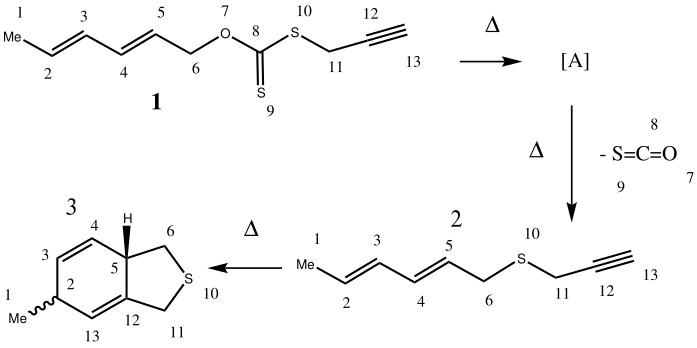
As usual, one has to start somewhere, and here the task is to number the atoms, and then try to “reaction map” them to the products.

14a

  1. The first real decision is how to map S9 or S10. Occam’s razor suggests that the sulfur in the SCO comes from S9 (this would allow C10-C11 to be left alone), but if that hypothesis is wrong, we can always return and try the alternative. Let us go with the simpler option first.
  2. Another relatively simple decision is to map C12-C13 as shown in 3, since this only changes its bond order by one (few mechanisms require a change in bond order of > 1 in any single mechanistic step). 

Analysis of the 1H NMR starts with the most obvious (marker) group, the methyl:

  1. The methyl is J-coupled to C2-H (6Hz), and hence this is assigned to 5.77 ppm.
  2. C2-H is J-coupled to C3-H (16.5 Hz) and hence this is assigned to 5.51 ppm
  3. C3-H is J-coupled to C4-H (8 Hz) and hence this is assigned to 4.84 ppm. 
  4. We now encounter a problem. C4-H has a chemical shift which suggests it is not attached to an sp2-C, but has become sp3-hybridized. But the relatively high chemical shift suggests that this carbon may be attached to electronegative substituents. C4 is flagged for attention below.
  5. C4-H is J-coupled via J 7 Hz to the peak at 5.88 ppm. The chemical shift is typical of sp2-C, and is assigned as C5-H.
  6. C5-H is J-coupled via two couplings of 10 and 17 Hz to peaks at 5.15 and 5.27 ppm. Both these are also sp2-C, which may be assigned as C6-H. As such it can only carry three attached atoms (two Hs and a C-C) and so the C6-O7 bond cannot be retained. C6 is flagged for attention below.
  7. The remaining peaks can be assigned as C11-H and C13-H from their mutual 4J coupling of 3Hz.

Armed with these inferences, a list of to-dos can now be assembled.

  1.  For the transform 1 → [A], break C6-O7
  2. Form a bond to C4 using if possible an electronegative atom.

This pattern of break one σ-bond/form one σ-bond, reminds of a sigmatropic pericyclic reaction. A typical example is the Cope rearrangement, in which a bond forms between the termini of two double bonds separated by three σ-bonds. The penny drops when one re-draws the original compound by rotating about a single bond (a perfectly allowed operation):

14b

A [3,3] Cope is now exposed. The (re)-numbering in red shows the pattern described above, and completes the assignment of the bond forming above to C4 as C4-S9. The next step is to find out how to extrude S=C=O. 

  1. To get to 2, one needs to create the C6-S10 bond (it is  sp2-C in [A]). 
  2. The O8-S10 bond needs to break.
  3. The recently formed C4-S9 bond needs to break again, with the result of extruding the required S=C=O.

This pattern of forming and breaking bonds, but in unequal number reminds of the so-called ene class of pericyclic reaction. Both the Cope and now the ene are six-electron thermal pericyclic processes.

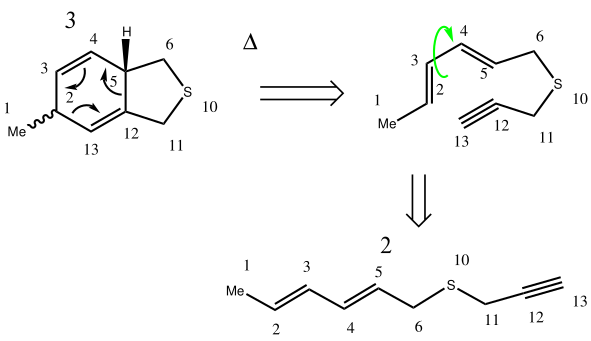
We can now turn our attention to the last reaction shown above. Since we have both structures now, we can do a retrosynthetic analysis, which reveals that in the final step, C2-C13 and C5-C12 have both got to form. Such a pattern is another six-electron pericyclic reaction, the Diels-Alder π2s + π4s cycloaddition. Again, we have to rotate about the C3-C4 single bond (green arrow) to get the diene of the reactant into a conformation capable of undertaking this reaction. We are helped in this by ensuring that the trans hydrogens at both C2-C3 and C4-C5 (which we inferred from the values of the J-couplings above) are not transformed during our redrawing of this conformation.

14c

The conclusion to this tutorial comes in assigning the stereochemistry of that methyl group. The π4s component of the cycloaddition mandates that the two bonds forming to C5 and to C2 must both form suprafacially across this four-carbon unit. We know that the bond to C5 must form on the bottom face, so as to rotate the C5-H up. Therefore it must form on the bottom face also of C2, likewise rotating the attached hydrogen up. Therefore the methyl must point  down in the final product.

QED.

But not quite, since nowadays, one can take the NMR analysis one step further. In another post, I will perform a full quantum mechanical prediction of the above NMR spectrum to see how well it matches what is reported above.

References

  1. K. Harano, M. Eto, K. Ono, K. Misaka, and T. Hisano, "Sequential pericyclic reactions of unsaturated xanthates. One-pot synthesis of hydrobenzo[c]thiophenes", Journal of the Chemical Society, Perkin Transactions 1, pp. 299, 1993. https://doi.org/10.1039/p19930000299

The strangely attractive conformation of C17H36.

Sunday, January 13th, 2013

We tend to think of simple hydrocarbons as relatively inert and un-interesting molecules. However, a recent article[1], which was in fact highlighted by Steve Bachrach on his blog , asks what “The Last Globally Stable Extended Alkane” might be. In other words, at what stage does a straight-chain hydrocarbon fold back upon itself, and no significant population of the linear form remain? The answer was suggested to be C17H36. I thought I might subject this conformation to an NCI (non-covalent-interaction) analysis.

NCI analysis. Click for  3D.

NCI analysis. Click for 3D.

The colour coding for the NCI surface is such that towards blue is attractive, with green being mildly attractive and yellow mildly repulsive. Both blue and yellow can be seen at the point where the molecule bends round, and attractive green dominates the region where the two chains are parallel. Much in the manner of a Gekko’s feet[2], the strangely attractive van der Waals terms in a hydrocarbon are surprisingly cumulative!  You can generate an NCI surface for your favourite molecule here.

Addendum:  To show that NCI interactions are pretty additive, here is  C28H58:

C28 double hairpin. Click for  3D.

C28 double hairpin. Click for 3D.

References

  1. N.O.B. Lüttschwager, T.N. Wassermann, R.A. Mata, and M.A. Suhm, "The Last Globally Stable Extended Alkane", Angewandte Chemie International Edition, vol. 52, pp. 463-466, 2012. https://doi.org/10.1002/anie.201202894
  2. J. Yu, S. Chary, S. Das, J. Tamelier, N.S. Pesika, K.L. Turner, and J.N. Israelachvili, "Gecko‐Inspired Dry Adhesive for Robotic Applications", Advanced Functional Materials, vol. 21, pp. 3010-3018, 2011. https://doi.org/10.1002/adfm.201100493

A conflation of concepts: Conformation and pericyclic.

Thursday, January 10th, 2013

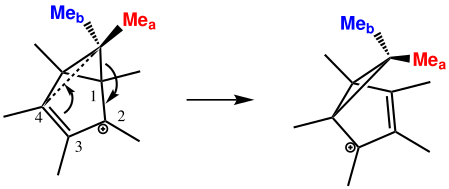
This is an interesting result I got when studying the [1,4] sigmatropic rearrangement of heptamethylbicyclo-[3.1.0]hexenyl cations. It fits into the last lecture of a series on pericyclic mechanisms, and just before the first lecture on conformational analysis. This is how they join.

14me

The experiment it relates to[1] may well be a contender for the top ten list of most influential experiments ever conducted in chemistry. At -40°C, the 1H NMR spectrum of this species has three peaks, at δ2.06, 1.57 and 1.13 ppm with an integral ratio of 15:3:3. The five basal methyls are averaged to 2.06 ppm, whereas those marked above as Mea and Meb exhibit distinct separate resonances. At -90°C, the five basal methyls split into peaks at δ2.48, 2.02, 1.66, in the integral ratio of 6:3:6. This indicates a process that is slow at the lower temperature but becomes fast (on the NMR time scale) at the higher temperature. The process must retain the individual identity of Mea and Meb.

The explanation is of course that a pericyclic [1,4] sigmatropic shift occurs. As a four electron process, this must have one antarafacial component, and this is by far easier to achieve by inverting the configuration at the migrating carbon centre. To convince oneself that this process does indeed retain the individual identity of Mea and Meb, an IRC of the reaction can be computed (ωB97XD/6-311G).

Click for  3D.

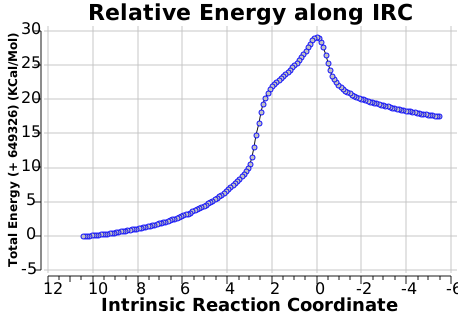
The energy profile is smooth and springs no surprises. The barrier is about right for the temperatures noted above. 14meE

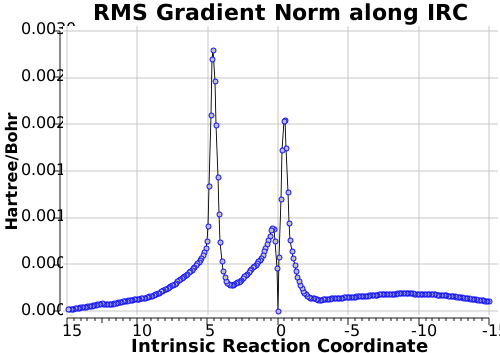
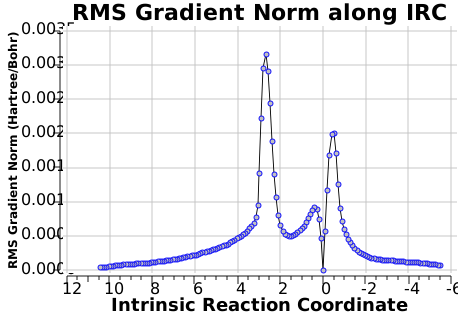
But the RMS gradient norm along the IRC is unexpected. 14meG

  1. Between the limits IRC ± 9, the profile is that of a reaction, involving bonds breaking and forming.
  2. In the range IRC ± (9 – 15), unexpected features appear (hidden intermediates if you check this post). A whole plethora of them. This is the conformational region where the methyl flags start waving (and no bonds are formed or broken). If you watch the animation above very carefully, you will note that the methyl groups start rotating at the start and at the end of the migration, at a stage when the ring has an allyl cation. This delocalised cation has a different impact upon the conformation of the methyl groups from that of the transition state, where the charge now resides largely on the migrating carbon, and the ring now has just a neutral butadiene. This latter imparts a different conformational preference upon the methyl groups. You can see an orbital analysis of these effects at this post.
  3. But perhaps the most surprising aspect of all of this is that each methyl flag waves at a different time from the others; first one waves, then the second and then the third. The two remaining basal methyls (attached to sp3 carbons) do not wave at all.

So this classic reaction is not just a pericyclic exemplar, it also illustrates nicely and concisely the conformational analysis of methyl groups interacting with an unsaturated system. Two for the price of one so to speak.

References

  1. R.F. Childs, and S. Winstein, "Ring opening and fivefold degenerate scrambling in hexa- and heptamethylbicyclo[3.1.0]hexenyl cations", Journal of the American Chemical Society, vol. 90, pp. 7146-7147, 1968. https://doi.org/10.1021/ja01027a059

Hidden intermediates in the benzidine rearrangement. The monoprotonated mechanism.

Tuesday, January 8th, 2013

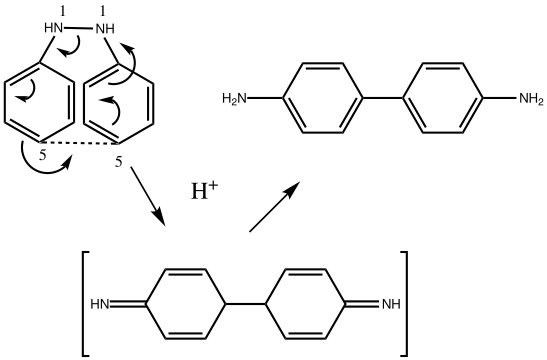
Eagle-eyed footnote readers might have spotted one at the bottom of the post on the benzidine rearrangement. I was comparing the N-N bond lengths in crystal structures of known diprotonated hydrazines (~1.45Å) with the computed N-N bond length at the start point of the intrinsic reaction coordinate for the [5,5] sigmatropic rearrangement of di-N-protonated diphenylhydrazine (the active species in the benzidine rearrangement itself), which was some 1Å longer. This post explores the implications of this oddity.

benzidine

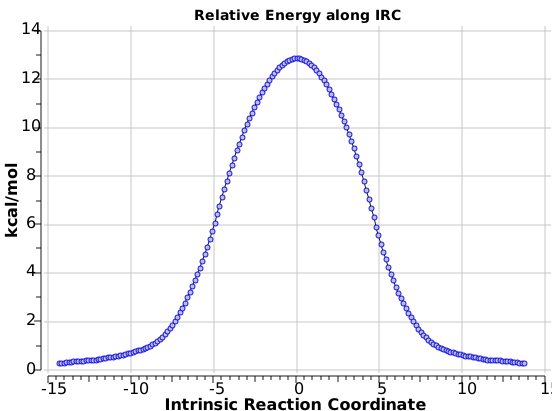
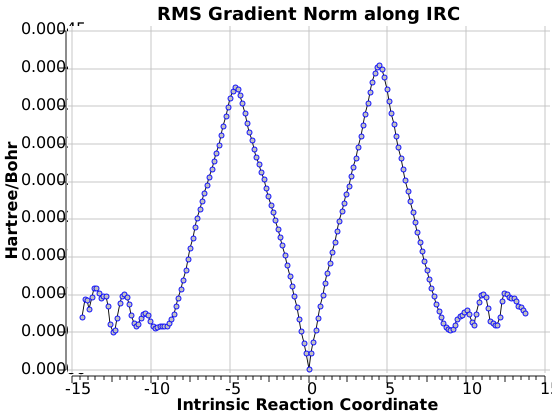
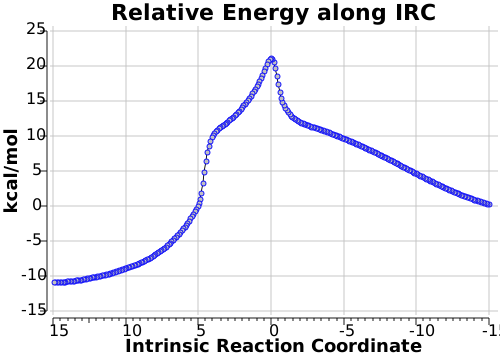
My start point however is actually the mono-N-protonated system. The IRC for the calculated transition state is shown below. The activation barrier is a lot higher than with the diprotonated route, but I want to bring to your attention a feature at IRC = +5 to +3. At this point the RMS gradient norm dips, approaching but not quite reaching zero. This is what is called a hidden intermediate, an intermediate that does not quite form. It is in this region that the N-N bond length changes from the value of about 1.45Å for the monoprotonated hydrazine, to around 2.5Å at the point of the “hidden intermediate”. This represents the formation of the π-π-stacked complex as the preamble to the actual rearrangement, the transition state for which is of course reached at IRC =0.0. For this system, the [5,5] sigmatropic is actually slightly higher ( ΔG298 +2.4 kcal/mol) than the competing [3,3] rearrangement, which also shows that hidden intermediate ( at IRC ~+2.0). This close balance between the [3,3] and the [5,5] mechanisms suggests that factors such as ring substituents, counter-ion, solvent etc may in fact be able to swing this balance one way or the other. 

 
The 5,5, sigmatropic rearrangement of monoprotonated. Click for  3D

The 5,5, sigmatropic rearrangement of monoprotonated diphenylhydrazine. Click for 3D

 benzidine-HCl-55E benzidine-HCl-55G
The 3,3 sigmatropic rearrangement of monoprotonated diphenylhydrazine. Click for  3D.

The 3,3 sigmatropic rearrangement of monoprotonated diphenylhydrazine. Click for 3D.

benzidine-HCl-33E benzidine-HCl-33G

Which brings us back to the diprotonated species, the one with the N-N bond length of 2.53Å. This is a stable minimum (i.e. the RMS gradient norm is zero) with no imaginary frequencies computed, and hence it is no longer a hidden intermediate, but an exposed π-complex. Adding that second proton has stabilised it considerably. It is higher in ΔG298 than the anti-conformation of diprotonated diphenylhydrazine by 6.1 kcal/mol, the latter having the normal N-N bond length of 1.46Å. The free energy barrier from the π-complex to the transition state for [5,5] rearrangement (shown in previous post) is a mere 2.4 kcal/mol. The barrier from the same π-complex to the transition state (N-N length 1.97Å) leading back to N-N diprotonated diphenylhydrazine is also small, 3.1 kcal/mol, so this π-complex is bounded only by small barriers and hence is very unlikely to be directly detected.

The benzidine p-complex. Click for 3D.

The benzidine π-complex. Click for 3D.

Anti-diprotonated diphenyl hydrazine. Click for  3D.

Anti-diprotonated diphenyl hydrazine. Click for 3D.

Transition state between p-complex and  N-N diprotonated diphenyhydrazine. Click for  3D.

Transition state between π-complex and N-N diprotonated diphenyhydrazine. Click for 3D.

To conclude, mono-protonated diphenyl hydrazine rearranges to the 4,4′-diaminobiphenyl via the so-called benzidine rearrangement by a concerted process that involves a hidden π-complex forming before the transition state is reached. Diprotonation exposes this hidden complex formed from diphenylhydrazine. This complex is the true starting point for the [5,5] sigmatropic rearrangement (if it can still be called that). The overall reaction becomes more exothermic by in effect separating the two positive charges resulting from nitrogen diprotonation onto the two phenyl rings, an affect which also encourages the π-complex to form.


Another good example of such a species is the intermediate carbocation in the solvolysis of t-butyl chloride. This too is hidden.

It is rather curious that Ph-NH-O-Ph is in effect unknown (apart from one patent). Could it be that it cannot be prevented from rearranging by the same mechanism as Ph-NH-NH-Ph?


The mechanism of the Birch reduction. Sequel to benzene reduction.

Wednesday, December 5th, 2012

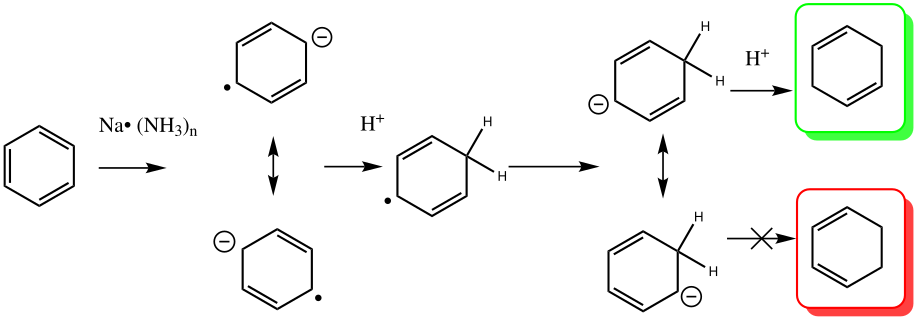
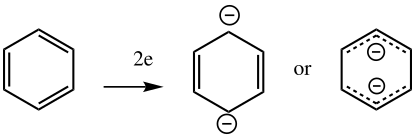
I noted briefly in discussing why Birch reduction of benzene gives 1,4-cyclohexadiene (diagram below) that the geometry of the end-stage pentadienyl anion was distorted in the presence of the sodium cation to favour this product. This distortion actually has some pedagogic value, and so I elaborate this here.

The starting point is now the molecular orbitals of benzene, and in particular the lowest unoccupied set (LUMO), which is doubly degenerate (in energy).

First of the pair of degenerate lowest unoccupied MOs of benzene. Click for 3D.

Second of the pair of degenerate lowest unoccupied MOs of benzene. Click for 3D.

An (overall) two-electron reduction of benzene (followed by protonation) can formally at least place the two electrons into either of these orbitals. Doing so would lower the energy of the occupied orbital, and hence induce a geometric distortion as illustrated below. In effect, the outcome is an (antiaromatic) di-anion with either two short and four long bonds, or the alternative of four shorter and two long bonds. The proximate presence of a solvated sodium cation now clearly breaks this degeneracy; the coordination preference of Na+ (and a proton) favours the former over the latter, and the outcome is as shown in the previous post.

The orbitals of benzene are frequently included in undergraduate teaching, but here we have a direct use for the LUMO pair in explaining the outcome of the reduction of benzene by electrons. It also links into what happens when anti-aromaticity is avoided (when a  4n π-electron system distorts to avoid it).

Postscript:  The computed structure of benzene di-anion is shown below. It is 19.5 kcal/mol lower than the alternative valence bond isomer.

Stable form. Click for 3D.


Less stable form. Click for 3D.