Posts Tagged ‘energy’

The mechanism of the Birch reduction. Part 1: reduction of anisole.

Saturday, December 1st, 2012

The Birch reduction is a classic method for partially reducing e.g. aryl ethers using electrons (from sodium dissolved in ammonia) as the reductant rather than e.g. dihydrogen. As happens occasionally in chemistry, a long debate broke out over the two alternative mechanisms labelled O (for ortho protonation of the initial radical anion intermediate) or M (for meta protonation). Text books seem to have settled down of late in favour of O. Here I take a look at the issue myself.
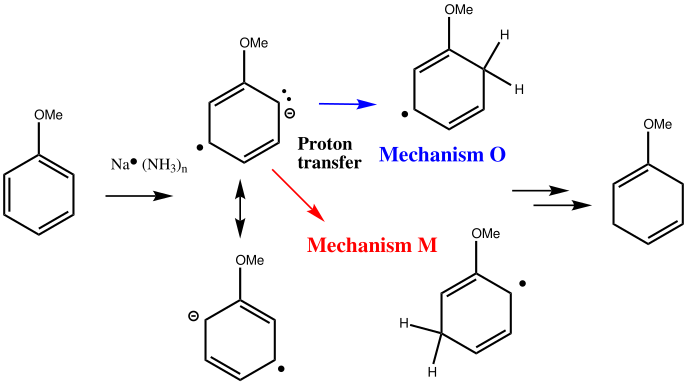
Readers of my blog will note that I promote the use of models which are as reasonably complete as one can make them. In this case, if the intermediate is an anion, then I argue that the model should include the positive counter-ion. This is very often simply not included, on the grounds that it “probably does not influence things”. Well, not on this blog! My model is methoxybenzene, a sodium atom solvated by 3NH3 (the reaction itself is done in liquid ammonia with some added t-butanol) and continuum solvent (not ammonia itself, but acetonitrile which has a similar dielectric to liquid ammonia with some added butanol). 

The start point is a solvated sodium atom (loosely) coordinated to anisole (methoxybenzene). The calculation (ωB97XD/6-311+G(d,p)/SCRF=acetonitrile) on this neutral system shows the spin density arising from the single unpaired electron is mostly (0.851) on the sodium, although a little spin density has crept onto the anisole. The dipole moment (12.0D) shows that solvation cannot just be ignored. 

Start point, with select spin densities. Click for 3D

The next stage involves an electron transfer from the sodium to the anisole ring, and indeed the spin densities transfer from the Na to the two ortho- and two meta-positions on the ring (the residual value on Na is -0.02). This suggests that the valence bond representations in the diagram above are incomplete (they imply spin density on only two rather than four carbon atoms). The geometry of the anisole ring now shows bond alternation, with two long bonds (1.45 – 1.46Å) and four short bonds (1.39-1.41Å). This could be viewed as the result of a pseudo-Jahn-Teller distortion resulting from placing an electron into one of the degenerate LUMO molecular orbitals of the benzene-like set. The free energy ΔG298 of this charge-transferred product is 11.1 kcal/mol exothermic compared to the reactant and it has a dipole moment of 11.6D, similar to the precursor despite being an ion pair!

The contact ion-pair resulting from electron transfer. Click for 3D.

I start the analysis of how this species will protonate by inspecting the four highest energy NBOs (natural bond orbitals). Their energies are -0.144, -0.152, -0.167 and -0.167 au. The first of these with the highest energy might be expected to be the most basic. It corresponds to M in the above scheme (below). The next however is O and the last two are the remaining O/M positions.

Highest energy (-0.144) NBO orbital on M. Click for 3D.


Next highest energy (-0.152)  NBO on O. Click for 3D.

Another measure of basicity is the molecular electrostatic potential (a measure of how attractive any point in space is towards a proton). It is shown below (as a green surface) only as the -ve potential (that part that is attractive to a proton). On the face bearing the proton donors (the ammonia groups attached to the Na) there is a clear preference for O (marked with a magenta arrow, but not the same O as predicted by the NBO), but with a slightly smaller basin corresponding to M (again, not the M from the NBO analysis and marked with an orange arrow).

Molecular electrostatic potential (-ve phase). Click for 3D

Viewed from the other side of the anisole ring (and rendered at a higher threshold), the electrostatic potential seems to favour O, but only very slightly over M. There really is not much in it.

Molecular electrostatic potential (-ve phase, other face). Click for 3D.

All these properties are measures of the radical-anion-ion-pair. It is clear these different measures do not agree with one another! What we really need is the transition state for the proton transfer. I will go off and hunt for these. If I find them, I will report back here. And beyond the transition state are the dynamic trajectories for the protonation, which ultimately may be the only way of finally resolving this conundrum. 
Secrets of a university tutor. An exercise in mechanistic logic: second dénouement.

Monday, October 29th, 2012

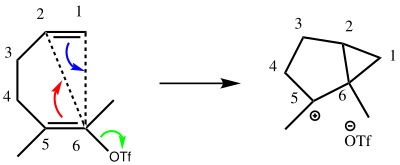
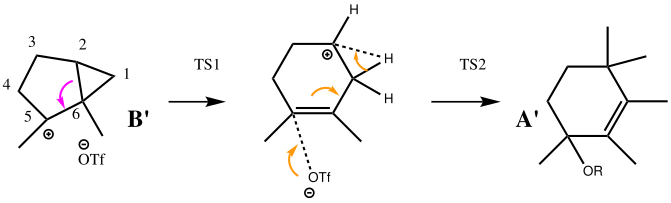
Following on from our first mechanistic reality check, we now need to verify how product A might arise in the mechanism shown below, starting from B.

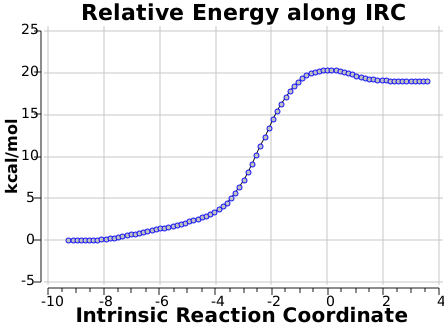
This pathway backtracks the original one in reversing the final arrow of that process (shown in red in previous post and in magenta here for the arrow in reverse), to go uphill in energy to reach the secondary (unstabilised) carbocation. This turns out to be a very shallow minimum, almost merely a ledge on the mountainside. It is not difficult to see how the original pathway down to B’ might have missed this Y-fork (= bifurcation).

Transition state for cyclopropyl ring opening. Click for 3D.

This unstable carbocation does not hang around; the barrier to transfer of a hydrogen (orange arrows) is tiny. This motion completes the formation of the product A.

We have seen here a classical analysis of mechanism in terms of an energy profile that has a separate pathway and associated transition state for each product in a reaction. But one should note that there are increasing claims for reactions whose outcome is determined not by an explicit transition state for each reaction pathway, but where the very dynamics of the system as it exits from a single transition state can result in a bifurcation into two (or indeed more) final products. I would like to suggest that the reaction described here might also be such an example. Thus although the mechanism as shown below shows just the single product B, it might be that only a small diversion from that initial pathway would also result in formation of A, and that there would be no need for the explicit transition states to this species as shown above to be actually visited.

It would finish by noting that all the mechanisms above were studied with inclusion of the triflate counter-ion; indeed the first step could not really be studied without it. The system seems a good candidate for a thorough molecular dynamics exploration;  I have certainly come a long way from an introductory tutorial in organic chemistry!

Text-books and the bromination of ethene.

Sunday, October 14th, 2012

There is often a disconnect between how a text-book (schematically) represents a reaction and a more quantitive “reality” revealed by quantum mechanics. Is the bromination of ethene to give 1,2-dibromoethane one such example?

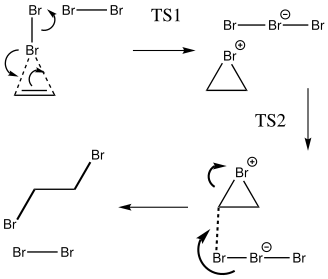
Text-books will show how ethene interacts with bromine to form a cyclic bromonium cation, which with the liberated bromide anion makes for an ion-pair. Using quantum mechanics (DFT ωB97XT/6-311G(d,p)/SCRF=dichloromethane), one soon realises that the ion-pair will need to be stabilised, both by solvation and possibly by interacting the bromide anion with a further bromine to form a tribromide anion (as shown above). A transition state for this process can indeed be located, and this is shown below, together with the IRC for the process.

Transition state for reaction between bromine and ethene. Click for 3D

The barrier (~ 7 kcal/mol) is appropriately small for what is a rapid reaction. The ion-pair formed is only stable by ~ 1 kcal/mol towards a reverse reaction. Here however, the limitations of this relatively simple solvation model (a continuum solvent and an extra bromine molecule) may be under-estimating its stability. 

The interesting bit comes next. The ion-pair has got to relocate itself to a position where the tribromide anion can back-side attack the bromonium cation. Ion-pairs are unlike normal molecules, where covalent bonds determine fairly clearly what the geometry and its conformations might be. There are no straightforward rules for establishing what the geometry of an ion-pair might be, or indeed what its energy relative to other poses might be, other than perhaps simply minimising its dipole moment. In this example, quantum mechanics tells us that in fact the ion-pair is about 2 kcal/mol MORE stable in its new location, and so it can presumably diffuse over with a clear driving force. Once it is back-side located, the reaction completes without any enthalpic barrier; it is downhill all the way!

This is a fairly simple model for the reaction between bromine and ethene. Modelling it however is not that simple. Any reaction which undergoes a transition from covalency to ionicity in one or more bond is always a challenge. And ionic systems may not always be best represented by (non-statistical) models which include only one molecule (as is the case with ionic solids). But the picture I have shown here takes the text-book schemes up one level, and we now have at least an estimate of the energies involved, as well as geometries.


 The geometry of TS2 is shown below. It has a dipole moment of 19.3D and is some 9.6 kcal/mol in ΔG above TS1, which has a dipole moment of 18.7D. It may of course not be the lowest energy pathway for reorganisation of the ion-pair.

Click for animation.

Where backside attack is prevented by steric bulk, this very ion-pair can actually be isolated as a crystal[1]

Crystal structure of a bromonium cation-tribromide anion pair. Click for 3D.

It is also possible to isolate the bromonium cation using a different counter-anion, by the same subterfuge of steric hindrance[2]. This structure also is unusual in revealing an isolated hydronium ion cation, H3O+.

A cyclic bromonium ion using triflate counter-anions. Click for 3D

References

  1. H. Slebocka-Tilk, R.G. Ball, and R.S. Brown, "The question of reversible formation of bromonium ions during the course of electrophilic bromination of olefins. 2. The crystal and molecular structure of the bromonium ion of adamantylideneadamantane", Journal of the American Chemical Society, vol. 107, pp. 4504-4508, 1985. https://doi.org/10.1021/ja00301a021
  2. R.S. Brown, R.W. Nagorski, A.J. Bennet, R.E.D. McClung, G.H.M. Aarts, M. Klobukowski, R. McDonald, and B.D. Santarsiero, "Stable Bromonium and Iodonium Ions of the Hindered Olefins Adamantylideneadamantane and Bicyclo[3.3.1]nonylidenebicyclo[3.3.1]nonane. X-Ray Structure, Transfer of Positive Halogens to Acceptor Olefins, and ab Initio Studies", Journal of the American Chemical Society, vol. 116, pp. 2448-2456, 1994. https://doi.org/10.1021/ja00085a027

Ring-flipping in cyclohexane in a different light

Friday, October 12th, 2012

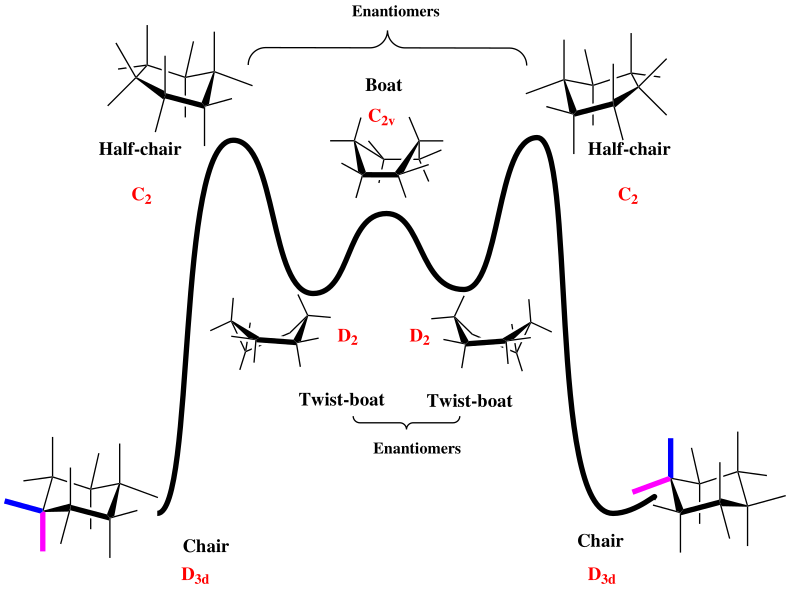
The conformational analysis of cyclohexane is a mainstay of organic chemistry. Is there anything new that can be said about it? Let us start with the diagram below:

This identifies the start of the process as a chair conformation of cyclohexane, with D3d symmetry. I have highlighted a pair of hydrogens attached to the left most carbon atom in blue (equatorial) and magenta (axial). On the right hand side of the diagram this pair has transposed position, with the blue now being axial and the magenta equatorial. The same is true of the other five pairs of methylene hydrogens. We need to identify the pathway by which this happens. The pathway shown above proceeds through a half-chair transition state of C2 symmetry, falling to the first intermediate twist-boat of D2 symmetry before reaching a second transition state of C2v symmetry known as the boat. The whole diagram is mirror-symmetric about this point. The point to note about this diagram is that the species labelled C2 and D2 are dissymetric (chiral), whereas the ones labelled D3d and C2v are not. This means that there are two enantiomeric half-chair transition states, as there are the two twist-boats. This introduction of (di)symmetry does rather change the way we look at the process!

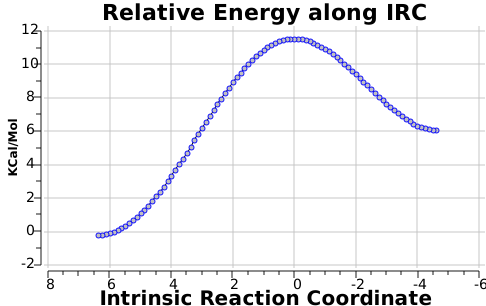
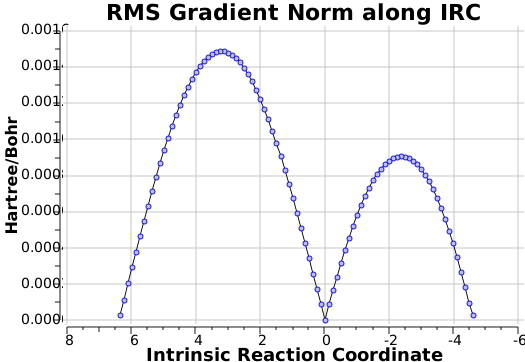
Now let me introduce the intrinsic reaction coordinate (IRC, ωB97XD/6-311G(d,p)/SCRF=cyclohexane), as followed from the half-chair transition state, and connecting the chair and the twist-boat.

View 1 (click to see Chair ) View 2 (click to see Twist-boat)

View 1 is looking down the C2 axis present in the half-chair transition state and both start and end points. View 2 rotates this by 90° along the y-axis, and is again looking down a C2 axis. This axis is present only when the IRC starts at the D3d chair conformation or reaches a D2 twist-boat conformation (becoming one of three at this point). The latter conformation is ~6 kcal/mol higher in energy than the chair. At this twist-boat geometry (shown below), the two hydrogens labelled with blue and magenta appear to be in an identical environment (in other words the axial or equatorial distinction between them is lost at this point). This might appear to be what we need to “flip” the environments of any pair of axial and equatorial hydrogens. But is it sufficient?

At the twist boat above, whilst the chemical environment of the pair of hydrogens identified with blue and magenta arrows is identical, their (pro)chirality is not. Because they both sit in a chiral molecule, their individual relationship to that chirality is said to be pro-chiral. The path shown above, on its own, does not interconvert the (pro)chirality of this pair of hydrogens. To do this, we need to get to the enantiomeric twist-boat conformation shown below, and this is achieved by passing through an achiral transition state of C2v symmetry, in other words a pure boat (see below).

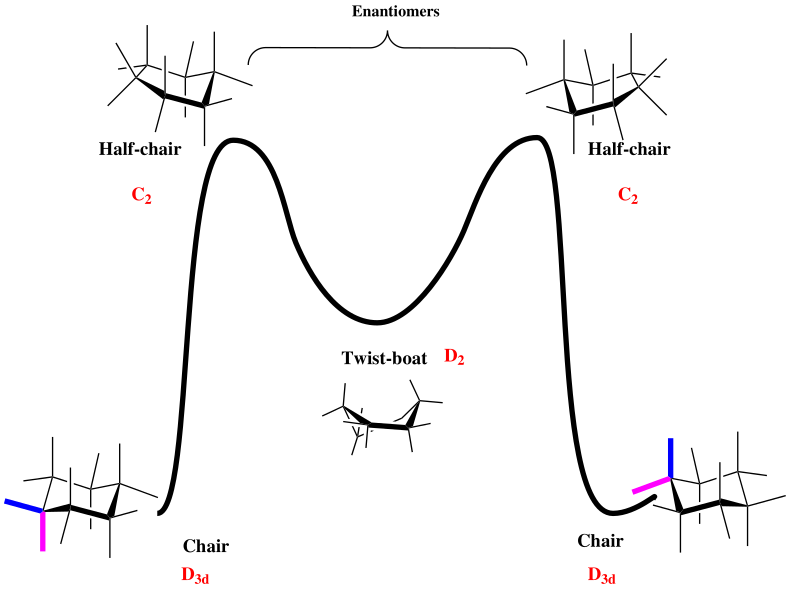
Well, now I pose a question. Is the above route the ONLY way of transposing the axial/equatorial identity of pairs of methylene hydrogens in this molecule? If you check the text books, some will in fact show a different diagram, in which the C2v boat is entirely uninvolved and only one enantiomer of the D2 twist-boat conformations is shown, as below.

These two pathways do differ fundamentally. The first (longer) pathway passes through an achiral boat transition state. The second (shorter) one involves two chiral half-chair transition states connecting a single chiral twist-boat, but implies that there must be two such pathways, each the enantiomer of the other.  I should point out that since these two options share a common transition state, their energies are identical. Which one is the more realistic?  I think only the technique of molecular dynamics, in which the momentum of the trajectories along the path is factored in, will tell us. 


Postscript: The IRC for the enantiomerization of one twist boat into the other via a boat transition state is shown below. The axial-equatorial transpositions can be clearly seen in this view.

Frozen Semibullvalene: a holy grail (and a bis-homoaromatic molecule).

Saturday, September 15th, 2012

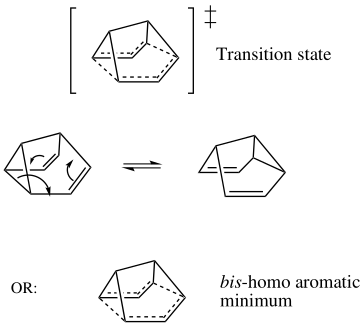
Semibullvalene is an unsettling molecule. Whilst it has a classical structure describable by a combination of Lewis-style two electron and four electron bonds, its NMR behaviour reveals it to be highly fluxional. This means that even at low temperatures, the position of these two-electron bonds rapidly shifts in the equilibrium shown below. Nevertheless, this dynamic behaviour can be frozen out at sufficiently low temperatures. But the barrier was sufficiently low that a challenge was set; could one achieve a system in which the barrier was removed entirely, to freeze out the coordinates of the molecule into a structure where the transition state (shown at the top) became instead a true minimum (bottom)? A similar challenge had been set for freezing out the transition state for the Sn2 reaction into a minimum, the topic also of a more recent post here. Here I explore how close we might be to achieving inversion of the semibullvalene [3,3] sigmatropic potential.

Why might such a frozen transition state be interesting? Well, all transition states for allowed thermal pericyclic reactions can be described as aromatic. If one were able to transmogrify such a transition state into a minimum, then it too would be expected to be aromatic, but a most unusual type of aromatic. The C-C bonds which represent the breaking and forming bonds in a [3,3] sigmatropic rearrangement would in effect be two-centre 1-electron bonds, and those electrons would be part of the aromatic sextet. Such bonds are normally referred to as homoaromatic, examples of which are pretty rare. In my previous post, I had noted a crystal structure[1] that apparently sustains two equal C-C bonds of length 1.99Å. However, a calculation at this geometry reveals it in fact to be a transition state (above, top), with an imaginary mode of 275i cm-1. So the challenge (computationally at least) is to find a system where this imaginary mode is changed to become real rather than imaginary.

CAZFUE. Click for animation of imaginary transition state mode.

My effort to achieve this involved augmenting CAZFUE with a further two cyano groups. This did indeed reduce the imaginary mode to 74i cm-1; we are getting close! 

Tetracyano derivative of CAZFUE. Click for animation.

The next step was to read a recent article[2] in which replacing the key C-C bond with a C-N bond was observed to reduce the barrier for the rearrangement to ~ 4 kcal/mol. So I immediately computed the tetra-azo system, in which the two key C-C bonds are now replaced by N-N bonds in order to extend this effect.

Tetra-azo semibullvalene. Click for animation of key frozen mode.

It was gratifying to observe that the [3,3] sigmatropic vibration, imaginary (i.e. corresponding to a transition state) in the previous examples, became +ve (+238 cm-1) in this system. The two N-N bonds are however not completely symmetric (2.06 and 2.17Å), but they are in effect essentially frozen at the half-way stage of the equilibrium.
The final step in this path is to combine the two effects above, by exploring the di-cyano-diaza derivative.

Di-cyano, diazo derivative. Click for 3D.

This now has C2 (chiral) exact two-fold symmetry, with C-N distances of 2.139Å. The [3,3] sigmatropic vibrational mode is again real, with a value of 255 cm-1. A real candidate for synthesis perhaps?

Finally, is it aromatic? The wavefunction for this system is stable (which means no triplet state lower in energy can be found), so it stands a good chance of being so. I will report back on this aspect in a later post.


Postscript: The above calculation for the last system was done at the B3LYP/6-311G(d,p)/SCRF=thf level. A similar result is obtained at e.g. a  MP2/6-311G(d,p)/SCRF=thf level; the  [3,3] vibrational mode has the real value of 318 cm-1.

References

  1. L.M. Jackman, A. Benesi, A. Mayer, H. Quast, E.M. Peters, K. Peters, and H.G. Von Schnering, "The Cope rearrangement of 1,5-dimethylsemibullvalene-2,6- and 3,7-dicarbonitriles in the solid state", Journal of the American Chemical Society, vol. 111, pp. 1512-1513, 1989. https://doi.org/10.1021/ja00186a064
  2. S. Zhang, J. Wei, M. Zhan, Q. Luo, C. Wang, W. Zhang, and Z. Xi, "2,6-Diazasemibullvalenes: Synthesis, Structural Characterization, Reaction Chemistry, and Theoretical Analysis", Journal of the American Chemical Society, vol. 134, pp. 11964-11967, 2012. https://doi.org/10.1021/ja305581f

“Text” Books in a (higher) education environment.

Friday, May 18th, 2012

Text books (is this a misnomer, much like “papers” are in journals?) in a higher-educational chemistry environment, I feel, are at a cross-roads. What happens next?

Faced with the ever-increasing costs of course texts, the department where I teach introduced a book-bundle about five years ago. The bundle included all the recommended texts for an appreciable discount over individual purchase. In their first week at Uni, students were encouraged to acquire the bundle. As it happened, I met them for a tutorial shortly after this acquisition. The bundle weighed some 9 kg, and came shrink-wrapped into a strapless plastic sheath, posing a rather slippery and weighty challenge for the student to get back to their residency. A few months later, I asked the students how they were getting on reading their newly acquired texts. You must appreciate that it does take a few months for students to start getting “street-wise” about their uni experience. One savvy student recounted they had learnt that if one did not remove the plastic outer layer from the bundle, it would retain much of its resale value to the next generation of incoming students.

Now, I will not mention the publisher of this particular bundle, but its cost is in the region of £50 per text. And for some students, the 1500 or so pages of each volume remain largely unread. Rarely if ever do I see these texts brought into tutorials, and I expect the margins remain blank, un-annotated with any questions or notes (it affects the resale value if you do that). Which is a stark contrast to how the students nowadays annotate their lecture note hand-outs often (but not invariably) issued to them at the start of a lecture. I also observe that increasingly my tutorials are effectively annotated by the students attending (2-4 pages of notes can be taken during a 50 minute discussion. The unit can be declared as pages, since this is also done on paper).

Despite these trends, pedagogic usage of tablet devices such as Kindles and iPads remains relatively low. It is a chicken-and-egg situation. The aforementioned book bundle is not available for these devices, and if it were, then in the current business model, it would be DRM (digital-rights-management) protected to prevent resale, and would also probably retain (if not exceed) the cost of the printed version. Hardly attractive to a student. The lecture notes we distribute (as printed handouts) do indeed come as PDF versions which can be placed on a mobile tablet, but this advantage alone has not sufficed to promote rapid uptake of tablet here. Few materials are specifically optimised to take advantage of the unique features of a tablet, and so the printed lecture notes are considered acceptable. Perhaps this comes to the core of what such tablets are supposed to be. Are they devices for “content consumption”, or should we also expect them to be capable of “content creation”? Lecture (and tutorial) annotation is of course content creation (or perhaps augmentation). 

I might also take a look at the situation from the point of view of the textbook author. Unless you are a big name, you might expect to redeem about 10% royalties from one of the traditional publishers of academic texts. It might take you a year or so to write it, and you would expect to issue a further edition five years down the line if the book is successful. Two generations ago, every academic might be expected to write at least one book. I suspect that aspect has reduced nowadays; authors can hardly be encouraged to write if they think there is a prospect that the shrink-wrapping might not even be removed! If you are intending to write a text about, lets say stereochemistry, you also have to accept the 2D limitations of a printed book, or the inability to say animate a reaction path.

Where are these thoughts leading? Well, I do have to give an explicit example; Steve Jobs’ vision of the educational text-book, re-invented along the lines of what he famously introduced for music distribution. There, he recognised that the (presumed illegal) sharing of music via download sites that preceded the iTunes store was not a sustainable model. The $.99 download was conspicuously cheaper than the price of a physical music CD (excepting classical music, which did become absurdly cheap in this form), and a compromise on sharing stipulated only on devices owned by you rather than more widely amongst your friends. The same model was introduced for the iBook store. Here, the author of an eBook (I am no longer calling it a textbook) can if they wish retain 70% of whatever income it generates (it can also be free of course). The unit price was a fraction of the traditional paper-based book, low enough that the DRM-imposed inability to resell it was less of an issue.

What are the downsides of moving on from paper?

  1. Well, unlike a paper book which is instantly useable, the reader has to purchase a device. This device can cost more than the book bundle referred to above, although at its cheapest, the device is actually only about half the cost of the book bundle. And one might expect that device to last only 2-4 years before it becomes obsolete.
  2. It can be lost or damaged, although unlike a paper book, the online content can be readily restored at zero cost .
  3. If you purchase an eBook for one (proprietary) device, you cannot transfer it to another such device (say Kindle to iPad or vice versa), although if the content is free, that would not matter.
  4. Authors of such texts will have to retrain themselves to produce ebooks; it is not just a matter of using a standard word processor any more. I suspect writing/imaging/styling/scripting/widgeting (a verb for this collective process is needed; how about to flow?) an ebook takes a lot longer than word processing a text-book.
  5. You might have to consider the ongoing cost of using an ebook. By this I mean the data-plan that you might need in place to download components which are not actually part of the book (see below).

The upsides? Well, rather than my producing a list at this point, you might want to take a look at the first two examples below, both created by Bob Hanson, and think about how such inclusion in an ebook might enhance it:

  1. A device-sensitive page for display (try this out on an iPad or Android tablet; the Kindle might be more of a challenge).
  2. A page for building and minimising a molecular model
  3. This example is included, since it belongs to a chemistry text book, but actually would exist on a mobile device in functional form, if not actually a component of an ebook.

So an ebook becomes an environment where you can download a model from public databases, and annotate it with properties etc. Or you could use your ebook to build a model from scratch, then minimise its (molecular mechanics) energy, to say explore conformational analysis in the context of a chapter on the topic.

Well, at the start I posed the question what happens next? The two above examples give possible answers. An equally interesting question might then be who makes it happen? Will that be the evolutionary role of the traditional publishing houses? Will a new generation of skilful author capable of “flowing” an ebook emerge? Will students instead favour retaining their dependency on paper? Watch this space.

"Text" Books in a (higher) education environment.

Friday, May 18th, 2012

Text books (is this a misnomer, much like “papers” are in journals?) in a higher-educational chemistry environment, I feel, are at a cross-roads. What happens next?

Faced with the ever-increasing costs of course texts, the department where I teach introduced a book-bundle about five years ago. The bundle included all the recommended texts for an appreciable discount over individual purchase. In their first week at Uni, students were encouraged to acquire the bundle. As it happened, I met them for a tutorial shortly after this acquisition. The bundle weighed some 9 kg, and came shrink-wrapped into a strapless plastic sheath, posing a rather slippery and weighty challenge for the student to get back to their residency. A few months later, I asked the students how they were getting on reading their newly acquired texts. You must appreciate that it does take a few months for students to start getting “street-wise” about their uni experience. One savvy student recounted they had learnt that if one did not remove the plastic outer layer from the bundle, it would retain much of its resale value to the next generation of incoming students.

Now, I will not mention the publisher of this particular bundle, but its cost is in the region of £50 per text. And for some students, the 1500 or so pages of each volume remain largely unread. Rarely if ever do I see these texts brought into tutorials, and I expect the margins remain blank, un-annotated with any questions or notes (it affects the resale value if you do that). Which is a stark contrast to how the students nowadays annotate their lecture note hand-outs often (but not invariably) issued to them at the start of a lecture. I also observe that increasingly my tutorials are effectively annotated by the students attending (2-4 pages of notes can be taken during a 50 minute discussion. The unit can be declared as pages, since this is also done on paper).

Despite these trends, pedagogic usage of tablet devices such as Kindles and iPads remains relatively low. It is a chicken-and-egg situation. The aforementioned book bundle is not available for these devices, and if it were, then in the current business model, it would be DRM (digital-rights-management) protected to prevent resale, and would also probably retain (if not exceed) the cost of the printed version. Hardly attractive to a student. The lecture notes we distribute (as printed handouts) do indeed come as PDF versions which can be placed on a mobile tablet, but this advantage alone has not sufficed to promote rapid uptake of tablet here. Few materials are specifically optimised to take advantage of the unique features of a tablet, and so the printed lecture notes are considered acceptable. Perhaps this comes to the core of what such tablets are supposed to be. Are they devices for “content consumption”, or should we also expect them to be capable of “content creation”? Lecture (and tutorial) annotation is of course content creation (or perhaps augmentation). 

I might also take a look at the situation from the point of view of the textbook author. Unless you are a big name, you might expect to redeem about 10% royalties from one of the traditional publishers of academic texts. It might take you a year or so to write it, and you would expect to issue a further edition five years down the line if the book is successful. Two generations ago, every academic might be expected to write at least one book. I suspect that aspect has reduced nowadays; authors can hardly be encouraged to write if they think there is a prospect that the shrink-wrapping might not even be removed! If you are intending to write a text about, lets say stereochemistry, you also have to accept the 2D limitations of a printed book, or the inability to say animate a reaction path.

Where are these thoughts leading? Well, I do have to give an explicit example; Steve Jobs’ vision of the educational text-book, re-invented along the lines of what he famously introduced for music distribution. There, he recognised that the (presumed illegal) sharing of music via download sites that preceded the iTunes store was not a sustainable model. The $.99 download was conspicuously cheaper than the price of a physical music CD (excepting classical music, which did become absurdly cheap in this form), and a compromise on sharing stipulated only on devices owned by you rather than more widely amongst your friends. The same model was introduced for the iBook store. Here, the author of an eBook (I am no longer calling it a textbook) can if they wish retain 70% of whatever income it generates (it can also be free of course). The unit price was a fraction of the traditional paper-based book, low enough that the DRM-imposed inability to resell it was less of an issue.

What are the downsides of moving on from paper?

  1. Well, unlike a paper book which is instantly useable, the reader has to purchase a device. This device can cost more than the book bundle referred to above, although at its cheapest, the device is actually only about half the cost of the book bundle. And one might expect that device to last only 2-4 years before it becomes obsolete.
  2. It can be lost or damaged, although unlike a paper book, the online content can be readily restored at zero cost .
  3. If you purchase an eBook for one (proprietary) device, you cannot transfer it to another such device (say Kindle to iPad or vice versa), although if the content is free, that would not matter.
  4. Authors of such texts will have to retrain themselves to produce ebooks; it is not just a matter of using a standard word processor any more. I suspect writing/imaging/styling/scripting/widgeting (a verb for this collective process is needed; how about to flow?) an ebook takes a lot longer than word processing a text-book.
  5. You might have to consider the ongoing cost of using an ebook. By this I mean the data-plan that you might need in place to download components which are not actually part of the book (see below).

The upsides? Well, rather than my producing a list at this point, you might want to take a look at the first two examples below, both created by Bob Hanson, and think about how such inclusion in an ebook might enhance it:

  1. A device-sensitive page for display (try this out on an iPad or Android tablet; the Kindle might be more of a challenge).
  2. A page for building and minimising a molecular model
  3. This example is included, since it belongs to a chemistry text book, but actually would exist on a mobile device in functional form, if not actually a component of an ebook.

So an ebook becomes an environment where you can download a model from public databases, and annotate it with properties etc. Or you could use your ebook to build a model from scratch, then minimise its (molecular mechanics) energy, to say explore conformational analysis in the context of a chapter on the topic.

Well, at the start I posed the question what happens next? The two above examples give possible answers. An equally interesting question might then be who makes it happen? Will that be the evolutionary role of the traditional publishing houses? Will a new generation of skilful author capable of “flowing” an ebook emerge? Will students instead favour retaining their dependency on paper? Watch this space.

Stereoselectivities of Proline-Catalyzed Asymmetric Intermolecular Aldol Reactions.

Sunday, April 22nd, 2012

Astronomers who discover an asteroid get to name it, mathematicians have theorems named after them. Synthetic chemists get to name molecules (Hector’s base and Meldrum’s acid spring to mind) and reactions between them. What do computational chemists get to name? Transition states! One of the most famous of recent years is the Houk-List.
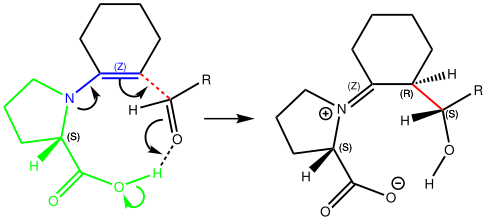
In the last 12 years or so, the area of enantioselective organocatalysis has blossomed, and an important example involves the asymmetric amino acid (S)-proline (below, shown in green). As its enamine derivative (below, shown in blue), it can catalyse the aldol condensation with an aldehyde or ketone to form two new adjacent stereogenic centres resulting from C-C bond formation (shown below as (R) and (S) as attached to the carbons connected to the red bond).

The Houk-List transition state was located for this reaction, and as a useful model for rationalising the stereospecificity of this reaction it has become justly famous (although to be fair, other models have also been proposed). The challenge is to identify the factors selecting for just one stereoisomer (S,R in this case) over the other three (a similar challenge is described in this post for the heterotactic polymerisation of lactide). Houk, List and co-workers constructed their model (the example shown below is for R=isopropyl)  as follows.

  1. They employed a B3LYP/6-31G(d) density functional model.
  2. The geometry of the transition state was located for all four diastereomeric transition states using this method. Importantly, this geometry was for the gas phase, which provided a value for ΔG298.
  3. These free energies were then corrected for the (relative) solvation energies of the four transition states. This was essential, since in the mechanism shown above, a neutral reactant gives a zwitterionic product, via a partially ionic transition state (indeed, the dipole moment of these transition states is around 10D). 
  4. The resultant Houk-List model then predicted that of the four isomeric transition states, the lowest was (as shown above) the (S,R) diastereomer.
  5. This particular transition state geometry has an interesting feature involving a 9-membered ring, large enough to accommodate a linear proton transfer without strain, by virtue of a trans double bond motif (the C=N bond). The (S,S) and (R,S) isomers have a cis motif instead at this location.

    Houk-List transition state. Original geometry.

Well, this transition state is now nine years old. Unlike asteroids, or mathematical theorems, or indeed molecules and their reactions, a transition state is a slightly more ephemeral object. Its features and properties do rather depend on the particular quantum model used to construct it. There is one feature of the model, necessary in 2003, but no longer so in 2012. This was the use of a gas-phase optimised geometry, augmented at that geometry with a so-called single-point solvation energy correction. Nowadays, the solvation correction is included in the energy used in the geometry optimisation, which now properly reflects the effect of the solvation. Re-optimisation with this inclusion, at the ωB97XD/6-311G(d,p)/SCRF=dmso level thus updates the original Houk-List geometry.

(S,R) Houk-List transition state, updated geometry. Click for 3D

  1. The most significant changes involve the O…H—O bond lengths. Respectively 1.13/1.31Å in the original, they change to 1.06/1.40Å at the new level.
  2. The forming C-C bond changes in length from 1.89 to 2.05Å (the latter, it has to be said, being a much more “normal” value for a transition state). 
  3. Whilst these might not seem very great changes, we do not yet know how they might impact upon the relative free energies of the four transition states. Houk and List reported the (S,R), (R,R), (S,S) and (R,S) relative free energies as 0.0, 6.7, 7.8 and 4.6 kcal/mol. The updated values for (S,R), (R,R), (S,S) and (R,S) [click on preceding links to view models] are 0.0, 6.0, 5.7 and 5.4 kcal/mol [click on preceding links to view calculation archives], which represent only minor changes to these energies.
  4. The (S,S) diastereoisomer is an interesting outlier. The transition state normal mode wave numbers are -373, -481, -815 and -402 cm-1 respectively and the O…H…O bond lengths for (S,S) are 1.18 and 1.20Å, a rather more symmetrical proton transfer than the other three.

Which brings us to the main point; what is the origin of the diastereoselectivity? An NBO analysis can compare the total steric exchange energy (due to Pauli bond-bond repulsions) of the four isomers, which  turns out to be respectively 1214, 1221, 1235 and 1229 kcal/mol. In other words, the favoured isomer has the smallest steric exchange energy. Of course this one term is not the only contributing factor, and a more elaborate analysis will no doubt provide further insight.

So an update to the Houk-List transition state reveals the general characteristics are intact and it is still a very useful model for analysing stereoselectivity in proline organocatalysis.

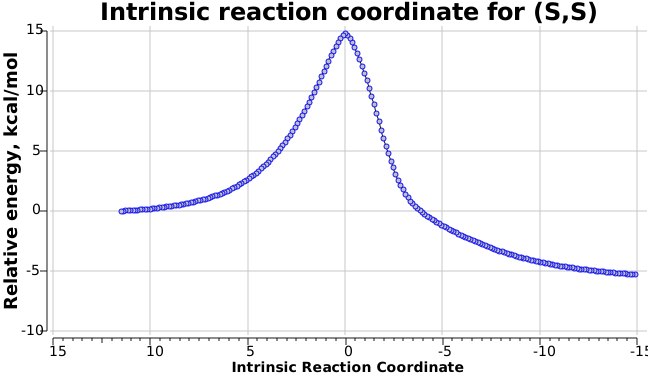
Postscript:  The Intrinsic reaction coordinate  (for (S,S) ) is shown below.


An exothermic E2 elimination: an unusual intrinsic reaction coordinate.

Monday, February 6th, 2012

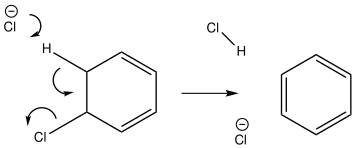
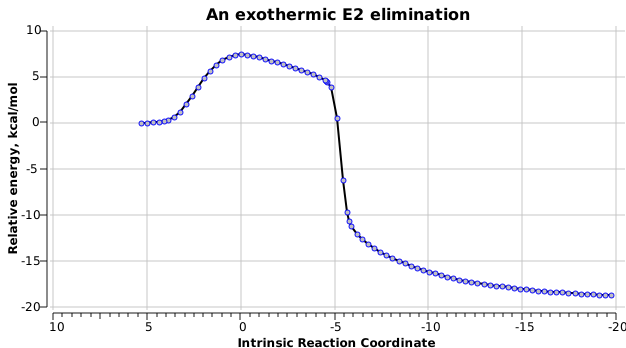
The previous post explored why E2 elimination reactions occur with an antiperiplanar geometry for the transition state. Here I have tweaked the initial reactant to make the overall reaction exothermic rather than endothermic as it was before. The change is startling.


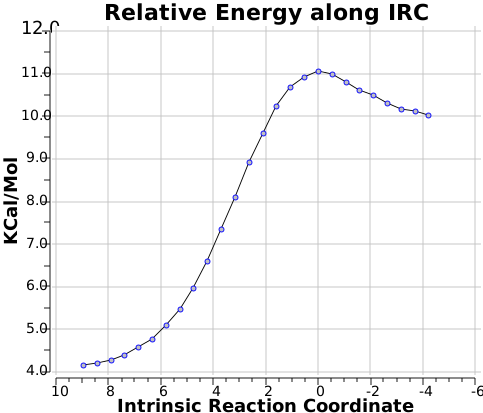
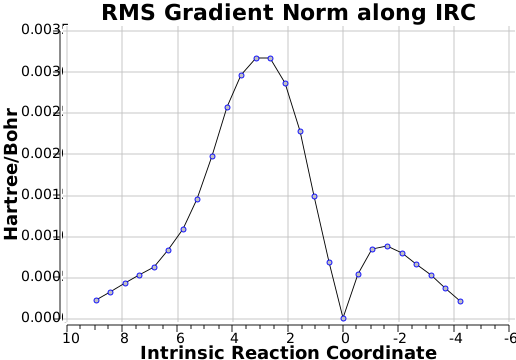
The exothermicity is of course due to the aromatisation of the ring. The IRC is however quite different from before.

IRC for E2 elimination. Click for 3D

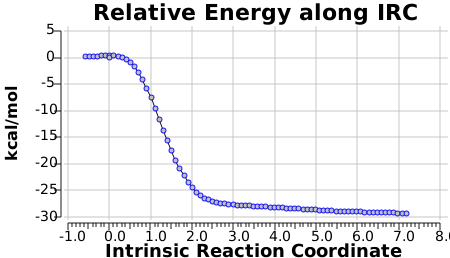
  1. The transition state (IRC=0.0) is reached early, and the initial movement is of the chlorine on the right. This in fact resembles an E1 elimination to form an intermediate carbocation. This, being a resonance stabilised (Wheland) type of cation, is particularly favoured.
  2. At this point, the H-C bond has scarcely started breaking (1.13Å).
  3. When IRC of -5 is reached, the C-Cl bond is essentially broken (3.05Å). At this point the energy is still higher than the reactant.
  4. A sudden abrupt change occurs resulting from rapid proton transfer at IRC -6, and the energy plummets to become exothermic.

So, like the SN1 reaction discussed in another post, this E2 reaction occurs in distinct stages, the first resembling an E1 mechanism, followed by a second phase leading to elimination. It is still a concerted reaction, but the proton transfer occurs only AFTER the transition state. The simple designation  E2/E1  is clearly not a fully adequate description of such mechanisms.

A modern take on pericyclic cycloaddition. Dimerisation of cis-butene

Monday, November 28th, 2011

The π2 + π2 cyclodimerisation of cis-butene is the simplest cycloaddition reaction with stereochemical implications. I here give it the same treatment as I did previously for electrocyclic pericyclic reactions.


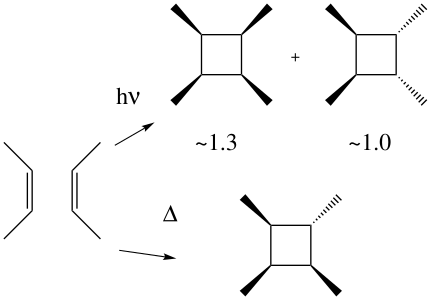
The photochemical reaction is known to give a mixture of two tetramethylcyclobutanes in the ratio of 1.3:1.0, with the all-cis isomer apparently predominating. The key geometry is the conical intersection, at which the energies of the S1 and S0 states coincide. This geometry has a typical trapezoidal appearance, with suprafacial addition accross both components. The exo addition is calculated to be about 1 kcal/mol lower in total energy than the endo (at the CASSCF(12,8)/6-31G(d) level), which implies that the latter should be the minor and not the major form. However, these CASSCF energies are not corrected for thermal (entropic) or dynamic correlation components, and moreover the active space orbitals are probably not identical either (I demonstrated in another post how the orbitals of the alkene interact with those of the methyl groups, and its quite likely that the endo and exo orientations will result in slightly different interactions) which makes such comparisons non trivial. These calculations do support the idea that both isomers should form (which at first sight might be counter-intuitive given the apparent steric constraints of the endo isomer).

2+2 exo addition. click for 3D

2+2 endo addition. Click for 3D.

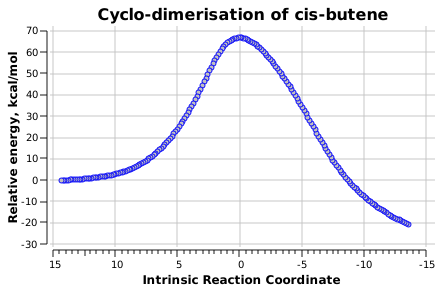
The thermally activated reaction is not known for this alkene, and the calculations support this with an enormous barrier to reaction (> 68 kcal/mol).

As a 4n-electron pericyclic, the selections rules require there to be one antarafacial component present, and the IRC for this reaction illustrates this very nicely. The formation of two pairs of C-C bonds is very asynchronous. Only when the first bond is almost complete does the second C=C start to rotate. The second C-C bond only starts to form after this rotation (the antarafacial component) is essentially complete, forming a product where one methyl group is on the opposite face of the ring to the other three. Note in particular that the rhs alkene has the two C-H hydrogens synplanar to start with, but that they are exactly antiperiplanar in the product.

2a + 2s cycloaddition showing IRC. Click for 3D

For this small system the two critical points, a conical intersection and a transition state, could not be more different. But they do capture the essential features of pericyclic reactions and their selection rules.