Posts Tagged ‘energy’
Sunday, November 13th, 2011
Following on from Armstrong’s almost electronic theory of chemistry in 1887-1890, and Beckmann’s radical idea around the same time that molecules undergoing transformations might do so via a reaction mechanism involving unseen intermediates (in his case, a transient enol of a ketone) I here describe how these concepts underwent further evolution in the early 1920s. My focus is on Edith Hilda Usherwood, who was then a PhD student at Imperial College working under the supervision of Martha Whitely.1
The doctoral degree itself had only been introduced into British universities in 1919,1 and so Usherwood was very much a forerunner of the modern system of training.The academic staff and students at Imperial totalled 30, making it one of the largest research schools in UK chemistry at the time. Usherwood’s project was on tautomers, or isomers of molecules which differ only in the position of a labile hydrogen atom. The then quite novel electron-pair symbolism introduced by G. N. Lewis’ in 1916 was adopted to represent two tautomeric equilibria (the supposed mobile or tautomeric hydrogens being enclosed in […])2
- [H]C:::N ⇔ C::N[H]
- [H]C:::CH ⇔ C::CH[H]
or in our more modern representation (in which lines replace colons, and charges are used to ensure the octet rule is adhered to when possible):
- H-C≡N ⇔ –C≡N+-H
- HC≡CH ⇔ :C=CH2
Modern structural techniques such as electron diffraction or microwave spectroscopies not yet existing, the problem was tackled using specific heat measurements as a function of temperature. This method suggested to Usherwood that for e.g. equilibrium 2, the concentration of iso-acetylene (we now call this vinylidene) was insignificant at ordinary temperatures, but it became appreciable between 200-300°C. Further evidence was claimed for the formation of the “unseen” vinylidene by observing ketene as a by-product of the oxidation of acetylene. This article very much set the trend of (an almost mandatory) speculation on the outcome of (nowadays much more complex) reactions by the need to formulate a reaction mechanism in which various (otherwise undetected but) plausible intermediates are involved.
Moving on some 90 years, and how might one approach such a problem nowadays? Well, I have oft argued on this blog that a good place to obtain an immediate reality check on a proposed mechanism is a calculation. It will come as no surprise that a very accurate calculation can be done on the systems shown above. For example, CCSD(T)/cc-pVTZ will yield a free energy for the equilibria with a pretty small error (< 1 kcal/mol). We use ΔG = -RT Ln K to inter-convert free energies and equilibrium constants. If we are generous and state that in order to observe an appreciable concentration of a minor species, the equilibrium constant can be no smaller than 10-3, its energy cannot be greater than 4 kcal/mol above the more abundant isomer. Our reality check will be to see if the free energy of vinylidene is indeed no more than 4 kcal/mol greater than acetylene. Well, CCSD(T)/cc-pVTZ predicts vinylidene is 41.3 kcal/mol higher @298K, reduced to 33.8 @2000K (and before you ask, these results took a total of perhaps 30 minutes to obtain).
In 1924, the concept of calculating the relative energies of two species using first principles was not even a glimmer on the horizon. The nature of mechanisms was slowly and often painfully established by recourse to experiments alone. And many of the unseen intermediates often remained just such, their existence only inferred indirectly from the models one constructed (of specify heats in Usherwood’s case). It is perhaps no great surprise that these models do not always stand the test of time. In this case, within a year of Usherwood’s publication, Partington was suggesting that the model for the specific heats of acetylene should have included allowance for polymer formation.3 The modern take, armed with the calculation I note above, might in fact side with Partington after all. As for the formation of ketene by oxidation, it is indeed known that (peracid) oxidation of an alkyne will produce ketene, but the modern mechanism (an interesting exercise in arrow pushing for a student) does not involve vinylidene intermediates.
I will add at this point that Hilda Usherwood was married to Christopher Ingold, and the pair of them subsequently published many of the seminal articles in what became known as physical organic chemistry. That legacy continues to this day with (as I noted above) the almost mandatory speculation about the mechanism of any new reaction. But it is only in the last five years or so that these speculations have started to be increasingly tested against reliably accurate computation. A new era is underway.
1 My post was inspired by reading W. H. Brock, “The case of the Poisonous Socks”, chapter 28, RSC Publishing, 2011, 978-1-84973-324-3.
2 These representations are taken from ref 1, p 225 (and including a correction of replacing C:C as drawn there by C::C). The original article apparently appeared in the proceedings of the British Association of 1924, which is not yet available online.
3 Brock, in ref 1, p226, suggests that Usherwood stood her ground on this one, and won her case by showing that Partington’s evidence for polymerization was valid for only a small part of the temperature range she had investigated. I have not managed to track down the original sources for this exchange.
Tags:200-300, by-product, Christopher Ingold, energy, free energy, Hilda Usherwood, Historical, Imperial College, Martha Whitely, microwave, polymerization, RSC Publishing, United Kingdom
Posted in Interesting chemistry | 2 Comments »
Thursday, November 10th, 2011
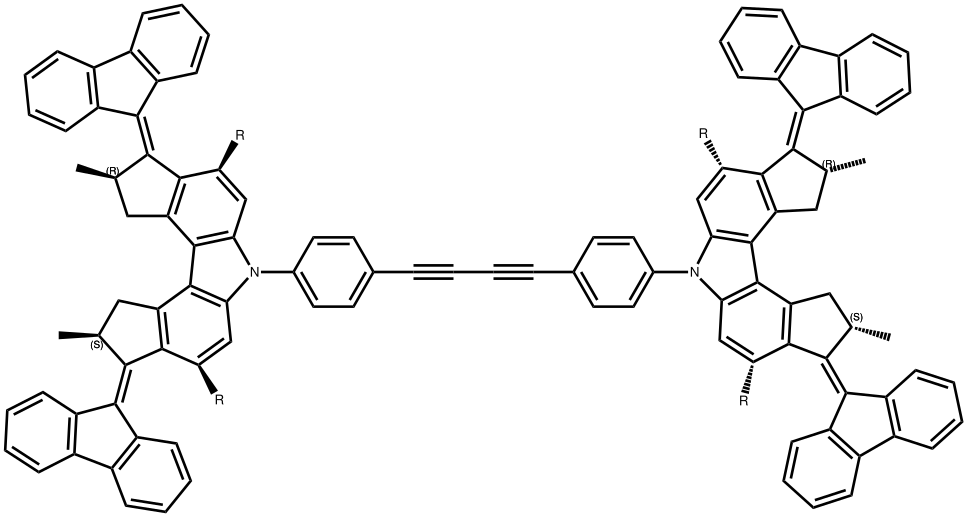
Fascination with nano-objects, molecules which resemble every day devices, is increasing. Thus the world’s smallest car has just been built. The mechanics of such a device can often be understood in terms of chemical concepts taught to most students. So I thought I would have a go at this one!

A molecular car (from 10.1038/nature10587)
The car comprises a single (relatively small) molecule, shown above as the authors represented it. The motion along a surface comprised of copper atoms is driven by light as fuel coupled with encouragement from an STM probe. The distance travelled in a straight line was about 6nm in ten steps (note the nanodistance), although the average speed for the complete journey is not recorded. It is probably safe to say it was not recorded using a speed camera!

The car rattling along a copper surface (grey).
The chemistry is shown below. The car has four wheels (the fluorene units) which rotate about an C=C double bond axle using light as the fuel (a configurational change). The component labelled helix inversion can also be described by the chemical name atropisomerism, a topic I dealt with earlier with the example of Taxol and which is a conformational change.

The nitty-gritty of the car's engine.
These two processes are used to rotate the wheels in the sequence shown below (after which the wheels return to their starting point).

The four stages of powering the car (from 10.1038/nature10587)
I set out to build the car by optimising the 3D geometry of the molecule. This so that I could view the device from any direction (not just the one represented in the diagrams above). I also felt it important to estimate the change in energy of the car as the wheels rolled (something not touched upon in the original article). A good place to start would be to raid the supplementary information associated with the article. This comprises a PDF document and four movies. As it happens, none of these contain 3D coordinates for the molecule. Well, in truth this is not unusual, and I am used to such absence by now. Ah well, I would start from the top diagram, which is a schematic 2D representation of the molecule. As you can read in this post, such representations can often be illusory, or even contradictory. One is indeed lucky if they are free of ambiguity. Thus:
- The stereogenic centres are fine, they are labelled (R) and (S), and they provide an important aspect of the mechanism for allowing the motions of the four wheels to be coordinated such that the car drives in a straight line. Much is made of this aspect in the article.
- It is the atropisomerism that starts to cause problems. Here the diagram contains emboldened bonds carved into a benzene ring. This convention was first proposed by Hubert Maehr in 1985, but his intended use has since been much abused. As I fear it is here. Although it is difficult to be certain, the benzo groups in the car are annotated with several Maehr-like emboldened bonds, and a few non-Maehr wedged bonds as well. It is all meant to indicate perspective, and probably not intended in the Maehr sense at all.
- That latter feeling is reinforced when the benzo groups of the fluorene unit are annotated with dashed bonds replacing the single bonds in the Kekule resonance structure. Normally, a C- – -C is taken to indicate a breaking, or transition bond, but here it is again just an attempt at perspective (and a new addition to the bond menagerie).
Well, it is possible to build a 3D model armed with these instructions (although it has to be done visually, with constant comparisons with the space fill representations in the article).
- Here is my take on the starting point for the car:

The initial conformation of the molecular car. Click for 3D.
- The car starts its journey by a light-driven rotation of the C=C bonds to form an isomer (about 8 kcal/mol higher according to my estimate using PM6).

Car after step 1, double bond isomerisation. Click for 3D.
- There is then an STM-induced helix inversion, or atropisomerism. The two benzo groups are induced to swap over, much in the manner of bi-phenyls. The energy at this point is identical to the starting position. It is worth noting that the molecule was not returned to this position by reversing the first C=C rotation, but by two quite different operations (light and STM-electrons). I presume this was done to ensure the wheels turn in a constant direction, and do not simply flip back and forth randomly.

Car after step 2, helix inversion. Click for 3D.
- A final light-induced twist of the double bond (the energy is again about 8 kcal/mol higher than the start point)

Car after step 3, double bond isomerism. Click for 3D.
- and another STM-induced helix inversion returns the car to ~0.6nm on from its starting position.
So to understand nanotechnology and nano-sized objects, all you need is a good training in introductory chemistry! But a plea please to nano-scientists. Could you please include 3D coordinates for your wonderful machines. Movies are fine, but to really see what is going on, I would suggest you need proper 3D models (not least because you can then use these immediately to test my assertions about the energies of the various conformations).
Oh, I cannot resist observing that the group reporting this work probably do not ride motorcycles!
Postscript: The optimised ωB97XD/6-31G(d) geometries for the two poses of the car are to be found at 10042/to-10227 and 10042/to-10219 The total energy difference is 15.5 kcal/mol (compared with 8 at the PM6 level).
Tags:car drives, car rattling, chemical concepts, chemical name atropisomerism, chemical perspective, conformational analysis, day devices, energy, energy difference, Hubert Maehr, molecular car, nanocar, PDF, smallest car, Taxol
Posted in General, Interesting chemistry | 3 Comments »
Friday, October 28th, 2011
Moore’s law describes a long-term trend in the evolution of computing hardware, and it is often interpreted in terms of processing speed. Here I chart this rise in terms of the size of computable molecules. By computable I mean specifically how long it takes to predict the geometry of a given molecule using a quantum mechanical procedure.

LSD, the 1975 benchmark for computable molecules.
The geometry (shape) of a molecule is defined by 3N-6 variables, where N is the number of atoms it contains. Optimising the value of variables in order to obtain the minimum value of a function was first conducted by chemical engineers, who needed to improve the function of chemical reactor plants. The mathematical techniques they developed were adopted to molecules in the 1970s, and in 1975 a milestone was reached with the molecule above. Here, N=49, and 3N-6=141. The function used was one describing its computed enthalpy of formation, using a quantum mechanical procedure known as MINDO/3. The computer used was what passed then for a supercomputer, a CDC 6600 (of which a large well endowed university could probably afford one of). It was almost impossible to get exclusive access to such a beast (its computing power was shared amongst the entire university, in this case of about 50,000 people), but during a slack period over a long weekend, the optimised geometry of LSD was obtained (it’s difficult to know how many hours the CDC 6600 took to perform this feat, but I suspect it might have been around 72). The result was announced by Paul Weiner to the group I was then part of (the Dewar research group), and Michael immediately announced that this deserved an unusual Monday night sojourn to the Texas Tavern, where double pitchers of beer would be available. You might be tempted to ask what the reason for the celebration was. Well, LSD was a “real molecule” (and not a hallucination). It meant one could predict for the first time the geometry of realistic molecules such as drugs and hence be taken seriously by people who dealt with molecules of this size for a living. And if you could predict the energy of its equilibrium geometry, you could then quickly move on to predicting the barriers to its reaction. A clear tipping point had been reached in computational simulation.
In 1975, MINDO/3 was thought to compute an energy function around 1000 to 10,000 faster than the supposedly more accurate ab initio codes then available (in fact you could not then routinely optimise geometries with the common codes of this type). With this in mind, one can subject the same molecule to a modern ωB97XD/6-311G(d,p) optimisation. This level of theory is probably closer to 104 to 105 times slower to compute than MINDO/3. On a modest “high performance” resource (which nowadays runs in parallel, in fact on 32 cores in this case), the calculation takes about an hour (starting from a 1973 X-ray structure, which turns out to be quite a poor place to start from, and almost certainly poorer than the 1975 point). In (very) round numbers, the modern calculation is about a million times faster. Which (coincidentally) is approximately the factor predicted by Moore’s law.
I will give one more example, this time for an example dating from around 2003, 28 years on from the original benchmark.

Transition state for lactide polymerisation.
This example has 114 atoms, and hence 3N-6 =336, or 2.42 times the 1975 size. It is a transition state, which is a far slower calculation then an equilibrium geometry. It is also typical of the polymerisation chemistry of the naughties. Each run on the computer (B3LYP/6-31G(d), with the alkyl groups treated at STO-3G) now took about 8-10 days (on a machine with 4 cores), and probably 2-4 runs in total would have been required per system (of which four needed to be studied to derive meaningful conclusions). Let us say 1000 hours per transition state. Together with false starts etc, the project took about 18 months to complete. Move on to 2010; added to the model was a significantly better (= slower) basis set and a solvation correction, and a single calculation now took 67 hours. In 2011, it would be reduced to ~10 hours (by now we are up to 64-core computers).
In 2011, calculations involving ~250 atoms are now regarded as almost routine, and molecules with up to this number of atoms cover most of the discrete (i.e. non repeating) molecular systems of interest nowadays. But the 1975 LSD calculation still stands as the day that realistic computational chemistry came of age.
Tags:3g, chemical engineers, chemical reactor plants, computational chemistry, energy, energy function, hallucination, Historical, LSD, molecular systems, Paul Weiner, simulation, sojourn, Texas Tavern, X-ray
Posted in Interesting chemistry | No Comments »
Friday, October 28th, 2011
Moore’s law describes a long-term trend in the evolution of computing hardware, and it is often interpreted in terms of processing speed. Here I chart this rise in terms of the size of computable molecules. By computable I mean specifically how long it takes to predict the geometry of a given molecule using a quantum mechanical procedure.
LSD, the 1975 benchmark for computable molecules.
The geometry (shape) of a molecule is defined by 3N-6 variables, where N is the number of atoms it contains. Optimising the value of variables in order to obtain the minimum value of a function was first conducted by chemical engineers, who needed to improve the function of chemical reactor plants. The mathematical techniques they developed were adopted to molecules in the 1970s, and in 1975 a milestone was reached with the molecule above. Here, N=49, and 3N-6=141. The function used was one describing its computed enthalpy of formation, using a quantum mechanical procedure known as MINDO/3. The computer used was what passed then for a supercomputer, a CDC 6600 (of which a large well endowed university could probably afford one of). It was almost impossible to get exclusive access to such a beast (its computing power was shared amongst the entire university, in this case of about 50,000 people), but during a slack period over a long weekend, the optimised geometry of LSD was obtained (it’s difficult to know how many hours the CDC 6600 took to perform this feat, but I suspect it might have been around 72). The result was announced by Paul Weiner to the group I was then part of (the Dewar research group), and Michael immediately announced that this deserved an unusual Monday night sojourn to the Texas Tavern, where double pitchers of beer would be available. You might be tempted to ask what the reason for the celebration was. Well, LSD was a “real molecule” (and not a hallucination). It meant one could predict for the first time the geometry of realistic molecules such as drugs and hence be taken seriously by people who dealt with molecules of this size for a living. And if you could predict the energy of its equilibrium geometry, you could then quickly move on to predicting the barriers to its reaction. A clear tipping point had been reached in computational simulation.
In 1975, MINDO/3 was thought to compute an energy function around 1000 to 10,000 faster than the supposedly more accurate ab initio codes then available (in fact you could not then routinely optimise geometries with the common codes of this type). With this in mind, one can subject the same molecule to a modern ωB97XD/6-311G(d,p) optimisation. This level of theory is probably closer to 104 to 105 times slower to compute than MINDO/3. On a modest “high performance” resource (which nowadays runs in parallel, in fact on 32 cores in this case), the calculation takes about an hour (starting from a 1973 X-ray structure, which turns out to be quite a poor place to start from, and almost certainly poorer than the 1975 point). In (very) round numbers, the modern calculation is about a million times faster. Which (coincidentally) is approximately the factor predicted by Moore’s law.
I will give one more example, this time for an example dating from around 2003, 28 years on from the original benchmark.
Transition state for lactide polymerisation.
This example has 114 atoms, and hence 3N-6 =336, or 2.42 times the 1975 size. It is a transition state, which is a far slower calculation then an equilibrium geometry. It is also typical of the polymerisation chemistry of the naughties. Each run on the computer (B3LYP/6-31G(d), with the alkyl groups treated at STO-3G) now took about 8-10 days (on a machine with 4 cores), and probably 2-4 runs in total would have been required per system (of which four needed to be studied to derive meaningful conclusions). Let us say 1000 hours per transition state. Together with false starts etc, the project took about 18 months to complete. Move on to 2010; added to the model was a significantly better (= slower) basis set and a solvation correction, and a single calculation now took 67 hours. In 2011, it would be reduced to ~10 hours (by now we are up to 64-core computers).
In 2011, calculations involving ~250 atoms are now regarded as almost routine, and molecules with up to this number of atoms cover most of the discrete (i.e. non repeating) molecular systems of interest nowadays. But the 1975 LSD calculation still stands as the day that realistic computational chemistry came of age.
Tags:3g, chemical engineers, chemical reactor plants, computational chemistry, energy, energy function, hallucination, Historical, LSD, molecular systems, Paul Weiner, simulation, sojourn, Texas Tavern, X-ray
Posted in Interesting chemistry | No Comments »
Wednesday, October 26th, 2011
My previous post on the topic of mauveine left the outcome dangling. Put simply, λmax is measured at about 549nm for mauveine A, but was calculated at about 440nm using a modern method for predicting colour (TD-DFT). According to the colour table below, that would make it orange, not mauve. Can the theoretical prediction be out by 110nm, or might it be the structure of the molecule itself that has been wrongly described?

A new idea struck me, summarised below. No crystal structure of a mauveine has ever been reported, and so the position of the N-H groups is not determined. It is normally drawn as tautomer 1, but what about tautomers 2-4?

Tautomers of mauveine.
Following the principle of completeness, it is important to include a counterion. And because the colour mauve is recorded in methanol solutions (i.e. it is unlikely to be due to aggregation), we will include some explicit solvent (water) as well. To illustrate the model, I show the geometries calculated for two counter-ion isomers of tautomer 4 using ωB97XD/6-311G(d,p)/SCRF=water.
 Tautomer 4. Click for 3D. |
 Tautomer 4, with different arrangement of Chloride. Click for 3D. |
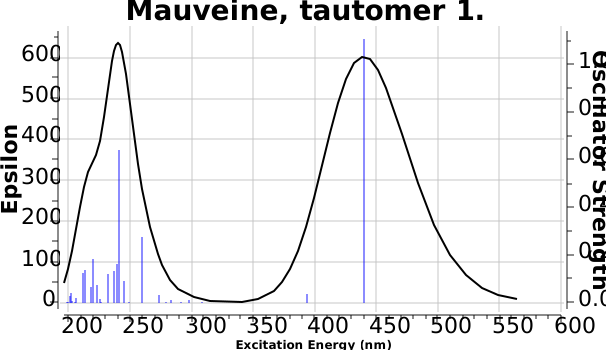
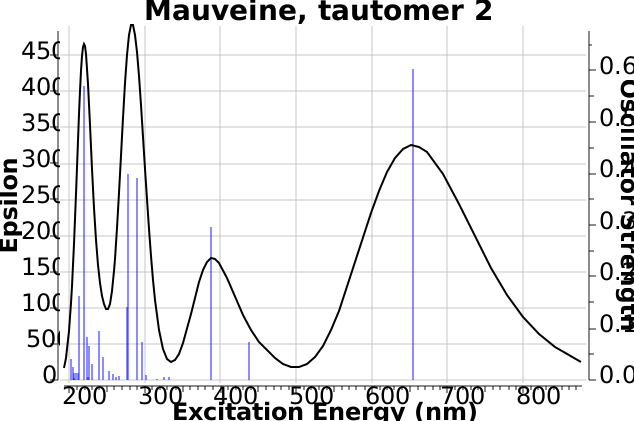
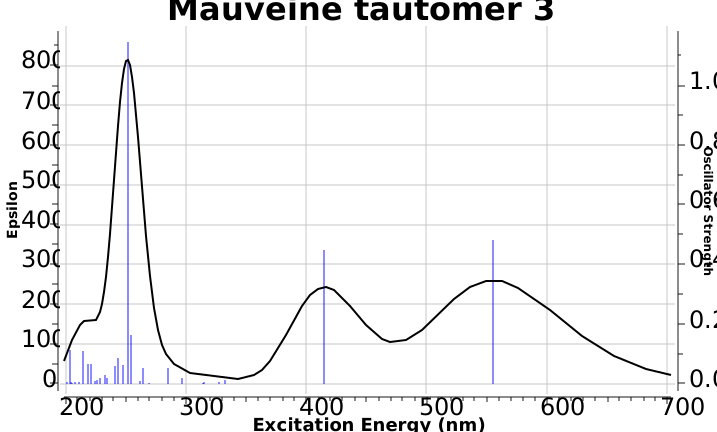
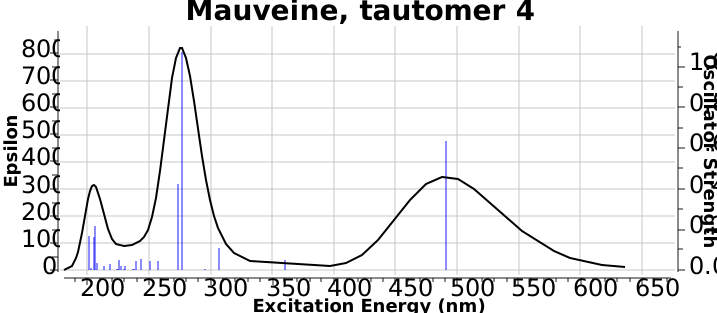
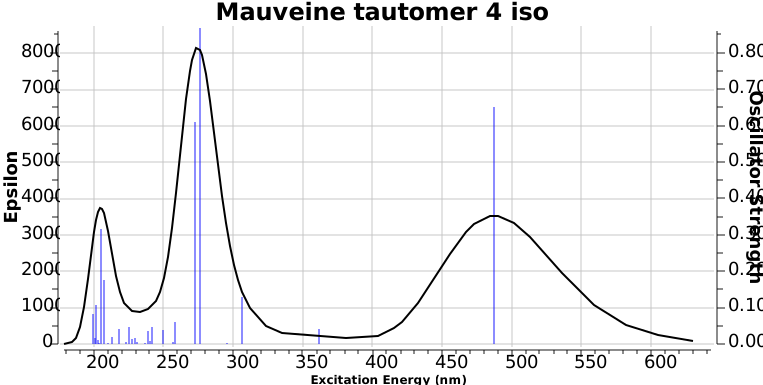
The predicted UV/Visible spectra are shown below (ωB97XD/6-311++G(d,p)/SCRF=water model), and λmax ranges from 440 to 655nm simply by moving one proton around! The spectrum that matches the measured best corresponds to tautomer 4. Unfortunately, it is calculated to be about 15 kcal/mol higher in energy than tautomer 1, which is the lowest in energy.
So one step forward, and one back. A better colour match can be obtained by modelling a different tautomer of mauveine, but this now leaves the energy unexplained. I think perhaps a determined effort to get mauveine itself to form good crystals and to analyse those to confirm where the three exchangeable hydrogens reside would be well worth the effort. Even then, that will not necessarily tell us what is happening in solution. Such an old, and famous molecule, and still there is a mystery.
Tags:and one back, energy, forward, Historical, Mauveine, methanol solutions
Posted in Uncategorized | 4 Comments »
Monday, October 10th, 2011
I wrote earlier about the strangely close contact between two hydrogen atoms in cis-butene. The topology of the electron density showed characteristics of a bond, but is it a consensual union? The two hydrogens approach closer than their van der Waals radii would suggest is normal, so something is happening, but that something need not be what chemists might choose to call a “bond“. An NCI (non-covalent analysis) hinted that any stability due to the electron topologic characteristics of a bond (the BCP) might be more than offset by the repulsive nature of the adjacent ring critical point (RCP). Here I offer an alternative explanation for why the two hydrogens approach so closely.
 One of four C-H NBO donor orbitals. Click for 3D |
 The empty C=C π* orbital. Click for 3D to show both orbitals superimposed. |
We need to try to “concentrate” or “focus” the effect into the bonds of the molecule, and a good way of doing this is to calculate the NBO (natural bond orbitals). The first we focus on is localised onto one (of four) C-H bonds of the methyl group; the other is the anti bonding π* orbital of the alkene. NBO theory allows us to calculate how these two orbitals perturb each other, in the sense of the occupied orbital donating to the empty orbital. This energy is known as E(2), and for any of the four (equivalent) interactions above, it is computed at 5.17 kcal/mol. If you look closely at the orbitals, the C-H bond is leaning away from the centre, but so is the π* acceptor orbital (that is the nature of anti bonding orbitals). These characteristics improve the overlap of the orbitals, and hence tend to increase the value of E(2).
What about an alternative conformation of cis-butene in which the close contact of the H…H atoms is removed by rotation? Well, the C-H NBOs now rotate in, but the anti bonding π* orbital still tilts out. The overlap between them is no longer quite so good, and indeed the E(2) energy decreases to 4.43 kcal/mol.
 Donor C-H bond in rotated isomer of cis-butene. Click for 3D |
 NBO C=C p* orbital in rotated isomer of cis-butene. Click for 3D |
How many more orbitals should be considered? Well, the NBO technique in effect concentrates these effects into a relatively small number of orbitals (those separated by the smallest energy gap). We can also add in the four interactions between the bonding π orbital and the anti-bonding C-H* NBO. The totals for the first conformation come to 34.08 and for the second 30.44.
So we can conclude by observing that cis-butene makes a sacrifice for its greater good. Rotating the methyl groups means that the overlap of four C-H bonds with the alkene is optimised, but an undesired side effect is to induce two hydrogens to get close to each other. They would not normally be happy doing so, but the gain from the first effect is greater than the loss from the second. Whilst they may be close, chemists would prefer not to call the H-H approach a bond, even though the topology of the electron density might say it is.
By the way, this is my 150th post. I had little idea when I started that I might reach this milestone.
Tags:conformational analysis, energy, energy decreases, smallest energy gap, Tutorial material
Posted in General, Interesting chemistry | 9 Comments »
Friday, October 7th, 2011
The properties of electrons are studied by both chemists and physicists. At the boundaries of these two disciplines, sometimes interesting differences in interpretation emerge. One of the most controversial is that due to Bader (for a recent review, see DOI: 10.1021/jp102748b) a physicist who brought the mathematical rigor of electronic topology to bear upon molecules. The title of his review is revealing: “Definition of Molecular Structure: By Choice or by Appeal to Observation?”. He argues that electron density is observable, and that what chemists call a bond should be defined by that observable (with the implication that chemists instead often resort to arbitrary choice). Here I explore one molecule which could be said to be the focus of the differences between physics and chemistry; cis-but-2-ene.

Two possible conformations of cis but-2-ene.
The structure of this system has been determined by electron diffraction to exhibit a H…H distance of ~2.1Å as in (a), DOI: 10.3891/acta.chem.scand.24-0043. Why is this of interest? Because a rotational alternative, shown as (b) could result in a significantly longer H…H distance (~ 2.6Å). Now bear in mind that the van der Waals radius of hydrogen is estimated at ~1.2Å, and that two hydrogens will be most strongly attracted by dispersion forces when separated by ~2.4Å. As they get closer, that attraction will be counterbalanced by a repulsion, which will eventually win out. Structure (b) does not benefit from H…H dispersion attractions, but are the hydrogens in structure (a) too close to do so as well?
Well, let us adopt Bader’s approach, and look at the topology (QTAIM) of the electronic distribution in structure (a). The features to concentrate on are the purple dots, which in this analysis have been named bond critical points (BCP) and the single yellow sphere, which is a ring critical point (RCP). There are two other types of critical points, which I will call nuclear attractors (NACP) and cage points (CCP). The total occurrences of all these critical points is determined by a topological theorem (Poincare-Hopf), which states that NACP-BCP+RCP-CCP=1. You can see below that the H…H region is indeed connected by a bond critical point (none of the other purple dots are controversial). To a physicist, this is a real feature of the (observable or in this instance the calculated) electron density. In effect, it is a topological bond. Unfortunately, chemists like to think of bonds as entities which result in stability; a bond contributes to the stability of a molecule (and an anti-bond, should such exist, to instability). Hence aromaticity (=stability) vs anti-aromaticity (=instability). Chemists, by choice, might prefer not to call the H…H region a bond because it is probably not contributing to the stability of the molecule. Of course, the two camps are arguing about different things; the topology of the electron density ρ(r) vs the energy of the molecule.

QTAIM topological analysis of cis but-2-ene. Click for 3D.
Somewhat ignored in this discussion up to this point has been the yellow dot, the RCP. Firstly, notice how close it is to the H…H BCP. Secondly, notice from the Poincare-Hopf relationship that if you remove BOTH of these points, the theorem is still satisfied; a BCP and a RCP are said to be capable of annihilating each other (much like and electron and a positron might). So perhaps a chemical picture might emerge if you choose to consider BOTH points together, rather than just the BCP?
I have done so below using the NCI (non-covalent interaction) procedure (which I have commented on in many other posts here). The NCI surface is shown below, embedded within the NCI surface as purple dots are the BCP and RCP discussed above. Now, the NCI method cleverly attempts to ascertain whether a region is attractive or repulsive, and it colour codes the surface accordingly. In the below, blue is deemed attractive, and red repulsive. We immediately see that the H…H BCP is embedded in an attractive region, but the adjacent RCP is embedded in a repulsive region. Whatever attraction the BCP might be experiencing is negated by the repulsion the RCP has. The two cancel (annihilate). Taken together, the H…H region is probably repulsive (ways of quantifying how NCI regions integrate are being investigated and will be discussed in a future post). Perhaps this manner of looking at it satisfies both the physicists and the chemists?

The NCI surface for cis but-2-ene. Click for 3D.
Well, not quite. A chemist would still ask why structure (a) is preferred over structure (b), if the wider H…H region is not deemed attractive (I call it a region rather than a bond in a probably futile attempt to avoid controversy). Actually, the answer might be in how the two methyl groups each interact with the other part of the molecule, the alkene, and how that might depend on their orientation with respect to the alkene. But that analysis is for
another post!
Tags:CCP, chemical picture, chemist, conformational analysis, energy, Julia Contreras-Garcia, physicist
Posted in General, Interesting chemistry | 6 Comments »
Thursday, September 1st, 2011
I have mentioned Lewis a number of times in these posts; his suggestion of the shared electron covalent bond still underpins much chemical thinking. Take for example mechanistic speculations on the course of a reaction, a very common indulgence in almost all articles reporting such, and largely based on informed arrow pushing. This process is bound to follow the rules of reasonable Lewis structures for any putative intermediates. Here, I suggest that we are now firmly in an era where such speculations must of necessity be backed up by quantum mechanical estimates of the energies and structures. I would propose that journals routinely encourage referees to insist on such (additional) checks. Let me give one specific example of the need to do this (part of a follow up to an earlier article I blogged on previously).

Scheme 1 (reproduced from 10.1002/chem.201100693 )
The example is found as scheme 1 of an article written by Legrand, Gilles, Petit, van der Lee and Barboiu entitled “Unprecedented Synthesis of 1,3-Dimethylcyclobutadiene in the Solid State and Aqueous Solution” (DOI: 10.1002/chem.201100693; Scheme 1 reproduced here with the permission of the publishers). Structures 1 – 3 are my additions, and are not present in scheme 1 of the above article.

Possible species involved in the mechanism for photochemical irradiation of dimethyl pyrone.
The scientific problem is to identify what the products are of photolysis of Me21. The species is contained as a guest inside a calixarene host, the whole assembly being dissolved in water (D2O). This was photolysed and the products characterised by (inter alia) their 1H NMR spectra, Figure 7. Focus in particular on 7b, which shows a set of five spectra that are claimed to identify the consecutive species Me21, Me22, (Me23 or 1), Me2CBDS/CO2, Me2CBDR and Me24 as the outcomes of photolysis at “different irradiation times at l=320–500 nm or at l=190–500 nm“.

Figure 7 (taken from 10.1002/chem.201100693, reproduced with permission of publisher )
How might one apply a computational reality check to this scheme? Lewis himself might have ventured to suggest that representation Me23 does not adhere to his rules; a modern chemistry student would draw it instead as 2, a vinyl zwitterion. This species in turn could either eliminate carbon monoxide (red arrow) or ring close to give the unusual ylid 3 (blue arrow). In fact DFT calculations on the isolated molecules in water (ωB97XD/6-311G(d,p)/SCRF=water) indicate that the C-O bond in an isolated molecule of Me23 does not persist and fragments to carbon monoxide and an alkoxy zwitterion, making it around ~36.5 kcal/mol higher in free energy than the alternative zwitterion 1. The third species 3 is somewhat more stable, being ~20 kcal/mol above 1. Calculations also reveal that whilst rectangular Me2CBDR is obtained on the singlet surface, the square Me2CBDS/CO2 can only be obtained on the triplet surface. This state however is ~8-10 kcal/mol higher in energy and unlikely to have a long lifetime before it decays down to the singlet surface. One could study all the species in the scheme above in this manner, but that analysis is for another place and time.
Until relatively recently, such reality checks would be all one might attempt computationally. But these experiments were NOT conducted on isolated molecules in solution, they were done in the presence of a calixarene host. Could that change things? Zwitterion 1 can be placed inside this cavity and the calculation repeated (again simulating solvent water), as can 2. In fact the latter spontaneously collapses to 3, and now has an energy ~ 27 kcal/mol higher than 1. Whether 1 itself (or indeed Me2CBDR) has any persistent lifetime is another issue, and one not addressed in this blog post.
In fact, the reality check has another purpose, which is to stimulate other ideas. In this case for example one could regard 3 as a carbene, in which case one might ask if coordination of the carbene to a suitable metal might be a stabilizing mode. Amazingly, a number of such systems are known! I show just one below.
 SCHXFe structure diagram. |

SCHXFe. Click for 3D structure. |
There is a lot more that could be said (and written) about this article, including discussion of the 1H NMR spectra, but I will stop at this point. Hopefully, I have shown how simple computational reality checks on a proposed mechanism can easily result in both unexpected outcomes and ideas for new chemistry!
Tags:3-dimethylcyclobutadiene, blog server, calixarene, chemical thinking, energy, free energy, Lewis, pericyclic, Petit, photolysis., square Me, suitable metal
Posted in Interesting chemistry | 2 Comments »
Thursday, September 1st, 2011
I have mentioned Lewis a number of times in these posts; his suggestion of the shared electron covalent bond still underpins much chemical thinking. Take for example mechanistic speculations on the course of a reaction, a very common indulgence in almost all articles reporting such, and largely based on informed arrow pushing. This process is bound to follow the rules of reasonable Lewis structures for any putative intermediates. Here, I suggest that we are now firmly in an era where such speculations must of necessity be backed up by quantum mechanical estimates of the energies and structures. I would propose that journals routinely encourage referees to insist on such (additional) checks. Let me give one specific example of the need to do this (part of a follow up to an earlier article I blogged on previously).
Scheme 1 (reproduced from 10.1002/chem.201100693 )
The example is found as scheme 1 of an article written by Legrand, Gilles, Petit, van der Lee and Barboiu entitled “Unprecedented Synthesis of 1,3-Dimethylcyclobutadiene in the Solid State and Aqueous Solution” (DOI: 10.1002/chem.201100693; Scheme 1 reproduced here with the permission of the publishers). Structures 1 – 3 are my additions, and are not present in scheme 1 of the above article.
Possible species involved in the mechanism for photochemical irradiation of dimethyl pyrone.
The scientific problem is to identify what the products are of photolysis of Me21. The species is contained as a guest inside a calixarene host, the whole assembly being dissolved in water (D2O). This was photolysed and the products characterised by (inter alia) their 1H NMR spectra, Figure 7. Focus in particular on 7b, which shows a set of five spectra that are claimed to identify the consecutive species Me21, Me22, (Me23 or 1), Me2CBDS/CO2, Me2CBDR and Me24 as the outcomes of photolysis at “different irradiation times at l=320–500 nm or at l=190–500 nm“.
Figure 7 (taken from 10.1002/chem.201100693, reproduced with permission of publisher )
How might one apply a computational reality check to this scheme? Lewis himself might have ventured to suggest that representation Me23 does not adhere to his rules; a modern chemistry student would draw it instead as 2, a vinyl zwitterion. This species in turn could either eliminate carbon monoxide (red arrow) or ring close to give the unusual ylid 3 (blue arrow). In fact DFT calculations on the isolated molecules in water (ωB97XD/6-311G(d,p)/SCRF=water) indicate that the C-O bond in an isolated molecule of Me23 does not persist and fragments to carbon monoxide and an alkoxy zwitterion, making it around ~36.5 kcal/mol higher in free energy than the alternative zwitterion 1. The third species 3 is somewhat more stable, being ~20 kcal/mol above 1. Calculations also reveal that whilst rectangular Me2CBDR is obtained on the singlet surface, the square Me2CBDS/CO2 can only be obtained on the triplet surface. This state however is ~8-10 kcal/mol higher in energy and unlikely to have a long lifetime before it decays down to the singlet surface. One could study all the species in the scheme above in this manner, but that analysis is for another place and time.
Until relatively recently, such reality checks would be all one might attempt computationally. But these experiments were NOT conducted on isolated molecules in solution, they were done in the presence of a calixarene host. Could that change things? Zwitterion 1 can be placed inside this cavity and the calculation repeated (again simulating solvent water), as can 2. In fact the latter spontaneously collapses to 3, and now has an energy ~ 27 kcal/mol higher than 1. Whether 1 itself (or indeed Me2CBDR) has any persistent lifetime is another issue, and one not addressed in this blog post.
In fact, the reality check has another purpose, which is to stimulate other ideas. In this case for example one could regard 3 as a carbene, in which case one might ask if coordination of the carbene to a suitable metal might be a stabilizing mode. Amazingly, a number of such systems are known! I show just one below.
SCHXFe structure diagram. |
SCHXFe. Click for 3D structure. |
There is a lot more that could be said (and written) about this article, including discussion of the 1H NMR spectra, but I will stop at this point. Hopefully, I have shown how simple computational reality checks on a proposed mechanism can easily result in both unexpected outcomes and ideas for new chemistry!
Tags:3-dimethylcyclobutadiene, blog server, calixarene, chemical thinking, energy, free energy, Lewis, pericyclic, Petit, photolysis., square Me, suitable metal
Posted in Interesting chemistry | 2 Comments »
Sunday, July 10th, 2011
Steve Bachrach has blogged on the reaction shown below. If it were a pericyclic cycloaddition, both new bonds would form simultaneously, as shown with the indicated arrow pushing. Ten electrons would be involved, and in theory, the transition state would have 4n+2 aromaticity. In fact Fernandez, Sierra and Torres have reported that they can trap an intermediate zwitterion 2, and in this sense therefore, the reaction is not pericyclic but nucleophilic addition from the imine lone pair to the carbonyl of the ketene (it finds the half way stage convivial). But this got me thinking. Does this reaction have any pericyclic character at all? And if so, could it be enhanced by design?

A formal 8+2 cycloaddition.
Steve as usual provided the coordinates of the transition state, and I had a good look at the 3D structure (in fact, his post brilliantly illustrates the point of providing coordinates, because playing with them may always enable new aspects to be spotted). My annotation of the transition state (labelled TS1in Steve’s post) is shown below.

8+2 transition state. Click for 3D.
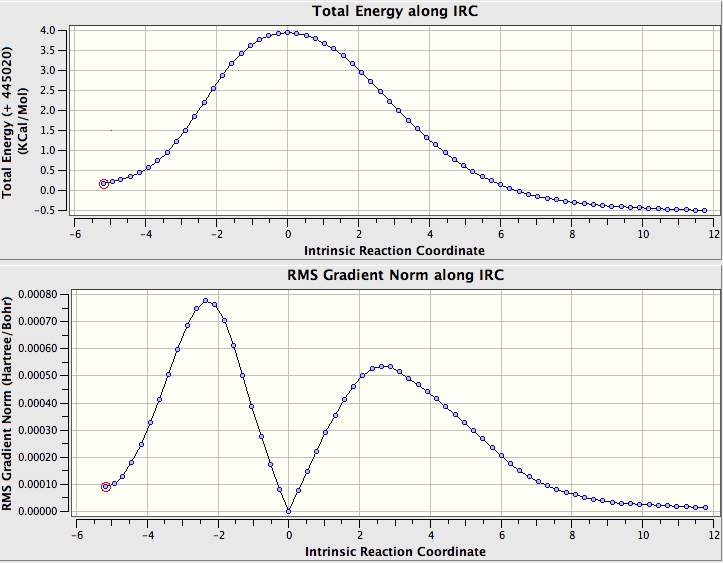
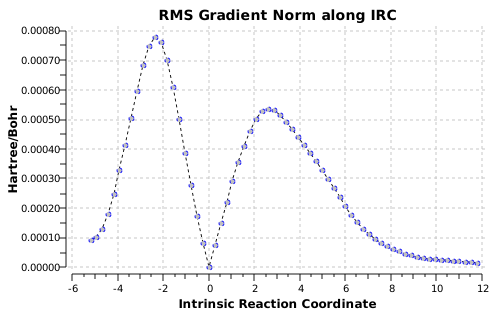
The 8π component has bonds forming on the nitrogen (and if it were pericyclic, on the ring carbon as well). If you load the 3D coordinates by clicking on the above graphic, you will see these two bonds appear to be forming from opposite faces of the 8π system. The term for this is antarafacial. The 2π component of the ketene is also twisted, and one can observe at least a hint that the two bonds to it are also from opposite faces (for more details, see this article we published in 1993), again antarafacial. It was only in 2005 that it was recognised that a transition state with two antarafacial components would be 4n+2 aromatic (equivalent to a doubly twisted Möbius system), and it has to be said no good examples of this mode have yet to be observed experimentally. In fact, in the present example, that second bond does not go on to form in a concerted manner with the first, so the reaction is in fact stepwise and not pericyclic. But it does seems to at least initially have some features of a doubly twisted Möbius cycloaddition. The IRC (intrinsic reaction coordinate) for TS1 which reveals the stepwise nature is in fact a classic (the lhs forms the zwitterion, typically with a small reverse barrier).
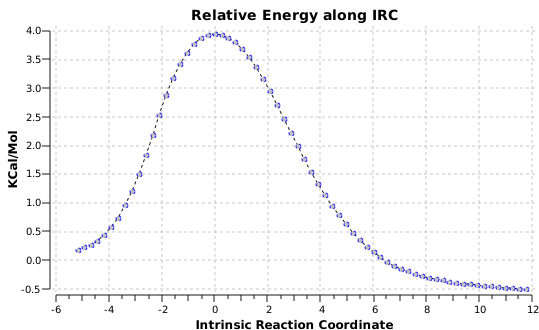
Intrinsic reaction coordinate for TS1.
- So on to the design. Attempt one is to remove the nucleophilic nitrogen lone pair, and the electrophilic carbonyl, thus suppressing the desire of the reaction to form a stable ionic intermediate. The cycloaddition between an octatetraene (the 8π component) and ethene (the 2π component), formally labelled as a π8a+π2a cycloaddition, looks as below.

A Di-antarafacial 2+8 cycloaddition. Click for 3D.
In fact, this too is not a proper concerted transition state for a pericyclic reaction, since it has a second (albeit small) imaginary mode of 84 cm-1 corresponding to desymmetrisation so that one bond forms before the other. Ethene, it seems, is not fond of cycloadding bonds antarafacially. The transition state is however aromatic, with all the ring bonds of the correct length (~1.4Å). In the interests of balance, I do have to note that a competing π8s+π2s reaction is likely to be lower in energy.
- The design is now to try to convert that second negative force constant to a positive one. Let us try replacing ethene with O=C=C=O, which might object less to an antarafacial mode across the central C=C bond. No luck there, the second mode is still imaginary (92i). The pericyclic mode is also unusual, involving breaking the central OC-CO bond.

8+2 cycloaddition involving carbon suboxide.
- One more go, this time to replace ethene with cyclopropene (the double bond might be expected to be more reactive now). Still no luck (126i cm-1).
- In fact, a more complete exploration reveals that all these various combinations exhibit the same behaviour; π6a+π4a, π10a+π4a, π8a+π6a and the triple-twist Möbius π4a+π4a+π4a.
This post attempts to show how one can take an experimental observation, couple it with some calculations, and see if anything out of the ordinary might emerge. One might then try to tweak the reaction to amplify any effects one might observe. In this case, it does seem that trying to coerce two antarafacial modes onto simple alkenes may not be possible.
Tags:antarafacial, cycloaddition, energy, Fernandez, Möbius, pericyclic, Sierra, Steve Bachrach, Torres
Posted in Interesting chemistry | 2 Comments »