Posts Tagged ‘Cambridge’

The mysterious (aromatic) structure of n-Butyl lithium.

Sunday, March 17th, 2013

n-Butyl lithium is hexameric in the solid state and in cyclohexane solutions. Why? Here I try to find out some of its secrets.

SUHBEC. CLICK FOR 3D.

SUHBEC. CLICK FOR 3D.

The crystal structure reveals the following points of interest:

  1. Six lithium atoms form a cluster with triangular faces.
  2. An off-centre carbanion caps a triangular lithium face.
  3. Four of the butyl groups are in a fully extended antiperiplanar conformation
  4. But two di-axial n-butyl exhibit a gauche conformation.

The lithium cluster has twelve electrons available for bonding; if the Li is considered as Li+, balanced by six C carbanions, the twelve electrons come from the six carbon lone pairs pointing towards each of six triangular faces. An ELF analysis can help identify how these twelve electrons are arranged. Shown below is the environment of a single Li-face, with the ELF basin ringed. It integrates to 2.08 electrons. So each tetrahedral cluster of three lithiums and one carbanion could be considered as a two-electron-four-centre bond, perhaps a natural progression from the two-electron-three-centre bonding found in a slightly less electron deficient system such as diborane. 

ELF basins. Click for  3D

ELF basins. Click for 3D

NBOs (natural bond orbitals) reflect this character. An NBO represents a localised two-electron orbital, and analysis indeed reveals six such orbitals, each having the form shown below.

NBO. Click for  3D.

NBO. Click for 3D.

This picture in turn leads us to identify this system as spherically aromatic (doi: 10.1002/1521-3773(20010803)40:15<2834::AID-ANIE2834>3.0.CO;2-H ). The three-dimensional equivalent of the Hückel rule is that any system with 2(N+1)2 σ or π electrons (or both) in a cluster can be considered aromatic/diatropic. In this case, N=0 and hence the magic count is 2 for each of the six CLi3 tetrahedra. The diatropic ring current might be manifested in the computed 1H NMR chemical shifts of the CH2 protons (-0.8ppm). Aromaticity does not immediately spring to mind with the name n-butyl lithium, but this unprepossessing molecule has six aromatic regions!

Each lithium atom is in turn hemispherically surrounded by three of these 2.08 electron basins (below, although the ELF centroid is very much biased towards the carbon, indicating considerable ionicity). What wonderful electronic economy! Despite there being only twelve electrons to be shared amongst six lithium atoms, each lithium manages nevertheless to surround itself with 6.24 electrons. All crammed into one half sphere, leaving a nice coordination hole; n-butyl lithium is after all a highly reactive species (even as a hexamer).

n-butyl-ELF1

I want to finish by exploring the observation that two of the six n-butyl groups adopt a gauche conformation. In free n-butane itself, around 31% of the population adopts this shape, which curiously is around the same proportion as is found in the hexameric structure of n-butyl lithium. More generally, a search of the Cambridge database for compounds containing such groups reveals the following distribution; about 1 in 7.

Gauche

Well, when you deprive a molecule of electrons, as any species with lithium must invariably suffer from, it is wonderful how the system responds. In this sense, a hexameric structure seems a very natural outcome. And it has brought us the two-electron-four-centre bond and the associated spherical aromaticity, both of which are a nice bonus.
The conformation of acetaldehyde: a simple molecule, a complex explanation?

Friday, February 8th, 2013

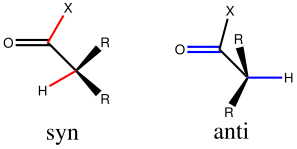
Consider acetaldehyde (ethanal for progressive nomenclaturists). What conformation does it adopt, and why? This question was posed of me by a student at the end of a recent lecture of mine. Surely, an easy answer to give? Read on …

acetaldehyde

There really are only two possibilities, the syn and anti. Well, I have discovered it is useful to start with a search of the Cambridge data base. With R=H or C, X unspecified,  acyclic and T ≤ 175K, two searches were performed. The first identified the torsion around O=C-C-H. This clearly shows a maximum at 120° (with twice the probability), and a smaller one at 0°. This matches syn; the anti conformation above would be expected to have peaks at 60° and 180°; the latter in particular is singularly missing.

acetaldehyde-180

An alternative search is to define the distance between the oxygen and the H. For the syn conformer, distances of ~2.5 and 3.1Å are expected; for the anti conformer, 2.7 and 3.3Å. Again, syn matches better. Remember, searches based on the position of a hydrogen are less reliable than most, so these distributions provide only a statistical indication.

acetaldehyde-dist

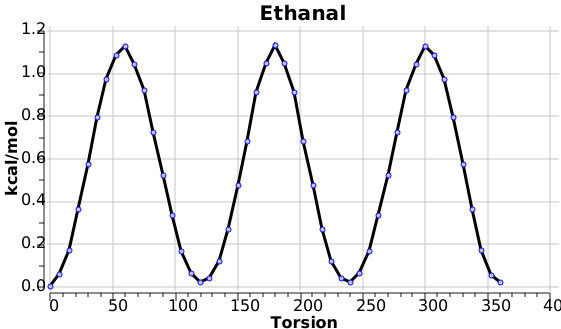
Now for a (ωB97XD/6-311G(d,p) calculation of the rotational barrier. The minima occur at torsions of 0, 120 and 240°, matching syn, although the barrier is very low.

acet-rot

Now to try to find explanations. The standard one finds this in three effects:

  1. Donation from two C-H bonds (R=H above) into the π*C=O NBO orbital (in the manner that was used to explain the cis-orientation of the two methyl groups in cis-butene). 
  2. Donation from the single co-planar C-H bond into the σ*C=O NBO orbital (blue bonds above)
  3. Pauli bond-bond repulsions between two filled NBOs. 

Effect 1 has an NBO perturbation energy E(2) of 7.0 kcal/mol for the syn conformer and 6.45 for the anti. The explanation is the π*C=O NBO “leans outward”, overlapping better with the C-H bonds in the syn than in the anti.  the One up to the syn! Effect 2 has values of 1.3 for the syn and 4.1 for the anti. The latter now has the edge. But wait, there are other (smaller) interactions. The syn has an antiperiplanar orientation of the two C-H bonds shown above (X=H,red), E(2) = 3.3 vs 0.6 for the corresponding syn-planar orientation in the anti-conformation. It’s now a tie; neck-and-neck.

Effect three suggests that the disjoint NLMO steric exchange energy is 54.34 for the anti and 53.88 (i.e. lower) for the syn. It is vaguely disappointing that no absolutely clear-cut explanation emerges. But then the difference (in total free energy) is only 1.4 kcal/mol. But even this small difference in energy can manifest in fairly clear-cut conformational preferences obtained from crystal structures. Ultimately of course, all effects in chemistry are reducible to the sum of lots of small effects (in other words unpredictable until one does the sum). 

I cannot end without mentioning the largest of all the NBO interactions, namely the in-plane lone pair on the oxygen as donor and the aldehyde proton C-H as acceptor (X=H). This has values of 29.3 for syn and 28.8 kcal/mol for anti. This manifest (inter alia) in a greatly reduced C-H vibrational wavenumber (ν 2982 for syn, 2900 cm-1 for anti) compared to the methyl C-H values (~3043-3164).

So this tiny little molecule ended up a little less obvious than might have seemed at the outset. One can find interesting things in even the tiniest of things! 


HC...C-H alignment. Click for  3D.

HC…C-H alignment. Click for 3D.


HC...C-H alignment. Click for  3D.

O=C*…C-H alignment. Click for 3D.

σ-π-Conjugation: seeking evidence by a survey of crystal structures.

Sunday, February 3rd, 2013

The electronic interaction between a single bond and an adjacent double bond is often called σ-π-conjugation (an older term for this is hyperconjugation), and the effect is often used to e.g. explain why more highly substituted carbocations are more stable than less substituted ones. This conjugation is more subtle in neutral molecules, but following my use of crystal structures to explore the so-called gauche effect (which originates from σ-σ-conjugation), I thought I would have a go here at seeing what the crystallographic evidence actually is for the σ-π-type.

sigma-pi-conjugation

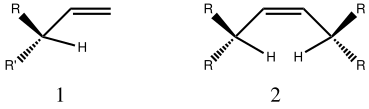
The basic two molecules are shown above; in effect propene 1 and butene 2. The latter was in fact the topic of another post, in which I attempted to show that the close H…H contact in cis-butene (2.1Å) was in effect an unwelcome consequence of the σ-π-conjugation of any of the four “outward leaning” C-H bonds of the methyl groups acting as donors (red-blue below) overlapping with the similarly “outward leaning” π* orbital of the alkene (purple-orange below; blue and purple overlap positively).

C-H/alkene interaction. Click for  3D.

NBO orbitals for C-H/alkene interaction. Click for 3D.

So how general might this be? To find out, I performed the following search on the Cambridge crystal database: cis-butene-search

  1. The search defines an alkene, bearing two cis-substituents each with at least one C-H bond. The substituents are both sp3 carbon, and the attachment bond to the alkene is defined as acyclic
  2. The H…H distance uses normalised terminal hydrogen positions (to try to correct for the normally over-short C-H bond lengths found by X-ray).
  3. Other constraints were R factor < 0.05, no disorder, no errors and (perhaps most importantly) T < 150K to try to reduce thermal libration.

I should qualify all of this by reminding that hydrogen positions in crystal structures are notoriously prone to errors. Nevertheless, with 624 hits using the above search, one might hope for statistical significance of a real effect.

Search result for close H...H contacts in cis-butenes.

Search result for close H…H contacts in cis-butenes.

For this sample, the most frequent H…H distance emerged as 2.1Å. This can only result from having the C-H bonds lie coplanar with the C=C alkene, as is shown above. The value is also remarkably close to the H…H distance for cis-butene itself (both computationally and as determined using electron diffraction). This does I feel provide a strong indication that σ-π-conjugation is manifesting in these systems.

Re-defining the search for propenes 1 as above gives 1656 hits, with a maximum in the distribution at 2.35Å corresponding to a syn-orientation of the C=C and the C-H bonds. The smaller maximum at about 2.75Å arises from a gauche-orientation between the C=C and C-H (in effect you have to halve this number, since there are twice as many possibilities for this to occur than for the syn). The “inward leaning” gauche C-H bond overlaps less well with the “outward leaning” π* orbital of the alkene.

Propene.

Search result for close H…H contacts in propenes.

These aspects are perhaps better seen in the orbital overlaps shown below.

Click for 3D.

Click for 3D.

I will follow-up this theme with esters and amides next.

The gauche effect: seeking evidence by a survey of crystal structures.

Friday, January 4th, 2013

I previously blogged about anomeric effects involving π electrons as donors, and my post on the conformation of 1,2-difluorethane turned out one of the most popular. Here I thought I would present the results of searching the Cambridge crystal database for examples of the gauche effect. The basic search is defined belowCCDC-search

Here, we define a four-atom torsion (TOR1), the two central carbon atoms having two groups R which can be only H or C. These two carbons are also defined as acyclic. The restrictions of the search as defined above also include R-factor < 0.05, not disordered and no errors. These combine to reduce the number of hits significantly (although not dissimilar distributions are obtained for less restricted searches). Each search takes only a few seconds, and one can rattle through many permutations very quickly.

So here come the results. First, QA=4M=F. All but one of the examples has a torsion in the region of 60°, the classic gauche effect!

F-C-C-F

F-C-C-F

Next, QA=O, 4M=F. Rather more hits, and the effect is almost as clear-cut. I should point out that the apparent “exceptions” to the gauche conformation may arise from structural restrictions, and each really would have to be inspected individually for the reasons (which I do not attempt here). 

OCCF

OCCF

With QA=4M=O,  one has many more instances. The effect is pretty convincing (it may be that hydrogen bonding may also control the conformation).

O-C-C-O

O-C-C-O

Now for QA=4M=Cl. The distribution is slanted more to the anti conformation, but there are still quite a few gauche.

Cl-CC-Cl

Cl-CC-Cl

With QA=4M=S, the conformations are now almost all anti; the gauche effect is no more! 

S-C-C-S

S-C-C-S

And for QA=4M=Br, it has also almost vanished (there is only one instance for I, and that too is antiperiplanar).

Br-C-C-Br

Br-C-C-Br

I now return to an earlier post in which I speculated that a cyano group might participate in the anomeric effect. Well here it is in the gauche effect; QA=CN, 4M = any of N,O,F,Cl,S. Quite a few gauche orientations for this pseudo-halogen!

Neg-C-C-CN

Neg-C-C-CN

Another group that can act as a powerful acceptor of electrons from a donor is QA=N(Me)3+.. With 4M= N, O, F, Cl, here  the population of gauche conformers is large. QA=CF3 is a similar group.

Neg-C-C-NMe3

Neg-C-C-NMe3


Neg-C-C-CF3

Neg-C-C-CF3


One can envisage other combinations. Thus QA= C=C, 4M = any of  N, O, F, Cl. An alkene seems one of the more powerful gauche effect participants!

alkene-C-C-Neg

alkene-C-C-Neg

And alkynes, perhaps slightly less so.

Alkyne-C-C-Neg

Alkyne-C-C-Neg

What about metals (QA = any metal, 4M = any of N, O, F, Cl, S). Well, not particularly biased either way, but clearly one in which the identity of the metal may matter.

Metal-C-C-electronegative

Metal-C-C-electronegative

I should end with inverting the model. If QA is electropositive (any group to the left of carbon, or below it in the periodic table) and 4M is electronegative, than they align almost exclusively anti-periplanar and not gauche. But notice how relatively few examples there are.  Synthetic chemists, please make more such molecules!

Electropositive-C-C-Electronegative

Electropositive-C-C-Electronegative

If you thought the gauche effect was restricted to just a few molecules, think again!

Hydrogen bond strength as a function of ring size.

Thursday, January 3rd, 2013

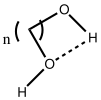
One frequently has to confront the question: will a hydrogen bond form between a suitable donor (lone pair or π) and an acceptor? One of the factors to be taken into consideration for hydrogen bonds which are part of a cycle is the ring size. Here I explore one way of quantifying the effect for the series below, n=1-5 (4-8 membered rings).h-bond

I will use the NBO approach. To remind, this reduces the wavefunction for a molecule to a set of localised orbitals, referred to as natural bond orbitals. The perturbation interaction energy E(2) between any (doubly occupied, i.e. donor) orbital and an (unoccupied) acceptor orbital establishes the strength of that interaction. For a hydrogen bond, this can be expressed as the NBO corresponding to the (in this case oxygen) lone pair (shown in orange and purple below) and the corresponding H-O σ* empty orbital (shown as red and blue below). E(2) is a function both of how close in energy this pair of orbitals is (the smaller the energy gap the better) and how well they overlap (the relevant overlap in this case is the positive one between purple and blue). This latter attribute is shown below for the series n=2,3,4,5 (n=1 does not form any discernible hydrogen bond), at the ωB97XD/6-311G(d,p) computational level.

NBO interaction for 5-ring H-bond. Click for 3D.

NBO interaction for 6-ring H-bond. Click for 3D

NBO interaction for 7-ring H-bond. Click for 3D.

NBO interaction for 8-ring H-bond. Click for 3D.

The interaction energies E(2) are collected below, together with the computed lengths. To put E(2) into context, it is around 16 kcal/mol for a strong anomeric interaction, and about 6 kcal/mol for the stereoelectronic influence in di-fluoroethane. One can see that by the time the angle subtended at the hydrogen has increased to ~150°, the interaction energy has reached a respectable value.

E(2), kcal/mol  O…H length, Å  Angle, °
1 ~0.0  –  81.8
2 0.75 2.294  109.7
3 3.56 1.984  139.6
4 6.24 2.017  146.5
5 8.35 1.957  153.4

So the simple trick of looking at the donor-acceptor NBO interaction in a cyclic hydrogen bond can give us a straightforward way of quantifying how the size of the ring and hence the orbital overlap (one presumes that the Lp/C-O σ* energy gap is similar for all the systems) affects the strength of the interaction. One might also explore this by looking at structures in the Cambridge crystal database. But note from the above that whilst the  E(2) energies follow ring size, this does not appear to happen for the H…O lengths! The analysis reveals that the maximum number of structures for the span 5 to 8-rings occurs at ~2.15, 1.85, 1.65 and 1.85Å respectively. 

Crystal data for 5-rings

Crystal data for 5-rings

Crystal data for  6-rings.

Crystal data for 6-rings.

Crystal data for 7-rings

Crystal data for 7-rings

Crystal data for  8-rings

Crystal data for 8-rings

What is the range of values for a (sp3)C-C(sp3) single bond length?

Wednesday, September 12th, 2012

Here is a challenge: what is the longest C-C bond actually determined (in which both carbon termini are sp3 hybridised)? I pose this question since Steve Bachrach has posted on how to stabilize long bonds by attractive dispersive interactions, and more recently commenting on what the longest straight chain alkane might be before dispersive interaction start to fold it (the answer appears to be C17).

A search of the Cambridge database (the following conditions apply; structure determined at less than 160K, no errors, no disorder, and a minimum separation of 1.7Å) reveals only 7 entries longer than 1.7A. The reference codes for these are FIBBOI, HOLKOI, LAGHOQ01, RIRTUH, RUNHOY, XIQRIZ, BATSIA, the latter having a value of 1.731Å (T=123K, R=4.44%, DOI: 10.1246/cl.2012.541). Of course, a very close inspection of the crystallography would also be needed to determine if these values are to be taken at face value.

BATSIA. Click for 3D model.

If one relaxes the temperature constraint for measurement, CAZFUE01 has a claimed C-C length of 1.99Å (R=4.5%, DOI: 10.1246/cl.2012.541). This however represents the so-called frozen transition state for a [3,3] sigmatropic rearrangement. A ωB97XD/6-311G(d,p)/SCRF=dichloromethane calculation seems to indicate that this species is in fact a transition state for the [3,3] reaction, and hence that the crystal structure may in fact correspond to the mean position of the two end points of the reaction, and so be an artefact. More on this in a later post. 

CAZFUE. Click for 3D model.

And I suppose one should ask what the shortest such single bond is as well as the longest. This is currently claimed to be 1.436Å for KAVKUO (10.1002/anie.200501605) and 1.434Å for WUDKAH (10.1016/S0040-4020(02)00695-6). The origins of this contraction also deserve to be more fully explored in a later post.

KAVKUO. Click for 3D


WUDKAH. Click for 3D.

Certainly, the (sp3)C-C(sp3) bond does seem to be capable of a large range of values ranging from 1.44 to at least 1.73 and possibly 1.99Å.

Dynamic effects in nucleophilic substitution at trigonal carbon (with Na+).

Thursday, July 19th, 2012

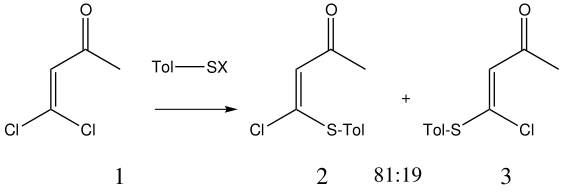
In the preceding post, I described a fascinating experiment and calculation by Bogle and Singleton, in which the trajectory distribution of molecules emerging from a single transition state was used to rationalise the formation of two isomeric products 2 and 3.  In the present post, I explore possible consequences of including a sodium cation (X=Na+ below) in the computational model.

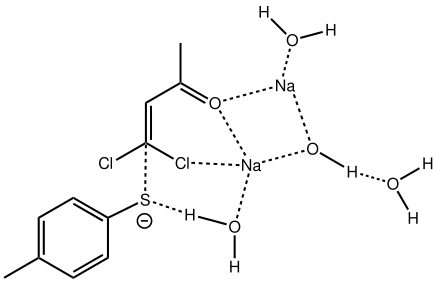
Sitting down to construct such a model, one is immediately faced with important decisions. Na+ comes with baggage, namely groupies in the form of solvent molecules and ionic bonding. The latter means less certainty regarding where to place the ion (covalent bonds have that nice attribute that their orientation and length is pretty predictable most of the time). I decided to construct the model shown below, using not one Na+ but two (such structures are known from the Cambridge crystal data base), the second Na+ being charge balanced by hydroxide anion.

The resulting transition state (B3LYP/6-31+G(d,p)/CPCM=ethanol) is shown below, and the free energy activation barrier, ΔG is 11.7 kcal/mol, well down on the value obtained using X=H+, and entirely reasonable for a reaction occurring at room temperature. This suggests that the model is not unreasonable (but of course does not prove it is the best).

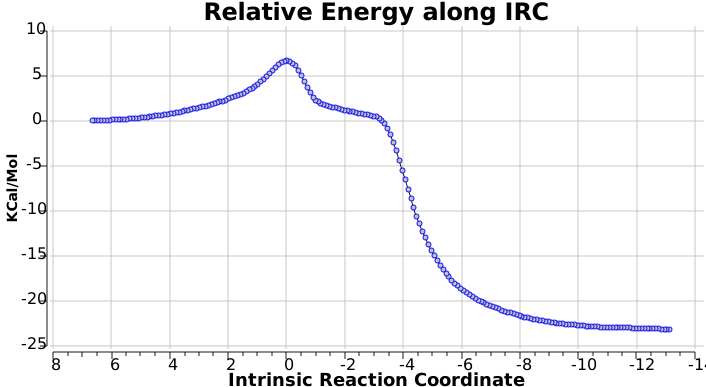
The geometry of this transition state is significant. Of the two C-Cl bond lengths, the shorter (click the image above to inspect the model) is the one cis to the carbonyl (subsequent elimination of which would result in formation of the major product 2). But an IRC reveals what happens next. Recollect that when X=H+ a tetrahedral intermediate is formed that then collapses with elimination of H3O+Cl. This time, no intermediate is seen on the IRC, and the requisite C-Cl bond is broken to form 2 in a concerted (but very asynchronous) manner, and in the manner reported by Bogle and Singleton for a model without counterion and explicit solvent.

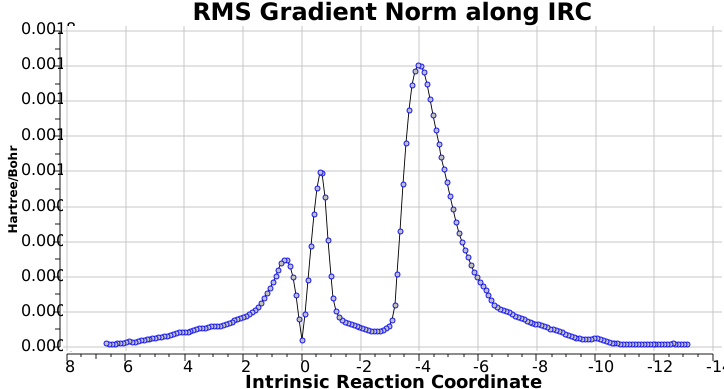
Notice how preparation for eviction of the C-Cl bond only starts after the transition state is passed. The forces on the departing chloride start to grow after the dihedral angle of the Ar-S-C-Cl system has become antiperiplanar (IRC -3), resulting in the anion shooting out towards one of the two Na+ cations to form solvated NaCl.

So we now have a rather more complete model. But is it yet complete enough? How would one go about evicting the other chloride, resulting in formation of 3? I think it is fairly clear that the model will have to be enlarged yet again, this time to include at least one more Na+ located on the other side of the carbonyl, and ready to receive the anion. Possibly at least another two water molecules and one hydroxide anion would be required to surround this cation. Clearly, such a model would have grown substantially compared to the original one (Occam might not be happy), and that we are gradually edging towards having two quite separate transition state models to account for each of 2 and 3. At this stage, it would be interesting to apply Bogle and Singleton‘s direct dynamics model to try to establish if each transition state leads to only one product, or whether either of these transition states could result in cross-over to the other product.

I have no feel for whether the  transition state presented here can be treated using direct dynamics; if it could, that would indeed be an interesting simulation.

More joining up of pieces. Stereocontrol in the ring opening of cyclopropenes.

Thursday, July 12th, 2012

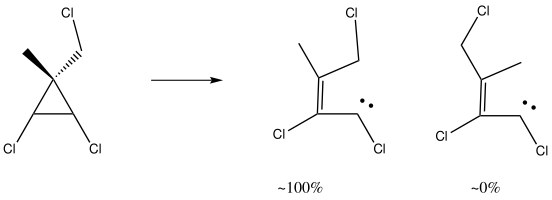
Years ago, I was travelling from Cambridge to London on a train. I found myself sitting next to a chemist, and (as chemists do), he scribbled the following on a piece of paper. When I got to work the next day Vera (my student) was unleashed on the problem, and our thoughts were published[1]. That was then.

This is now. I have just finished a post on ring-opening reactions of oxirene, a 4n electron anti-aromatic ring. I was casting around for an example of a calculation done just before the modern Internet era, and happened upon the above. Although this was a mere 20 years ago, much of the detail had faded; I had not thought much about it in the intervening years, but I did recollect that although we had attributed the high stereoselectivity shown above to a stereoelectronic orbital alignment, I was not entirely happy with the interpretation. Put simply, we had relied on a molecular orbital diagram, and this diagram (in resplendent colour in the journal, one of the few being so published at that time, and for no colour charge to boot) was just too complicated. Arguably it was the fixated complexity (I remember at the time that it looked complicated no matter what the viewing angle was) that set me on the road to the use of the Web, and ultimately here to this blog. So I thought a re-analysis using modern algorithms and presentation might help simplify. The newly recalculated transition state (ωB97XD/6-311G(d,p) looks like:

Transition state for ring opening of a cyclopropene. Click for 3D.

  1. The reaction is a 4n (n=1) electron electrocyclic ring opening, and so according to the rules, should proceed with the formation/cleavage of an antarafacial bond. You might think that there are not quite enough substituents to reveal this stereochemistry, but there are if the carbene lone pair is included. So how to add the lone pair?
  2. Well, its coordinates can be computed using the ELF (electron localisation function). The relevant lone pair is ringed in red below. Using (old technology, i.e. a static figure) you may choose to believe me when I argue that this lone pair is above the plane of the forming ring from the perspective shown, whilst the terminus of the bond it forms is to the bottom. This defines an antarafacial component. Well, I might have carefully manipulated the viewing angle to show this. Now, in 2012 rather than 1992, you can load the 3D coordinates by clicking below, and check for yourself!

    Lone pair centroid for the transition state. Click for 3D

  3. What about the stereo-control? Take a look at the angle between the axis of the C-Cl bond (atoms ringed in blue) and the centroid of the carbene lone pair (red). It is about 162°, or almost anti-periplanar. A magic orientation in organic chemistry. Time to attack the orbitals again. Our published diagram looked as below. It shows the HOMO aligning with the LUMO+2 (if your eyes are not distracted by all the other detail).
    But we can now simplify such a complex molecular orbital by using instead a localized version, an NBO. A little explanation is needed. The NBO orbital shown with red/blue phases is antibonding for the C-Cl bond. That with orange/purple is the carbene lone pair. Where orange overlaps with red, we have a positive overlap that stabilises the system. The NBO E2 perturbation energy is around 4.6 kcal/mol. Although this may seem small, it is actually quite large for a through-space interaction of this type. It is this stabilisation (amounting to ~ 1.6 kcal/mol in free energy) that accounts for the high selectivity for the stereoisomer shown above.

    NBO for transition state. Click for 3D.

Well, I think that the passage of 20 years has enabled us to tidy up the origins of the stereoelectronic effect responsible for controlling this reaction, and to produce clearer diagrams which the reader can interactively explore for themselves. It did take 20 years to join things up though!

References

  1. M.S. Baird, J.R. Al Dulayymi, H.S. Rzepa, and V. Thoss, "An unusual example of stereoelectronic control in the ring opening of 3,3-disubstituted 1,2-dichlorocyclopropenes", Journal of the Chemical Society, Chemical Communications, pp. 1323, 1992. https://doi.org/10.1039/c39920001323

Scalemic molecules: a cheminformatics challenge!

Wednesday, July 6th, 2011

A scalemic molecule is the term used by Eliel to describe any non-racemic chiral compound. Synthetic chemists imply it when they describe a synthetic product with an observable enantiomeric excess or ee (which can range from close to 0% to almost 100%). There are two cheminformatics questions of interest to me:

  1. How many non-trivial scalemic molecules have been reported in the literature (let’s assume their ee is significantly greater than 0%)?
    • The distribution function for the ee of these molecules would be most interesting!
  2. Of those, how many have the absolute configuration of the predominant enantiomer established with high confidence?
    • Or, to put this another way, how many may prove to be mis-assigned?

Note the careful qualification in the above questions. Thus by non-trivial, I mean compounds whose scalemic attributes persist in solution for a chemically useful duration. That could be taken to mean configurationally stable chiral molecules, rather than those that might be conformationally chiral (an example of a trivial scalemic molecule would be e.g. the twist-boat conformation of cyclohexane, which having D2 symmetry is dissymetric, but which would only retain its scalemic property for a trivially short timescale).

What are boundary values? These are some:

  • As I write this, CAS records 61,257,703 chemical substances. Needless to say (unless I missed it), the answer to my first question is not to be found there.
  • Beilstein (Reaxys) records 1,126,995 compounds as having one or more reported chiroptical properties (which is the most direct way of establishing a molecule is scalemic, although strictly, having say an optical rotation of 0° does not necessarily mean the molecule is not scalemic). We have no way of knowing how many molecules are scalemic for which no chiroptical measurement has been made (but one would hope its a small proportion). Perhaps that is a good answer to question 1?
    • of which 1,097,094 relate to optical rotatory power, 17,515 to optical rotatory dispersion and 62,248 to electronic circular dichroism.
    • it is more difficult to answer how many of these 1,126,995 substances have a firmly established absolute configuration. Measuring a chiroptical property per se does NOT in itself establish the absolute configuration. Doing so is a fascinating exercise in sequential logical argument, and how one does it has changed quite a lot over time. And what might I mean with high confidence? An older assignment (made say > 40 years ago) might be less confident than one established in 2011 (fortunately, we can probably trust the absolute configurations of the amino acids!). A bit of a can of worms, nevertheless. But it interests me because it is a good example of what the semantic web is supposed to be all about.
  • The Cambridge crystallographic database reports 560,307 entries, of which 72,340 are in chiral space groups (in which a chiral molecule can crystallise) and exhibit no disorder or other errors. We do not know how many of these are non-trivial, since all manner of small (and low energy) distortions can create a chiral species (in the solid state), but which would not persist  for a chemically useful duration in solution (i.e. it might for example immediately racemize and become non-scalemic).
  • The Flack parameter has been used since 1983 for enantiomorph estimation (a value of ~≤ 0.10(10) would be considered meaningful). This could in principle provide an answer of known confidence to my question 2 above (but would not address the issue of non-triviality).
    • The challenge now is to quantify how many compounds have a meaningful reported Flack parameter (presumably a sub-set of 72,340?)

Let me declare one personal interest. Over the last four years or so, we have been asked to confirm the absolute configuration of around eight scalemic molecules. After a detailed study, we concluded three were mis-assigned. Now this in no way implies anything about what the answer to question 2 above might be! But it does make one think!

Déjà vu all over again. Are H…H interactions attractive or repulsive?

Tuesday, May 31st, 2011

The Pirkle reagent is a 9-anthranyl derivative (X=OH, Y=CF3). The previous post on the topic had highlighted DIST1, the separation of the two hydrogen atoms shown below. The next question to ask is how general this feature is. Here we take a look at the distribution of lengths found in the Cambridge data base, and focus on another interesting example.

9-anthranyl derivatives. Click for Pirkle with normalised C-H lengths.

The histogram below shows all 9-anthranyl compounds in the CCDC database distributed by DIST1. The search was conducted with the restrictions of no disorder, no “errors”, and using normalised hydrogen bond lengths. A note of explanation for the latter. Because of the nature of x-ray diffraction, when a C-H distance is obtained from a structural refinement, it tends to emerge ~0.1Å to short. Normalisation means adjusting that distance to a more correct 1.09Å (the heavy atom stays put, its the  H that moves). In our case, this has the effect of actually shortening DIST1. In the Pirkle structure (shortcode SOCLIF) the nominal value for DIST1 is 1.94-1.96Å, but normalisation reduces these to 1.82-1.85Å. This really is an unusually short contact between two hydrogen atoms (the sum of the vdW radii is 2.4Å). So how unusual might this be? Show below is the result of the CCDC search.

H...H Contacts in 9-anthranyl derivatives

Notice how a maximum in the number of examples is visible at ~1.9Å, but examples all the way down to ~1.7Å are known! If one restricts the search to examples where X=O, the following plot is obtained. The entry on the bottom left is JARYEG, where Y is sufficiently large to enforce short H…H or O…H contacts on both sides. Click on the histogram picture below to see it. When you do so, you will also see the NCI surface computed at this geometry. Note that both the short H..H (DIST1) and the short O…H (DIST2) interaction surfaces are coloured blue, indicating attractive contacts!

9-anthranyl derivatives, X=O.

If you explore the 3D model further, you will notice other blue interaction surfaces, and a number which have both blue AND orange (= repulsive) zones. We see here yet another example of a weak interaction being simultaneously both attractive and repulsive. It is no longer sufficient to say that the interaction between two atoms is either one or the other. Depending on where you measure it, it can be both! In other words, even weak bonds can have internal structure (for a discussion of the internal structure of a strong C-S bond, see DOI 10.1021/ct100470g).