Posts Tagged ‘Interesting chemistry’

Anatomy of an asymmetric reaction. The Strecker synthesis, part 2.

Wednesday, May 26th, 2010

In the first part of the post on this topic, I described how an asymmetric sulfoxide could be prepared as a pure enantiomer using a chiral oxygen transfer reagent. In the second part, we now need to deliver a different group, cyano, to a specific face of the previously prepared sulfoxide-imine. The sulfoxide is now acting as a chiral auxilliary, and helps direct the delivery of the cyanide group to specifically one face of the imine rather than the other. After removal of the aluminum carrier for the cyano group and hydrolysis of the cyano group to a carboxylic acid group, we end up with an enantiomerically pure amino acid.

The Strecker synthsis: asymmetric delivery of cyanide anion. Click for 3D model of transition state

Two transition states can be computed (ωB97XD/6-311G(d,p)/SCRF[dichloromethane], see DOI 10042/to-4927) and the S,S(S) diastereomer is found to be  1.35 kcal/mol lower in total free energy than the R,S(S) isomer. This agrees with the observed specificity. Again, a reason for the specificity needs identifying, and again we use  AIM.

AIM analysis for the asymmetric delivery of cyanide to an imine, S,S(S) form.

In the favoured diastereomer, a BCP or bond-critical-point (green arrow above) can be found connecting a hydrogen from an aryl group to the oxygen of the Al-OMe group  via a weak hydrogen bond (H…O distance 2.25Å). In the disfavoured form, this interaction vanishes, and is instead replaced by a repulsive close N=CH…C-aryl contact of 2.49Å (for which there is no  BCP, red arrow below).

Disfavoured transition state. R,S(S) form.

The take home message from these two posts is that quite unusual interactions may often be responsible for asymmetric induction in a stereospecific reaction, and that helpful clues to these interactions may well be derived from an AIM analysis. Indeed, anyone doing stereospecific synthesis in the lab should be familiar with these methods! You have to be a jack-of-all-trades nowadays to keep up!

Anatomy of an asymmetric reaction. The Strecker synthesis, part 1.

Monday, May 24th, 2010

The assembly of a molecule for a purpose has developed into an art form, one arguably (chemists always argue) that is approaching its 100th birthday (DOI: 10.1002/cber.191104403216) celebrating Willstätter’s report of the synthesis of cyclo-octatetraene. Most would agree it reached its most famous achievement with Woodward’s synthesis of quinine (DOI: 10.1021/ja01221a051) in 1944. To start with, the art was in knowing how and in which order to join up all the bonds of a target. The first synthesis in which (relative) stereocontrol of those bonds was the primary objective was reported in 1951 (10.1021/ja01098a039). The art can be taken one step further. It involves control of the absolute stereochemistry, involving making one enantiomer specifically (rather than the mirror image, which of course has the same relative stereochemistry). Nowadays, a synthesis is considered flawed if the enantiomeric excess (of the desired vs the undesired isomer) of such a synthesis does not achieve at least ~98%. It is routine. But ask the people who design such syntheses if they know exactly the reasons why their reaction has succeeded, you may get a less precise answer (or just a lot of handwaving; chemists also like to wave their hands as well as argue).

Here I set out one such asymmetrically stereospecific scheme, which is the first part of a reaction used to make both natural and un-natural configurations of aminoacids; the Strecker synthesis.

The asymmetric synthesis of an S(S) sulfoxide. Click for 3D model

It makes use of a natural product based on the camphor ring system which nature provides as a single enantiomer. It is converted to an oxaziridine, and this reagent is now used to transfer one oxygen atom to an imino-thioether (DOI: 10.1021/ja00030a045). The result is the formation of a single S(S) enantiomer (the enantiomeric excess is > 98%) of a sulfoxide. In the second stage, cyanide is then delivered asymmetrically (i.e. to one face rather than the other) of the C=N group, the precursor to forming a pure enantiomer of an amino acid. Here we will probe why the first reaction, the asymmetric oxygen atom delivery, is so specific. It would be fair to say that this reaction was probably originally designed with no fundamental understanding of how it might achieve its magic asymmetric delivery. For example, those two chlorine atoms on the camphor ring look as if they were selected by trial-and-error. What indeed IS their role? Steric? Electronic? Other?

If you click on the diagram above, a rotatable 3D model should appear (a static version is shown below). This is an AIM (atoms-in-molecules) analysis of the curvature of the electron density in this transition state (see DOI: 10042/to-4929). To help you navigate, arrow 1 is pointing to the small purple sphere representing the BCP (bond critical point) for the forming S…O bond. Three more purple spheres are highlighted with a halo. One of these is pointed to by arrow 2 below (to see the other two, you really will need the 3D model). This represents a BCP which appears between the hydrogen of the N=CH group and one of the oxygen atoms of the sulphone group. The label indicates the electron density at that point (0.017 au). This is characteristic of a hydrogen bond, albeit an unusual C-H…O type (a type that is too rarely invoked when explanations of stereospecificity are sought), and the density indicates its a reasonably strong one!

AIM analysis of Transition state for oxygen transfer

In fact, two more BCPs can be located between this H and other groups, and they too are marked with halos. The first leads to the oxygen atom being transferred, and the second to specifically one of the two chlorine atoms (there are other interactions to the chlorines as well). Now, it turns out that these interactions are largely absent for the alternative transition state (which would form the enantiomeric R(S) sulfoxide). Since a C-H…O hydrogen bond can easily be worth ~2 kcal/mol, it is no surprise to find that the energy of the favoured transition state is overall 2.4 kcal/mol lower in free energy compared to the isomer not formed. This represents (@300K) a ratio of 60:1 in the predicted ratio of the two species, or indeed an ee ~98%.

Armed with this insight, one could design further experiments to test the hypothesis. For example, it appears only one of the two chlorines plays an active role. Replacing the passive chlorine with e.g. hydrogen might make little difference. Suppressing the hydrogen bonds by changing the N=CH to e.g. N=CF should have a big effect. The two oxygens of the sulfone also do not play equal roles. Perhaps this can be tested with a sulfoxide in place of the sulfone? All these hypotheses can of course first be tested with calculations. Of course, coming up with synthetic strategies for these new molecules might be tricky. But these experiments may give confidence (or demolish it) in the AIM technique used here to analyse the stereospecificity of this reaction.

So the next time you hear a synthetic chemist proudly announce a new enantioselective synthesis, ask them what their deeper understanding of why their reaction works is. And be prepared to run away fast if they growl at you!

A Digital chemical repository – is it being used?

Tuesday, May 4th, 2010

In this previous blog post I wrote about one way in which we have enhanced the journal article. Associated with that enhancement, and also sprinkled liberally throughout this blog, are links to a Digital Repository (if you want to read all about it, see DOI: 10.1021/ci7004737). It is a fairly specific repository for chemistry, with about 5000 entries. These are mostly the results of quantum mechanical calculations on molecules (together with a much smaller number of spectra, crystal structure and general document depositions). Today, with some help (thanks Matt!), I decided to take a look at how much use the repository was receiving.

  1. The first entry in the log dates from 2008-02-05.
  2. The repository is now receiving about 1200 accesses via handle resolutions each day, which comprises
  3. ~150 unique client IPs, and
  4. ~900 unique handles accessed daily

Whilst most of the hits are coming from web spiders by auto-discovery, a fair number (perhaps ~300) of the 5000 entries have also been linked to via journal articles, and of course this blog, and some hits may be presumed to be the result of non-random ping-backs. A breakdown of a typical day (2010-02-10) when 839 unique handles were accessed shows access by, amongst others, five universities, Google/Yahoo, several other information corporations and Microsoft. I had no idea Microsoft was interested in calculations on molecules! You saw that here first!!

Other anecdotal feedback regarding the repository: I often use it to exchange calculations with collaborators, sending them the handle instead of a vast checkpoint or log file. Some collaborators, it has to be said are baffled by the interface presented to them (which was designed in large measure by DSpace, not by us).

It is early days in many ways, and being pretty much the only standards-compliant digital repository operating in chemistry in this manner means that awareness is still low. If anyone reading this blog knows of significant others, please comment.

Semantically rich molecules

Sunday, May 2nd, 2010

Peter Murray-Rust in his blog asks for examples of the Scientific Semantic Web, a topic we have both been banging on about for ten years or more (DOI: 10.1021/ci000406v). What we are seeking of course is an example of how scientific connections have been made using inference logic from semantically rich statements to be found on the Web (ideally connections that might not have previously been spotted by humans, and lie overlooked and unloved in the scientific literature). Its a tough cookie, and I look forward to the examples that Peter identifies. Meanwhile, I thought I might share here a semantically rich molecule. OK, I identified this as such not by using the Web, but as someone who is in the process of delivering an undergraduate lecture course on the topic of conformational analysis. This course takes the form of presenting a set of rules or principles which relate to the conformations of molecules, and which themselves derive from quantum mechanics, and then illustrating them with selected annotated examples. To do this, a great many semantic connections have to be made, and in the current state of play, only a human can really hope to make most of these. We really look to the semantic web as it currently is to perhaps spot a few connections that might have been overlooked in this process. So, below is a molecule, and I have made a few semantic connections for it (but have not actually fully formalised them in this blog; that is a different topic I might return to at some time). I feel in my bones that more connections could be made, and offer the molecule here as the fuse!

Two chair conformations of the molecule DULSAE. Click here for 3D. Note the (attractive) short H...H contacts.

To list all the likely semantics that a chemist would perceive in the graphic above would take far too long (by the time one would have finished, a text book would have been written). So here is a very very short summary in the context of conformational analysis.

  1. The molecule has a six membered ring as its backbone
  2. which can adopt two possible chair conformations
  3. which can interconvert by exchanging the axial and equatorial group pair for each of the four carbon atoms in the ring.
  4. An organic chemist will immediately notice a very unusual group, Fe(CO)2Cp, which itself is a semantic goldmine,
  5. but for the purposes here we will regard merely as a C-Fe bond!

The (semantic) question to be posed is “which of the two conformations shown above is the most stable“? That too of course has an abundance of implicit semantics, but most human chemists will probably know that this refers to asking which of the two geometries represents the lowest thermodynamic free energy (and we leave aside the issue of what medium the molecule is in, i.e. solid, solution or gas). A far trickier question is “why”?

So to (some interim) answers. Well, a ωB97XD/6-311G(d) calculation (wow, think of what is implied in that concise notation) predicts conformation (a) to be more stable by 2.3 kcal/mol (2.1 in ΔG, see DOI: 10042/to-4911). Now to the why. What connections would someone well versed in conformation analysis spot?

  1. The molecule has two methyl groups on adjacent atoms. They may prefer to be di-axial rather than di-equatorial to avoid excessive steric repulsions (whatever we mean by that!). That might prefer (b).
  2. The molecule has one carbon with both a cyano and an ether linkage. Well, that is susceptible to an anomeric effect (although, as I pointed out in an earlier post here, this connection has in fact often NOT been made in the literature). Only in conformation (a) is one of the oxygen lone pairs aligned anti-periplanar to the axis of the C-CN bond. The reasons why this is important are outlined in my Lecture course.
  3. Having spotted the last, the human might ask whether there is any possibility of an anomeric effect between an oxygen lone pair and the axis of the C-Fe bond? Well, I rather think that not a single human ever has asked that question! (I cannot know that of course, and perhaps someone has speculated upon this in the literature; this is where a full semantic web would help. That question could be posed of it! The reason  I suspect the connection might not have been made is that the anomeric effect is the domain of the organic chemistry, and  C-Fe bonds are those of the organometallic chemist. They do tend to see the chemical world rather differently, these two groups of chemists). If there was such an effect, it would favour (a).
  4. Then we have an X-C-C-Y motif. Depending on the nature of X and Y, the molecule might actually prefer a gauche conformation, i.e the dihedral angle XCCY would be around 60°. There are several such motifs one can detect; X=Y=O (twice). It might be that other permutations such as X=CN, Y=Fe(CO)2Cp, favour anti-periplanar. There are other permutations whose orientational preference may not even be recorded (in text books). Suddenly its gotten complicated!
  5. There are a number of short (~2.4Å) H…H contacts
  6. We are starting to understand that to unravel the conformation of this molecule, one may have to identify quite a number of different “rules”, and then to quantify each, and add up the numbers to get the final result. That energy of 2.3 kcal/mol may be composed of the result of applying quite a number of different rules. Hence the title of this post, a semantically rich molecule!

Well, I will leave it here for this post, without giving answers to the six points listed above, or really answering my main question posed above. That would make the post too complex (but I will follow this up!). I do want to end by planting the idea that answering this question involves making a great many chemical connections about the properties of this molecule, and then identifying quantitative ways (algorithms) in which an answer can be formulated. The molecule above is presented as a challenge for the Semantic Web to address!

The conformation of 1,2-difluoroethane

Tuesday, April 6th, 2010

Here I offer another spin-off from writing a lecture course on conformational analysis. This is the famous example of why 1,2-difluoroethane adopts a gauche rather than antiperiplanar conformation.

The gauche and antiperiplanar conformations of 1,2-difluoroethane

One major contribution to the greater stability of the gauche is the stereoelectronic interactions, and this is best probed using the NBO (Natural Bond Orbital) approach of Weinhold (DOI: 10.1021/ja00501a009). The process is approximately described as first reducing the wavefunction down to a set of orbitals which have been localized (using appropriate algorithms) down to two or one centres (corresponding to two-centre covalent bonds, or one-centre electron lone pairs). Perturbation theory is then used to evaluate the interaction energy between any filled and any empty combination. For the molecule above, six such combinations are inspected, involving any one of the six filled C-H or C-F σ-orbitals, and the best-overlapping σ* orbital which turns out to be located on the C-H or C-F bond anti-periplanar to the filled orbital.

Filled C-H NBO orbital. Click for 3D to superimpose empty C-F anti bonding orbital.

Empty C-F antibonding NBO orbital. Click for 3D

A filled C-H orbital is shown above on the left, accompanied by an empty C-F σ* orbital on the right which is anti-periplanar to the first. This alignment allows the phases of the two orbitals to overlap maximally (blue-blue on the top, red-red beneath).

The interaction energy between this pair is determined not only by the efficacy of the overlap, but by the energy gap between the two. The smaller the gap, the better the interaction energy (referred to as E2, in kcal/mol). For the gauche conformation, the six pairs of orbitals have the following interaction energies; two σC-H/σ*C-F interactions (illustrated above), 4.9; two σC-H/σ*C-H 2.6 and two σC-F/σ*C-H 0.8 kcal/mol. For the anti-periplanar conformation, the terms are four σC-H/σ*C-H 2.5 and two σC-F/σ*C-F 1.8 kcal/mol. The two totals (16.6 vs 13.6) indicate that gauche is stabilized more by such interactions.

There is of course a bit more to this story, but I have documented the above here, since I can include an explicit (and rotatable) illustration of the orbitals involved (which  I have not seen elsewhere). If you want a recipe for generating these orbitals, go here.

Conformational analysis of biphenyls: an upside-down view

Friday, April 2nd, 2010

One of the (not a few) pleasures of working in a university is the occasional opportunity that arises to give a new lecture course to students. New is not quite the correct word, since the topic I have acquired is Conformational analysis. The original course at Imperial College was delivered by Derek Barton himself about 50 years ago (for articles written by him on the topic, see DOI 10.1126/science.169.3945.539 or the original 10.1039/QR9561000044), and so I have had an opportunity to see how the topic has evolved since then, and perhaps apply some quantitative quantum mechanical interpretations unavailable to Barton himself.

The example I have chosen to focus on here is biphenyl (a derivative of which also happens to be the first structure shown by Barton in his 1970 Science article noted above), but modified with iso-electronic B/N substitution for carbon for a particular reason.
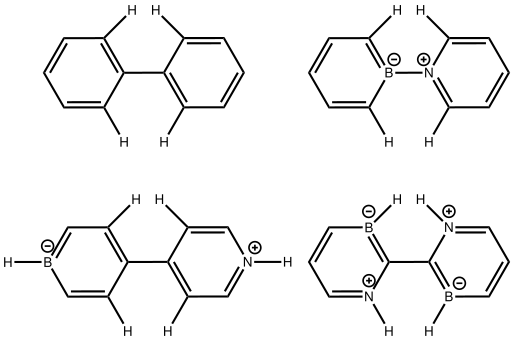
biphenylFour hydrogen atoms are highlighted in the above drawings by virtue of how close they might approach each-other, and what impact this will have on the conformation of each species. Such close approaches are normally defined with reference to the so-called van der Waals radius of the element concerned. For hydrogen, this radius is either 1.2Å (if the contact is to another hydrogen) or 1.1Å (if its to any other element, see DOI: 10.1021/jp8111556). An interpretation of this value is that the van der Waals attraction due to to dispersion or long range correlation effects reaches a maximum for two non-bonded hydrogen atoms at ~2.4Å. Significantly, a slightly closer approach than this value might still be mildly attractive, but it would be generally agreed that any distance less than ~2.1Å now represents a genuine repulsion between the hydrogens (see also this post). This represents a somewhat more quantitative judgement on what used to be called steric interactions.

With the scene set, let me introduce the results of a calculation (wB97XD/6-31G(d,p), a DFT method selected because it treats the long range correlation effects with a specific correction)

Conformational analysis of biphenyl 1

One can see here minima at ~45, 135, 225 and 315° for 1 (see DOI 10042/to-4853). Due to symmetry, the first and last are identical as are 2nd and 3rd, and the 1st and 2nd minima are in fact enantiomers of each other (the symmetry is D2, which is chiral). Two different transition states connect these minima, one with angles of 0/180 and the other slightly lower energy at 90/270°.

The non-bonded H…H distance are as follows: 1.95Å@0°, 2.39Å@45° and 3.54Å@90°. We may conclude that the first of these is repulsive, the second attractive and the third non interacting. Counterbalancing this effect is of course resonance due to π-π-overlaps across the central bond, which decreases to zero as the angle moves to 90°. The conformational minimum @45° is such because of the maximal H…H dispersion attraction and the still significant π-π-overlap. This brief analysis suggests however that these two effects are finely balanced, and so the next question is whether one might be able to perturb the system to distort the balance. The perturbation chosen is to replace one or two pairs of carbon atoms with the iso-electronic combination B+N.

The first perturbation is to replace the central rotating bond by a B-N combination 2 (DOI: 10042/to-4854).

Rotation about the B-N bond in 2

For this species, the H…H distances are 2.02Å@0°, 2.36Å@45° and 3.61Å@90°, the only significant difference with 1 emerging as the 0° conformation being around 1 kcal/mol lower relative to the other two. It is tempting to attribute this to the longer H…H separation for this rotamer in 2 due to the B-N bond being longer (1.562Å) than the C-C bond it replaced (1.496Å)

The next perturbation is to relocate the N/B pair as in 3 (DOI: 10042/to-4855). If one imagines that this will be a minor perturbation, take a look at the profile below.

Rotation about central C-C bond in 3.

The world has been turned upside down. What were transition states @0° and @180° are now minima and the reason is easy to find. The central C-C bond is now only 1.400Å long, having acquired substantial double bond character, and being accordingly very much more difficult to twist (the barrier being ~30 kcal/mol). The π-π-overlap has won out completely, and in the process has forced the H…H distance down to a presumably repulsive 1.918Å. The penalty for this is that the overall energy of 3 is some 22.8 kcal/mol higher than 2.

Added in proof (as the expression goes): If the above profile is conducted with full geometry optimization in a solvent field (water), which helps stabilise charge separations, the profile changes to the below. The solvation reduces the barrier to rotation considerably, the energy maxima now reveal a proper stationary point (rather than the cusp), the minima are very slightly non-planar, but the basic inversion of the potential energy surface compared to 1 or 2 is still observed.

Rotation about the C-C bond for 3, with solvation correction

The final perturbation is 4 (DOI: 10042/to-4856) with the following rotational profile. Another surprise:

Rotation about the central C-C bond in 4.

The H…H distances are 1.930Å@0°, 1.789/2.275Å@180°. The difference from 1 is that the hydrogens now have opposite polarity for the N-H (which is positive) and the B-H (which is negative). At the rotation angle of 0°, two H(+)…(-)H style dihydrogen bonds (see also this post) are established (these are presumed to be very attractive); at an angle of 180°, the H(+)…(+)H and H(-)…(-)H interactions are presumed to be very repulsive. The difference between the two is ~18 kcal/mol.

We have learnt that conformational analysis for molecules such as these is a fight between π-π-overlaps, which themselves can have unexpected outcomes, weak van der Waals dispersion interactions between “neutral” non-bonded hydrogen atoms, and strong electrostatic attractions and repulsions between “ionic” hydrogens. Now perhaps the reason for the choice of the wB97XD DFT method can be seen; it is capable (at least in theory) of balancing these forces properly.

So the world of conformational analysis can be turned upside down, and analysing what happens from this topsy-turvy viewpoint can teach a lot!

Dial a molecule: Can new reactions be designed by computer?

Saturday, March 13th, 2010

One future vision for chemistry over the next 20 years or so is the concept of having machines into which one dials a molecule, and as if by magic, the required specimen is ejected some time later. This is in some ways an extrapolation of the existing peptide and nucleotide synthesizer technologies and sciences. A pretty significant extrapolation, suitable no doubt for a grand future challenge in chemistry (although the concept of tumbling a defined collection of atoms in a computer model and seeing what interesting molecules emerge, dubbed with some sense of humour as mindless chemistry, is already being done; see DOI: 10.1021/jp057107z).

A possible carbene transfer reagent

Well, let us return to present day reality (I know it was a little unfair to capture your attention with such a grand title!). Consider the sequence above. Sulfenes are known simple elaborations of sulfur trioxide, with one oxygen replaced by a CH2 group. They can exist as isomeric rings, known as sultines (and which are of similar energy to the sulfenes, see DOI: 10.1016/j.theochem.2007.10.035). Few people have speculated upon what might be done with this small collection of atoms. It struck me (I am unaware it has struck anyone else, but I am happy to be corrected) that it might be useful as a reagent for delivering a carbene. The precedent is that oxaziridines (in which the SO unit is replaced by e.g. NR) can be used to transfer either oxygen or NR to alkenes, and dioxiranes (in which the SO unit is replaced by an oxygen) are very useful reagents for oxygen transfer to an alkene. In the example of the sultine, loss instead of carbene (CH2) would result in the thermodynamically stable sulfur dioxide. Also apparent is that the sultine is asymmetric (chiral) and so perhaps there is also a prospect of delivering that carbene asymmetrically (a reaction normally done with the help of metal catalysts). As shown above, the carbene is also nucleophilic, rather than electrophilic, which may also be useful in some contexts.

Enter the computer, which will be used to see if these simple ideas can be turned into the design of a new reaction. Firstly, the assertion that the reaction producing cyclopropane and sulfur dioxide is exothermic is easily tested (B3LYP/cc-pVTZ); it comes out as exothermic in free energy by -26.6 kcal/mol (some of which of course is due to entropy). Next, the transition state for the delivery.

Transition state for carbene transfer from sulfine

This emerges (DOI: 10042/to-4476) with a free energy barrier of 37.4 kcal/mol relative to the sultine. Rather too high a barrier to constitute a useful synthetic reaction! But there is something interesting to be learnt from this transition state. Whilst the product is clearly cyclopropane and sulfur dioxide, the reactant is not the sultine but appears to be another species, labelled above as the 1,3 dipole (DOI: 10042/to-4487), a species which is 13 kcal/mol higher in free energy than the sultine itself (but does it have to be formed first, or is it merely on the reaction path?). There are other noteworthy aspects of the transition state. The carbene cycloaddition is a 4n electron process, with an apparent antarafacial component, this mapping onto inversion at the carbene centre. The bond formation at the alkene is very asynchronous, and the SO2 unit clearly does appear to act as a chiral auxilliary. Also these aspects would have to be factored into the eventual design.

We now enter an optimization stage of the process, in which we try to reduce the activation barrier in order to produce a viable reaction. Replacing CH2 by CF2 however increases the barrier to 42.5 kcal/mol, whilst substituting Se for S induces a barrier of 40.6 kcal/mol. More variation of the various substituents (including the alkene) will be needed to see if such a reaction could actually be carried out, but this is relatively routine process, not attempted here (perhaps not entirely routine; thus predicting what might happen is easy compared to analyzing what does not happen, see DOI: 10.1002/anie.200801206). So, there is certainly no claim here that a new reaction has been designed. Rather a tentative hint at the kind of processes that might be involved, eventually, in dialing a molecule.

The structure of the hydrogen ion in water.

Sunday, February 21st, 2010

Stoyanov, Stoyanova and Reed recently published on the structure of the hydrogen ion in water. Their model was H(H2O)n+, where n=6 (DOI: 10.1021/ja9101826). This suggestion was picked up by Steve Bachrach on his blog, where he added a further three structures to the proposed list, and noted of course that with this type of system there must be a fair chance that the true structure consists of a well-distributed Boltzmann population of a number of almost iso-energetic forms.

The proposed structure of the hydrated proton in water

The evidence for the structure above comes from IR spectra. These operate on a fast enough scale to freeze-out individual forms, and therefore represent the instantaneous species rather than time averaged environments. A lively debate started on Steve’s blog, starting with Steve’s observation that the original article had reported only experimental results and no theoretical modelling of the proposed structure. It emerged that one way of modelling such species was within a cavity surrounded bv a continuum field modelling the bulk solvent (water in this case), and in particular one must properly optimize the structure and calculate the force constants within this field. When this is done, one significant difference between a simple gas-phase model of the structure above and its continuum-field structure emerges. In the former, the central O…H…O motif is symmetric (indeed the entire molecule is C2-symmetric). When the solvent field is applied, this unit desymmetrizes, ending up with one short (1.118Å) and one long (1.295Å) bond. I have transferred discussion of this from Steve’s blog to this one so that the resulting vibrations of this species can be shown here in animated form (its not possible to post animations in the comment field of a blog).

Firstly, the model. It is a PBE1PBE/aug-cc-pVTZ (the DFT method being the same as Steve used in his modelling, the basis set being rather better) and the continuum field applied was as SCRF(CPCM,solvent=water). The complete calculation can be inspected at DOI: 10042/to-4261. It is also important to remember that the force constants are harmonic. The resulting vibrations with the highest calculated intensities are tabled below.

Obs 1H freq Intensity 2H freq
338 481 ?
654 476 429 438
1202 1242 3837 942
1746 1749 599 1284
2816 3065 2829 2268
3127 913 2253
3134 3341 2018 2462
3134 3347 668 2424

One might note that the vibrations in the range 3100-3300 always tend to be over-estimated using theory, in part because of incomplete basis sets, and in part because the harmonic frequencies are always 200 or more wavenumbers higher than the observed anharmonic values. The match for the mid range vibrations (1746, 1202) seems remarkably good. Only the low range value (654) is significantly out, and this may be another anharmonic effect. Added for good measure are the closest matches to each vibration when the system is fully substituted with deuterium (because of mode mixing, the modes do not always map exactly; thus the mode at 338 appears to have no exact deuteriated analogue).

The displacement vectors are shown below (click on each picture to obtain an animation).

Normal mode 476 cm-1.

Normal mode 1242.

Normal mode 1749

Normal mode 3065

Normal mode 3341

Normal mode 3347

Calculated IR spectrum for H(H2O)6 +

Calculated IR spectrum for D(D2O)6 +

The overall conclusion does seem to be that the structure shown above for the solvated proton does seem to match the observed IR peaks rather well, and that further more accurate modelling of this species might be a worthwhile endeavour.

Conformational analysis of cyclotriborazane

Sunday, February 14th, 2010

In an earlier post, I re-visited the conformational analysis of cyclohexane by looking at the vibrations of the entirely planar form (of D6h symmetry). The method also gave interesting results for the larger cyclo-octane ring. How about a larger leap into the unknown?

Let us proceed as follows. One fun game to play in chemistry is to invoke iso-electronic substitutions. In this case, we can subtitute a nitrogen and a boron atom for a pair of carbons. Thrice invoked, it leads to a molecule known as cyclotriborazane.

Cyclotriborazane.

This species is in fact very well known, and a crystal-structure was determined some time ago (DOI: 10.1021/ja00786a022). It is worth considering some of its properties.

  1. The species is crystalline, and sublimes rather than melts. Contrast this with the iso-electronic cyclohexane, which melts at around 6C (itself a surprisingly high value).
  2. The parent H3BNH3 also has a very high melting point of > 100C, which is attributed to an extensive array of so-called dihydrogen bonds in the crystal lattice, in which a positively charged hydrogen deriving from an NH is attracted to a negatively charged hydrogen deriving from a BH. Such dihydrogen bonds have been shown to be quite strong due to this electrostatic interaction, and are responsible for the extraordinary elevation of the melting point compared to the iso-electronic ethane.
  3. The chair form of cyclotriborazane aligns the three hydrogens shown in either blue or red in the axial positions. The three red hydrogens might be expected to be all negatively charged, and the three blue ones positively charged. So in the chair conformation, might we expected the electrostatic repulsions between either the blue or the red hydrogens to destabilize these axial positions, and hence perhaps even destabilize the chair conformation itself?

The crystal structure however shows clearly that the chair is still the favoured conformation. Equally intriguing, one might expect the three blue hydrogens to stack up to attract electrostatically to the three red hydrogens. But you can see from the crystal packing if you activate the model below that this does not happen!

Cyclotriborazane Crystal structure. Click for 3D

What of the vibrational analysis, conducted as it was for cyclohexane itself (DOI: 10042/to-4170). Well, just as before, for the planar geometry, three imaginary modes are calculated (A2“, E”) and just as before, they distort the geometry in the direction of a chair (Cs symmetry), a C2-disymmetric twist boat (with a predicted optical rotation of -54°) and a boat respectively (the latter, as before, being a transition state connecting the two C2-enantiomers).

Planar cyclotriborazane distorting to chair.

But here we get a surprise! According to the B3LYP/6-311G(d,p) model, the final resting energy for the chair is almost the same (indeed 0.2 kcal/mol higher in free energy) as the twist-boat. Perhaps that blue/red repulsion did have an effect after all! If you look at the calculated structure, you can indeed see that the blue/red hydrogens are splayed-out, avoiding each other!

Calculated geometry of the chair form of cyclotriborazane

This is one of those molecules where one might have expected surprises. In the end, it is surprising at how similar cyclotriborazane is to its iso-electronic cousin cyclohexane.

The conformation of cyclohexane

Thursday, January 28th, 2010

Like benzene, its fully saturated version cyclohexane represents an icon of organic chemistry. By 1890, the structure of planar benzene was pretty much understood, but organic chemistry was still struggling somewhat to fully embrace three rather than two dimensions. A grand-old-man of organic chemistry at the time, Adolf von Baeyer, believed that cyclohexane too was flat, and what he said went. So when a young upstart named Hermann Sachse suggested it was not flat, and furthermore could exist in two forms, which we now call chair and boat, no-one believed him. His was a trigonometric proof, deriving from the tetrahedral angle of 109.47 at carbon, and producing what he termed strainless rings.

Whilst the chair form of cyclohexane now delights all generations of chemistry students, the boat is rather more mysterious. Perhaps due to Sachse, it is still often referred to as a higher energy form of the chair (Barton, in the 1956 review that effectively won him the Nobel prize, clearly states that the boat is one of only two conformations free of angle strain, DOI: 10.1039/QR9561000044). Over the last 30 years or so, and especially with the advent of molecular modelling programs, the complexity of the conformations of cyclohexane has become realised. A nice recent illustration of that complexity is by Jonathan Goodman using commercial software. Here a slightly different take on that is presented.

The starting point is the flat Baeyer model for cyclohexane. Like benzene, it has D6h symmetry. When subjected to a full force constant analysis using a modern program (in this instance Gaussian 09), this geometry is revealed (DOI: 10042/to-3708) to have three negative force constants, which in simple terms means it has three distortions which will reduce its energy. The eigenvectors of these force constants are shown below, and each set of vectors acts to reduce the symmetry of the species. Such symmetry-reduction is a well known aspect of group theory, and its analysis in the Lie symmetry groups is used in many areas of physics and mathematics, but it is a less used in chemistry.

348i cm-1 (B2g) 244i (E2u) 244i (E2u)
D6h to C2h for cyclohexane

D6h to C2h for cyclohexane. Click for animation.

D6h to D2

D6h to D2. Click for animation.

D6h to C2v

D6h to C2v. Click for animation.

The first of these symmetry-reducing vibrations (the B2g mode) converts the geometry immediately to the chair conformation of cyclohexane. So in some ways, this use of symmetry is a modern equivalent of the trigonometry used by Sachse to prove his point.

The next two modes are degenerate in energy, and the first of these reduces the symmetry to D2. The result is what we now call the twist-boat. It is interesting, because the D2 group is one of the (relatively few) chiral groups, and the twist-boat exhibits disymmetric symmetry. In other words, following the vibrational eigenvectors in one direction leads to one enantiomer of the twist boat, and in the other direction to the other enantiomer. So (in theory only), one might actually be able to produce chiral cyclohexane (the experiment and resolution would have to be done at very low temperatures!). It is also interesting that theory nowadays could quite reliably calculate the optical rotation of this species (and its circular dichroism spectrum), so we certainly would know what to look out for.

The second component of the degenerate E imaginary mode leads directly to a species of C2v symmetry, which we recognize as Sachse’s second possible form of cyclohexane. The symmetry-reductions of D6h to C2h, D2 and C2v all have paths on the grand diagram of the 32 crystallographic point groups and their sub groups, and is an interesting application of group theory to a mainstream topic in organic chemistry.

But the story is not quite complete yet. The C2v boat is not the final outcome of the last distortion! It too is a transition state, connecting again the two D2 forms. So the path from D6h to C2v is NOT a minimum energy reaction path, but a rather different type of path known as a valley-ridge inflection path. An example of such a surface can be seen for the dimerisation of cyclopentadiene (DOI: 10.1021/ja016622h) and effectively it connects one transition state to a second transition state, without involving any intermediates on the pathway. At some stage, the dynamics of the system takes over, and the symmetry breaks without the system ever actually reaching the second transition structure. This final aspect of the potential energy surface of cyclohexane was not discussed by Jonathan Goodman in his own article on the topic.

So symmetry-breaking is the topic of this blog, and its connection to physics and mathematics. And, I might add that the same approach can be taken for looking at the conformations of cyclobutane, pentane, heptane and octane. But that will be left for another post.

Postscript.  See this more recent post.