Posts Tagged ‘Functional groups’
Sunday, September 11th, 2016
To quote from Wikipedia: in chemistry, a carbene is a molecule containing a neutral carbon atom with a valence of two and two unshared valence electrons. The most ubiquitous type of carbene of recent times is the one shown below as 1, often referred to as a resonance stabilised or persistent carbene. This type is of interest because of its ability to act as a ligand to an astonishingly wide variety of metals, with many of the resulting complexes being important catalysts. The Wiki page on persistent carbenes shows them throughout in form 1 below, thus reinforcing the belief that they have a valence of two and by implication six (2×2 shared + 2 unshared) electrons in the valence shell of carbon. Here I consider whether this name is really appropriate.
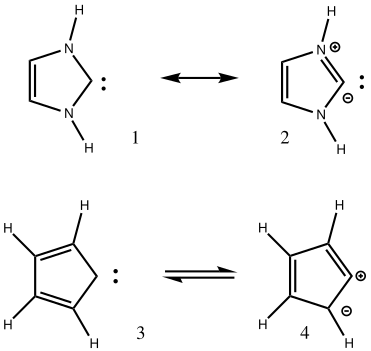
Let us start by counting the electrons in the 2p atomic orbitals on the ring atoms of 1, forming what we call a π-system. There are six; two from the carbons shown connected by a double bond, C=C and a further four from the two nitrogen lone pairs. Now in benzene, we also have six π-electrons in a ring and this molecule is of course famously aromatic due to the diatropic ring current created by the circulation of these six electrons. Moreover, all the C-C bonds are equal in length, ~1.4Å long (although the reasons for this equality are subtle).
So does 1 behave similarly? A ωB97XD/Def2-TZVPP calculation[1] shows the following calculated structure, in which all the bonds are clearly intermediate between single and double. The N-C(“carbene”) length of 1.357Å in particular is much shorter than a C-N single bond (~1.44AÅ), which tends to suggest that the resonance form 2 is a better representation than 1. This form is also pretty similar to pyrrole, itself a well-known hetero-aromatic species.
An alternative reality check is crystal structures. There are 42 examples (no errors, no disorder, R < 0.05) in the Cambridge structure database (CSD) and the distribution of C-N bond lengths below is indeed quite similar to the calculation shown above for the unsubstituted parent, with the lhs “hot-spot” almost exactly coincident. The C-C length similarly corresponds.


Let us try a technique for explicitly counting electrons, the ELF (electron localisation method), which works directly on a function of the electron density to identify the centroids of localized “basins” containing the integrated density. The three surrounding the “carbene” atom sum to 7.54e (with small seepage also into the carbon 1s core; 2.08e). A “normal” carbon on the C=C bond is 7.65e. The localization below turns out to closely resemble resonance structure 2 above.

Further in-silico experiments can be carried out with species 3 and 4, in which a carbon atom replaces each of the nitrogens. This reduces the total electron count by two and now this poor molecule has a difficult choice to make. Should it be the π-system that sacrifices these two electrons, or could it be the σ-lone-pair found on the two-coordinate carbon? We will let the quantum mechanical solution decide[2] (with a constraint that the molecule be planar). The electrons arrange themselves to resemble the resonance form 4, choosing to retain the six π-electrons and sacrifice the carbene “unshared pair”. The 2-coordinate carbon as a vinyl cation now does have ~6 valence electrons (ELF indicates 5.23e). 
What about the other choice? By promoting two electrons from HOMO to LUMO one can also calculate 3 (again constrained to planarity)[3] which finally does correspond to the classical description of a carbene.

The arrow connecting 3 and 4 in the scheme at the top is NOT in this case an electronic resonance, but a a real equilibrium between two different species separated by an energy barrier. With only four π-electrons in a cycle it is also antiaromatic, and so the two localised alkene bonds avoid any conjugation with each other. This form has a free energy some 5.7 kcal/ml higher than the aromatic form. In fact, the molecule is very keen to avoid all antiaromaticity and hence if the planar constraint is lifted, it will distort with no activation to a non-planar diene (just as cyclo-octatetraene does to a non-planar tetra-ene). And to complete the tale, even though 4 is aromatic, it too distorts without activation to an odd-looking non-planar form with no symmetry[4],[5],[6] (but that is another story).
The final word should be that the naming of these types of persistent carbene does need a reality check; they should not be called this at all! They are really dipolar species or carbon-ylides as shown in 2. As it happens, a very closely related species in which one sulfur replaces one nitrogen is a very familiar compound, vitamin B1 or thiamine. The only example of a stable deprotonated thiamine derivative is referred to as a carbene[7], perhaps because with an acid catalyst it can dimerise in the manner expected of a real carbene. Significantly however, without acid catalyst this does not happen; a true carbene would not require such a catalyst.
References
- H. Rzepa, "NHC wfn", 2016. https://doi.org/10.14469/hpc/1473
- H. Rzepa, "butadiene carbene aromatic -192.700746", 2016. https://doi.org/10.14469/hpc/1581
- H. Rzepa, "butadiene carbene antiaromatic guess=alter -192.691607", 2016. https://doi.org/10.14469/hpc/1582
- H. Rzepa, "C5H4 non-planar, Cs symmetry", 2016. https://doi.org/10.14469/hpc/1583
- H. Rzepa, "C5H4 non-planar, C2 symmetry", 2016. https://doi.org/10.14469/hpc/1584
- H. Rzepa, "C5H4 non-planar, no symmetry", 2016. https://doi.org/10.14469/hpc/1585
- A.J. Arduengo, J.R. Goerlich, and W.J. Marshall, "A Stable Thiazol‐2‐ylidene and Its Dimer", Liebigs Annalen, vol. 1997, pp. 365-374, 1997. https://doi.org/10.1002/jlac.199719970213
Tags:Carbenes, chemical bonding, energy barrier, free energy, Functional groups, Ligand, Mesoionic carbene, Organometallic chemistry, Persistent carbene, quantum mechanical solution, Reactive intermediates, Transition metal carbene complex, Valence, Valence electron
Posted in crystal_structure_mining, General | No Comments »
Sunday, September 11th, 2016
To quote from Wikipedia: in chemistry, a carbene is a molecule containing a neutral carbon atom with a valence of two and two unshared valence electrons. The most ubiquitous type of carbene of recent times is the one shown below as 1, often referred to as a resonance stabilised or persistent carbene. This type is of interest because of its ability to act as a ligand to an astonishingly wide variety of metals, with many of the resulting complexes being important catalysts. The Wiki page on persistent carbenes shows them throughout in form 1 below, thus reinforcing the belief that they have a valence of two and by implication six (2×2 shared + 2 unshared) electrons in the valence shell of carbon. Here I consider whether this name is really appropriate.

Let us start by counting the electrons in the 2p atomic orbitals on the ring atoms of 1, forming what we call a π-system. There are six; two from the carbons shown connected by a double bond, C=C and a further four from the two nitrogen lone pairs. Now in benzene, we also have six π-electrons in a ring and this molecule is of course famously aromatic due to the diatropic ring current created by the circulation of these six electrons. Moreover, all the C-C bonds are equal in length, ~1.4Å long (although the reasons for this equality are subtle).
So does 1 behave similarly? A ωB97XD/Def2-TZVPP calculation[1] shows the following calculated structure, in which all the bonds are clearly intermediate between single and double. The N-C(“carbene”) length of 1.357Å in particular is much shorter than a C-N single bond (~1.44AÅ), which tends to suggest that the resonance form 2 is a better representation than 1. This form is also pretty similar to pyrrole, itself a well-known hetero-aromatic species.
An alternative reality check is crystal structures. There are 42 examples (no errors, no disorder, R < 0.05) in the Cambridge structure database (CSD) and the distribution of C-N bond lengths below is indeed quite similar to the calculation shown above for the unsubstituted parent, with the lhs “hot-spot” almost exactly coincident. The C-C length similarly corresponds.


Let us try a technique for explicitly counting electrons, the ELF (electron localisation method), which works directly on a function of the electron density to identify the centroids of localized “basins” containing the integrated density. The three surrounding the “carbene” atom sum to 7.54e (with small seepage also into the carbon 1s core; 2.08e). A “normal” carbon on the C=C bond is 7.65e. The localization below turns out to closely resemble resonance structure 2 above.

Further in-silico experiments can be carried out with species 3 and 4, in which a carbon atom replaces each of the nitrogens. This reduces the total electron count by two and now this poor molecule has a difficult choice to make. Should it be the π-system that sacrifices these two electrons, or could it be the σ-lone-pair found on the two-coordinate carbon? We will let the quantum mechanical solution decide[2] (with a constraint that the molecule be planar). The electrons arrange themselves to resemble the resonance form 4, choosing to retain the six π-electrons and sacrifice the carbene “unshared pair”. The 2-coordinate carbon as a vinyl cation now does have ~6 valence electrons (ELF indicates 5.23e). 
What about the other choice? By promoting two electrons from HOMO to LUMO one can also calculate 3 (again constrained to planarity)[3] which finally does correspond to the classical description of a carbene.

The arrow connecting 3 and 4 in the scheme at the top is NOT in this case an electronic resonance, but a a real equilibrium between two different species separated by an energy barrier. With only four π-electrons in a cycle it is also antiaromatic, and so the two localised alkene bonds avoid any conjugation with each other. This form has a free energy some 5.7 kcal/ml higher than the aromatic form. In fact, the molecule is very keen to avoid all antiaromaticity and hence if the planar constraint is lifted, it will distort with no activation to a non-planar diene (just as cyclo-octatetraene does to a non-planar tetra-ene). And to complete the tale, even though 4 is aromatic, it too distorts without activation to an odd-looking non-planar form with no symmetry[4],[5],[6] (but that is another story).
The final word should be that the naming of these types of persistent carbene does need a reality check; they should not be called this at all! They are really dipolar species or carbon-ylides as shown in 2. As it happens, a very closely related species in which one sulfur replaces one nitrogen is a very familiar compound, vitamin B1 or thiamine. The only example of a stable deprotonated thiamine derivative is referred to as a carbene[7], perhaps because with an acid catalyst it can dimerise in the manner expected of a real carbene. Significantly however, without acid catalyst this does not happen; a true carbene would not require such a catalyst.
References
- H. Rzepa, "NHC wfn", 2016. https://doi.org/10.14469/hpc/1473
- H. Rzepa, "butadiene carbene aromatic -192.700746", 2016. https://doi.org/10.14469/hpc/1581
- H. Rzepa, "butadiene carbene antiaromatic guess=alter -192.691607", 2016. https://doi.org/10.14469/hpc/1582
- H. Rzepa, "C5H4 non-planar, Cs symmetry", 2016. https://doi.org/10.14469/hpc/1583
- H. Rzepa, "C5H4 non-planar, C2 symmetry", 2016. https://doi.org/10.14469/hpc/1584
- H. Rzepa, "C5H4 non-planar, no symmetry", 2016. https://doi.org/10.14469/hpc/1585
- A.J. Arduengo, J.R. Goerlich, and W.J. Marshall, "A Stable Thiazol‐2‐ylidene and Its Dimer", Liebigs Annalen, vol. 1997, pp. 365-374, 1997. https://doi.org/10.1002/jlac.199719970213
Tags:Carbenes, chemical bonding, energy barrier, free energy, Functional groups, Ligand, Mesoionic carbene, Organometallic chemistry, Persistent carbene, quantum mechanical solution, Reactive intermediates, Transition metal carbene complex, Valence, Valence electron
Posted in crystal_structure_mining, General | No Comments »
Wednesday, June 22nd, 2016
I previously used data mining of crystal structures to explore the directing influence of substituents on aromatic and heteroatomatic rings. Here I explore, quite literally, a different angle to the hydrogen bonding interactions between a benzene ring and OH or NH groups.

I start by defining a benzene ring with a centroid. The distance is from that centroid to the H atom of an OH or NH group and the angle is C-centroid-H. To limit the search to approach of the OH or NH group more or less orthogonal to the ring, the absolute value of the torsion between the centroid-H vector and the ring C-C vector is constrained to lie between 70-100° (the other constraints being no disorder, no errors, T < 140K and R < 0.05).[1]

The above shows the results for NH groups interacting with the aromatic ring. The maximum distance 2.8Å is more or less the van der Waals contact distance between a hydrogen and a carbon and as you can see the contacts "funnel down" to the centroid at < 2.1Å. The shortest distance[2] is for ammonium tetraphenylborate, which you can view in e.g. spacefill mode here[3]

The other interesting close contact derives from a protonated pyridine[4], which can in turn be viewed here.[5] The main message from the distribution shown above is that as the distances between the HN and the centroid get shorter, the "trajectory" of approach remains orthogonal to the ring (the angle defined above remains ~90°) and heads towards the centroid of the π-cloud. The hotspot itself (red, ~2.6Å) also lies along this trajectory.
Recollect that when I used such hydrogen bonding to see if crystal structures discriminate between the ortho or meta positions of a ring carrying an electron donating substituent, it was the distance from a HO to the carbon that was measured as the discriminator. So it's a faint surprise to find that with HN, and without the necessary perturbation of an electron donating substituent, the intrinsic preference seems to be for the ring centroid and not any specific carbon atom of the ring.
So how about the OH group? There are in fact rather fewer examples, and so the statistics are a bit less clear-cut. But there is a tantalising suggestion that this time, the trajectory is not ~90° but rather less, implying that the destination is no longer the centroid of the π-cloud but one of the carbon atoms of the ring itself. For those who like to "read between the lines" and spot things that are absent rather than present, you may have asked yourself why I did not use NH probes in my earlier post. Well, it appears that the NH group is less effective at e.g. o/p discrimination than is an OH group.

I can only speculate as to the origins (real or not) of the difference in behaviour between OH and NH groups towards a phenyl π-face. Perhaps it is simply bias in the CSD database? Or might there be electronic origins? Time to end with that phrase "watch this space".
References
- H. Rzepa, "How does an OH or NH group approach an aromatic ring to hydrogen bond with its Ï-face?", 2016. https://doi.org/10.14469/hpc/673
- T. Steiner, and S.A. Mason, "Short N<sup>+</sup>—H...Ph hydrogen bonds in ammonium tetraphenylborate characterized by neutron diffraction", Acta Crystallographica Section B Structural Science, vol. 56, pp. 254-260, 2000. https://doi.org/10.1107/s0108768199012318
- Steiner, T.., and Mason, S.A.., "CCDC 144361: Experimental Crystal Structure Determination", 2000. https://doi.org/10.5517/cc4v6tz
- O. Danylyuk, B. Leśniewska, K. Suwinska, N. Matoussi, and A.W. Coleman, "Structural Diversity in the Crystalline Complexes of <i>para</i>-Sulfonato-calix[4]arene with Bipyridinium Derivatives", Crystal Growth & Design, vol. 10, pp. 4542-4549, 2010. https://doi.org/10.1021/cg100831c
- Danylyuk, O.., Lesniewska, B.., Suwinska, K.., Matoussi, N.., and Coleman, A.W.., "CCDC 819118: Experimental Crystal Structure Determination", 2011. https://doi.org/10.5517/ccwhc5w
Tags:10.1021, 10.1107, 10.5517, aromaticity, benzene, Centroid, chemical bonding, data mining, Functional groups, Hydrogen bond, Physical organic chemistry, Pyridine, Simple aromatic rings, Supramolecular chemistry
Posted in Chemical IT, crystal_structure_mining | 3 Comments »
Saturday, June 18th, 2016
In this post, I pondered upon the C=O infra-red spectroscopic properties of esters, and showed three possible electronic influences:
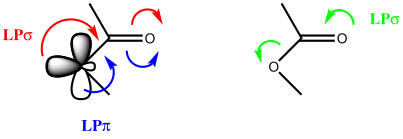
The red (and blue) arrows imply the C-O bond might shorten and the C=O bond would lengthen; the green the reverse. So time for a search of the crystal structure database as a reality check. The query is as follows:

The response shows the bimodal distribution with as expected the s-cis conformation dominating. There is indeed a hint that for the s-cis, the C-O distance is rather shorter than for the s-trans conformation.

Repeating the search, but specifying that the temperature of data acquisition is < 90K, one gets a much clearer indication of the difference in bond lengths.

This alternative representation shows the C-O and the C=O distances, with red indicating s-trans and blue indicating s-cis conformations (T < 140K). The red dots occupy a bottom right cluster for which the C-O distance is longer and the C=O shorter than the corresponding blue cluster.

Again reducing the temperature of data collection to < 90K shows a rather weak inverse correlation between the two distances for eg the blue dots.

A shame however that this database does not hold IR values for the carbonyl stretches. I am sure correlations must exist, but how to get at them (other than manual collection of data).
Tags:Ester, Functional groups, Infra-Red
Posted in Chemical IT, crystal_structure_mining | 1 Comment »
Wednesday, May 11th, 2016
I have previously commented on the Bürgi–Dunitz angle, this being the preferred approach trajectory of a nucleophile towards the electrophilic carbon of a carbonyl group. Some special types of nucleophile such as hydrazines (R2N-NR2) are supposed to have enhanced reactivity[1] due to what might be described as buttressing of adjacent lone pairs. Here I focus in on how this might manifest by performing searches of the Cambridge structural database for intermolecular (non-bonded) interactions between X-Y nucleophiles (X,Y= N,O,S) and carbonyl compounds OC(NM)2.

The search query[2] is shown above and involves plotting the distance from the nucleophilic atom (N above) to the carbon of the carbonyl group. The carbon is defined as having 3-coordination, one of which is O=C and two non-metal attachments. The torsion is constrained to values of |70-110|° to ensure that the approach of the nucleophile is approximately perpendicular to the plane of the carbonyl in order to overlap with the π*-orbital as electrophile. The pairwise sums of van der Waals radii are NC, 3.25; OC, 3.22 and SC, 3.5Å and the plots show all contacts shorter than these. The results of the searches are shown below.


The general observation is that the red hotspots do tend to come at trajectory angles of <100° and many are <90° such as the X=Y=N or X=Y=S examples. Given that the original Bürgi–Dunitz hypothesis (actually based on a small number of molecules synthesized for the purpose) proposed rather larger angles (105±5°) corresponding to optimum alignment of the nucleophile with the carbonyl π*-orbital, we might speculate whether the use of enhanced nucleophiles is the reason for the apparent decrease in the angle. And if so, what the underlying reasons would be.
I also cannot help but observe that the term supernucleophile is quite rare in the literature; SciFinder gives only 45 hits, but most are about neither hydrazines nor peroxides. There are also some unusual nucleophile varieties such as Cob(I)alamin[3], of which there are probably insufficient examples to reflect in the crystal structure statistics shown above. Given the interest in superbases, the relative lack of examples of unusual supernucleophiles seems surprising.
References
- G. Klopman, K. Tsuda, J. Louis, and R. Davis, "Supernucleophiles—I", Tetrahedron, vol. 26, pp. 4549-4554, 1970. https://doi.org/10.1016/s0040-4020(01)93101-1
- H. Rzepa, "Crystal structure search using enhanced nucleophiles", 2016. https://doi.org/10.14469/hpc/487
- K.P. Jensen, "Electronic Structure of Cob(I)alamin: The Story of an Unusual Nucleophile", The Journal of Physical Chemistry B, vol. 109, pp. 10505-10512, 2005. https://doi.org/10.1021/jp050802m
Tags:Bases, Bürgi–Dunitz angle, Carbonyl, Electrophile, Ester, Flippin–Lodge angle, Functional groups, hydrazine, non-metal attachments, Nucleophile, Physical organic chemistry, search query, Superbase
Posted in Chemical IT, crystal_structure_mining | 1 Comment »
Friday, April 15th, 2016
In the previous post I described how hydronium hydroxide or H3O+…HO–, an intermolecular tautomer of water, has recently been observed captured inside an organic cage[1] and how the free-standing species in water can be captured computationally with the help of solvating water bridges. Here I explore azane oxide or H3N+-O–,‡ a tautomer of the better known hydroxylamine (H2N-OH).
The usual search[2] of the Cambridge structure database reveals only two (related) entries[3],[4] the second reported in 2015.[5].


Now, location of hydrogen atoms is always a bit tricky, but here we see two species H3N+-OH…–O-+NH3 connected by a strong hydrogen bond of 1.54Å (click on the above image to see this packing). However, it is noteworthy that the N-O bonds for each of these species are exactly the same length (1.412Å); one might have imagined that whether the oxygen carries a proton or not would affect its bond length to nitrogen. There is here a strong hint that energetically the azane oxide might be relatively low in energy relative to hydroxylamine and perhaps that the zwitterionic form might be favoured when captured with hydrogen bonds.
So certainly time for a computational exploration of this species. I am using the three water bridges as before, each comprised of three water molecules and the ωB97XD/6-311++G(d,p)/SCRF=water method. In fact the structure optimises[6] to a delightful propeller-like geometry in which bridges are formed from both two AND three waters across the ion-pair, with overall three-fold C3 symmetry (i.e. chiral! Indeed, this species has a predicted optical rotation of 40° at 589nm).

Hydroxylamine itself has a less symmetric arrangement of hydrogen bonds[7], with a free energy in fact very similar (within 1 kcal/mol) to the ion-pair isomer. Here, a stochastic (statistical) exploration of all the various arrangements of water would be needed to be confident that the lowest energy form had been located. I would note that the N-O bond lengths in the ion-pair and neutral forms are respectively 1.399 and 1.435Å.

Certainly, this very brief computational look at azane oxide suggests that concentrations of this species in aqueous solutions of hydroxylamine might be appreciable (detectable). Its "trapping" inside a suitably designed cavity must be a realistic possibility (the cavity used to trap hydronium hydroxide probably does not have the correct dimensions for this purpose), as indeed illustrated in the two crystal structures noted above.
‡ I have represented this species in ionic form, but you may find text books showing it in dative form, or H3N→O. My personal inclination is to always prefer the ionic form, if only because it enables connections/analogies such as the one here to hydronium hydroxide to be more easily made.
References
- M. Stapf, W. Seichter, and M. Mazik, "Unique Hydrogen‐Bonded Complex of Hydronium and Hydroxide Ions", Chemistry – A European Journal, vol. 21, pp. 6350-6354, 2015. https://doi.org/10.1002/chem.201406383
- H. Rzepa, "Search for Azane oxide", 2016. https://doi.org/10.14469/hpc/380
- Fischer, Dennis., Klapotke, Thomas M.., and Stierstorfer, Jorg., "CCDC 1054611: Experimental Crystal Structure Determination", 2015. https://doi.org/10.5517/cc14ddqn
- Fischer, D.., Klapotke, T.M.., and Stierstorfer, J.., "CCDC 827687: Experimental Crystal Structure Determination", 2012. https://doi.org/10.5517/ccws8lh
- D. Fischer, T.M. Klapötke, and J. Stierstorfer, "1,5‐Di(nitramino)tetrazole: High Sensitivity and Superior Explosive Performance", Angewandte Chemie International Edition, vol. 54, pp. 10299-10302, 2015. https://doi.org/10.1002/anie.201502919
- H.S. Rzepa, "H 21 N 1 O 10", 2016. https://doi.org/10.14469/ch/192000
- H.S. Rzepa, "H 21 N 1 O 10", 2016. https://doi.org/10.14469/ch/192001
Tags:Ammonia, aqueous solutions, Bases, energy relative, free energy, Functional groups, Hydrogen bond, Hydronium, Hydroxides, Hydroxyl, Hydroxylamine, lowest energy form, Properties of water, Reducing agents, Self-ionization of water
Posted in General, Interesting chemistry | No Comments »
Friday, April 8th, 2016
Previously, I looked at models of how ammonia could be protonated by water to form ammonium hydroxide. The energetic outcome of my model matched the known equilbrium in water as favouring the unprotonated form (pKb ~4.75). I add here two amines for which R=Me3Si and R=CN. The idea is that the first will assist nitrogen protonation by stabilising the positive centre and the second will act in the opposite sense; an exploration if you like of how one might go about computationally designing a non-steric superbasic amine that becomes predominantly protonated when exposed to water (pKb <1)† and is thus more basic than hydroxide anion in this medium.
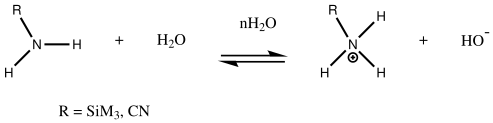
Before reporting any calculations, let us see what the CSD (Cambridge structure database) might contain. The search query is simple, a 3-coordinate amine forming a 4-coordinate quaternary nitrogen† with one N-H and a positive (formal) charge on the N, and a 1-coordinate oxygen with one O-H and a negative charge on the O. With the constraints R < 10%, no disorder and no errors, one gets as many as 15 hits,[1] several of which also apparently contain separate water molecules in the crystal. A warning bell (perhaps several) sounds, since if R < 5%, the number of hits drops to just 2; these are clearly difficult structures to refine!‡ So there is some tantalising evidence that in the solid state at least, the quaternary ammonium group (with at least one N-H), water and a hydroxide anion might be capable of co-existence. As noted below† some fascinating 2-coordinate amines have also been reported as having superbasic properties.

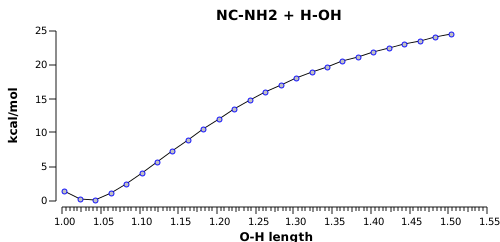
R=CN: the well known compound cyanamide is known to act only as an acid and its basic properties are never quoted. Shown below is the reaction path for transfer of a proton from water to the amine using an 8-water model (n=8) in which two bridges can serve to help stabilize any ionic form. The energy required to do so however is at least 24 kcal/mol (ωB97XD/Def2-TZVPPD/SCRF=water) which indicates that no protonated amine is formed. This can be attributed to the electron withdrawing cyano group strongly destablising any adjacent positive ammonium centre and thus effectively completely inhibiting its formation.
R=Me3Si: this too is already known[2],[3] but only in the presence of the non-coordinating counter-anion B(C6F5)4 crystallised from non-protic solution. An ionised form can now be located using the model above. This has the structure shown below; note the very short hydrogen bonds associated with the hydroxide anion and the possibility of forming only two water bridges across the ion-pair. The relative free energy of the ion-pair (table below) shows it to be if anything less basic than ammonia.

NBO (natural bond orbital) analysis might here be a useful metric of basicity. Hence Me3SiNH2…H2O suggests that donation from the N lone pair into an antiperiplanar Si-C bond is quite large (E(2) = 11.9 kcal/mol), although alternative donation by nitrogen into the H-O σ* bond of the water is much higher (33.4 kcal/mol).
Perhaps the basicity of simple amines is related to their ability to form stabilizing water bridges across the ion-pair? With trimethylsilyl substituents, this feature (and hence the basicity) is partially or even fully suppressed as in e.g. tris(trimethylsilyl)amine.The pKb of the latter appears to be unreported[8] but it does seem to be only weakly basic and "inert to H2O",[9] a property attributed instead to multiple character in the Si-N bonds.
I will in a future post look at the alternative class of phosphazenium amines which do manage to achieve superbasicity.[10]
†A phosphazenium 3-coordinate amine[11] was in 1991 claimed to be the strongest metal-free neutral base. This has now been superceded by combining this base motif with that of a sterically operating proton sponge.[12],[10] I will report the computational modelling of these systems in a later post.
‡One of the structures identified with R<10% is UBEJIU[13] and which is worth showing below. Note the apparent close contact of the type N-H…H-O (1.416-1.463Å) rather than the expected N-H…OH. If correct (this feature is not mentioned in the article itself) it would be classified as a dihydrogen bond, a type normally only found in situations such as B-H…H-N. There are a number of other inconsistencies which must be resolved if this structure is to stand as correct.

References
- H. Rzepa, "Substituted ammonium hydroxides", 2016. https://doi.org/10.14469/hpc/361
- Y. Sarazin, J.A. Wright, and M. Bochmann, "Synthesis and crystal structure of [C6H5Hg(H2NSiMe3)][H2N{B(C6F5)3}2], a phenyl–mercury(II) cation stabilised by a non-coordinating counter-anion", Journal of Organometallic Chemistry, vol. 691, pp. 5680-5687, 2006. https://doi.org/10.1016/j.jorganchem.2006.09.021
- Sarazin, Y.., Wright, J.A.., and Bochmann, M.., "CCDC 608250: Experimental Crystal Structure Determination", 2007. https://doi.org/10.5517/ccndxzx
- H.S. Rzepa, and H.S. Rzepa, "H21NO9", 2016. https://doi.org/10.14469/ch/191946
- H.S. Rzepa, and H.S. Rzepa, "C 3 H 29 N 1 O 9 Si 1", 2016. https://doi.org/10.14469/ch/191987
- H.S. Rzepa, and H.S. Rzepa, "C 3 H 29 N 1 O 9 Si 1", 2016. https://doi.org/10.14469/ch/191982
- H.S. Rzepa, "CH20N2O9", 2016. https://doi.org/10.14469/ch/191983
- E.W. Abel, D.A. Armitage, and G.R. Willey, "Relative base strengths of some organosilicon amines", Transactions of the Faraday Society, vol. 60, pp. 1257, 1964. https://doi.org/10.1039/tf9646001257
- J. Goubeau, and J. Jimenéz‐Barberá, "Tris‐(trimethylsilyl)‐amin", Zeitschrift für anorganische und allgemeine Chemie, vol. 303, pp. 217-226, 1960. https://doi.org/10.1002/zaac.19603030502
- Kögel, Julius F.., Oelkers, Benjamin., Kovačević, Borislav., and Sundermeyer, Jörg., "CCDC 1002088: Experimental Crystal Structure Determination", 2014. https://doi.org/10.5517/cc12mrfw
- R. Schwesinger, and H. Schlemper, "Peralkylated Polyaminophosphazenes— Extremely Strong, Neutral Nitrogen Bases", Angewandte Chemie International Edition in English, vol. 26, pp. 1167-1169, 1987. https://doi.org/10.1002/anie.198711671
- J.F. Kögel, B. Oelkers, B. Kovačević, and J. Sundermeyer, "A New Synthetic Pathway to the Second and Third Generation of Superbasic Bisphosphazene Proton Sponges: The Run for the Best Chelating Ligand for a Proton", Journal of the American Chemical Society, vol. 135, pp. 17768-17774, 2013. https://doi.org/10.1021/ja409760z
- P. Vianello, A. Albinati, G.A. Pinna, A. Lavecchia, L. Marinelli, P.A. Borea, S. Gessi, P. Fadda, S. Tronci, and G. Cignarella, "Synthesis, Molecular Modeling, and Opioid Receptor Affinity of 9,10-Diazatricyclo[4.2.1.1<sup>2,5</sup>]decanes and 2,7-Diazatricyclo[4.4.0.0<sup>3,8</sup>]decanes Structurally Related to 3,8-Diazabicyclo[3.2.1]octanes", Journal of Medicinal Chemistry, vol. 43, pp. 2115-2123, 2000. https://doi.org/10.1021/jm991140q
Tags:Acid, Acid dissociation constant, Amide, Amine, Ammonia, Ammonium, Bases, City: Cambridge, energy, from non-protic solution, Functional groups, Hydrogen bond, Hydroxide, Lone pair, metal, Nitrile, relative free energy, search query
Posted in General, Interesting chemistry | 2 Comments »
Sunday, January 10th, 2016
Earlier I explored models for the heteroaromatic electrophilic protiodecarboxylation of an 3-substituted indole, focusing on the role of water as the proton transfer and delivery agent. Next, came models for both water and the general base catalysed ionization of indolinones. Here I explore general acid catalysis by evaluating the properties of two possible models for decarboxylation of 3-indole carboxylic acid, one involving proton transfer (PT) from neutral water in the presence of covalent un-ionized HCl (1) and one with PT from a protonated water resulting from ionised HCl (2).
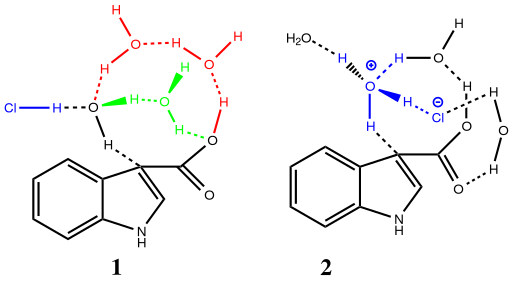
The original study[1] noted that the rate of decarboxylation fitted well to the kinetic expression: rate = {a + b[L3O+]/(1 + c[L3O+])}[indole], where L can be H or D. Experimentally, [L3O+] is controlled by adding a strong general acid such as HCl, which when the appropriate number of water molecules are added[2] fully ionizes to H3O+.OH–. Now for B3LYP+D3/Def2-TZVPD/SCRF=water calculations:
- Model 1 takes the pure water model and adds HCl (blue above) via hydrogen bonding to the H2O that is transferring the proton to the indole ring. Three water molecules are hydrogen bonding to the carboxylate oxygens to create a bicyclic network in which a ring of either 8 or 10 atoms can act as the proton relay structure. The question now arises whether the proton relay takes the longer (red) route or the slightly shorter green route.
- Isomeric model 2 uses H3O+ for proton transfer, with an adjacent Cl– to complete the ion-pair.
‡Reactant as a non-ionised covalent HCl. †reactant as an isomeric ionized H3O+.Cl– beng 2.0 kcal/mol higher in energ within this solvation model.
- An IRC for Model 1 shows that the proton relay takes the red path, whereas without the HCl the green path is followed.

The transition state free energy however is ..
- 10.6‡ or 8.6† kcal/mol higher than model 2 (click on the image below to load a 3D model). The general acid catalysed model is therefore preferred. The difference in free energy between the two models corresponds to a rate acceleration of >106, which is indeed similar to that observed[1].

The clincher comes with calculation[3] of the kinetic isotope effects (KIE). For general acid catalysis, they were measured as kH/kD ~2.5.[1]
- For model 1, using an un-ionised reactant and un-ionised transition state, the calculated KIE is 5.69 (very similar to that calculated for the water catalysed reaction, 5.66) but not a good fit to experiment.
- For model 2, using the same un-ionised reactant but an ionised transition state, KIE = 2.04, a much better fit.
- For model 2, using ionised reactant AND transition state, KIE = 2.45, an even better fit to experiment.
So we now have a model for the general acid catalysed decarboxylation of a 3-indole carboxylate which agrees with both the kinetic behaviours and the isotope effects measured for this reaction. Since the barrier is a relatively large one, proton tunnelling may play a lesser role in this interpretation, and the stage is set to use this model to e.g. explore how isotope effects are indeed influenced by tuning the reactivity using ring substitutents, the original purpose of my researches all those years ago. Perhaps the catch phrase I’ve started so I’ll start is now more apposite.
References
- B.C. Challis, and H.S. Rzepa, "Heteroaromatic hydrogen exchange reactions. Part 9. Acid catalysed decarboxylation of indole-3-carboxylic acids", Journal of the Chemical Society, Perkin Transactions 2, pp. 281, 1977. https://doi.org/10.1039/p29770000281
- A. Vargas‐Caamal, J.L. Cabellos, F. Ortiz‐Chi, H.S. Rzepa, A. Restrepo, and G. Merino, "How Many Water Molecules Does it Take to Dissociate HCl?", Chemistry – A European Journal, vol. 22, pp. 2812-2818, 2016. https://doi.org/10.1002/chem.201504016
- H. Rzepa, "Ionic model for general acid catalysed decarboxylation", 2016. https://doi.org/10.14469/hpc/204
- H.S. Rzepa, "C 9 H 16 Cl 1 N 1 O 6", 2016. https://doi.org/10.14469/ch/191792
- H.S. Rzepa, "C 9 H 16 Cl 1 N 1 O 6", 2016. https://doi.org/10.14469/ch/191795
- H.S. Rzepa, "C 9 H 16 Cl 1 N 1 O 6", 2016. https://doi.org/10.14469/ch/191794
- H.S. Rzepa, "C9H16ClNO6", 2016. https://doi.org/10.14469/ch/191767
- H.S. Rzepa, "C 9 H 16 Cl 1 N 1 O 6", 2016. https://doi.org/10.14469/ch/191790
Tags:Acid, Acids, bicyclic network, carboxylic acid, free energy, Functional groups, Hydrogen bond, Indole, transition state free energy
Posted in Interesting chemistry | 1 Comment »
Saturday, September 5th, 2015
The previous post explored the structural features of amides. Here I compare the analysis with that for the closely related thioamides.

Here is the torsional analysis around the C-N bond. The “diff” (difference) is that almost all the hits are concentrated into angles of 0° or 180°; the twist about the C-N bond from co-planarity is much less if S is present. This is normally explained in terms of Spπ-Cpπ overlaps being less favourable than Opπ-Cpπ ones owing to the mismatch in the size of the atomic orbital for S and C. Hence the resonance which reduces the C=S double bond character in favour of greater C=N character is enhanced compared to O.

A consequence is that the nitrogen atom is less easily deformed from planarity in a thioamide. Notice also that at the hotspot, the C=N distance is ~1.32Å compared to 1.34Å for a regular amide.

This emerges from the plot below as well; the range of values for the C-N bond is reduced compared to amides, but the diagonal trend that as the C=N bond gets longer so the C-S gets shorter is still seen.

All these trends are described qualitatively in most text books of organic chemistry, but one never sees statistical evidence for them. And it truly only takes 5-10 minutes to produce.
Tags:Amide, Functional groups, Thioamide
Posted in Chemical IT, crystal_structure_mining | No Comments »
Saturday, September 5th, 2015
The previous post explored the structural features of amides. Here I compare the analysis with that for the closely related thioamides.
Here is the torsional analysis around the C-N bond. The “diff” (difference) is that almost all the hits are concentrated into angles of 0° or 180°; the twist about the C-N bond from co-planarity is much less if S is present. This is normally explained in terms of Spπ-Cpπ overlaps being less favourable than Opπ-Cpπ ones owing to the mismatch in the size of the atomic orbital for S and C. Hence the resonance which reduces the C=S double bond character in favour of greater C=N character is enhanced compared to O.
A consequence is that the nitrogen atom is less easily deformed from planarity in a thioamide. Notice also that at the hotspot, the C=N distance is ~1.32Å compared to 1.34Å for a regular amide.
This emerges from the plot below as well; the range of values for the C-N bond is reduced compared to amides, but the diagonal trend that as the C=N bond gets longer so the C-S gets shorter is still seen.
All these trends are described qualitatively in most text books of organic chemistry, but one never sees statistical evidence for them. And it truly only takes 5-10 minutes to produce.
Tags:Amide, Functional groups, Thioamide
Posted in Chemical IT, crystal_structure_mining | No Comments »
