Posts Tagged ‘X-ray’
Thursday, March 21st, 2013
A quartet of articles has recently appeared on the topic of cyclobutadiene.[1],[2],[3],[4]. You will find a great deal discussed there, but I can boil it down to this essence. Do the following coordinates (obtained from a (disordered) previously published[5] x-ray refinement) correspond to a van der Waals complex of 1,3-dimethyl cyclobutadiene and carbon dioxide, or do they instead represent a covalent interaction between these two components resulting in a compound with the chemical name 2-oxabicyclo[2.2.0]hex-5-en-3-one (i.e. not a cyclobutadiene)?

Click for 3D. The unconnected atoms are the result of disordered partial occupancy.
The two bonds to concentrate on are shown in gold; a O…C pair with a distance of 1.61Å as obtained from the x-ray refinement and a C…C pair with a distance of 1.5Å (and if you want to go further, the O=C=O bond angle). I list below values obtained from the wonderful Webelements site. Using these values, this makes a van der Waals O…C contact 3.22Å and a C…C contact 3.40Å and covalent values of respectively 1.38Å and 1.5Å.
| Element |
Covalent radius, Å |
van der Waals radius |
| C |
0.75 |
1.70 |
| O |
0.63 |
1.52 |
According to chemistry convention, we classify the interaction between a pair of atoms according to which category best fits the observed distance. So this should allow you to decide if the molecule is a van der Waals complex of 1,3-dimethyl cyclobutadiene and carbon dioxide or the covalent system 2-oxabicyclo[2.2.0]hex-5-en-3-one.
Oh, if the observed O…C pair with a distance of 1.61Å does not seem to perfectly fit either category above, one of the quartet of articles above[1] offers the explanation of an unusual π-anomeric effect lengthening the C…O bond in 2-oxabicyclo[2.2.0]hex-5-en-3-one slightly beyond the standard covalent distance. Of course, if the system were to be a van der Waals complex, that explanation cannot apply.
References
- H.S. Rzepa, "A Computational Evaluation of the Evidence for the Synthesis of 1,3‐Dimethylcyclobutadiene in the Solid State and Aqueous Solution", Chemistry – A European Journal, vol. 19, pp. 4932-4937, 2013. https://doi.org/10.1002/chem.201102942
- M. Shatruk, and I.V. Alabugin, "Reinvestigation of “Single‐Crystal X‐ray Structure of 1,3‐dimethylcyclobutadiene”", Chemistry – A European Journal, vol. 19, pp. 4942-4945, 2013. https://doi.org/10.1002/chem.201103017
- Y. Legrand, D. Dumitrescu, A. Gilles, E. Petit, A. van der Lee, and M. Barboiu, "A Constrained Disorder Refinement: “Reinvestigation of “Single‐Crystal X‐ray Structure of 1,3‐Dimethylcyclobutadiene” by M. Shatruk and I. V. Alabugin”", Chemistry – A European Journal, vol. 19, pp. 4946-4950, 2013. https://doi.org/10.1002/chem.201203234
- Y. Legrand, D. Dumitrescu, A. Gilles, E. Petit, A. van der Lee, and M. Barboiu, "Reply to A Computational Evaluation of the Evidence for the Synthesis of 1,3‐Dimethylcyclobutadiene in Solid State and Aqueous Solution—Beyond the Experimental Reality", Chemistry – A European Journal, vol. 19, pp. 4938-4941, 2013. https://doi.org/10.1002/chem.201203235
- Y. Legrand, A. van der Lee, and M. Barboiu, "Single-Crystal X-ray Structure of 1,3-Dimethylcyclobutadiene by Confinement in a Crystalline Matrix", Science, vol. 329, pp. 299-302, 2010. https://doi.org/10.1126/science.1188002
Tags:crystallography, cyclobutadiene, Waals complex, X-ray
Posted in Interesting chemistry | 4 Comments »
Tuesday, February 12th, 2013
An extensive discussion developed regarding my post on a fascinating helical [144]-annulene. Topics included the nature of the ring current sustained by the π-electrons and in particular the bond-length alternation around the periphery and whether this should alter if the electron count were to be changed to that of a 4n+2 system (i.e. a dication). Whilst the [144]-annulene itself is hypothetical, it emerged that some compounds known as expanded porphyrins have very similar (albeit smaller scale) helical structures. X-ray structures for two such provide useful reality checks on the calculations. Here‡ I include the (3D) coordinates of these two systems so that you can explore for yourself their helicity.

SELQUW. Click for 3D X-ray structure

HIYTAL. Click for 3D X-ray structure
I include below Δrmeso, being the mean unsigned difference in bond length (Å) at the meso positions of the porphrin ring, the calculations being at the 6-311G(d,p) level using the DFT procedure indicated below. The linking number analysis[1] for such systems will be reported elsewhere.[2]
‡The WordPress system operated here does not enable 3D coordinates to be inserted into the comment section of a post, only the main body.
References
- S.M. Rappaport, and H.S. Rzepa, "Intrinsically Chiral Aromaticity. Rules Incorporating Linking Number, Twist, and Writhe for Higher-Twist Möbius Annulenes", Journal of the American Chemical Society, vol. 130, pp. 7613-7619, 2008. https://doi.org/10.1021/ja710438j
- H.S. Rzepa, "Lemniscular Hexaphyrins as Examples of Aromatic and Antiaromatic Double-Twist Möbius Molecules", Organic Letters, vol. 10, pp. 949-952, 2008. https://doi.org/10.1021/ol703129z
Tags:Helical annulenes, X-ray
Posted in Interesting chemistry | 13 Comments »
Sunday, February 3rd, 2013
The electronic interaction between a single bond and an adjacent double bond is often called σ-π-conjugation (an older term for this is hyperconjugation), and the effect is often used to e.g. explain why more highly substituted carbocations are more stable than less substituted ones. This conjugation is more subtle in neutral molecules, but following my use of crystal structures to explore the so-called gauche effect (which originates from σ-σ-conjugation), I thought I would have a go here at seeing what the crystallographic evidence actually is for the σ-π-type.
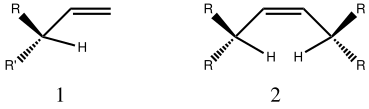
The basic two molecules are shown above; in effect propene 1 and butene 2. The latter was in fact the topic of another post, in which I attempted to show that the close H…H contact in cis-butene (2.1Å) was in effect an unwelcome consequence of the σ-π-conjugation of any of the four “outward leaning” C-H bonds of the methyl groups acting as donors (red-blue below) overlapping with the similarly “outward leaning” π* orbital of the alkene (purple-orange below; blue and purple overlap positively).

NBO orbitals for C-H/alkene interaction. Click for 3D.
So how general might this be? To find out, I performed the following search on the Cambridge crystal database: 
- The search defines an alkene, bearing two cis-substituents each with at least one C-H bond. The substituents are both sp3 carbon, and the attachment bond to the alkene is defined as acyclic
- The H…H distance uses normalised terminal hydrogen positions (to try to correct for the normally over-short C-H bond lengths found by X-ray).
- Other constraints were R factor < 0.05, no disorder, no errors and (perhaps most importantly) T < 150K to try to reduce thermal libration.
I should qualify all of this by reminding that hydrogen positions in crystal structures are notoriously prone to errors. Nevertheless, with 624 hits using the above search, one might hope for statistical significance of a real effect.

Search result for close H…H contacts in cis-butenes.
For this sample, the most frequent H…H distance emerged as 2.1Å. This can only result from having the C-H bonds lie coplanar with the C=C alkene, as is shown above. The value is also remarkably close to the H…H distance for cis-butene itself (both computationally and as determined using electron diffraction). This does I feel provide a strong indication that σ-π-conjugation is manifesting in these systems.
Re-defining the search for propenes 1 as above gives 1656 hits, with a maximum in the distribution at 2.35Å corresponding to a syn-orientation of the C=C and the C-H bonds. The smaller maximum at about 2.75Å arises from a gauche-orientation between the C=C and C-H (in effect you have to halve this number, since there are twice as many possibilities for this to occur than for the syn). The “inward leaning” gauche C-H bond overlaps less well with the “outward leaning” π* orbital of the alkene.

Search result for close H…H contacts in propenes.
These aspects are perhaps better seen in the orbital overlaps shown below.

Click for 3D.
I will follow-up this theme with esters and amides next.
Tags:above search, Cambridge, conformational analysis, Tutorial material, X-ray
Posted in crystal_structure_mining, Interesting chemistry | 1 Comment »
Monday, October 8th, 2012
Metathesis reactions are a series of catalysed transformations which transpose the atoms in alkenes or alkynes. Alkyne metathesis is closely related to the same reaction for alkenes, and one catalyst that is specific to alkynes was introduced by Schrock (who with Grubbs won the Nobel prize for these discoveries) and is based on tungsten (M=W(OR)3).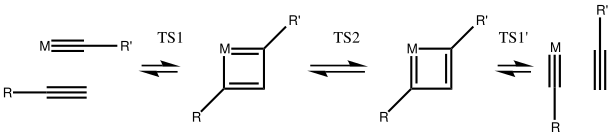
In the previous post, I expressed surprise at the nature of the transition state for the alkene reaction, since the C-C or M-C bond (M=Ru) had hardly started to form by the time the transition state was reached. So what of the nature of the alkyne analogue? Firstly, I should mention that since the intention is to study the intrinsic reaction coordinate, which can be a lengthy calculation, it is necessary to prune the catalyst itself down to bare essentials. Unfortunately, it is now increasingly recognised that those sterically bulky groups that often adorn modern catalysts can in fact dramatically affect the nature of transition state. For one example where e.g. addition of bulky groups can transform a transition state to a minimum, see here[1] (and there may well be other examples of the reverse transformation of changing a minimum into a transition state). So with that caveat in place, take a look at the computed transition state (ωB97XD/Def2-SVPD/SCRF=dichloromethane) for a model where the t-Butoxy ligands of the real catalyst are replaced by simple OH groups.

Transition state for addition of alkyne to Schrock catalyst. Click for 3D
The C-W and C-C forming bonds are respectively 2.45 and 2.59 Å long; both are significantly shorter than those for the alkene transition state. The latter however had four ligands other than the incoming alkene to reorganise, whereas this one has one fewer. With less reorganisation needed, it can start forming bonds earlier.
The transition state leads to a fascinating product, being a metallacyclobutadiene. The carbocycle itself is of course famously transient and unstable (normally ascribed to its being anti-aromatic). In contrast, changing one carbon to tungsten makes the ring stable enough to be isolated as a crystal, one example of which is shown below (with an imine replacing one of the alkoxy groups).

Crystal structure of a metallacyclobutadiene. Click for 3D.
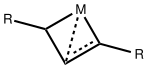
This is an example where replacing an atom carrying a pπ orbital with one carrying a dπ orbital inverts the aromaticity rules. However, the alternating bond pattern characteristic of cyclobutadiene (and anti-aromaticity) remains visible in this structure. Thus the two C-C lengths in the X-ray structure below are 1.39 and 1.53Å, which perhaps corresponds to something like the following resonance form rather than implicating anti-aromaticity. More analysis is clearly needed here at some future stage. At any rate, the barrier for converting one bond-localized form into the other (via TS2) looks likely to be very small, and that the rate-determining-step is going to be TS1/TS1′.
The intrinsic reaction coordinate appears thus, with the C-C forming only shortly after the W-C bond is formed.

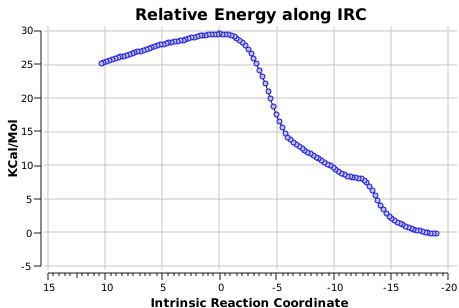
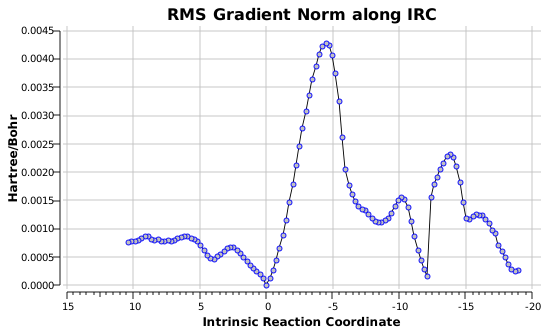
A postscript to the above. The IRC paths for these reactions are particularly difficult to compute; the secret lies in discovering the correct combination of parameters and step size to use. As a result, I have been able to chart a larger proportion of the IRC than initially reported.
- The barrier to addition of ethyne is smaller than found previously for alkene
- At IRC -5, we start to see several features (amplified in the gradient norm along the IRC) which correspond to conformational reorganisation of the hydroxyl groups attached to the metal
- The final conformation of these matches the crystal structure shown in the post. This leads one to conclude that the conformation of these ligands may be crucial in determining the catalytic activity of the system
- In the final conformation, the two C-C bond lengths are predicted as 1.41Å and 1.45Å. The crystal structure shows a rather greater asymmetry, but perhaps we can see the origins of this asymmetry as originating in the conformational re-orientation of the di-axial alkoxy groups. If you look at the IRC very carefully, you will notice that near the end, the W-OH groups start to strongly rotate. As they do so, the relative lengths of the two C-C bonds invert (ie the longer one ends up as the shorter one). This in turn implies that the orientation of the lone pairs on the oxygen controls the relative lengths of the two C-C bonds of the metallacyclobutadiene.
- So the IRC in the end teaches us some very interesting stereoelectronic features of this catalytic system which deserve to be further investigated.
So this brief foray into metathesis chemistry seems to indicate that the attributes of the alkene and alkyne reactions are indeed rather different, most obviously in the amount of reorganisation in the ligand coordination geometry that each requires. The full story however is bound to only emerge when realistically sized ligands replace the simple small ones here.
References
- K. Abersfelder, A. Russell, H.S. Rzepa, A.J.P. White, P.R. Haycock, and D. Scheschkewitz, "Contraction and Expansion of the Silicon Scaffold of Stable Si<sub>6</sub>R<sub>6</sub> Isomers", Journal of the American Chemical Society, vol. 134, pp. 16008-16016, 2012. https://doi.org/10.1021/ja307344f
Tags:Reaction Mechanism, X-ray
Posted in Interesting chemistry | No Comments »
Monday, May 28th, 2012
Streptomycin is an antibiotic active against tuberculosis, and its discovery has become something of a cause célèbre. It was first isolated on October 19, 1943 by a graduate student Albert Schatz in the laboratory of Selman Waksman at Rutgers University. I want to concentrate in this post on its molecular structure. Its initial isolation was followed by an extraordinarily concentrated period of about three years devoted to identifying that structure, culminating in a review of this chemistry in 1948 by Lemieux and Wolfram.[1] This review presents the structure as shown below (left). The modern rendering on the right is based on a crystal structure done in 1978.[2]
 |
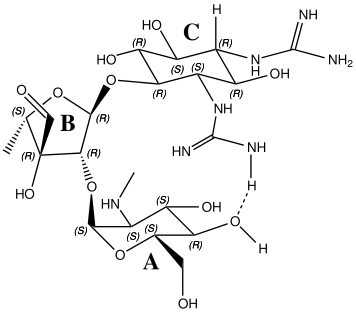 |
My interest in this was kindled by wondering how elucidating such a structure would be accomplished during the 1940s. None of the modern structural techniques were available then (NMR, MS, X-Ray); only IR and polarimetry (optical rotation). So how was it done? Well, the same way it had been done for the previous 100 years or so; degradation. In this case, into three smaller fragments, labelled A-C in the rhs diagram, and named streptidine, streptose and glucosamine in the original analysis.
- This reduction to smaller fragments is set out on page 338 of the Lemieux and Wolfram article.[1]
- The procedure to isolate streptomycin is described from p343 and the purification on p345, which concludes with the molecular formula C21H37-39N7O12
- On p346, after evaluating other methods for determining the molecular weight, C21H39N7O12 is the final candidate for its formula.
- Next, “strongly basic” degradation yields streptidine (Ring C), with the formula C8H18N6O4. Likewise, formulae were established for the other components.
- On p347, the odyssey to assemble a structure from this information begins. I will not dwell on the details. But by p359, a partial structure of Streptidine-streptose-N-methyl-L-glucosamine is suggested.
- By p366, they have boiled it down to two possibilities (they call XXXIX and XL), and they abandon the hydrolytic procedures used up to that point and adopt oxidative reactions, which narrow it down to XXXIX.
- The next property to be used to determine the structure is optical rotation. They knew it incorporates an L-sugar (whose absolute configuration was not known in 1948), and of course there are 15 stereogenic centres in the entire system (32768 possibilities). P368 -375 continues discussion of the stereochemistry, and in particular the need to demonstrate that none of the degradative/oxidative procedures have interfered with it, so to speak.
- By p375, it has all boiled down to the stereochemistry of the glycosidic bonds (marked with a red ring above). This was assigned on the basis of optical rotations and the use of additive rules (Table 1 of their article). This discussion ends with the stereochemistry shown above. Although initially assigned trans, it was subsequently revised to cis, and then back to trans again.
- On p382, the wrap up has started. Table III there shows the properties of the 18 products obtained merely from the preparation of ring A (for comparison with the product obtained by degradation). Some 127 articles have been cited for supporting information and around 50 pages of tight logical argument presented as evidence, similar in length indeed to the longer mathematical proofs!
- There was one residual uncertainty (green ring above) that had to wait for the crystal structure in 1978 to resolve. It took so long because of the challenge of finding a crystalline derivative.
I cannot help but note that the skills required to assemble a structure by degradation, and no use of NMR, MS or X-ray, were formidable, and very probably there are few chemists alive nowadays who could do a similar job (the motivation to do so would also be lacking). Assuming good crystals were available, solving such a structure nowadays using crystallography would only take 24 hours or so. And structures with 100+ stereogenic centres can now be done. When Woodward mused about the progress in chemistry, he might have had streptomycin in mind. I think it is worth remembering that the structural chemistry of 60 years ago was quite an intellectual achievement.
References
- R. Lemieux, and M. Wolfrom, "The Chemistry of Streptomycin", Advances in Carbohydrate Chemistry, pp. 337-384, 1948. https://doi.org/10.1016/s0096-5332(08)60034-x
- S. Neidle, D. Rogers, and M.B. Hursthouse, "The crystal and molecular structure of streptomycin oxime selenate tetrahydrate", Proceedings of the Royal Society of London. A. Mathematical and Physical Sciences, vol. 359, pp. 365-388, 1978. https://doi.org/10.1098/rspa.1978.0047
Tags:Albert Schatz, candidate for its formula, Historical, laboratory of Selman Waksman, MS, muse, pence, Rutgers University, tuberculosis, X-ray
Posted in Interesting chemistry | 1 Comment »
Friday, October 28th, 2011
Moore’s law describes a long-term trend in the evolution of computing hardware, and it is often interpreted in terms of processing speed. Here I chart this rise in terms of the size of computable molecules. By computable I mean specifically how long it takes to predict the geometry of a given molecule using a quantum mechanical procedure.

LSD, the 1975 benchmark for computable molecules.
The geometry (shape) of a molecule is defined by 3N-6 variables, where N is the number of atoms it contains. Optimising the value of variables in order to obtain the minimum value of a function was first conducted by chemical engineers, who needed to improve the function of chemical reactor plants. The mathematical techniques they developed were adopted to molecules in the 1970s, and in 1975 a milestone was reached with the molecule above. Here, N=49, and 3N-6=141. The function used was one describing its computed enthalpy of formation, using a quantum mechanical procedure known as MINDO/3. The computer used was what passed then for a supercomputer, a CDC 6600 (of which a large well endowed university could probably afford one of). It was almost impossible to get exclusive access to such a beast (its computing power was shared amongst the entire university, in this case of about 50,000 people), but during a slack period over a long weekend, the optimised geometry of LSD was obtained (it’s difficult to know how many hours the CDC 6600 took to perform this feat, but I suspect it might have been around 72). The result was announced by Paul Weiner to the group I was then part of (the Dewar research group), and Michael immediately announced that this deserved an unusual Monday night sojourn to the Texas Tavern, where double pitchers of beer would be available. You might be tempted to ask what the reason for the celebration was. Well, LSD was a “real molecule” (and not a hallucination). It meant one could predict for the first time the geometry of realistic molecules such as drugs and hence be taken seriously by people who dealt with molecules of this size for a living. And if you could predict the energy of its equilibrium geometry, you could then quickly move on to predicting the barriers to its reaction. A clear tipping point had been reached in computational simulation.
In 1975, MINDO/3 was thought to compute an energy function around 1000 to 10,000 faster than the supposedly more accurate ab initio codes then available (in fact you could not then routinely optimise geometries with the common codes of this type). With this in mind, one can subject the same molecule to a modern ωB97XD/6-311G(d,p) optimisation. This level of theory is probably closer to 104 to 105 times slower to compute than MINDO/3. On a modest “high performance” resource (which nowadays runs in parallel, in fact on 32 cores in this case), the calculation takes about an hour (starting from a 1973 X-ray structure, which turns out to be quite a poor place to start from, and almost certainly poorer than the 1975 point). In (very) round numbers, the modern calculation is about a million times faster. Which (coincidentally) is approximately the factor predicted by Moore’s law.
I will give one more example, this time for an example dating from around 2003, 28 years on from the original benchmark.

Transition state for lactide polymerisation.
This example has 114 atoms, and hence 3N-6 =336, or 2.42 times the 1975 size. It is a transition state, which is a far slower calculation then an equilibrium geometry. It is also typical of the polymerisation chemistry of the naughties. Each run on the computer (B3LYP/6-31G(d), with the alkyl groups treated at STO-3G) now took about 8-10 days (on a machine with 4 cores), and probably 2-4 runs in total would have been required per system (of which four needed to be studied to derive meaningful conclusions). Let us say 1000 hours per transition state. Together with false starts etc, the project took about 18 months to complete. Move on to 2010; added to the model was a significantly better (= slower) basis set and a solvation correction, and a single calculation now took 67 hours. In 2011, it would be reduced to ~10 hours (by now we are up to 64-core computers).
In 2011, calculations involving ~250 atoms are now regarded as almost routine, and molecules with up to this number of atoms cover most of the discrete (i.e. non repeating) molecular systems of interest nowadays. But the 1975 LSD calculation still stands as the day that realistic computational chemistry came of age.
Tags:3g, chemical engineers, chemical reactor plants, computational chemistry, energy, energy function, hallucination, Historical, LSD, molecular systems, Paul Weiner, simulation, sojourn, Texas Tavern, X-ray
Posted in Interesting chemistry | No Comments »
Friday, October 28th, 2011
Moore’s law describes a long-term trend in the evolution of computing hardware, and it is often interpreted in terms of processing speed. Here I chart this rise in terms of the size of computable molecules. By computable I mean specifically how long it takes to predict the geometry of a given molecule using a quantum mechanical procedure.
LSD, the 1975 benchmark for computable molecules.
The geometry (shape) of a molecule is defined by 3N-6 variables, where N is the number of atoms it contains. Optimising the value of variables in order to obtain the minimum value of a function was first conducted by chemical engineers, who needed to improve the function of chemical reactor plants. The mathematical techniques they developed were adopted to molecules in the 1970s, and in 1975 a milestone was reached with the molecule above. Here, N=49, and 3N-6=141. The function used was one describing its computed enthalpy of formation, using a quantum mechanical procedure known as MINDO/3. The computer used was what passed then for a supercomputer, a CDC 6600 (of which a large well endowed university could probably afford one of). It was almost impossible to get exclusive access to such a beast (its computing power was shared amongst the entire university, in this case of about 50,000 people), but during a slack period over a long weekend, the optimised geometry of LSD was obtained (it’s difficult to know how many hours the CDC 6600 took to perform this feat, but I suspect it might have been around 72). The result was announced by Paul Weiner to the group I was then part of (the Dewar research group), and Michael immediately announced that this deserved an unusual Monday night sojourn to the Texas Tavern, where double pitchers of beer would be available. You might be tempted to ask what the reason for the celebration was. Well, LSD was a “real molecule” (and not a hallucination). It meant one could predict for the first time the geometry of realistic molecules such as drugs and hence be taken seriously by people who dealt with molecules of this size for a living. And if you could predict the energy of its equilibrium geometry, you could then quickly move on to predicting the barriers to its reaction. A clear tipping point had been reached in computational simulation.
In 1975, MINDO/3 was thought to compute an energy function around 1000 to 10,000 faster than the supposedly more accurate ab initio codes then available (in fact you could not then routinely optimise geometries with the common codes of this type). With this in mind, one can subject the same molecule to a modern ωB97XD/6-311G(d,p) optimisation. This level of theory is probably closer to 104 to 105 times slower to compute than MINDO/3. On a modest “high performance” resource (which nowadays runs in parallel, in fact on 32 cores in this case), the calculation takes about an hour (starting from a 1973 X-ray structure, which turns out to be quite a poor place to start from, and almost certainly poorer than the 1975 point). In (very) round numbers, the modern calculation is about a million times faster. Which (coincidentally) is approximately the factor predicted by Moore’s law.
I will give one more example, this time for an example dating from around 2003, 28 years on from the original benchmark.
Transition state for lactide polymerisation.
This example has 114 atoms, and hence 3N-6 =336, or 2.42 times the 1975 size. It is a transition state, which is a far slower calculation then an equilibrium geometry. It is also typical of the polymerisation chemistry of the naughties. Each run on the computer (B3LYP/6-31G(d), with the alkyl groups treated at STO-3G) now took about 8-10 days (on a machine with 4 cores), and probably 2-4 runs in total would have been required per system (of which four needed to be studied to derive meaningful conclusions). Let us say 1000 hours per transition state. Together with false starts etc, the project took about 18 months to complete. Move on to 2010; added to the model was a significantly better (= slower) basis set and a solvation correction, and a single calculation now took 67 hours. In 2011, it would be reduced to ~10 hours (by now we are up to 64-core computers).
In 2011, calculations involving ~250 atoms are now regarded as almost routine, and molecules with up to this number of atoms cover most of the discrete (i.e. non repeating) molecular systems of interest nowadays. But the 1975 LSD calculation still stands as the day that realistic computational chemistry came of age.
Tags:3g, chemical engineers, chemical reactor plants, computational chemistry, energy, energy function, hallucination, Historical, LSD, molecular systems, Paul Weiner, simulation, sojourn, Texas Tavern, X-ray
Posted in Interesting chemistry | No Comments »
Sunday, June 5th, 2011
In 1923, Coster and von Hevesey (DOI: 10.1038/111182a0) claimed discovery of the element Hafnium, atomic number 72 (latin Hafnia, meaning Copenhagen, where the authors worked) on the basis of six lines in its X-ray spectrum. The debate had long raged as to whether (undiscovered) element 72 belonged to the rare-earth group 3 of the periodic table below yttrium, or whether it should be placed in group 4 below zirconium. Establishing its chemical properties finally placed it in group 4. Why is this apparently arcane and obscure re-assignment historically significant? Because, in June 1922, in Göttingen, Niels Bohr had given a famous series of lectures now known as the Bohr Festspiele on the topic of his electron shell theory of the atom. Prior to giving these lectures he had submitted his collected thoughts in January 1922[1].
Like Mendeleev before, who had predicted ekasilicon, ekaaluminium and ekaboron (eventually discovered as germanium, gallium and scandium), Bohr had used his electron shell theory to (correctly) predict the properties of element 72. In modern terms, he had concluded that its electron shell structure must be 2.8.18.32.10.2 or [Xe].4f14.5d2.6s2. Classification as a rare earth would have resulted in the 4f shell having 15 electrons, impossible in Bohr’s theory. Coster and von Hevesey note in their article that Bohr’s striking prediction was now verified.
Why I am writing all of this? For various reasons:
- Unlike Mendeleev, Bohr’s prediction of the properties of a (then uncharacterized) element, whilst famous at the time, is nowadays largely forgotten by chemists. It is one of the great achievements of the then new quantum theory.
- Reading the 67 pages of Bohr’s article on the topic reveals no discussion of element 72 (articles of this era are nowadays only available as scanned images, not full text, and one must rely on a human visual scan of all 67 pages, which of course may not be reliable) but its (absence) in the table below is striking. Here VI means the 6th row of the periodic table.

Niels Bohr’s Periodic table, 1922.
- Notice the only other missing elements, Technetium (43), Promethium (61), Astatine (85), Francium (87) and Rhenium (75, the only non-radioactive one remaining to be discovered),
- I must presume that Bohr introduced his discussion of element 72 into his June lectures to make an impact with his audience! One might have hoped that tracking down what happened between January 1922, when Bohr fails to make much of the missing element 72, and June in the same year would be possible from Coster and von Hevesey’s citation of Bohr in 1923. But it was the practice of the time to rarely cite one’s sources. Thus they give no published citation to Bohr, and one might conclude that they might instead be quoting Bohr from his lectures rather than his writings (who, I wonder, was poor old Bury, now forgotten!).

Coster and Hevesey’s allusion to Bohr’s theory.
- Bohr’s own 1922 article on the topic is also visually striking. It contains in its 67 pages:
- 13 (short) equations
- Two figures (the second a variation on the first)
- One table (above).
- and lots of text (in German).
- No citations at the end, not even one, although many people are acknowledged in the text itself.
- No explicit statement of shell structures as e.g. 2.8.18.32.10.2 or [Xe].4f14.5d2.6s2.
Given that Bohr’s article can be regarded as one of the most influential of the 20th century (even prior to its being placed on a firm theoretical footing by solution of the Schroedinger equation for the hydrogen atom), I find it interesting how quickly it achieved this status (Bohr won the Nobel prize in 1922 as well). One might conclude that reputations were made as much via verbal presentations as by the immediate visual impact of the associated publications.
Finally, I note the striking contrast between Bohr’s article and Langmuir’s, written about a year earlier in 1921. Here, Langmuir sets out some postulates, the first of which is shown below.

Langmuir’s 1921 postulate.
The filled electron shells are clearly set out here (much more clearly than in Bohr’s 1922 article). But yet again, we remain baffled as to how Langmuir arrived at this postulate. Although he (very briefly) mentions Bohr in his own paper, it is only in the context of speculating about what prevents the electrons from falling into the nucleus, and few citations are again given (a notable exception is to Pease for suggesting the triple bond). We may only suspect that Langmuir had heard Bohr talking about his theory, and had extended G. N. Lewis’ concept (also not directly cited) of (filled) valence shells for his own theory of chemical bonding.
Well, in a little less than 90 years, we have progressed from finding almost no sources cited in some of the most influential papers of the 20th century, to the DOI (or URL) embedded in everything. I think that when the history of the present era is written, the introduction of the DOI/URL will take its place in the pantheon of great scientific events. Its the connections that matter, stupid!
Postscript. Hevesey in this review written in 1925 sets out a good history of Hafnium. This article contains (on p7) a clear statement of the electron shell structure of Hafnium as 2.8.18.32.8.2.2, which is cited as Bohr’s result. Hevesey quotes Bohr via reference 12, which is in fact to a book Bohr published in 1924. There is no mention of Langmuir in Hevesey’s review.
Postscript1: Hafnium (as its oxide) is now an essential element to the ever smaller fabrication of silicon chips (32nm and smaller). It is one of 14 elements considered essential to the future green technologies (six of which, but not including Hafnium, are considered in critical risk of supply disruption by 2015).
References
- N. Bohr, "Der Bau der Atome und die physikalischen und chemischen Eigenschaften der Elemente", Zeitschrift f�r Physik, vol. 9, pp. 1-67, 1922. https://doi.org/10.1007/bf01326955
Tags:Bohr, Bury, chemical bonding, chemical properties, Copenhagen, green technologies, Hafnium, Historical, Langmuir, Niels Bohr, silicon chips, Technetium, X-ray
Posted in Chemical IT, General | 5 Comments »
Tuesday, May 31st, 2011
The Pirkle reagent is a 9-anthranyl derivative (X=OH, Y=CF3). The previous post on the topic had highlighted DIST1, the separation of the two hydrogen atoms shown below. The next question to ask is how general this feature is. Here we take a look at the distribution of lengths found in the Cambridge data base, and focus on another interesting example.

9-anthranyl derivatives. Click for Pirkle with normalised C-H lengths.
The histogram below shows all 9-anthranyl compounds in the CCDC database distributed by DIST1. The search was conducted with the restrictions of no disorder, no “errors”, and using normalised hydrogen bond lengths. A note of explanation for the latter. Because of the nature of x-ray diffraction, when a C-H distance is obtained from a structural refinement, it tends to emerge ~0.1Å to short. Normalisation means adjusting that distance to a more correct 1.09Å (the heavy atom stays put, its the H that moves). In our case, this has the effect of actually shortening DIST1. In the Pirkle structure (shortcode SOCLIF) the nominal value for DIST1 is 1.94-1.96Å, but normalisation reduces these to 1.82-1.85Å. This really is an unusually short contact between two hydrogen atoms (the sum of the vdW radii is 2.4Å). So how unusual might this be? Show below is the result of the CCDC search.

H...H Contacts in 9-anthranyl derivatives
Notice how a maximum in the number of examples is visible at ~1.9Å, but examples all the way down to ~1.7Å are known! If one restricts the search to examples where X=O, the following plot is obtained. The entry on the bottom left is JARYEG, where Y is sufficiently large to enforce short H…H or O…H contacts on both sides. Click on the histogram picture below to see it. When you do so, you will also see the NCI surface computed at this geometry. Note that both the short H..H (DIST1) and the short O…H (DIST2) interaction surfaces are coloured blue, indicating attractive contacts!

9-anthranyl derivatives, X=O.
If you explore the 3D model further, you will notice other blue interaction surfaces, and a number which have both blue AND orange (= repulsive) zones. We see here yet another example of a weak interaction being simultaneously both attractive and repulsive. It is no longer sufficient to say that the interaction between two atoms is either one or the other. Depending on where you measure it, it can be both! In other words, even weak bonds can have internal structure (for a discussion of the internal structure of a strong C-S bond, see DOI
10.1021/ct100470g).
Tags:9-anthranyl, Cambridge, disorder, Julia Contreras-Garcia, X-ray
Posted in Interesting chemistry | 1 Comment »
Monday, April 4th, 2011
Andy Mclean posted a comment to my story of copper phthalocyanine (Monastral blue). The issue was its colour, and more specifically why this pigment has two peaks λmax 610 and 710nm making it blue. The first was accurately reproduced by calculation on the monomer, but the second was absent with such a model. Andy suggested this latter was due to stacking. Here, the calculated spectrum of a stacked dimer is explored.

Copper phthalocyanine, showing herring-bone stacking. Click for 3D.
The X-ray structure (above) shows layers of the phthalocyanine, dislocated so that the Cu of one unit aligns perfectly with a N of the units above and below the first one (Cu-N 3.28Å). This corresponds to the di-axially solvated system I
explored in a comment appended to the original post. The
TD-DFT calculated (since each unit is a doublet radical, the dimer was treated as a triplet state, this being much lower in energy than a singlet closed shell state) electronic spectrum for two units, stacked above each other as shown above reveals two transitions at ~ 600 and 620 nm. This is still some way away from reproducing the measured (solid state or solution spectra).
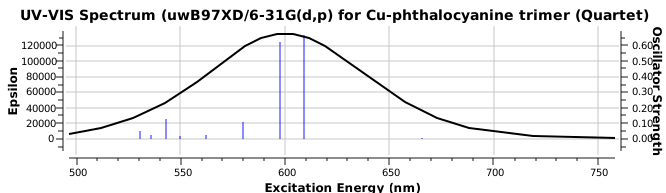
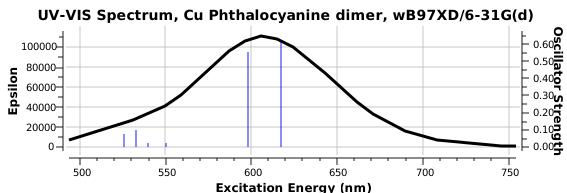 The hypothesis must now be that the effect of such π-π stacking on the electronic spectrum converges only slowly with the degree of stacking (if indeed it is that that is the root cause of the 710nm transition). A calculation on a triple-layered model is currently under way (this being the absolute limit of what can be done without a periodic boundary model). The spectrum will be appended to this post in a week or so (see below). There is little sign of the spectrum evolving a quite separate band at 710nm. The model is still incomplete!
Tags:Andy Mclean, copper phthalocyanine, energy, Historical, TD-DFT, X-ray
Posted in Interesting chemistry | No Comments »


