Posts Tagged ‘search query’

The mechanism of silylether deprotection using a tetra-alkyl ammonium fluoride.

Wednesday, May 25th, 2016

The substitution of a nucleofuge (a good leaving group) by a nucleophile at a carbon centre occurs with inversion of configuration at the carbon, the mechanism being known by the term SN2 (a story I have also told in this post). Such displacement at silicon famously proceeds by a quite different mechanism, which I here quantify with some calculations.
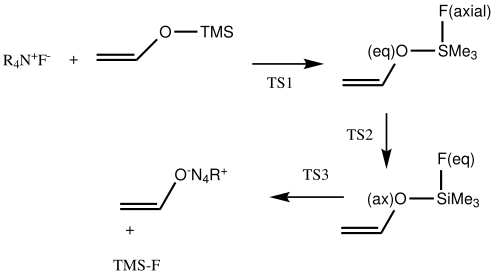
Trialkylsilyl is often used to protect OH groups, and as shown in the diagram above is specifically used to enforce the enol form of a ketone by replacing the OH with OTMS. The TMS can then be removed when required by utilising nucleophilic addition of e.g. fluoride anion from tetra-alkyl ammonium fluoride to form a 5-coordinate silicon intermediate, followed by collapse of this intermediate with expulsion of the oxygen to form an enolate anion. Before starting the calculations, I searched the crystal structure database for examples of R3SIF(OR), as in the search query below.

There were 55 instances of such species, and show below are their geometric characteristics. In all cases, the two electronegative substituents occupy the axial positions of a trigonal bipyramidal geometry. This of course is the orientation adopted by the two electronegative substituents in the SN2 mechanism for carbon, but with silicon this carbon "transition state" can be replaced by a stable (and as we see often crystalline) intermediate!

Turning to calculations (ωB97XD/6-31+G(d)/SCRF=thf), one can locate three transition states for the silicon process (there is only one for the SN2 reaction with carbon).

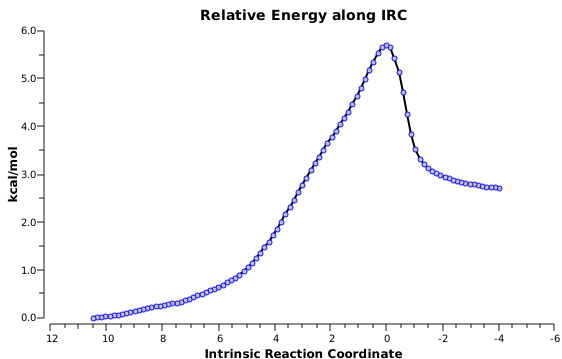
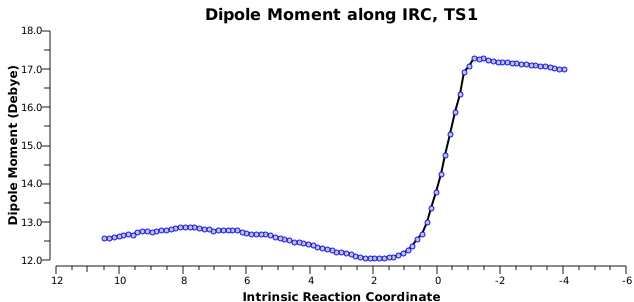
  1. TS1 represents attack of fluoride anion along the axial position of the forming 5-coordinate silicon.[1],[2] The oxygen in this instance occupies an equatorial position, and this close proximity between the incoming F(-) and the about to depart OR groups represents a retention of configuration at the Si. Note that the reaction is endo-energic. (c.f. [3]).


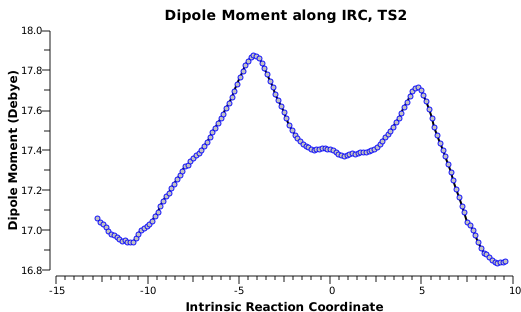
  2. The next step, TS2[4],[5]  is to move the F ligand to an equatorial position and the OR group from equatorial to its own axial position so that it can depart in the manner the F adopted to arrive. This requires what is called a Berry pseudorotation, an essentially isoenergic process.


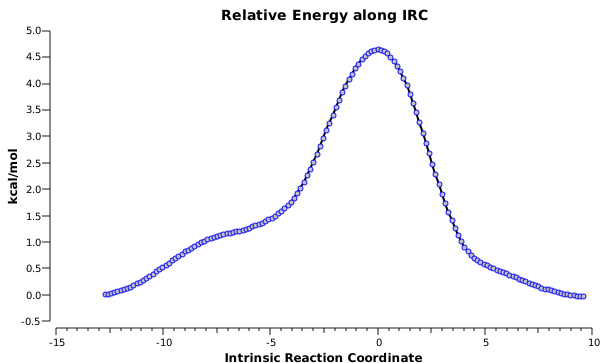
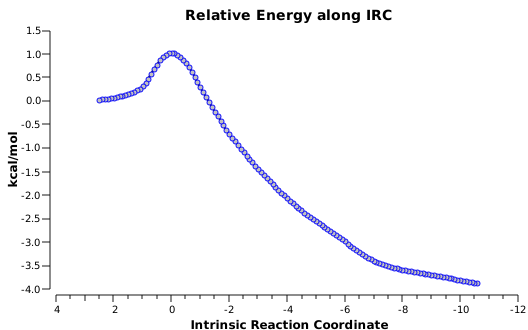
    You might note a "hidden intermediate" at IRC ~-7 (the "bump" in the energy profile). This is caused by re-organisation of the ion-pair geometry, with the tetra-alkyl ammonium cation moving its orientation.
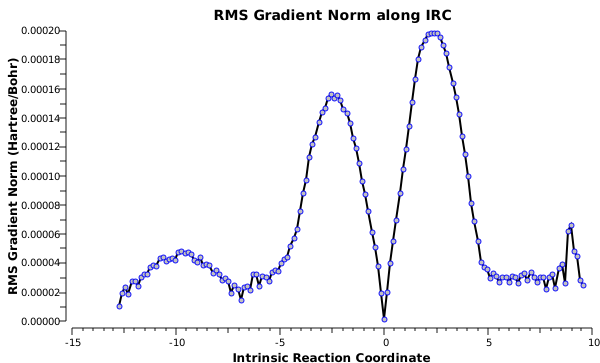
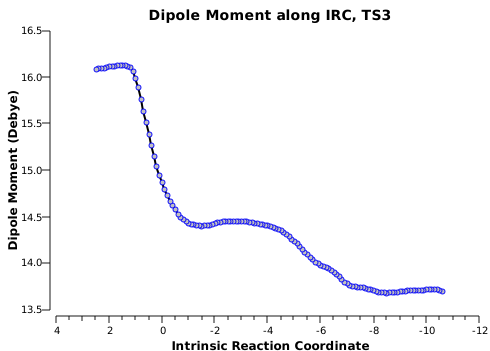
  3. TS3[6],[7] now eliminates the OR group to complete the deprotection.


The free energies are summarised below. Key points include:

  1. The overall free energy of deprotection is appropriately exo-energic.
  2. The highest energy barrier is actually for pseudo-rotation! This suggests that tuning the deprotection with alternative alkyl or aryl groups on the silicon may be a matter of controlling the Berry pseudorotation process.
  3. TS1-3 proceed with the attacking and leaving groups in close proximity (the angle between an axial and an equatorial group is ~90° of course, whereas for a di-axial relationship (the inversion of the SN2 mechanism) it is instead 180°. This close proximity of nucleophile and nucleofuge minimises the required reorganisation of the ammonium counter-ion in the ion-pairs, and possibly also the dipole moments induced by the reactions, the changes of which for the three reactions are shown below:
  4. The 5-coordinate intermediate where both F and O are axial is in fact significantly lower in energy (a cooperative effect) than when only one of them is axial, which matches the orientations identified above in the 55 crystal structures. For a substitution to occur, the cooperative strengthening of the Si-O and Si-F bonds must be removed; hence the retention of configuration.
System Relative free energy DataDOI
Reactants 0.0 [8]
TS1 7.9 [1]
Int F(ax), O(eq) 5.1 [9]
TS2 10.2 (9.2)* [4]
Int F(eq), O(ax) 5.1 [10]
TS3 5.2 [6]
Products -4.0 [11]
Int F,O(ax) -2.5 [12]

*A lower energy orientation of the ion-pair has subsequently been found.[13]

This analysis shows just how different the carbon and the silicon substitution reactions are and how it is the pseudorotation interconverting two 5-coordinate intermediates that appears to be a key step. But questions remain unanswered. What is the energy of the pseudorotation interconverting an intermediate with ax/eq electronegative groups to one with di-axial electronegative groups? Are there transition states starting from the diaxial intermediate and resulting in elimination, and if so what are their relative energies? I leave answers to a follow up post. 

References

  1. H. Rzepa, "trimethyl silyl enol + Me4N(+).F(-) 5-coordinate intermediate F axial TS", 2016. https://doi.org/10.14469/hpc/554
  2. H. Rzepa, "trimethyl silyl enol + Me4N(+).F(-) 5-coordinate intermediate F axial TS IRC", 2016. https://doi.org/10.14469/hpc/564
  3. L. Wozniak, M. Cypryk, J. Chojnowski, and G. Lanneau, "Optically active silyl esters of phosphorus. II. Stereochemistry of reactions with nucleophiles", Tetrahedron, vol. 45, pp. 4403-4414, 1989. https://doi.org/10.1016/s0040-4020(01)89077-3
  4. H. Rzepa, "trimethyl silyl enol + Me4N(+).F(-) 5-coordinate intermediate Berry pseudorotation TS", 2016. https://doi.org/10.14469/hpc/551
  5. H. Rzepa, "trimethyl silyl enol + Me4N(+).F(-) 5-coordinate intermediate Berry pseudorotation TS IRC", 2016. https://doi.org/10.14469/hpc/553
  6. H. Rzepa, "trimethyl silyl enol + Me4N(+).F(-) TS", 2016. https://doi.org/10.14469/hpc/539
  7. H. Rzepa, "trimethyl silyl enol + Me4N(+).F(-) TS IRC", 2016. https://doi.org/10.14469/hpc/552
  8. H. Rzepa, "enol + Me4N(+).F(-) Reactant", 2016. https://doi.org/10.14469/hpc/565
  9. H. Rzepa, "enol + Me4N(+).F(-) 5-coordinate intermediate F axial", 2016. https://doi.org/10.14469/hpc/555
  10. H. Rzepa, "trimethyl silyl enol + Me4N(+).F(-) 5-coordinate intermediate", 2016. https://doi.org/10.14469/hpc/540
  11. H. Rzepa, "enol + Me4N(+).F(-) Product", 2016. https://doi.org/10.14469/hpc/563
  12. H. Rzepa, "trimethyl silyl enol + Me4N(+).F(-) 5-coordinate intermediate F/O axial", 2016. https://doi.org/10.14469/hpc/550
  13. H. Rzepa, "5-coordinate intermediate Berry pseudorotation TS2 New conf?", 2016. https://doi.org/10.14469/hpc/577

What is the approach trajectory of enhanced (super?) nucleophiles towards a carbonyl group?

Wednesday, May 11th, 2016

I have previously commented on the Bürgi–Dunitz angle, this being the preferred approach trajectory of a nucleophile towards the electrophilic carbon of a carbonyl group. Some special types of nucleophile such as hydrazines (R2N-NR2) are supposed to have enhanced reactivity[1] due to what might be described as buttressing of adjacent lone pairs. Here I focus in on how this might manifest by performing searches of the Cambridge structural database for intermolecular (non-bonded) interactions between X-Y nucleophiles (X,Y= N,O,S) and carbonyl compounds OC(NM)2.

The search query[2] is shown above and involves plotting the distance from the nucleophilic atom (N above) to the carbon of the carbonyl group. The carbon is defined as having 3-coordination, one of which is O=C and two non-metal attachments. The torsion is constrained to values of |70-110|° to ensure that the approach of the nucleophile is approximately perpendicular to the plane of the carbonyl in order to overlap with the π*-orbital as electrophile. The pairwise sums of van der Waals radii are NC, 3.25; OC, 3.22 and SC, 3.5Å and the plots show all contacts shorter than these. The results of the searches are shown below.

The general observation is that the red hotspots do tend to come at trajectory angles of <100° and many are <90° such as the X=Y=N or X=Y=S examples. Given that the original Bürgi–Dunitz hypothesis (actually based on a small number of molecules synthesized for the purpose) proposed rather larger angles (105±5°) corresponding to optimum alignment of the nucleophile with the carbonyl π*-orbital, we might speculate whether the use of enhanced nucleophiles is the reason for the apparent decrease in the angle. And if so, what the underlying reasons would be.

I also cannot help but observe that the term supernucleophile is quite rare in the literature; SciFinder gives only 45 hits, but most are about neither hydrazines nor peroxides. There are also some unusual nucleophile varieties such as Cob(I)alamin[3], of which there are probably insufficient examples to reflect in the crystal structure statistics shown above. Given the interest in superbases, the relative lack of examples of unusual supernucleophiles seems surprising.

References

  1. G. Klopman, K. Tsuda, J. Louis, and R. Davis, "Supernucleophiles—I", Tetrahedron, vol. 26, pp. 4549-4554, 1970. https://doi.org/10.1016/s0040-4020(01)93101-1
  2. H. Rzepa, "Crystal structure search using enhanced nucleophiles", 2016. https://doi.org/10.14469/hpc/487
  3. K.P. Jensen, "Electronic Structure of Cob(I)alamin:  The Story of an Unusual Nucleophile", The Journal of Physical Chemistry B, vol. 109, pp. 10505-10512, 2005. https://doi.org/10.1021/jp050802m

Ways to encourage water to protonate an amine: superbasing.

Friday, April 8th, 2016

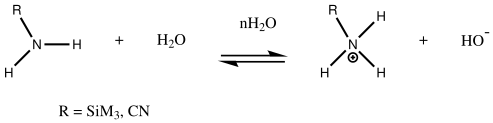
Previously, I looked at models of how ammonia could be protonated by water to form ammonium hydroxide. The energetic outcome of my model matched the known equilbrium in water as favouring the unprotonated form (pKb ~4.75). I add here two amines for which R=Me3Si and R=CN. The idea is that the first will assist nitrogen protonation by stabilising the positive centre and the second will act in the opposite sense; an exploration if you like of how one might go about computationally designing a non-steric superbasic amine that becomes predominantly protonated when exposed to water (pKb <1) and is thus more basic than hydroxide anion in this medium.

NH3-8

Before reporting any calculations, let us see what the CSD (Cambridge structure database) might contain. The search query is simple, a 3-coordinate amine forming a 4-coordinate quaternary nitrogen with one N-H and a positive (formal) charge on the N, and a 1-coordinate oxygen with one O-H and a negative charge on the O. With the constraints R < 10%, no disorder and no errors, one gets as many as 15 hits,[1] several of which also apparently contain separate water molecules in the crystal. A warning bell (perhaps several) sounds, since if R < 5%, the number of hits drops to just 2; these are clearly difficult structures to refine! So there is some tantalising evidence that in the solid state at least, the quaternary ammonium group (with at least one N-H), water and a hydroxide anion might be capable of co-existence. As noted below some fascinating 2-coordinate amines have also been reported as having superbasic properties.

NH3-8

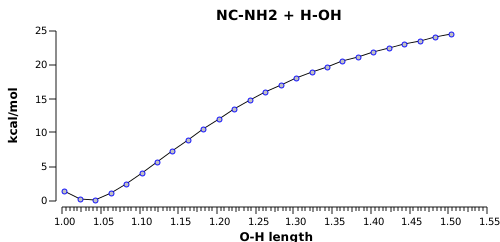
R=CN: the well known compound cyanamide is known to act only as an acid and its basic properties are never quoted. Shown below is the reaction path for transfer of a proton from water to the amine using an 8-water model (n=8) in which two bridges can serve to help stabilize any ionic form. The energy required to do so however is at least 24 kcal/mol (ωB97XD/Def2-TZVPPD/SCRF=water) which indicates that no protonated amine is formed. This can be attributed to the electron withdrawing cyano group strongly destablising any adjacent positive ammonium centre and thus effectively completely inhibiting its formation.

NH3-8

R=Me3Si: this too is already known[2],[3] but only in the presence of the non-coordinating counter-anion B(C6F5)4 crystallised from non-protic solution. An ionised form can now be located using the model above. This has the structure shown below; note the very short hydrogen bonds associated with the hydroxide anion and the possibility of forming only two water bridges across the ion-pair. The relative free energy of the ion-pair (table below) shows it to be if anything less basic than ammonia. 

NH3-8

n=8 R=H R=SiMe3 R=CN
ΔΔG298 7.0[4]

7.6[5],[6]

>24[7]

NBO (natural bond orbital) analysis might here  be a useful metric of basicity. Hence Me3SiNH2…H2O  suggests that donation from the N lone pair into an antiperiplanar Si-C bond is quite large (E(2) = 11.9 kcal/mol), although alternative donation by nitrogen into the H-O σ* bond  of the water is much higher (33.4 kcal/mol). 

Perhaps the basicity of simple amines is related to their ability to form stabilizing water bridges across the ion-pair? With trimethylsilyl substituents, this feature (and hence the basicity) is partially or even fully suppressed as in e.g. tris(trimethylsilyl)amine.The pKb of the latter appears to be unreported[8] but it does seem to be only weakly basic and "inert to H2O",[9] a property attributed instead to multiple character in the Si-N bonds. 

I will in a future post look at the alternative class of phosphazenium amines which do manage to achieve superbasicity.[10]


A phosphazenium 3-coordinate amine[11] was in 1991 claimed to be the strongest metal-free neutral base. This has now been superceded by combining this base motif with that of a sterically operating proton sponge.[12],[10] I will report the computational modelling of these systems in a later post.

One of the structures identified with R<10% is UBEJIU[13] and which is worth showing below. Note the apparent close contact of the type N-H…H-O (1.416-1.463Å) rather than the expected N-H…OH.  If correct (this feature is not mentioned in the article itself) it would be classified as a dihydrogen bond, a type normally only found in situations such as B-H…H-N. There are a number of other inconsistencies which must be resolved if this structure is to stand as correct.

NH3-8

References

  1. H. Rzepa, "Substituted ammonium hydroxides", 2016. https://doi.org/10.14469/hpc/361
  2. Y. Sarazin, J.A. Wright, and M. Bochmann, "Synthesis and crystal structure of [C6H5Hg(H2NSiMe3)][H2N{B(C6F5)3}2], a phenyl–mercury(II) cation stabilised by a non-coordinating counter-anion", Journal of Organometallic Chemistry, vol. 691, pp. 5680-5687, 2006. https://doi.org/10.1016/j.jorganchem.2006.09.021
  3. Sarazin, Y.., Wright, J.A.., and Bochmann, M.., "CCDC 608250: Experimental Crystal Structure Determination", 2007. https://doi.org/10.5517/ccndxzx
  4. H.S. Rzepa, and H.S. Rzepa, "H21NO9", 2016. https://doi.org/10.14469/ch/191946
  5. H.S. Rzepa, and H.S. Rzepa, "C 3 H 29 N 1 O 9 Si 1", 2016. https://doi.org/10.14469/ch/191987
  6. H.S. Rzepa, and H.S. Rzepa, "C 3 H 29 N 1 O 9 Si 1", 2016. https://doi.org/10.14469/ch/191982
  7. H.S. Rzepa, "CH20N2O9", 2016. https://doi.org/10.14469/ch/191983
  8. E.W. Abel, D.A. Armitage, and G.R. Willey, "Relative base strengths of some organosilicon amines", Transactions of the Faraday Society, vol. 60, pp. 1257, 1964. https://doi.org/10.1039/tf9646001257
  9. J. Goubeau, and J. Jimenéz‐Barberá, "Tris‐(trimethylsilyl)‐amin", Zeitschrift für anorganische und allgemeine Chemie, vol. 303, pp. 217-226, 1960. https://doi.org/10.1002/zaac.19603030502
  10. Kögel, Julius F.., Oelkers, Benjamin., Kovačević, Borislav., and Sundermeyer, Jörg., "CCDC 1002088: Experimental Crystal Structure Determination", 2014. https://doi.org/10.5517/cc12mrfw
  11. R. Schwesinger, and H. Schlemper, "Peralkylated Polyaminophosphazenes— Extremely Strong, Neutral Nitrogen Bases", Angewandte Chemie International Edition in English, vol. 26, pp. 1167-1169, 1987. https://doi.org/10.1002/anie.198711671
  12. J.F. Kögel, B. Oelkers, B. Kovačević, and J. Sundermeyer, "A New Synthetic Pathway to the Second and Third Generation of Superbasic Bisphosphazene Proton Sponges: The Run for the Best Chelating Ligand for a Proton", Journal of the American Chemical Society, vol. 135, pp. 17768-17774, 2013. https://doi.org/10.1021/ja409760z
  13. P. Vianello, A. Albinati, G.A. Pinna, A. Lavecchia, L. Marinelli, P.A. Borea, S. Gessi, P. Fadda, S. Tronci, and G. Cignarella, "Synthesis, Molecular Modeling, and Opioid Receptor Affinity of 9,10-Diazatricyclo[4.2.1.1<sup>2,5</sup>]decanes and 2,7-Diazatricyclo[4.4.0.0<sup>3,8</sup>]decanes Structurally Related to 3,8-Diazabicyclo[3.2.1]octanes", Journal of Medicinal Chemistry, vol. 43, pp. 2115-2123, 2000. https://doi.org/10.1021/jm991140q

Spotting the unexpected. Anomeric effects involving alkenes?

Wednesday, November 2nd, 2011

How one might go about answering the question: do alkenes promote anomeric effects? A search of chemical abstracts does not appear to cite any examples (I may have missed them of course, since it depends very much on the terminology you use, and new effects may not yet have any agreed terminology) and a recent excellent review of hyperconjugation does not mention it. Here I show how one might provide an answer.

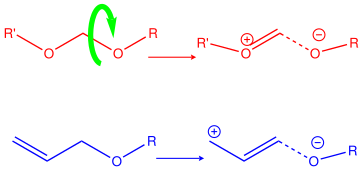
First, what is an anomeric effect? The diagram below shows the classic anomeric effect in which a donor (an oxygen lone pair) interacts with an acceptor (a C-O bond). The orientation around the single bond shown with a green arrow is crucial; the effect only happens when the donating lone pair is aligned antiperiplanar to the accepting C-O bond, at which point the lengthening of the C-O bond should be maximal (shown as a dashed line below). The blue analogue is the corresponding effect using an alkene as the donor, but retaining the C-O bond as the acceptor.

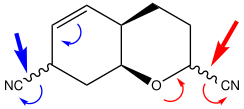
I had previously addressed this theme by discussing the molecule below. Switching the acceptor from a C-O to a C-cyano bond has the effect of inducing an axial orientation for both cyano groups, a “cyanomeric” effect! Whilst the stronger is undoubtedly the one shown in red, note the blue interaction, that involves an alkene rather than oxygen as donor.

One way of providing evidence is a crystallographic search. Here I am using Conquest, the program provided by the Cambridge crystallographic data centre, with the following specification (thanks to Andrew White for helping me frame this search!).

The search query

  1. The length of the C-O bond (blue arrow) is defined as a search parameter
  2. The absolute value of the torsion around the bond (red arrow) is also so defined
  3. I have restricted the acceptor to C-O bonds (this of course excludes C-CN).
  4. The C-O acceptor can be enhanced by bearing an electron withdrawing group, which can be e.g. carbonyl, phosphate, sulfate, perchlorate etc.
  5. The alkene donor can be enhanced with donating groups such as oxygen, nitrogen or carbon
  6. NOT Booleans are applied to restrict the substituents the alkene can carry  to only sp3 carbons (or H) by excluding sp2 or sp hybridised carbons. This is to prevent the substituents from delocalizing the alkene (in effect preventing competition from these substituents), but allowing them to stabilise any induced carbocation resonance by hyperconjugation.
  7. The C of the C-O is specified as acyclic (to allow the torsion to in theory have any allowed value).
  8. The search is also restricted to structures with no disorder or other errors, and an R factor of < 0.075.
These specifications can be seen in the first hit obtained:

A hit

A total of 215 structures are found, and a scatterplot of the C-O bond length version the (abs)C=C-C-O torsion is shown below.

Scatterplot. Click to view a larger version.

There are two main clusters of hits, those with torsions close to zero, and those with torsions between ~90-120°. The latter cluster is very clearly shifted to the right of the former, indicating that on average these C-O bond lengths are longer. The red-orange-light green hits (1.46-1.50Å range) are to be found exclusively in the “antiperiplanar” cluster. One might conclude that statistically, the π-anomeric effect appears real. Of course, there may be many other reasons why the C-O bond is lengthened, and each of the molecules above should be individually inspected to exclude these.

This sort of structural search takes only minutes (if you know how to formulate it) and I would certainly encourage you to try it out on your own favourite effect!  See if the excellent  and open CrystalEye resource gives a similar answer (the Conquest /CCDC system is commercial, and not open).


H. S. Rzepa, 2011-11-02. URL:http://www.ch.imperial.ac.uk/rzepa/blog/?p=5368. Accessed: 2011-11-02. (Archived by WebCite® at http://www.webcitation.org/62tOSgnzK)