Posts Tagged ‘Reaction Mechanism’

Why the Sharpless epoxidation is enantioselective!

Monday, December 17th, 2012

Part one on this topic showed how a quantum mechanical model employing just one titanium centre was not successful in predicting the stereochemical outcome of the Sharpless asymmetric epoxidation. Here in part 2, I investigate whether a binuclear model might have more success. The new model is constructed using two units of Ti(OiPr)4, which are likely to assemble into a dimer such as that shown below (in this crystal structure, some of the iPr groups are perfluorinated).

WAWBUR. Click for 3D

WAWBUR. Click for 3D

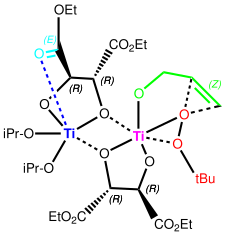
This allows one to construct a transition state model as follows.
sharpless-binuclear

  1. Two iPrOH molecules are displaced by diethyl tartrate for each half of the Ti2(OiPr)8, with the two metals then becoming bridged by one oxygen from each tartrate. 
  2. Two further iPrOH are then displaced from the second Ti by one of the substrate (allyl alcohol) and one of the oxidant (t-butyl peroxide).
  3. The oxygen transfer now proceeds via the second (hexacoordinate) Ti. The first Ti also achieves hexa-coordination via the carbonyl oxygen of one of the tartrate ester groups. It is the geometric properties of such a hexa-coordinated Ti that in part accounts for the subtle properties of this system. Put more simply, the extra crowding at the catalytic centre of the binuclear complex restricts the space available for the transition state, making it more selective for producing one enantiomer of the epoxide.

The (ωB97XD/6-311G(d,p)/SCRF=dichloromethane) optimised geometries are shown below. The reaction centre is shown in a magenta box for the disfavoured (R) epoxide and in green for the favoured (S) epoxide (the hydrogens are not shown for clarity; if you want to see them, click on the image to get the 3D model).

(R). Click for 3D.

(S). Click for 3D

(S). Click for 3D

You can see immediately that the biggest differences between the two occur in the bottom right corner. The t-butyl-O-O group folds in for (S) and this has a knock on effect on the two ester groups of the bottom right tartrate (the disposition of the tartrate on the top left is hardly changed). This folding is mediated by the hexa-coordination of the catalytic metal centre, together with dispersion interactions occurring to the t-butyl group, and this is helped by buttressing from the second Ti centre and its substituents.

The free energy difference ΔΔG298 favours the (S) for over the (R) by 3.0 kcal/mol. This free energy difference corresponds to an enantiomeric excess of >99%. In terms of attractive dispersion forces alone, (S) is favoured over (R) by -2.6 kcal/mol, and hence attractive dispersion seems to be the dominant term distinguishing between the two diastereomeric transition states. This aspect of non-covalent-interactions will be investigated in another post.

KOGYEK. Click for 3D.

KOGYEK, a Ti oligomer. Click for 3D.

One should however finally ask if this is the best model?

  1. Not all conformations have been explored in these models, although (S) was built from (R) as a template, so many features are the same. Nevertheless, further conformational exploration may be useful.
  2. Alkoxytitaniums are known to also form higher oligomers, such as the one shown above.[1]. If their concentration is significant, these too might be catalysing the reaction. Only computation would establish if they are capable of greater stereoselectivity/faster kinetics.

So we could end up with an answer that a number of oligomeric transition states are involved. But the one presented here, if not necessarily the most accurate or “best” model, seems good enough to form a template for further exploratory computation to see if the enantioselectivity of the reaction might be improved upon further.

References

  1. V.W. Day, T.A. Eberspacher, W.G. Klemperer, C.W. Park, and F.S. Rosenberg, "Solution structure elucidation of early transition metal polyoxoalkoxides using oxygen-17 NMR spectroscopy", Journal of the American Chemical Society, vol. 113, pp. 8190-8192, 1991. https://doi.org/10.1021/ja00021a068
Why is the Sharpless epoxidation enantioselective? Part 1: a simple model.

Sunday, December 9th, 2012

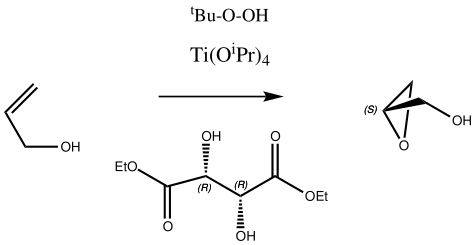
Sharpless epoxidation converts a prochiral allylic alcohol into the corresponding chiral epoxide with > 90% enantiomeric excess[1],[2]. Here is the first step in trying to explain how this magic is achieved.

The scheme above shows how (achiral) prop-2-enol is converted using the asymmetric catalyst (R,R)-diethyl tartrate  and t-butyl hydroperoxide as oxidant into the (S)-chiral epoxide. The first step is to try to construct a simple model for the reaction, and in this post I will start by using one titanium as the core of the stage on which these actors will perform. This is the mononuclear model. One can simply envisage that a molecule of tartrate displaces two iPrOH molecules from Ti(OiPr)4 in an ester exchange to form a Ti(OiPr)2(tartrate) complex. The remaining two iso-propanols are then replaced by one molecule each of prop-2-enol and tBu-OOH. Now we have the species Ti(OOtBu)(O-CH2CH=CH2)(tartrate) as the starting point from which a transition state for oxygen transfer to the alkene to form the (S) epoxide (for R,R tartrate) can be constructed (ωB97XD/6-311G(d,p)/SCRF=dichloromethane model).

Mononuclear TS for S-epoxide. Click for 3D.

Mononuclear TS for R-epoxide. Click for 3D.

IRC for mononuclear model showing oxygen atom transfer

The transition state leading to (S) epoxide emerges as 0.86 kcal/mol higher in ΔG than the (R), contrary to the experimental result where (S) is formed with high specificity[1]. Inspecting the model, it is clear that the allylic alcohol substrate sits in a very open pocket un-encumbered by any nearby groups (bottom right in the animation above) and so the lack of π-facial selectivity is perhaps not surprising.

To elaborate the model, I will turn to a crystal structure determined for a Ti complex bearing a t-butyl peroxy group[3], showing it to be a binuclear complex (magenta arrows indicate the peroxy groups) with bridging oxygen atoms.

ZUKJIY. Click for 3D

In the follow-up post,  we will see whether these binuclear models can do better at explaining the enantioselectivity of the Sharpless reaction.


See this post for an example of such “single-site” catalysis using Mg or this article for an example using silver[4].

A binuclear Zn catalyst with similar oxy-bridges is used to co-polymerise epoxides themselves with carbon dioxide[5]. Many such binuclear complexes are known.

The other element for which a number of examples of such t-butyl peroxy bonding are known is oddly enough, lithium.[6]

MUKVAQ. Click for 3D.


Postscript: Two lower energy conformations for the S and R transition states have been found, the latter being 1.6 kcal/mol lower in free energy. 

S R
S-new R-new

References

  1. J.M. Klunder, S.Y. Ko, and K.B. Sharpless, "Asymmetric epoxidation of allyl alcohol: efficient routes to homochiral .beta.-adrenergic blocking agents", The Journal of Organic Chemistry, vol. 51, pp. 3710-3712, 1986. https://doi.org/10.1021/jo00369a032
  2. R.M. Hanson, and K.B. Sharpless, "Procedure for the catalytic asymmetric epoxidation of allylic alcohols in the presence of molecular sieves", The Journal of Organic Chemistry, vol. 51, pp. 1922-1925, 1986. https://doi.org/10.1021/jo00360a058
  3. G. Boche, K. Möbus, K. Harms, and M. Marsch, "[((η<sup>2</sup>-<i>tert</i>-Butylperoxo)titanatrane)<sub>2</sub>· 3 Dichloromethane]:  X-ray Crystal Structure and Oxidation Reactions", Journal of the American Chemical Society, vol. 118, pp. 2770-2771, 1996. https://doi.org/10.1021/ja954308f
  4. J.L. Arbour, H.S. Rzepa, J. Contreras‐García, L.A. Adrio, E.M. Barreiro, and K.K.(. Hii, "Silver‐Catalysed Enantioselective Addition of OH and NH Bonds to Allenes: A New Model for Stereoselectivity Based on Noncovalent Interactions", Chemistry – A European Journal, vol. 18, pp. 11317-11324, 2012. https://doi.org/10.1002/chem.201200547
  5. A. Buchard, F. Jutz, M.R. Kember, A.J.P. White, H.S. Rzepa, and C.K. Williams, "Experimental and Computational Investigation of the Mechanism of Carbon Dioxide/Cyclohexene Oxide Copolymerization Using a Dizinc Catalyst", Macromolecules, vol. 45, pp. 6781-6795, 2012. https://doi.org/10.1021/ma300803b
  6. W. Uhl, M. Reza Halvagar, and M. Claesener, "Reducing GaH and GaC Bonds in Close Proximity to Oxidizing Peroxo Groups: Conflicting Properties in Single Molecules", Chemistry – A European Journal, vol. 15, pp. 11298-11306, 2009. https://doi.org/10.1002/chem.200900746

The mechanism of the Birch reduction. Sequel to benzene reduction.

Wednesday, December 5th, 2012

I noted briefly in discussing why Birch reduction of benzene gives 1,4-cyclohexadiene (diagram below) that the geometry of the end-stage pentadienyl anion was distorted in the presence of the sodium cation to favour this product. This distortion actually has some pedagogic value, and so I elaborate this here.

The starting point is now the molecular orbitals of benzene, and in particular the lowest unoccupied set (LUMO), which is doubly degenerate (in energy).

First of the pair of degenerate lowest unoccupied MOs of benzene. Click for 3D.

Second of the pair of degenerate lowest unoccupied MOs of benzene. Click for 3D.

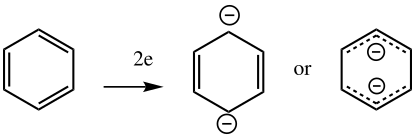
An (overall) two-electron reduction of benzene (followed by protonation) can formally at least place the two electrons into either of these orbitals. Doing so would lower the energy of the occupied orbital, and hence induce a geometric distortion as illustrated below. In effect, the outcome is an (antiaromatic) di-anion with either two short and four long bonds, or the alternative of four shorter and two long bonds. The proximate presence of a solvated sodium cation now clearly breaks this degeneracy; the coordination preference of Na+ (and a proton) favours the former over the latter, and the outcome is as shown in the previous post.

The orbitals of benzene are frequently included in undergraduate teaching, but here we have a direct use for the LUMO pair in explaining the outcome of the reduction of benzene by electrons. It also links into what happens when anti-aromaticity is avoided (when a  4n π-electron system distorts to avoid it).

Postscript:  The computed structure of benzene di-anion is shown below. It is 19.5 kcal/mol lower than the alternative valence bond isomer.

Stable form. Click for 3D.


Less stable form. Click for 3D.

The mechanism of the Birch reduction. Part 3: reduction of benzene

Tuesday, December 4th, 2012

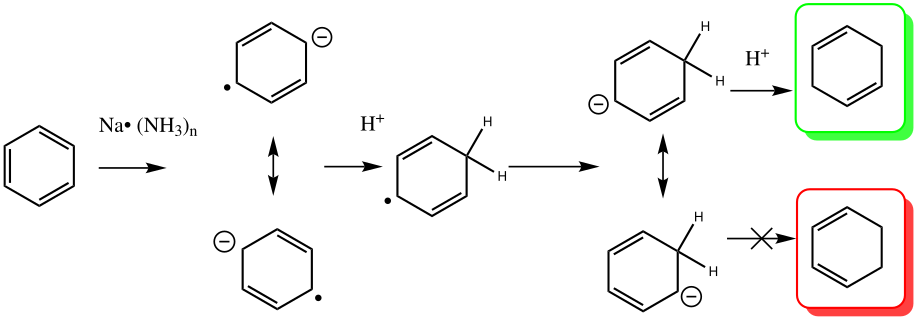
Birch reduction of benzene itself results in 1,4-cyclohexadiene rather than the more stable (conjugated) 1,3-cyclohexadiene. Why is this?

The mechanism, as elaborated in the previous two posts, involves a one-electron transfer from a sodium atom to form the radical anion, which is then protonated in a second step, and this is again reduced to form a pentadienyl anion in the penultimate step.[1] The question now becomes why does this anion protonate to give predominantly the less stable diene product? The answer involves the actual structure of this anion. A calculation at the ωB97XD/6-311+G(d,p)/SCRF=acetonitrile level for the ion pair comprising the cyclohexadienyl anion and a Na(NH3)3+ counterion is shown below.

Structure of the cyclohexadienyl ion pair. Click for 3D.

From this, it appears that the sodium cation is η2 coordinated to each of two relatively localised double bonds (1.37Å), resulting in the negative charge accumulating on just the one carbon (red arrow), this being the carbon that then exclusively receives a final proton. The highest energy (-0.115 au) natural bond orbital (NBO) also emerges as being located on this carbon (the next two highest energy NBOs only come in at -0.303 au, and reside on each of the localised alkene bonds).

The highest energy NBO orbital. Click for 3D.

The molecular electrostatic potential in effect integrates over all the electrons (not just those in the highest orbital), resulting in a function that measures the attractiveness of any point to a proton (red). It too shows that the most attractive region (red) for a proton is again on this carbon.

Molecular electrostatic potential. Click for 3D.

There is even evidence from crystal structures that this sort of motif is possible. Thus the dianion of 1,4-diphenylbenzene (with two Na(thf)3+ counter-ions) reveals[2] this type of coordination.  The buckling seen in the above mono-anion is inhibited by the presence of cations on both sides of the di-anion, but the pattern of short/long bonds seen above also manifests in the crystal structure.

Crystal model. Click for 3D.

So the take home message is that the counter-ion (solvated sodium cations) in the Birch reduction  of benzene itself may coordinate to the anionic intermediates in the reductive process, and the resulting geometry of this ion-pair determines the eventual product of protonation.

References

  1. H.E. Zimmerman, and P.A. Wang, "Regioselectivity of the Birch reduction", Journal of the American Chemical Society, vol. 112, pp. 1280-1281, 1990. https://doi.org/10.1021/ja00159a078
  2. J.H. Noordik, H.M. Doesburg, and P.A.J. Prick, "Structures of the sodium–<i>p</i>-terphenyl ion pairs: disodium terphenylide–tetrahydrofuran (1/6) and disodium diterphenylide terphenyl–1,2-dimethoxyethane (1/6)", Acta Crystallographica Section B Structural Crystallography and Crystal Chemistry, vol. 37, pp. 1659-1663, 1981. https://doi.org/10.1107/s0567740881006833

The mechanism of the Birch reduction. Part 2: a transition state model.

Monday, December 3rd, 2012

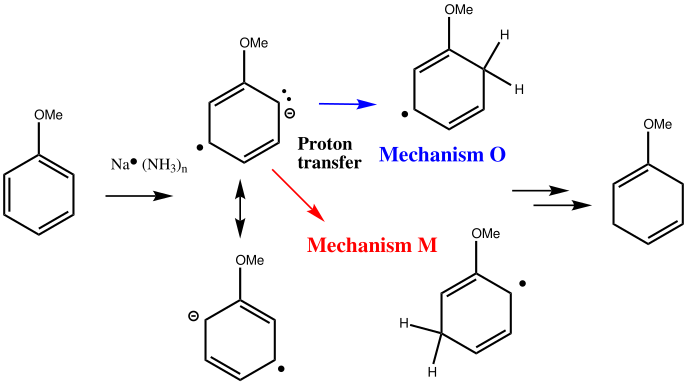
I promised that the follow-up to on the topic of Birch reduction would focus on the proton transfer reaction between the radical anion of anisole and a proton source, as part of analysing whether the mechanistic pathway proceeds O or M.

To add some context, Hammond’s postulate [1] states that “the structure of a transition state resembles that of the species nearest to it in free energy.” If the structure of the transition state for proton transfer above resembles that of the radical anion precursor we would call this an early transition state and it would be a reasonable approximation to infer properties of the reaction from the properties of that radical anion. The previous post explored those properties via the computed molecular electrostatic potential (MEP) and the highest energy NBO (natural bond orbitals, which are used here instead of molecular orbitals). Unfortunately, they did not agree with each other. Remember that Hammond’s postulate dates from 1955, an era when it was not practical to compute the structure of a transition state directly using quantum mechanics (certainly not so for such a complex reaction as that shown above). Indeed, one might argue that such a structure has only become computable in a practical sense very recently! As I showed previously, the radical ion-pair resulting from a 1-electron transfer from sodium to anisole has a dipole moment of ~11.6D, and the reaction is conducted in a solvent of medium polarity. This combination means that one really is obliged to take into account the dielectric of the solvent, and indeed any strong explicit hydrogen bonds that might be present. The codes for doing this have really only recently become robust enough to tackle such an endeavour[2], which might explain why such calculations are not yet abundant, or ubiquitously cited in the text books.

Proton transfer for M mechanism. Click for 3D.

The proton transfer via one M mechanism is shown above. The proton source is ammonia, which is known from experiment to lead to sluggish reactions (the more acidic t-butanol is often added to speed up the reaction), but we can see that the transition state is very late, νi 423.8 cm-1. The N…H bond is largely broken, and the C-H bond is mostly formed. The dipole moment is 7.7D, also different from that of the reactant. Perhaps, knowing this, it is not too surprising that inferences based on Hammond’s postulate as applied to the reactant are not reliable. The value of ΔG298computed from this model is 22.8 kcal/mol, which is on the high-ish side for a reaction to occur readily at room temperatures or below.[3] This nevertheless nicely conforms what we already know, that a more acidic proton donor is needed to achieve a fast reaction.

Proton transfer for O mechanism. Click for 3D.

The proton transfer via one O mechanism is similar, but a tad less “late”. This already raises doubts about application of Hammond’s postulate to this system; one cannot really compare two reactions in which each reactant differs in its resemblance to its transition state. The dipole moment of this alternative transition state is also 7.7D, but the transition imaginary mode is much higher at νi 869 cm-1. The free energy barrier is 21.0, some 1.8 kcal/mol lower than the barrier for the M mechanism. This corresponds to a rate about 21 times faster for O over M (at 298K).

To conclude, we characterise two (of the four) isomeric transition states for protonation of the radical anion intermediate in the Birch reduction of anisole. These two transition states are actually different in several subtle regards, differences which would not have manifested if only the properties of the reactant had been considered. The final word must be that the text books are likely correct on this one, although a little more work is still needed to tidy up loose ends.  

References

  1. G.S. Hammond, "A Correlation of Reaction Rates", Journal of the American Chemical Society, vol. 77, pp. 334-338, 1955. https://doi.org/10.1021/ja01607a027
  2. J. Kong, P.V.R. Schleyer, and H.S. Rzepa, "Successful Computational Modeling of Isobornyl Chloride Ion-Pair Mechanisms", The Journal of Organic Chemistry, vol. 75, pp. 5164-5169, 2010. https://doi.org/10.1021/jo100920e
  3. H.E. Zimmerman, and P.A. Wang, "Regioselectivity of the Birch reduction", Journal of the American Chemical Society, vol. 112, pp. 1280-1281, 1990. https://doi.org/10.1021/ja00159a078

The mechanism of the Birch reduction. Part 1: reduction of anisole.

Saturday, December 1st, 2012

The Birch reduction is a classic method for partially reducing e.g. aryl ethers using electrons (from sodium dissolved in ammonia) as the reductant rather than e.g. dihydrogen. As happens occasionally in chemistry, a long debate broke out over the two alternative mechanisms labelled O (for ortho protonation of the initial radical anion intermediate) or M (for meta protonation). Text books seem to have settled down of late in favour of O. Here I take a look at the issue myself.

Readers of my blog will note that I promote the use of models which are as reasonably complete as one can make them. In this case, if the intermediate is an anion, then I argue that the model should include the positive counter-ion. This is very often simply not included, on the grounds that it “probably does not influence things”. Well, not on this blog! My model is methoxybenzene, a sodium atom solvated by 3NH3 (the reaction itself is done in liquid ammonia with some added t-butanol) and continuum solvent (not ammonia itself, but acetonitrile which has a similar dielectric to liquid ammonia with some added butanol). 

The start point is a solvated sodium atom (loosely) coordinated to anisole (methoxybenzene). The calculation (ωB97XD/6-311+G(d,p)/SCRF=acetonitrile) on this neutral system shows the spin density arising from the single unpaired electron is mostly (0.851) on the sodium, although a little spin density has crept onto the anisole. The dipole moment (12.0D) shows that solvation cannot just be ignored. 

Start point, with select spin densities. Click for 3D

The next stage involves an electron transfer from the sodium to the anisole ring, and indeed the spin densities transfer from the Na to the two ortho- and two meta-positions on the ring (the residual value on Na is -0.02). This suggests that the valence bond representations in the diagram above are incomplete (they imply spin density on only two rather than four carbon atoms). The geometry of the anisole ring now shows bond alternation, with two long bonds (1.45 – 1.46Å) and four short bonds (1.39-1.41Å). This could be viewed as the result of a pseudo-Jahn-Teller distortion resulting from placing an electron into one of the degenerate LUMO molecular orbitals of the benzene-like set. The free energy ΔG298 of this charge-transferred product is 11.1 kcal/mol exothermic compared to the reactant and it has a dipole moment of 11.6D, similar to the precursor despite being an ion pair!

The contact ion-pair resulting from electron transfer. Click for 3D.

I start the analysis of how this species will protonate by inspecting the four highest energy NBOs (natural bond orbitals). Their energies are -0.144, -0.152, -0.167 and -0.167 au. The first of these with the highest energy might be expected to be the most basic. It corresponds to M in the above scheme (below). The next however is O and the last two are the remaining O/M positions.

Highest energy (-0.144) NBO orbital on M. Click for 3D.


Next highest energy (-0.152)  NBO on O. Click for 3D.

Another measure of basicity is the molecular electrostatic potential (a measure of how attractive any point in space is towards a proton). It is shown below (as a green surface) only as the -ve potential (that part that is attractive to a proton). On the face bearing the proton donors (the ammonia groups attached to the Na) there is a clear preference for O (marked with a magenta arrow, but not the same O as predicted by the NBO), but with a slightly smaller basin corresponding to M (again, not the M from the NBO analysis and marked with an orange arrow).

Molecular electrostatic potential (-ve phase). Click for 3D

Viewed from the other side of the anisole ring (and rendered at a higher threshold), the electrostatic potential seems to favour O, but only very slightly over M. There really is not much in it.

Molecular electrostatic potential (-ve phase, other face). Click for 3D.

All these properties are measures of the radical-anion-ion-pair. It is clear these different measures do not agree with one another! What we really need is the transition state for the proton transfer. I will go off and hunt for these. If I find them, I will report back here. And beyond the transition state are the dynamic trajectories for the protonation, which ultimately may be the only way of finally resolving this conundrum. 

A pericyclic dichotomy.

Friday, November 30th, 2012

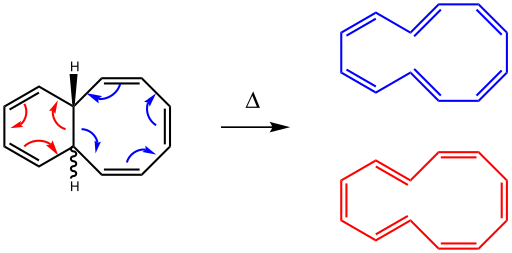
A dichotomy is a division into two mutually exclusive, opposed, or contradictory groups. Consider the reaction below. The bicyclic pentadiene on the left could in principle open on heating to give the monocyclic [12]-annulene (blue or red) via what is called an electrocyclic reaction as either a six (red) or eight (blue) electron process. These two possibilities represent our dichotomy; according to the Woodward-Hoffmann (WH) pericyclic selection rules, they represent contradictory groups. Depending on the (relative) stereochemistry at the ring junctions, if one reaction is allowed by the WH rules, the other must be forbidden, and of course vice-versa. It is a nice challenge to ask students to see if the dichotomy can be reconciled.

I start the process by pondering the relationship between the two forms of the [12]annulene shown on the right. Are the representations shown in red or blue just resonance isomers (analogous to the Kekule forms of benzene), or something else? If the former, then they truly represent the same species; they are just different ways of representing the contributions to the wavefunction, and the dichotomy stands. But if they are in fact different species, then we can start to eliminate the apparent contradiction by stating that the red and the blue arrows actually represent different reactions, leading to different (albeit isomeric) products. In this scenario, the red and blue forms of the [12]-annulene are NOT resonance isomers but distinct valence bond isomers, with a positive energy activation barrier to their interconversion. To find out, let us start with the transition states for both processes:

C2 symmetry Cs symmetry

Transition state for blue arrows. Click for 3D.

Transition state for red arrows. Click for 3D.

  1.  The blue arrows (representing 4n,n=2 electrons) result in a transition state with an axis of symmetry
  2. with the bond forming/cleaving from the bottom face of one terminus of the rhs-conjugated system to the top face of the other terminus, in other words an antarafacial bond, 
  3. with conrotation of the groups at the termini, resulting in
  4. all the bonds in the 8-ring being approximately 1.4Å in length (other than the central bond), whilst those in the 6-ring alternate strongly. The 8-ring is (Möbius) aromatic and the 6-ring is (Möbius) anti-aromatic.
  5. Contrary-wise, the red arrows (representing 4n+2,n=1 electrons) result in a transition state with a plane of symmetry
  6. with the bond forming from the same bottom face of the lhs-conjugated termini, in other words a suprafacial bond, 
  7. with disrotation of the groups at the termini, resulting in 
  8. all the bonds in the 6-ring being approximately 1.4Å in length, whilst those in the 8-ring alternate strongly. The 6-ring is now (Hückel) aromatic and the 8-ring is (Hückel) anti-aromatic.
  9. The transition state with C2 symmetry is in fact 10.1 kcal/mol lower in free energy than the one with Cs symmetry.
So the arrows follow the aromaticity (or vice versa), and this determines the stereochemistry (axis or plane of symmetry) and ultimately the nature of the product of each reaction. Are these annulenes indeed different? Shown below are the final outcomes of following an IRC (intrinsic reaction coordinate) from the transition state of the red and the blue reaction downhill to the [12]-annulenes. Not only is the outcome valence bond isomers, but they are also atropisomers.
Product, C2 (axis) Product, Cs (plane)

So at the end we see that there is no actual dichotomy. The reactions above (red or blue arrows) give different products, with different symmetries, and differently aromatic transition states. But in doing so, they encapsulate the selection rules for pericyclic reactions very nicely indeed. For more details of this, see this citation [1].

References

  1. H.S. Rzepa, "The Aromaticity of Pericyclic Reaction Transition States", Journal of Chemical Education, vol. 84, pp. 1535, 2007. https://doi.org/10.1021/ed084p1535

Di-imide reduction with a twist: A Möbius version.

Monday, November 26th, 2012

I was intrigued by one aspect of the calculated transition state for di-imide reduction of an alkene; the calculated NMR shieldings indicated an diatropic ring current at the centre of the ring, but very deshielded shifts for the hydrogen atoms being transferred. This indicated, like most thermal pericyclic reactions, an aromatic transition state. Well, one game one can play with this sort of reaction is to add a double bond. This adds quite a twist to this classical reaction!

The original di-imide reduction can be viewed as a six-electron process; one that fits the 4n+2 aromaticity rule. In fact, this is a specific instance of a more general topological rule, first proposed in 2008, which suggests that for 4n+2 electron thermal reactions, the electronic topology conforms to that of a Möbius link, for which the so-called linking number Lk is even (o, 2, 4, etc). For systems in which 4n electrons participate, such as the homologated example above, the rule changes to the topology of a Möbius knot, for which the linking number is odd (1, 3, etc)[1]. One interesting consequence of all this topology is that all the systems for which Lk > 0 are chiral (achiral benzene is thus seen as an exception rather than the norm of aromaticity)[2].

Transition state for 8-electron di-imide reduction. Click for 3D.

The calculated transition state for this reaction is shown above. As befits a torus knot, the two hydrogen atoms are transferred to opposite faces of the butadiene; an antarafacial mode. Now, to be fair the alternative mode in which the hydrogens are delivered suprafacially to just a single alkene is 26.1 kcal/mol lower in free energy. We might conclude that di-imide does not reduce butadiene in this manner, and that getting an experimental example of such stereochemistry might be a challenge!

What of the aromaticity of this Möbius version? The NICS(0) at the ring critical point is -15.7 ppm, whilst the shieldings of the transferring hydrogens are +14.0 ppm. So just like its 4n+2 electron counterpart, this Möbius di-hydrogen transfer reaction also proceeds through an aromatic transition state.

References

  1. S.M. Rappaport, and H.S. Rzepa, "Intrinsically Chiral Aromaticity. Rules Incorporating Linking Number, Twist, and Writhe for Higher-Twist Möbius Annulenes", Journal of the American Chemical Society, vol. 130, pp. 7613-7619, 2008. https://doi.org/10.1021/ja710438j
  2. C.S. Wannere, H.S. Rzepa, B.C. Rinderspacher, A. Paul, C.S.M. Allan, H.F. Schaefer, and P.V.R. Schleyer, "The Geometry and Electronic Topology of Higher-Order Charged Möbius Annulenes", The Journal of Physical Chemistry A, vol. 113, pp. 11619-11629, 2009. https://doi.org/10.1021/jp902176a

The regiospecificity of di-imide reduction of an alkene.

Sunday, November 25th, 2012

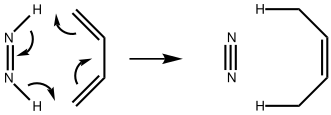
Not a few posts on this blog dissect the mechanisms of well known text-book reactions. But one reaction type where there are few examples on these pages are reductions. These come in three types; using electrons, using a hydride anion and using di-hydrogen. Here I first take a closer look at the third type, and in particular di-hydrogen as delivered from di-imide.

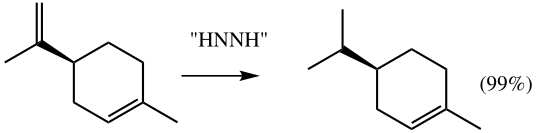
This reagent tends to be specific for terminal (less highly substituted) double bonds[1]. Two ωB97XD/6-311G(d,p) calculations predicts a free energy discrimination of 2.85 kcal/mol for the two double bonds in the system above, which works out as a ratio of 125:1 in favour of the less substituted system. The Wiberg bond orders of the two forming C-H bonds indicate that at the transition state the one to the less substituted terminal carbon is more highly formed (0.234) than the one to the more substituted carbon (0.198). The NICS(0) magnetic index of aromaticity at the ring critical point  (centroid) of the pericyclic participating atoms has a value of -22.2 ppm, which indicates a significant diamagnetic ring current indicative of a (σ-aromatic) transition state. The two transferring hydrogens have predicted “aromatic” shifts of 11.6 and 10.5 ppm.

Transition state for di-hydrogen transfer. Click for 3D.

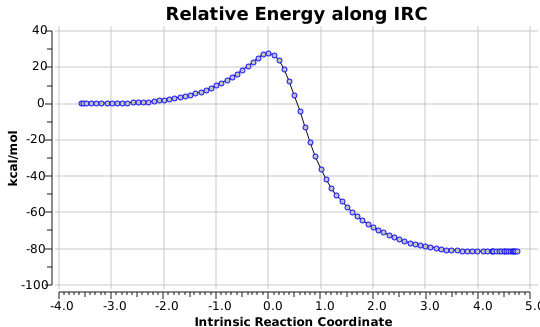
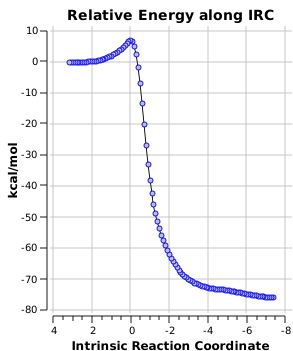
The intrinsic reaction coordinate (IRC) shows two distinct phases:

  1. From IRC 3 to -3, it represents a pericyclic process, involving an (aromatic) transition state in which the six atoms involved are all co-planar.
  2. From IRC -4 however, the newly reduced C-C bond starts to rotate to change the conformation from syn-planar to gauche. This rotation only comes at the very end of the reaction.

No real surprises here then, but it is useful to know that the regiospecificity of such reactions can apparently be well predicted.

References

  1. C. Smit, M.W. Fraaije, and A.J. Minnaard, "Reduction of Carbon−Carbon Double Bonds Using Organocatalytically Generated Diimide", The Journal of Organic Chemistry, vol. 73, pp. 9482-9485, 2008. https://doi.org/10.1021/jo801588d

The “unexpected” mechanism of peroxide decomposition.

Sunday, November 18th, 2012

A game chemists often play is to guess the mechanism for any given reaction. I thought I would give it a go for the decomposition of the tris-peroxide shown below. This reaction is known to (rapidly, very rapidly) result in the production of three molecules of propanone, one of ozone and a lot of entropy (but not heat).[1]

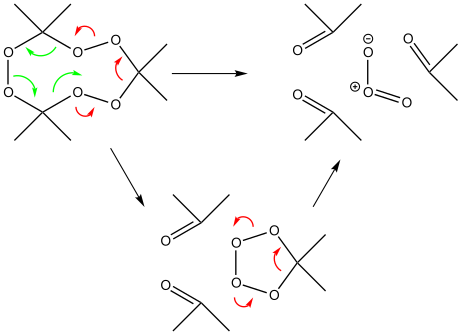
The conventional approach might be to try to push some sensible arrows (an approach not always followed up it has to be said, by a reality check using quantum mechanics). I found the arrows that emerged from my playing interesting for the following reasons. 

  1. One scheme might be a process involving six arrows (twelve electrons), which leads directly to the products.
  2. Or, one might try to group the arrows into two sets of three (shown in green and red above). A moment’s consideration suggests that the green set has to precede the red set (if not concurrent), resulting in the initial production of two molecules of propanone and the tetraoxapentane derivative shown. This new molecule then suffers a simple 2+4 pericyclic cycloelimination as the second stage.
  3. It is possible of course that the process may simply consist of homolytic O-O cleavages via biradicals. I will defer discussing this point until later. 

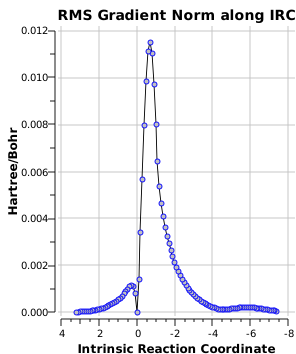
The reality check would then consider whether the two processes are consecutive or concurrent. The following is computed at the wB97XD/6-311G(d,p) level, and corresponds clearly to the three green arrows shown above (no motion corresponding to the red arrows is discernible) and hence would be a consecutive process with a distinct intermediate on the path. The IRC seems to support this.

Saddle point for decomposition. Click for first imaginary vibration.

Saddle point for decomposition. Click for second imaginary vibration.

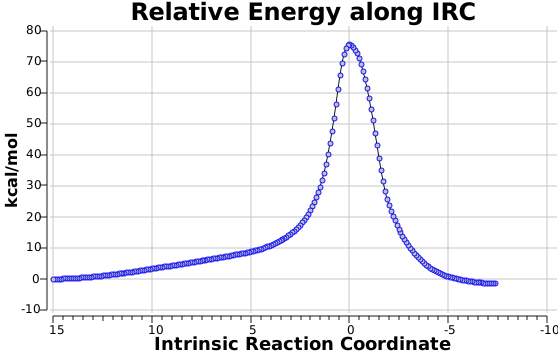
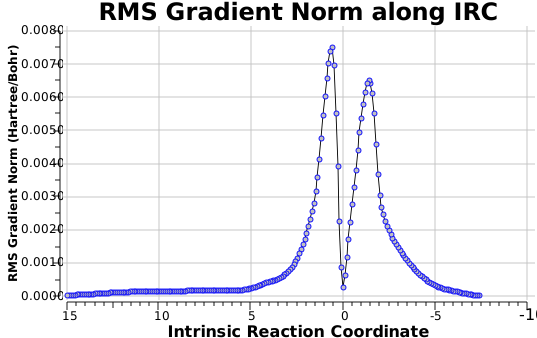
IRC for apparent concerted decomposition.

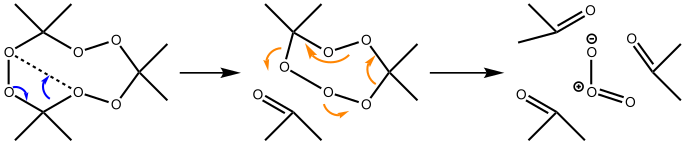
The diagram is shown twice above, because this geometry is in fact not a transition state but a second-order saddle point, with two imaginary vibrations. The first corresponds to the green arrows, but the second represents an asymmetric diversion to a quite different path. This second imaginary vibration can be followed in two directions, each potentially leading to a new lower energy saddle point. I was only able to locate one of these, shown below (if I track down the other,  I will append it).

Transition state for initial fragmentation. Click for 3D.

IRC for blue arrows. Click for 3D

IRC for orange arrows. Click for 3D.

As it happens, this corresponds to a rather different partitioning of the electron arrows, into a group of two first (blue) followed by four (orange). The first (proper) transition state is 5.0 kcal/mol lower in ΔG than the second order saddle point. The second transition state is 16.3 kcal/mol lower than the first. The intermediate in this process is actually different from the one shown earlier, but it can also eliminate ozone and two molecules of propanone.

What have we shown thus far? That one’s naive arrow pushing may in fact not come up with the goods. But how about that reality check? Whoops! Look at that activation barrier. The free energy (which is lower than the barrier itself because of the large +ve entropy of the reaction) is still a whopping 70 kcal/mol. 

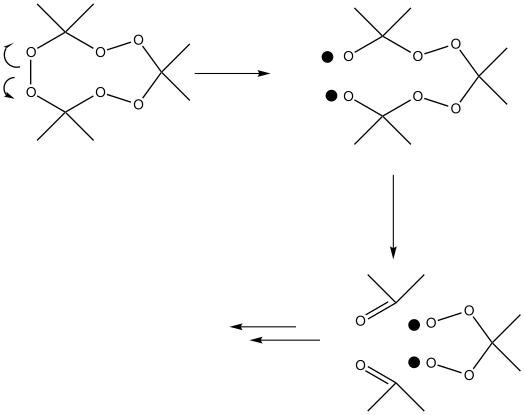
So the conclusion from all of this? Well, that homolytic pathways, involving a cleavage of an O-O bond to produce a biradical, are very probably the real mechanism after all. Something like the below perhaps? (OK, so you might have told me that at the outset!).


As milestones go, this is my 250th post.


References

  1. F. Dubnikova, R. Kosloff, J. Almog, Y. Zeiri, R. Boese, H. Itzhaky, A. Alt, and E. Keinan, "Decomposition of Triacetone Triperoxide Is an Entropic Explosion", Journal of the American Chemical Society, vol. 127, pp. 1146-1159, 2005. https://doi.org/10.1021/ja0464903