Posts Tagged ‘Chemistry’
Friday, March 10th, 2017
George Olah passed away on March 8th. He was part of the generation of scientists in the post-war 1950s who had access to chemical instrumentation that truly revolutionised chemistry. In particular he showed how the then newly available NMR spectroscopy illuminated structures of cations in solvents such “Magic acid“. The obituaries will probably mention his famous “feud” with H. C. Brown over the structure of the norbornyl cation (X=CH2+), implicated in the mechanism of many a solvolysis reaction that characterised the golden period of physical organic chemistry just before and after WWII.

The dispute between Olah and Brown was not played on a pitch using quite the same goal posts. Olah did much of his work in magic acid and Brown did his in aqueous solutions. I was involved in a tiny way when the discussion about the precise character of the norbornyl cation was reaching its peak in the mid 1970s. At the time, I was working with Michael Dewar, who was himself not shy in joining in the fun and sometimes very acrimonious disputes at conferences. We contributed by calculating the so-called core-electron carbon ESCA spectrum.[1] History records that we came down on the wrong side,‡ by suggesting that this form of spectroscopy supported Brown rather than Winstein/Olah on the basis of a 6:1 spectral deconvolution (classical) rather than 5:2 (non-classical). More recently of course the crystal structure of the parent cation itself has been shown to be non-classical[2] (there are other crystal structures which differ in respect to having one or more additional methyl groups[3]). For a 3D model of norbornyl cation, see DOI: 10.5517/CCZ21LN. This still leaves the issue (very slightly) open for the structure of the solvated cation when formed in water!
When I started to teach a course in molecular modelling, I touched briefly on how modelling could contribute and whilst updating the notes in the 1990s, wondered why the boron analogue had never been so studied (X=BH2). Unlike the crystallographically difficult norbornyl ion-pair, the iso-electronic boron species would be neutral and not need a counter-ion. Perhaps it might be a more manageable molecule? Checking the Cambridge structural database, such a species has never been reported!† So here as my homage to Olah, I report its calculated structure (b2plypd3/Def2-TZVPP, DOI: 10.14469/hpc/2236).

The norbornyl cation has symmetrical C-C bridging distances of ~1.80±0.02Å and a basal C-C distance of ~1.39±0.02Å. The calculated values for the boron equivalent are 2.16Å and 1.36Å respectively, with all positive force constants. B-C bonds are normally 1.66-1.72Å, significantly longer than C-C bonds, which makes the longer B-C lengths in this example unsurprising. More interestingly, the species has one vibrational normal mode (ν 203 cm-1) which corresponds to the [1,2] shift of the BH2 group across the basal C-C. For a classical species, this vibrational motion would correspond to a transition state (an imaginary vibration) but for a non-classical species it is of course real. In this sense it is analogous to the so-called real Kekulé mode in non-classical benzene, which “equilibrates” the two classical Kekulé structures. The corresponding calculated vibration for the norbornyl cation itself is ν 194 cm-1 (DOI: 10.14469/hpc/2238).
Of course, the entire controversy over the structure of this species is littered with comparisons between not quite similar systems, differing in a methyl group more or less. So morphing a C+ to a B might be seen as quite a large change. But perhaps if it had been crystallised in say the 1960s, would the subsequent debates have taken a different turn?
‡ We were also wrong about the symmetry of the Diels-Alder cyclisation, which is nowadays accepted to be synchronous rather than asynchronous for simple Diels-Alder reactions. But that is another story.
†GAXLIA is perhaps the closest analogue.[4],
References
- M.J.S. Dewar, R.C. Haddon, A. Komornicki, and H. Rzepa, "Ground states of molecules. 34. MINDO/3 calculations for nonclassical ions", Journal of the American Chemical Society, vol. 99, pp. 377-385, 1977. https://doi.org/10.1021/ja00444a012
- F. Scholz, D. Himmel, F.W. Heinemann, P.V.R. Schleyer, K. Meyer, and I. Krossing, "Crystal Structure Determination of the Nonclassical 2-Norbornyl Cation", Science, vol. 341, pp. 62-64, 2013. http://dx.doi.org/10.1126/science.1238849
- T. Laube, "Redetermination of the Crystal Structure of the 1,2,4,7‐<i>anti</i>‐tetramethylbicyclo[2.2.1]heptan‐2‐yl cation at 110 K", Helvetica Chimica Acta, vol. 77, pp. 943-956, 1994. https://doi.org/10.1002/hlca.19940770407
- P.J. Fagan, E.G. Burns, and J.C. Calabrese, "Synthesis of boroles and their use in low-temperature Diels-Alder reactions with unactivated alkenes", Journal of the American Chemical Society, vol. 110, pp. 2979-2981, 1988. https://doi.org/10.1021/ja00217a053
Tags:2-Norbornyl cation, aqueous solutions, Chemical bond, chemical instrumentation, Chemistry, George Andrew Olah, George Olah, Ion association, Magic acid, Michael Dewar, Molecule, Nature, Physical organic chemistry, Reactive intermediates, spectroscopy
Posted in Interesting chemistry | 18 Comments »
Friday, March 10th, 2017
A few years back, I did a post about the Pirkle reagent[1] and the unusual π-facial hydrogen bonding structure[2] it exhibits. For the Pirkle reagent, this bonding manifests as a close contact between the acidic OH hydrogen and the edge of a phenyl ring; the hydrogen bond is off-centre from the middle of the aryl ring. Here I update the topic, with a new search of the CSD (Cambridge structure database), but this time looking at the positional preference of that bond and whether it is on or off-centre.

The search (February 2017 database, DOI:10.14469/hpc/2233) is shown above, QA = N, O, F, Cl and other constraints are R < 0.01, no errors, no disorder. Two distances are plotted, one (DIST1) is from the H to the ring centroid and the second (DIST2) from the H to an edge carbon atom. The colour code relates to ANG1, the angle subtended at the centroid. A value of 90° would indicate the H is orthogonal to the plane of the aromatic ring.

You can see from the above that the yellow dots correspond to ~90° and that by and large the H…centroid distances are shorter than the H…C distances.

The above is another representation of this search, again showing that the preferred angle is 90°, although there is a fair bit of scatter. The extreme outliers may be crystallographic errors, but one point caught my eye and is circled in red above; ammonium tetrafluoroborate (3D model DOI: 10.5517/CC4V6TZ). This has a very short distance from the H to the centroid (2.07Å), shorter than the Pirkle reagent that we looked at all those years back. The authors[3] note that “The N-H…Ph distances, H…M 2.067Å … are exceptionally short (M = aromatic midpoint)” but also that “even at 20 K the ammonium ion performs large amplitude motions which allow the N-H vectors to sample the entire face of the aromatic system.” This implies that such bonds are largely agnostic about whether they bind to the centroid of the ring or to its edge and that the most probable position might arise simply because of crystal packing. An interesting variation on this molecule is a crystal that includes a further 5NH3 in addition to ammonium tetraphenylborate (3D model DOI: 10.5517/cc7bly2). Here an ammonia intervenes between the ammonium cation and a phenyl ring, resulting in a binding of the ammonia with two NHs closer to the edge of the ring and one NH interacting in parallel mode.

Time therefore for a calculation, using B3LYP+GD3BJ/Def2-TZVPP, the functional being chosen because the dispersion contribution is not built in, but uses what is currently thought to be the best representation of these attractions. The issue now is what molecular unit to use? This is an ionic structure and so a periodic boundary model is most appropriate, but given its size I reduced this to two models comprising smaller discrete fragments.
- A unit just comprising the simple ion pair. This leaves two of the four N-H bonds devoid of hydrogen bonding (DOI:10.14469/hpc/2234). The optimisation adopts a pose where two NH groups are directed towards a carbon atom rather than the ring centroid. How much of this is due to the smallness of this model?

- A unit comprising a double ion pair, which allows one ammonium group to participate with all four NH groups across four phenyl rings and exhibiting six NH interactions in total with six rings (DOI: 10.14469/hpc/2235). The NH hydrogen vectors all interact with ring carbons rather than the ring centroid.

This brief computational exploration has covered only one method (the B3LYP DFT procedure), albeit with what is thought to be a good dispersion attraction term added and a reasonable basis set. It does seem to show that hydrogen bonds interacting with the centroid of a phenyl ring are not the preferred mode, which is instead an interaction with the edge of the ring. The quote above, “even at 20 K the ammonium ion performs large amplitude motions which allow the N-H vectors to sample the entire face of the aromatic system” suggests that whilst the average position might be the centroid, a true hydrogen bond to the centroid might be rarer than thought. Although most of the crystallographic examples located in the searches above deem to show a preference for the ring centroid, this might be more apparent than real.
References
- H.S. Rzepa, M.L. Webb, A.M.Z. Slawin, and D.J. Williams, "? Facial hydrogen bonding in the chiral resolving agent (S)-2,2,2-trifluoro-1-(9-anthryl)ethanol and its racemic modification", Journal of the Chemical Society, Chemical Communications, pp. 765, 1991. https://doi.org/10.1039/c39910000765
- H.S. Rzepa, M.H. Smith, and M.L. Webb, "A crystallographic AM1 and PM3 SCF-MO investigation of strong OH ⋯π-alkene and alkyne hydrogen bonding interactions", J. Chem. Soc., Perkin Trans. 2, pp. 703-707, 1994. https://doi.org/10.1039/p29940000703
- T. Steiner, and S.A. Mason, "Short N<sup>+</sup>—H...Ph hydrogen bonds in ammonium tetraphenylborate characterized by neutron diffraction", Acta Crystallographica Section B Structural Science, vol. 56, pp. 254-260, 2000. https://doi.org/10.1107/s0108768199012318
Tags:Ammonia, Ammonium, aromaticity, Cations, Centroid, chemical bonding, Chemistry, Hydrogen bond, Phenyl group
Posted in crystal_structure_mining | No Comments »
Sunday, March 5th, 2017
Cyclobutadiene is one of those small iconic molecules, the transience and instability of which was explained theoretically long before it was actually detected in 1965.[1] Given that instability, I was intrigued as to how many crystal structures might have been reported for this ring system, along with the rather more stable congener cyclo-octatetraene. Here is what I found.
The Conquest search query shown (with no disorder, no errors and R < 0.1 also specified). 
There are 23 instances (February 2017 database; see DOI: 10.14469/hpc/2231 for search query) of the supposedly unstable cyclobutadiene motif!

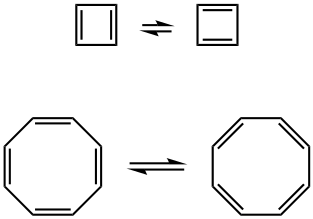
The three clusters deserve explanations. The orange cluster reveals a long C-C bond (rather longer than normal C-C bonds), accompanied by short C=C bonds, as indicated by the valence bond form shown below. Take particular note that the arrow connecting the two forms is NOT a resonance arrow but an equilibrium arrow. The “bond shifting” is not fast but slow, allowing long and short bonds to be measured in a crystal structure.
The rather larger blue cluster exhibits much more equal bonds. These arise from the presence of “push-pull” substituents on the ring which serve to delocalise the unfavourable cyclobutadiene ring and hence decrease the unfavourable anti-aromaticity. A typical example is shown below (EACBUT):

The small red cluster shows a long C=C bond and a short C-C bond! I have commented previously on apparently abnormally long C=C bonds, which in fact all turned out to be errors, and I suspect the same is true here. The bond orders in the indexing in the CSD data base have probably been mis-assigned, as per below for GANBII;

The Conquest search query is shown (with no disorder, no errors and R < 0.1 specified) for the 8-ring, which further specifies a torsion angle about a C-C bond to determine how planar the ring might be.

The “normal” cluster in the top left exhibits long C-C bonds and short C=C bonds. The colour code indicates how planar the ring is (red-blue spectrum = twisted ⇒ planar). The majority of examples are twisted about the C-C bond(s), but there are a few interesting examples that are not, as shown by the blue dots. There are only a few “bond-equalised” examples in the centre; perhaps “push-pull” induced equalisation is more difficult or perhaps few examples have been made?

The members of the red cluster in the bottom right all reveal short “C-C” bonds and long “C=C” bonds. Intriguingly they all also have low values of the torsion about one C-C bond (although not always about all four C-C bonds). A typical example (BAQVUK, DOI: 10.5517/CC4GWWB ) is shown below. These all need careful inspection and possibly reversal of the C-C and C=C indexing.


It was interesting to discover how many crystalline examples of this archetypal “unstable” cyclobutadiene motif have been made, and the means by which some of them at least have been stabilized. In the more abundant cyclo-octatetraene system, I learnt that one has to be cautious about blindly accepting the bond order designations in the database. Perhaps we might learn here that some of these have indeed been re-assigned in the next release of the database.
References
- L. Watts, J.D. Fitzpatrick, and R. Pettit, "Cyclobutadiene", Journal of the American Chemical Society, vol. 87, pp. 3253-3254, 1965. https://doi.org/10.1021/ja01092a049
Tags:antiaromaticity, Chemistry, cyclobutadiene, Instability, Nature, Physical organic chemistry, Physics, search query
Posted in crystal_structure_mining | 4 Comments »
Sunday, March 5th, 2017
Cyclobutadiene is one of those small iconic molecules, the transience and instability of which was explained theoretically long before it was actually detected in 1965.[1] Given that instability, I was intrigued as to how many crystal structures might have been reported for this ring system, along with the rather more stable congener cyclo-octatetraene. Here is what I found.
The Conquest search query shown (with no disorder, no errors and R < 0.1 also specified). 
There are 23 instances (February 2017 database; see DOI: 10.14469/hpc/2231 for search query) of the supposedly unstable cyclobutadiene motif!

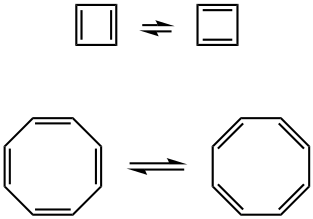
The three clusters deserve explanations. The orange cluster reveals a long C-C bond (rather longer than normal C-C bonds), accompanied by short C=C bonds, as indicated by the valence bond form shown below. Take particular note that the arrow connecting the two forms is NOT a resonance arrow but an equilibrium arrow. The “bond shifting” is not fast but slow, allowing long and short bonds to be measured in a crystal structure.
The rather larger blue cluster exhibits much more equal bonds. These arise from the presence of “push-pull” substituents on the ring which serve to delocalise the unfavourable cyclobutadiene ring and hence decrease the unfavourable anti-aromaticity. A typical example is shown below (EACBUT):

The small red cluster shows a long C=C bond and a short C-C bond! I have commented previously on apparently abnormally long C=C bonds, which in fact all turned out to be errors, and I suspect the same is true here. The bond orders in the indexing in the CSD data base have probably been mis-assigned, as per below for GANBII;

The Conquest search query is shown (with no disorder, no errors and R < 0.1 specified) for the 8-ring, which further specifies a torsion angle about a C-C bond to determine how planar the ring might be.

The “normal” cluster in the top left exhibits long C-C bonds and short C=C bonds. The colour code indicates how planar the ring is (red-blue spectrum = twisted ⇒ planar). The majority of examples are twisted about the C-C bond(s), but there are a few interesting examples that are not, as shown by the blue dots. There are only a few “bond-equalised” examples in the centre; perhaps “push-pull” induced equalisation is more difficult or perhaps few examples have been made?

The members of the red cluster in the bottom right all reveal short “C-C” bonds and long “C=C” bonds. Intriguingly they all also have low values of the torsion about one C-C bond (although not always about all four C-C bonds). A typical example (BAQVUK, DOI: 10.5517/CC4GWWB ) is shown below. These all need careful inspection and possibly reversal of the C-C and C=C indexing.


It was interesting to discover how many crystalline examples of this archetypal “unstable” cyclobutadiene motif have been made, and the means by which some of them at least have been stabilized. In the more abundant cyclo-octatetraene system, I learnt that one has to be cautious about blindly accepting the bond order designations in the database. Perhaps we might learn here that some of these have indeed been re-assigned in the next release of the database.
References
- L. Watts, J.D. Fitzpatrick, and R. Pettit, "Cyclobutadiene", Journal of the American Chemical Society, vol. 87, pp. 3253-3254, 1965. https://doi.org/10.1021/ja01092a049
Tags:antiaromaticity, Chemistry, cyclobutadiene, Instability, Nature, Physical organic chemistry, Physics, search query
Posted in crystal_structure_mining | 4 Comments »
Thursday, March 2nd, 2017
The thread thus far. The post about Na2He introduced the electride anionic counter-ion to Na+ as corresponding topologically to a rare feature known as a non-nuclear attractor. This prompted speculation about other systems with such a feature, and the focus shifted to a tetrahedral arrangement of four hydrogen atoms as a dication, sharing a total of two valence electrons. The story now continues here.
What emerged during comments about H42+ was that a density functional (DFT) derived wavefunction seemed to predict it to be a stable minimum, but that wavefunctions derived from coupled cluster or CASSCF methods predicted it to be a three-fold degenerate transition state instead. So I asked myself if perhaps other similar tetrahedral molecules less susceptible to such method ambiguity might be found. Here I record some of the species I investigated.
- N4 in a tetrahedral allotropic arrangement of the element (ωB97XD/Def2-TZVPP DFT method: 10.14469/hpc/2217 and CCSD(T)/Def2-TZVPP 10.14469/hpc/2216). I found this intriguing, because each nitrogen has a lone pair of electrons and such an arrangement of eight electrons might be spherically aromatic according to the rule: 2(n+1)2, where n=1[1]. N4 itself is indeed a true minimum (rN-N 1.460Å) with all positive force constants at both the DFT (767, 1005 and 1443) and CCSD(T) (726, 940 and 1304 cm-1) levels, but with a free energy ~185 kcal/mol higher than dinitrogen. The electronic topology is uneventfully classical, with six line (bond) critical points along each N-N axis (magenta), four ring critical points (green) and one cage point (inner blue sphere); there is no non-nuclear attractor present.
 The NICS value at the centre of the tetrahedron (coincident with the cage critical point) is -73 ppm, which does suggest aromaticity.
- C4 in a tetrahedral allotropic arrangement of this element is also a minimum as closed shell singlet (rC-C 1.646Å) again with positive force constants (ωB97XD/Def2-TZVPP DFT, 10.14469/hpc/2224, 434, 715, 1052 cm-1) and the same electronic topology as N4.

The magnetic shielding at the ring centre is -1685 ppm, a value clearly perturbed by core ring currents or other factors; the molecule does not map to the 2(n+1)2 spherical aromaticity rule, which only allows values of 2,8,18, 32… electrons. I tried applying the ELF procedure using the computed WFN file (either direct or symmetrised, using both TopMod and MultiWFN) but the results did not have Td symmetry.‡
- C42+ with two fewer electrons is also a minimum as a closed shell singlet (rC-C 1.521Å) tetrahedral species (ωB97XD/Def2-TZVPP: 10.14469/hpc/2218, 1132, 1136, 1448 cm-1; CCSD(T)/Def2-TZVPP 10.14469/hpc/2225 showing rather different normal mode energies of ~330, 592, 1126 cm-1 ) which can be thought as mapping to the spherical aromaticity formula 2(n+1)2, where n=0. The electronic topology is slightly different from C4 itself, with four ring points (green) very close to the cage point in the centre.
 The ELF function now behaves itself in terms of symmetry, and produces a result in fact very similar to the H42+ molecule which started this topic rolling. There is an ELF basin with 0.14e located in the centroid and six equivalent basins (2.25e) spanning each pair of carbon atoms, although these C-C bonds are hugely banana shaped! That central electron basin closely resembles the one found in H42+ itself. The magnetic shielding at the centre of 3349 ppm is not meaningful in deciding if the molecule is indeed “aromatic”.

- C41- is again a tetrahedral minimum, this time as a quartet 4A1 state (ωB97XD/Def2-TZVPP: 10.14469/hpc/2219, 918, 1024, 1377 cm-1; CCSD(T)/Def2-TZVPP 10.14469/hpc/2237, 824, 895, 1303 cm-1). The electronic topology is the same as before.
 Open shell spherical aromaticity[2] is given by the 2N2 + 2N + 1 (with S = N + ½) rule. A quartet state has S=3/2, hence N=1 and the formula stipulates 5 delocalizable electrons for aromaticity, which this species has! The isotropic magnetic shielding is 695 ppm, which again is not immediately helpful.
 The ELF analysis ((above) shows just two types of basin, with four “lone pairs” at each carbon vertex (1.24e) and eight associated with the C-C “bent” bonds (1.95e).
What did I learn?
- Firstly, that the (very unstable) tetrahedral allotrope of nitrogen might be a spherical aromatic.
- Secondly, that tetrahedral closed-shell singlet C4 has a very odd wavefunction; this needs further work.
- Thirdly that tetrahedral C42+ closely resembles H42+ in having a basin of electrons at the very centre, but that unlike H42+ it does appear to be a stable minimum.
- Finally, that the radical anion C4– might be perhaps the smallest possible example of an open shell spherical aromatic.
And perhaps also in trying to answer some simple questions, I have also raised several more puzzles. Onwards and occasionally upwards.
‡This wavefunction is clearly odd, and needs further analysis.
References
- A. Hirsch, Z. Chen, and H. Jiao, "Spherical Aromaticity inIh Symmetrical Fullerenes: The 2(N+1)2 Rule", Angewandte Chemie, vol. 39, pp. 3915-3917, 2000. https://doi.org/10.1002/1521-3773(20001103)39:21<3915::aid-anie3915>3.0.co;2-o
- J. Poater, and M. Solà, "Open-shell spherical aromaticity: the 2N2 + 2N + 1 (with S = N + ½) rule", Chemical Communications, vol. 47, pp. 11647, 2011. https://doi.org/10.1039/c1cc14958j
Tags:chemical bonding, Chemistry, Electride, free energy, Ion, Nature, Physical chemistry, Valence electron
Posted in Interesting chemistry | 1 Comment »
Wednesday, February 15th, 2017
This post arose from a comment attached to the post on Na2He and relating to peculiar and rare topological features of the electron density in molecules called non-nuclear attractors. This set me thinking about other molecules that might exhibit this and one of these is shown below.
The topology of the electron density is described by just four basic types, designed formally by the notation [3,-3], [3,-1], [3,1] and [3,3] and more colloquially by the terms nuclear attractor (NNA), line (or bond) critical point, a ring critical point and a cage critical point respectively. Mostly, the nuclear critical points coincide exactly with the actual nuclear positions, but more rarely these points are not found centered at a nucleus. It was such an NNA that was suggested as a comment on the post on Na2He. There I replied that another example of an NNA is to be found in H3+ and so its a short step to take a look at H42+ in a tetrahedral arrangement (DOI: 10.14469/hpc/2165). Since only two electrons are available for bonding, it is tempting to represent it as below, with dashed partial bonds connnecting the six edges of the tetrahedron and is associated with real normal vibrational modes; ν 416, 1490 and 1861 cm-1. A brief search on Scifinder, which appears to reference this species as hydrogen, ion (H42+), does not identify any publications associated with it (there are studies on H41+ however); if any reader here knows of any discussion please alert us!

Analysing the density however gives a different result. A NNA is located at the centre of the tetrahedron and a line (bond) critical point connects this to each of the four hydrogen nuclei. This result is similar to the obtained for H3+. It is rather odd that these non-nuclear attractors have not entered into the vocabulary used to describe the bonding in simple molecules, but this picture is certainly different from the more empirical dashed lines between the four nuclei that one is instinctively drawn to use (above).

The ELF analysis (performed using multiWFN) is more interesting. The nuclear basins associated with the hydrogens reveal each has 0.425e, but the central one (green below) has its own basin with 0.301e.

The NICS value associated with the non-nuclear attractor is -27 ppm, which is indicative of strong spherical aromaticity.
All of which goes to show that even the simplest of molecular species may still have properties that are unexpected or certainly not well-known!
Tags:Attractor, brief search, Chemistry, Electron, Electron density, Hydrogen, Molecule, Nature, Physics, Quantum chemistry
Posted in Interesting chemistry | 11 Comments »
Tuesday, February 14th, 2017
I analysed the bonding in chlorine trifluoride a few years back in terms of VSEPR theory. I noticed that several searches on this topic which led people to this post also included a query about the differences between it and the bromine analogue. For those who posed this question, here is an equivalent analysis.
The calculation is done at the same level as before (ωB97XD/6-311++D(d,p)) for consistency (DOI: 10.14469/hpc/2160)

Click for 3D
- Basins 8 and 9 have electron populations of 2.33e (2.07e for the chlorine analogue) with an angle subtended at Br of 159°. The greater electron population and hence electron pair repulsion has the effect of increasing the angle compared to Cl (154°). The coordination is even more square pyramidal than with Cl.
- Basin 7 has a population of 0.73e, this time less than Cl (0.87e).
- Basins 11 and 12 are 0.82e. With Cl, this single basin was replaced by a pair of split basins, each pair summing to 0.91e (the same effect happens with F-F). The angle 4-2-3 is 172° (174° for Cl) which suggests a slightly increased 2-electron-3-centre interaction between e.g. atoms 1-4 or 1-3 compared to Cl.
- The total basin count surrounding the Br is therefore 7.03e, compared to 6.84e with Cl, which suggests Br is slightly more electronegative in this context than Cl.
Bromine has a habit of springing surprises, but not so much in this example.
Tags:Bromine, Bromine trifluoride, Chemical elements, Chemistry, Chlorine, Fluorides, Halogens, Interhalogen compounds, Matter, Oxidizing agents, VSEPR theory
Posted in Interesting chemistry | 1 Comment »
Saturday, February 11th, 2017
On February 6th I was alerted to this intriguing article[1] by a phone call, made 55 minutes before the article embargo was due to be released. Gizmodo wanted to know if I could provide an (almost)† instant‡ quote. After a few days, this report of a stable compound of helium and sodium still seems impressive to me and I now impart a few more thoughts here.
The discovery originates from 17 authors based in 17 different institutions, an impressive illustration of global science and cooperation. I illustrate with this diagram, to be found not in the main article body but in its supporting information and for which the caption reads:

Computed charge density (eÅ-3) of Na2He at 300 GPa, plotted in the [110] plane of the conventional cell. The color bar gives the scale.
The nuclei carry of course the greatest charge density, but the density labelled “2e” is not nuclear-centered. This is typical of species known as electrides, where positive cations are associated with just electrons acting as the counter-anion and about which there was an extensive debate earlier on this blog. There is much discussion in the article[1] about the essential role of the He atoms in bringing about the formation of such an electride, an effect that is summarised in a second diagram also found in the supporting information:

I found myself thinking that it would be great to have the first diagram represented as a movie, evolving as the pressure is increased from say ambient to 300 GPa, and presumably showing the “2e” feature (which means diamagnetic electrons) forming as the pressure increases. Would their evolution be abrupt (a step change) or gradual as the pressure increases and the interatomic distances all decrease? As I understand it, this chemical phenomenon is due not so much to the usual coulombic attraction between positive nuclei and negative charge density from the electronic wavefunction leading to e.g. covalent bonds, but to electron repulsions induced by decreasing nuclear separations resulting in electride-like ionisation and hence electron localisation into the “interstitial cavities” of the lattice. Without pressure, you would just have sodium and helium atoms!
The urge to obtain this intriguing electronic wavefunction for myself now appeared (wavefunctions are rarely if ever included in supporting information). To do this you must have atom coordinates available, But such data was not to be found in the supporting information. It was eventually tracked down (by a crystallographer; thanks Andrew!) to the caption in Figure 2.

However, you probably do need to be a crystallographer to convert this data into a set of coordinates. This was done and is here deposited as a CIF file for you to play with if you wish (DOI:10.14469/hpc/2154)[2]. I have reduced the packing of the unit cell obtained from this CIF file (198 atoms) to just 60 and you can enjoy them by clicking on the diagram below. I should point out that if one uses a program that can recognise the periodic lattice such as Crystal (used in the article discussed here), there is no need to make such reductions, but in this instance I wanted to use a program such as Gaussian in discrete (non-periodic) mode, for which the calculation (B3LYP/Def2-SVPD) has DOI: 10.14469/hpc/2156[3] and where you can also find a wavefunction file to play with if you wish.

Click for 3D model
An ELF analysis for this non-periodic wavefunction looks as below. The ELF basins labelled “2e” located in the centre of the cube show an integrated electron population of ~1.9e and correspond to the localised electron pairs noted in the article above.

Click for 3D
The basins on the boundaries of this non-periodic unit show reduced integrations (red arrows below, 0.08 – 1.7e) and are artefacts of the non-periodic approximation introduced.

The ionization into an electride is brought about by the close proximity of the atoms as induced by high pressure. Releasing the pressure would allow the ionized electrons to re-attach themselves to the valence shell of the sodium atoms, thus destroying the unique properties of the system. It is certainly true that this system challenges our normal concepts of what a molecule is. The presence of He is essential and yet its electrons are hardly involved in the re-organised wavefunction. I cannot wait for more examples to be discovered!
†To meet the 55 minute deadline, I was given about 15 minutes thinking time!
‡Instant responses on social media now seem a sine qua non of the political world, so why not the scientific one?!
References
- X. Dong, A.R. Oganov, A.F. Goncharov, E. Stavrou, S. Lobanov, G. Saleh, G. Qian, Q. Zhu, C. Gatti, V.L. Deringer, R. Dronskowski, X. Zhou, V.B. Prakapenka, Z. Konôpková, I.A. Popov, A.I. Boldyrev, and H. Wang, "A stable compound of helium and sodium at high pressure", Nature Chemistry, vol. 9, pp. 440-445, 2017. https://doi.org/10.1038/nchem.2716
- H. Rzepa, "Na2He: a stable compound of helium and sodium at high pressure.", 2017. https://doi.org/10.14469/hpc/2154
- H. Rzepa, "He20Na40", 2017. https://doi.org/10.14469/hpc/2156
Tags:10.1038, Atom, Chemical elements, chemical phenomenon, Chemistry, Company: P. Acucar-CBD, Electride, Electron, Food Retail & Distribution - NEC, helium, Hydrogen, Matter, Oxygen, Physics, social media
Posted in Bond slam, crystal_structure_mining, Interesting chemistry | 11 Comments »
Friday, January 20th, 2017
This is one of those posts of a molecule whose very structure is interesting enough to merit a picture and a 3D model. The study[1] reports a molecular knot with the remarkable number of eight crossings.

The DOI for the 3D model is 10.5517/CCDC.CSD.CC1M85Y0 (or click on the image above). Such topology intersects with work we did a few years back on high-order crossings in fully conjugated π-systems[2], which were then illustrated[3] with hypothetical charged higher order annulenes exhibiting linking numbers Lk of up to 6π. A fully π-conjugated system, also with a linking number in the π-framework of 6π but in the form of a trefoil braid was even suggested on this blog, with a common feature of a central templating atom (a cation rather than an anion). Another example of a previously reported pentadecanuclear manganese metallacycle[4] was also assigned a linking number of 6π.
The molecule above is not completely π-conjugated around the braid and so special properties related to aromaticity and associated ring currents resulting from the topology of the cyclic conjugation[5] are not expected to accrue in the eight-crossing molecular braid[1]. We might also look forward to examples of the characterisation of braids with an odd-number of crossings such as trefoils, pentafoils, heptafoils, etc, as associated with the name Möbius.
References
- J.J. Danon, A. Krüger, D.A. Leigh, J. Lemonnier, A.J. Stephens, I.J. Vitorica-Yrezabal, and S.L. Woltering, "Braiding a molecular knot with eight crossings", Science, vol. 355, pp. 159-162, 2017. https://doi.org/10.1126/science.aal1619
- S.M. Rappaport, and H.S. Rzepa, "Intrinsically Chiral Aromaticity. Rules Incorporating Linking Number, Twist, and Writhe for Higher-Twist Möbius Annulenes", Journal of the American Chemical Society, vol. 130, pp. 7613-7619, 2008. https://doi.org/10.1021/ja710438j
- C.S. Wannere, H.S. Rzepa, B.C. Rinderspacher, A. Paul, C.S.M. Allan, H.F. Schaefer, and P.V.R. Schleyer, "The Geometry and Electronic Topology of Higher-Order Charged Möbius Annulenes", The Journal of Physical Chemistry A, vol. 113, pp. 11619-11629, 2009. https://doi.org/10.1021/jp902176a
- H.S. Rzepa, "Linking Number Analysis of a Pentadecanuclear Metallamacrocycle: A Möbius-Craig System Revealed", Inorganic Chemistry, vol. 47, pp. 8932-8934, 2008. https://doi.org/10.1021/ic800987f
- P.L. Ayers, R.J. Boyd, P. Bultinck, M. Caffarel, R. Carbó-Dorca, M. Causá, J. Cioslowski, J. Contreras-Garcia, D.L. Cooper, P. Coppens, C. Gatti, S. Grabowsky, P. Lazzeretti, P. Macchi, Ã. Martín Pendás, P.L. Popelier, K. Ruedenberg, H. Rzepa, A. Savin, A. Sax, W.E. Schwarz, S. Shahbazian, B. Silvi, M. Solà, and V. Tsirelson, "Six questions on topology in theoretical chemistry", Computational and Theoretical Chemistry, vol. 1053, pp. 2-16, 2015. https://doi.org/10.1016/j.comptc.2014.09.028
Tags:Cheminformatics, Chemistry, Drug discovery, Education, Matter, Molecule, Nature, spectroscopy, Structure validation, π-systems
Posted in Interesting chemistry | 3 Comments »
Monday, January 2nd, 2017
Here is an inside peek at another one of Derek Lowe’s 250 milestones in chemistry, the polymorphism of Ritonavir.[1] The story in a nutshell concerns one of a pharma company’s worst nightmares; a drug which has been successfully brought to market unexpectedly “changes” after a few years on market to a less effective form (or to use the drug term, formulation). This can happen via a phenomenon known as polymorphism, where the crystalline structure of a molecule can have more than one form. In this case, form I was formulated into soluble tablets for oral intake. During later manufacturing, a new less-soluble form appeared and “within weeks this new polymorph began to appear throughout both the bulk drug and formulation areas“[1]
The structure of the original form I is shown below (3D DOI: 10.5517/CCRVC75). The compound has three HN-CO peptide linkages, all of which are in the stereoelectronically favoured s-cis form, with a dihedral angle of 180° across the H-N and C=O vectors.

Click for 3D
To show how favourable this s-cis form is, here is a search of the Cambridge structural database for acyclic HN-C=O bonds; of the ~8200 examples, only 5 have an s-trans torsion of ~180°. It is I feel statistically not entirely correct to convert this ratio of K=1640 to a free energy, but if one does, then at 298K, RTlnK works out to 4.4 kcal/mol. Note also that two compounds show an angle of ~90° (artefacts?).

The new type-II form that emerged has only two s-cis peptide linkages, and the third has isomerised to this higher energy s-trans form (3D DOI: 10.5517/CCRVC97)

Click for 3D
This has various knock-on effects on the conformation of the actual molecule itself.
- The cis-trans isomerisation of a peptide or amide bond is a relatively high energy process, since the C=N bond order is higher than 1. For example, in the 1H NMR spectrum of N,N-dimethyl formamide at room temperature, one can famously observe two methyl resonances and it is only at higher temperatures that the two signals coalesce due to more rapid rotation about the C=N bond.
- A pedant might query whether this isomerism is correctly termed a conformational or a configurational change? High-energy rotations that result in cis/trans isomerisms are normally referred to as a configurational changes, whereas low energy rotations about e.g. single bonds are known as conformational changes (thus the conformational changes in cyclohexane). There is a grey region such as this one, where the boundary between the two terms is encountered.
- This isomerism has the knock-on effect of inducing a much lower energy rotation of a C-C single bond (on the left hand side of the representations above), rotating from a dihedral angle of +193 in form I to +51 in form II.
- More minor affects are seen in the conformation of the central benzyl group and the S/N heterocyclic ring on the right hand side.
- All these low energy conformational effects occur because a better hydrogen bonding network can then be set up in the crystal lattice, something not easily predictable from the diagrams of the single molecules shown above.
- Overall, the free energy of the lattice is lower, despite the higher energy of the s-trans peptide bond.
- Clearly, the dynamics of crystallisation initially favoured form I (despite the higher energy of the crystallised outcome), but if a tiny seed of form II is present (or perhaps other impurities) this can dramatically (but unpredictably) change these crystallisation dynamics.
I suspect that since 1998 when this story unfolded, all new drugs in which one or more s-cis peptide bonds are present have caused anxiety. In the system above for example, one might ask whether cis/trans isomerisation of instead either of the other two peptide bonds present might have similar results? Or hypothesize whether inhibiting the associated rotation of the C-C single bond noted above by appropriate “tethering” might prevent form I from converting to form II. Since 1998, I am sure trying to predict the solid form of an organic molecule from its isolated structure using computational methods has dramatically increased, although I have not found in SciFinder any reported instances of such modelling for Ritonavir itself.[2] Perhaps, if such a method were found, it might be too commercially valuable to share?
References
- J. Bauer, S. Spanton, R. Henry, J. Quick, W. Dziki, W. Porter, and J. Morris, "Ritonavir: An Extraordinary Example of Conformational Polymorphism", Pharmaceutical Research, vol. 18, pp. 859-866, 2001. https://doi.org/10.1023/a:1011052932607
- S.R. Chemburkar, J. Bauer, K. Deming, H. Spiwek, K. Patel, J. Morris, R. Henry, S. Spanton, W. Dziki, W. Porter, J. Quick, P. Bauer, J. Donaubauer, B.A. Narayanan, M. Soldani, D. Riley, and K. McFarland, "Dealing with the Impact of Ritonavir Polymorphs on the Late Stages of Bulk Drug Process Development", Organic Process Research & Development, vol. 4, pp. 413-417, 2000. https://doi.org/10.1021/op000023y
Tags:Carbamates, Chemistry, Derek Lowe, free energy, high energy process, High-energy rotations, higher energy, higher energy s-trans form, hydrogen bonding network, later manufacturing, Lipid polymorphism, low energy conformational effects, low energy rotations, lower energy rotation, Peek, Polymorphism, Protease inhibitors, Ritonavir, RTT, SN, Software engineering, Thiazoles, Ureas
Posted in Interesting chemistry | No Comments »