Archive for the ‘crystal_structure_mining’ Category
Saturday, April 1st, 2017
In a comment appended to an earlier post, I mused about the magnitude of the force constant relating to the interconversion between a classical and a non-classical structure for the norbornyl cation. Most calculations indicate the force constant for an “isolated” symmetrical cation is +ve, which means it is a true minimum and not a transition state for a [1,2] shift. The latter would have been required if the species equilibrated between two classical carbocations. I then pondered what might happen to both the magnitude and the sign of this force constant if various layers of solvation and eventually a counter-ion were to be applied to the molecule, so that a bridge of sorts between the different states of solid crystals, superacid and aqueous solutions might be built.
I augmented the model in stages. The results are summarised in the table below.
- Firstly, adding a self-consistent-reaction-field (SCRF) continuum model for water.
- Then adding to that four explicit water molecules symmetrically arranged around the four C-H groups mostly likely to be solvated via hydrogen bonds.
- The final model added a chloride anion to complete the ion pair and a further three water molecules to act as its solvation sphere. A search of the Cambridge structure database for any instances of a molecule with a designated C+ and a nucleophilic halide– with zero coordination number (a free halide anion) reveals no hits; such ion-pairs are clearly very unstable towards covalent bond formation, existing if at all only as transient species or when the counter-ion is non-nucleophilic such as R4B–.
| Calculated geometries, Def2-TZVPP/SCRF=water |
|
Model
|
Apical C-C
distance,Å
|
Basal C-C
distance,Å
|
ν [1,2]
cm-1
|
DataDOI |
Vacuum, cation
B3LYP+D3BJ |
1.888 |
1.388 |
+140 |
10.14469/hpc/2410 |
Vacuum, cation
ωB97XD |
1.830 |
1.388 |
+235 |
10.14469/hpc/2409 |
Vacuum, cation
B2PLYPD3 |
1.872 |
1.390 |
+194 |
10.14469/hpc/2238 |
SCRF, cation
ωB97XD |
1.819 |
1.387 |
+236 |
10.14469/hpc/2413 |
SCRF, cation
B2PLYPD3 |
1.858 |
1.388 |
+202 |
10.14469/hpc/2243 |
SCRF+4H2O, cation
B2PLYPD3 |
1.838 |
1.390 |
+254 |
10.14469/hpc/2246 |
SCRF+7H2O+Cl– ion pair
B3LYP+D3BJ |
1.593, 2.485 |
1.510 |
– |
10.14469/hpc/2408 |
SCRF+7H2O+Cl– ion pair
ωB97XD |
1.795, 1.817 |
1.385 |
+249 |
10.14469/hpc/2411 |
As the solvation and environment of the cationic model improves, the apical distance shortens significantly. But the crunch comes when a chloride counter-anion is added to desymmetrise this environment. Using the veritable B3LYP functional, but with an added dispersion term (D3BJ) and starting from a partially optimised ion-pair geometry, this geometry optimisation (shown animated below) rapidly quenches the ion-pair to form a covalent norbornyl chloride. It is noteworthy that the magnitude of the [1,2] vibration force constant (140 cm-1) is rather smaller using B3LYP than the other methods explored.

The next method tried was ωB97XD, which contains a built-in dispersion term (D2) and also reveals a larger force constant for the gas phase [1,2] shift (≡235 cm-1). Starting from the same initial geometry as the B3LYP calculation, optimisation of the ion-pair proceeds remarkably slowly‡ (even using the recalcfc=5 keyword to recompute the force constant matrix/search direction every five cycles to improve behaviour), suggesting that the potential energy surface is very flat indeed. The final geometry retains the ion-pair character (dipole moment 23D) but reveals distinct asymmetry in the resulting bridged structure, for which the [1,2] shift is ν 249 cm-1.

It is clear that the structure of the norbornyl ion-pair is balanced on a knife-edge. Perturbations such as change of density functional (e.g. B3LYP+D3BJ) can topple it over that edge. Weaker asymmetry can also be induced by the presence of the contact-anion and water molecules. I have selected just one solvation model, which includes seven water molecules and an explicit anion. Clearly a more statistical and dynamical approach to the number of waters and their orientation around the norbornyl ring system would sample a much larger set of models. It may be that some of them do again topple the symmetric bridge structure off its delicate perch whilst others retain it. Perhaps this is why the results from the enormous range of solvolysis mechanisms are so difficult to always reconcile. A crystal structure may also be a relatively large perturbation to the solution structure of this species!
The title of one of the last articles published (posthumously) with Paul Schleyer as a co-author[1] is “Norbornyl Cation Isomers Still Fascinate“. True indeed.
‡This renders refinement using the B2PLYPD3 double-hybrid method[2] an exceptionally slow process, since computing the force constant matrix using this method is very computationally intensive at the selected triple-ζ level.
References
- P.V.R. Schleyer, V.V. Mainz, and E.T. Strom, "Norbornyl Cation Isomers Still Fascinate", ACS Symposium Series, pp. 139-168, 2015. https://doi.org/10.1021/bk-2015-1209.ch007
- L. Goerigk, and S. Grimme, "Efficient and Accurate Double-Hybrid-Meta-GGA Density Functionals—Evaluation with the Extended GMTKN30 Database for General Main Group Thermochemistry, Kinetics, and Noncovalent Interactions", Journal of Chemical Theory and Computation, vol. 7, pp. 291-309, 2010. https://doi.org/10.1021/ct100466k
Tags:Carbocations, chemical bonding, Chemistry, constant matrix/search direction, continuum model for water, gas phase, Paul Schleyer, Physical organic chemistry, potential energy surface, Reactive intermediates, superacid and aqueous solutions
Posted in crystal_structure_mining, Interesting chemistry, reaction mechanism | 8 Comments »
Saturday, March 25th, 2017
A few years back I followed a train of thought here which ended with hexacoordinate carbon, then a hypothesis rather than a demonstrated reality. That reality was recently confirmed via a crystal structure, DOI:10.5517/CCDC.CSD.CC1M71QM[1]. Here is a similar proposal for penta-coordinate nitrogen.
First, a search of the CSD (Cambridge structure database) for such nitrogen. There are only three hits[2], [3], [4] all of which relate to RN bonded to four borons as part of a boron cage. There are none which relate to RN bonded to four carbon atoms.
The original argument was based on cyclopentadienyl anion and its symmetric coordination to RC3+ to achieve six coordination for one carbon. Morphing C to the iso-electronic N+ gets one to the ligand RN4+ and this can now be coordinated to the di-anion of cyclobutadiene, also iso-electronic in the 6π sense to cyclopentadienyl mono-anion.

The optimised structure of the methylated system (ωB97XD/Def2-TZVPP) as shown below (DOI: 10.14469/hpc/2348) is a true minimum and reveals a 5-coordinate nitrogen. It is the dication of an isomer of pentamethyl pyrrole.

One of the normal modes for this molecule is the so-called Kekule vibration, which elongates two C-C bonds and shortens the other two. The value (1266 cm-1) is typical of aromatic systems.

A QTAIM analysis shows four line (bond) critical points (LCP, magenta) connecting the 4-carbon base of the system and four further LCPs connecting each carbon to the nitrogen. Significantly, the four carbons are not themselves characterised by a ring critical point (RCP, green), these being confined to the rings formed between two carbons and the nitrogen. The value of the electron density ρ(r) at the basal bond is typical of a single bond; the value to the nitrogen indicates the bond has a smaller order.

An ELF (electron localisation function) analysis is similar, showing basal C-C electron basins of 2.12e and C-N basins of 1.25e.

In hunting for examples of hyper-coordination in the second row of the periodic table, the focus has tended largely towards identifying carbon examples. Perhaps that might now right-shift to the adjacent element nitrogen?
References
- M. Malischewski, and K. Seppelt, "Crystal Structure Determination of the Pentagonal‐Pyramidal Hexamethylbenzene Dication C<sub>6</sub>(CH<sub>3</sub>)<sub>6</sub><sup>2+</sup>", Angewandte Chemie International Edition, vol. 56, pp. 368-370, 2016. https://doi.org/10.1002/anie.201608795
- U. Doerfler, J.D. Kennedy, L. Barton, C.M. Collins, and N.P. Rath, "Polyhedral azadirhodaborane chemistry. Reaction of [{RhCl2(η5-C5Me5) }2] with [EtH2NB8H11NHEt] to give contiguous ten-vertex [1-Et-6,7-(η5-C5Me5)2- closo-6,7,1-Rh2NB7H7 ]", Journal of the Chemical Society, Dalton Transactions, pp. 707-708, 1997. https://doi.org/10.1039/a700132k
- L. Schneider, U. Englert, and P. Paetzold, "Die Kristallstruktur von Aza‐<i>closo</i>‐decaboran NB<sub>9</sub>H<sub>10</sub>", Zeitschrift für anorganische und allgemeine Chemie, vol. 620, pp. 1191-1193, 1994. https://doi.org/10.1002/zaac.19946200711
- M. Mueller, U. Englert, and P. Paetzold, "X-ray Crystallographic Structure of a 7-Aza-nido-undecaborane Derivative: (NB2tBu3H)NB10H12", Inorganic Chemistry, vol. 34, pp. 5925-5926, 1995. https://doi.org/10.1021/ic00127a034
Tags:aromatic systems, Chemistry, Hexacoordinate, Hypotheses, Matter, Molecular geometry, Stereochemistry
Posted in Bond slam, crystal_structure_mining, Hypervalency, Interesting chemistry | 1 Comment »
Thursday, March 23rd, 2017
It is not only the non-classical norbornyl cation that has proved controversial in the past. A colleague mentioned at lunch (thanks Paul!) that tri-coordinate group 14 cations such as R3Si+ have also had an interesting history.[1] Here I take a brief look at some of these systems.

Their initial characterisations, as with the carbon analogues, was by 29Si NMR. The first (of around 25) crystal structures appeared in 1994 (below) and they continue to fascinate to this day. I decided to focus on searching the Cambridge structure database (CSD), using the search query shown below (NM = non-metal). For a planar system the three angles subtended at the Si would of course total to 360°.

The first such structure, published in 1994[2] is shown in 2D representation below

However, the three angles subtended at the Si are 113, 115 and 114°. Could it be that these types of cation are not planar but pyramidal (a ωB97XD/Def2-TZVPP calculation of SiH3+ certainly gives it as planar). Below is a plot of the three angles:

Ringed in red are two systems where all three angles are ~120° (the ones with red dots). The blue circle contains examples where all three angles are <110°. So I took a closer look at the first of these published[2] and known by the code HAGCIB10 (angles of 113, 115 and 114°). The Si appears to be connected to a toluene present in the crystals via an Si-C bond (blue arrow). If correct, that would account for the angles around Si being <120° and indeed closer to tetrahedral, but it would also mean that the species was actually an arenium cation, otherwise known as a “Wheland intermediate”. That extra bond means that it is not a tri-coordinate silicon, but a four-coordinate silicon and that perhaps the indexing in the CSD needs correcting (as was done here).
Looking further, quite a few of the 25 examples contain so-called “N-heterocyclic carbene” ligands, as below (DOI for 3D model: 10.5517/CC12FWM0[3]).

Again one might question the location of the formal +ve charge. Perhaps it might instead reside on the nitrogen as per below, in which case we again do not have a true tri-coordinate silicon cation for systems with such ligands.
 This cannot be the whole story, although I would note that Si=C bonds can contain pyramidalised Si. The bonding clearly needs more investigation!
Very probably each of the 25 examples identified by this search as a silylium or silyl cation has its own story to tell. But in unravelling these stories, one should always perhaps take the 2D representations shown in both the CSD and the original publications with a pinch of salt until other possibly better representations such as the one above are excluded.
References
- J.B. Lambert, Y. Zhao, H. Wu, W.C. Tse, and B. Kuhlmann, "The Allyl Leaving Group Approach to Tricoordinate Silyl, Germyl, and Stannyl Cations", Journal of the American Chemical Society, vol. 121, pp. 5001-5008, 1999. https://doi.org/10.1021/ja990389u
- J.B. Lambert, S. Zhang, and S.M. Ciro, "Silyl Cations in the Solid and in Solution", Organometallics, vol. 13, pp. 2430-2443, 1994. https://doi.org/10.1021/om00018a041
- T. Agou, N. Hayakawa, T. Sasamori, T. Matsuo, D. Hashizume, and N. Tokitoh, "Reactions of Diaryldibromodisilenes with N‐Heterocyclic Carbenes: Formation of Formal Bis‐NHC Adducts of Silyliumylidene Cations", Chemistry – A European Journal, vol. 20, pp. 9246-9249, 2014. https://doi.org/10.1002/chem.201403083
Tags:2-Norbornyl cation, Carbocations, chemical bonding, Chemistry, metal, Physical organic chemistry, Reactive intermediates, search query, tri-coordinate
Posted in crystal_structure_mining | 8 Comments »
Sunday, March 19th, 2017
The Wikipedia entry on peroxydisulfate is quite short (as of today). But I suspect this article may change things.[1].
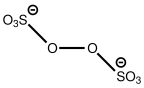
A search of the Cambridge structure database reveals around 18 high quality crystal structures containing this species are known, many as metal salts.

The article[1] reports that “in the presence of sulfate radicals generated from peroxydisulfate, the (Krebs cycle) intermediates underwent 24 interconversion reactions” covering “the critical topology of the oxidative Krebs cycle, the glyoxylate shunt and the succinic-semialdehyde pathway“. The suggestion therefore is that these crucial metabolic reactions may have existed before life itself absorbed them into the oxidative Krebs cycle. The challenge now is to explain how or if the more ancient reductive Krebs cycle (which fixes carbon dioxide) might have arisen prebiotically. More exciting stuff to come I fancy.
References
- M.A. Keller, D. Kampjut, S.A. Harrison, and M. Ralser, "Sulfate radicals enable a non-enzymatic Krebs cycle precursor", Nature Ecology & Evolution, vol. 1, 2017. https://doi.org/10.1038/s41559-017-0083
Tags:metal salts, Peroxydisulfate
Posted in crystal_structure_mining, Interesting chemistry | No Comments »
Sunday, March 19th, 2017
The Wikipedia entry on peroxydisulfate is quite short (as of today). But I suspect this article may change things.[1].
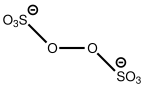
A search of the Cambridge structure database reveals around 18 high quality crystal structures containing this species are known, many as metal salts.

The article[1] reports that “in the presence of sulfate radicals generated from peroxydisulfate, the (Krebs cycle) intermediates underwent 24 interconversion reactions” covering “the critical topology of the oxidative Krebs cycle, the glyoxylate shunt and the succinic-semialdehyde pathway“. The suggestion therefore is that these crucial metabolic reactions may have existed before life itself absorbed them into the oxidative Krebs cycle. The challenge now is to explain how or if the more ancient reductive Krebs cycle (which fixes carbon dioxide) might have arisen prebiotically. More exciting stuff to come I fancy.
References
- M.A. Keller, D. Kampjut, S.A. Harrison, and M. Ralser, "Sulfate radicals enable a non-enzymatic Krebs cycle precursor", Nature Ecology & Evolution, vol. 1, 2017. https://doi.org/10.1038/s41559-017-0083
Tags:metal salts, Peroxydisulfate
Posted in crystal_structure_mining, Interesting chemistry | No Comments »
Sunday, March 19th, 2017
A pyrophoric metal is one that burns spontaneously in oxygen; I came across this phenomenon as a teenager doing experiments at home. Pyrophoric iron for example is prepared by heating anhydrous iron (II) oxalate in a sealed test tube (i.e. to 600° or higher). When the tube is broken open and the contents released, a shower of sparks forms. Not all metals do this; early group metals such as calcium undergo a different reaction releasing carbon monoxide and forming calcium carbonate and not the metal itself. Here as a prelude to the pyrophoric reaction proper, I take a look at this alternative mechanism using calculations.

There are ~60 crystal structures of metal oxalates, of which several are naturally occurring minerals (Fe, humboldtine[1], Ca, Weddellite[2], Li[3], Na[4], K[5], Cs[6]. The natural geometry of the oxalate di-anion is planar (torsion 0 or 180°) but a small number are twisted such as the caesium oxalate.

The kinetics of pyrolysis of a number of metal oxalates were studied some years ago (Ca[7], Li[8]) indicating barriers ranging from 53-68 kcal/mol. One proposed mechanism is as shown in this article.[7]

It was surmised from the kinetic analysis that the k1 activation step (rotation about the C-C bond from planar to twisted) was ~12 ± 20 kcal/mol, whilst steps k2 or k3 had the much higher activation energy noted above. A search (of Scifinder) for quantum mechanical “reality checks” of this mechanism revealed a blank and so I apply such a check here using Mg as the metal.
The carbonyl extrusion step (ωB97XD/Def2-TZVPPD/SCRF=water, DOI: 10.14469/hpc/2320) was studied with a water solvent field applied in an effort to mimic the solid state crystal structure of the species as a better representation of the ionic lattice than a pure vacuum calculation.
 An IRC (intrinsic reaction coordinate, DOI: 10.14469/hpc/2324) reveals the start-point geometry still has a very small negative force constant (-38 cm-1, DOI: 10.14469/hpc/2321) which now corresponds to a small rotation about the C-C bond to give a C2-symmetric conformation:
 But the barrier for this process is tiny and nothing like the ~12 ± 20 kcal/mol inferred from the kinetic analysis. Perhaps most of the incentive to pack into a totally planar geometry comes from the interactions in the ionic lattice. The calculated free energy barrier (ΔG298‡ 54.7 kcal/mol, ΔG755‡ 55.1 kcal/mol) is within the reported measured range.

The mechanism for production of pyrophoric metal itself is likely to be far more complex, involving (inter alia) electron transfer from oxygen to metal. If I find anything I will report back here.
References
- T. Echigo, and M. Kimata, "Single-crystal X-ray diffraction and spectroscopic studies on humboldtine and lindbergite: weak Jahn–Teller effect of Fe2+ ion", Physics and Chemistry of Minerals, vol. 35, pp. 467-475, 2008. https://doi.org/10.1007/s00269-008-0241-7
- C. Sterling, "Crystal structure analysis of weddellite, CaC2O4.(2+x)H2O", Acta Crystallographica, vol. 18, pp. 917-921, 1965. https://doi.org/10.1107/s0365110x65002219
- https://doi.org/
- G.A. Jeffrey, and G.S. Parry, "The Crystal Structure of Sodium Oxalate", Journal of the American Chemical Society, vol. 76, pp. 5283-5286, 1954. https://doi.org/10.1021/ja01650a007
- Dinnebier, R.E.., Vensky, S.., Panthofer, M.., and Jansen, M.., "CCDC 192180: Experimental Crystal Structure Determination", 2003. https://doi.org/10.5517/cc6fzcy
- Dinnebier, R.E.., Vensky, S.., Panthofer, M.., and Jansen, M.., "CCDC 192182: Experimental Crystal Structure Determination", 2003. https://doi.org/10.5517/cc6fzf0
- F.E. Freeberg, K.O. Hartman, I.C. Hisatsune, and J.M. Schempf, "Kinetics of calcium oxalate pyrolysis", The Journal of Physical Chemistry, vol. 71, pp. 397-402, 1967. https://doi.org/10.1021/j100861a029
- D. Dollimore, and D. Tinsley, "The thermal decomposition of oxalates. Part XII. The thermal decomposition of lithium oxalate", Journal of the Chemical Society A: Inorganic, Physical, Theoretical, pp. 3043, 1971. https://doi.org/10.1039/j19710003043
Tags:Aluminium, calculated free energy barrier, Carbon monoxide, Chemical elements, Chemistry, higher activation energy, Iron, Matter, metal, metal oxalates, Oxide, pyrophoric metal, Pyrophoricity, Reducing agents
Posted in crystal_structure_mining, reaction mechanism | 1 Comment »
Friday, March 10th, 2017
A few years back, I did a post about the Pirkle reagent[1] and the unusual π-facial hydrogen bonding structure[2] it exhibits. For the Pirkle reagent, this bonding manifests as a close contact between the acidic OH hydrogen and the edge of a phenyl ring; the hydrogen bond is off-centre from the middle of the aryl ring. Here I update the topic, with a new search of the CSD (Cambridge structure database), but this time looking at the positional preference of that bond and whether it is on or off-centre.

The search (February 2017 database, DOI:10.14469/hpc/2233) is shown above, QA = N, O, F, Cl and other constraints are R < 0.01, no errors, no disorder. Two distances are plotted, one (DIST1) is from the H to the ring centroid and the second (DIST2) from the H to an edge carbon atom. The colour code relates to ANG1, the angle subtended at the centroid. A value of 90° would indicate the H is orthogonal to the plane of the aromatic ring.

You can see from the above that the yellow dots correspond to ~90° and that by and large the H…centroid distances are shorter than the H…C distances.

The above is another representation of this search, again showing that the preferred angle is 90°, although there is a fair bit of scatter. The extreme outliers may be crystallographic errors, but one point caught my eye and is circled in red above; ammonium tetrafluoroborate (3D model DOI: 10.5517/CC4V6TZ). This has a very short distance from the H to the centroid (2.07Å), shorter than the Pirkle reagent that we looked at all those years back. The authors[3] note that “The N-H…Ph distances, H…M 2.067Å … are exceptionally short (M = aromatic midpoint)” but also that “even at 20 K the ammonium ion performs large amplitude motions which allow the N-H vectors to sample the entire face of the aromatic system.” This implies that such bonds are largely agnostic about whether they bind to the centroid of the ring or to its edge and that the most probable position might arise simply because of crystal packing. An interesting variation on this molecule is a crystal that includes a further 5NH3 in addition to ammonium tetraphenylborate (3D model DOI: 10.5517/cc7bly2). Here an ammonia intervenes between the ammonium cation and a phenyl ring, resulting in a binding of the ammonia with two NHs closer to the edge of the ring and one NH interacting in parallel mode.

Time therefore for a calculation, using B3LYP+GD3BJ/Def2-TZVPP, the functional being chosen because the dispersion contribution is not built in, but uses what is currently thought to be the best representation of these attractions. The issue now is what molecular unit to use? This is an ionic structure and so a periodic boundary model is most appropriate, but given its size I reduced this to two models comprising smaller discrete fragments.
- A unit just comprising the simple ion pair. This leaves two of the four N-H bonds devoid of hydrogen bonding (DOI:10.14469/hpc/2234). The optimisation adopts a pose where two NH groups are directed towards a carbon atom rather than the ring centroid. How much of this is due to the smallness of this model?

- A unit comprising a double ion pair, which allows one ammonium group to participate with all four NH groups across four phenyl rings and exhibiting six NH interactions in total with six rings (DOI: 10.14469/hpc/2235). The NH hydrogen vectors all interact with ring carbons rather than the ring centroid.

This brief computational exploration has covered only one method (the B3LYP DFT procedure), albeit with what is thought to be a good dispersion attraction term added and a reasonable basis set. It does seem to show that hydrogen bonds interacting with the centroid of a phenyl ring are not the preferred mode, which is instead an interaction with the edge of the ring. The quote above, “even at 20 K the ammonium ion performs large amplitude motions which allow the N-H vectors to sample the entire face of the aromatic system” suggests that whilst the average position might be the centroid, a true hydrogen bond to the centroid might be rarer than thought. Although most of the crystallographic examples located in the searches above deem to show a preference for the ring centroid, this might be more apparent than real.
References
- H.S. Rzepa, M.L. Webb, A.M.Z. Slawin, and D.J. Williams, "? Facial hydrogen bonding in the chiral resolving agent (S)-2,2,2-trifluoro-1-(9-anthryl)ethanol and its racemic modification", Journal of the Chemical Society, Chemical Communications, pp. 765, 1991. https://doi.org/10.1039/c39910000765
- H.S. Rzepa, M.H. Smith, and M.L. Webb, "A crystallographic AM1 and PM3 SCF-MO investigation of strong OH ⋯π-alkene and alkyne hydrogen bonding interactions", J. Chem. Soc., Perkin Trans. 2, pp. 703-707, 1994. https://doi.org/10.1039/p29940000703
- T. Steiner, and S.A. Mason, "Short N<sup>+</sup>—H...Ph hydrogen bonds in ammonium tetraphenylborate characterized by neutron diffraction", Acta Crystallographica Section B Structural Science, vol. 56, pp. 254-260, 2000. https://doi.org/10.1107/s0108768199012318
Tags:Ammonia, Ammonium, aromaticity, Cations, Centroid, chemical bonding, Chemistry, Hydrogen bond, Phenyl group
Posted in crystal_structure_mining | No Comments »
Sunday, March 5th, 2017
Cyclobutadiene is one of those small iconic molecules, the transience and instability of which was explained theoretically long before it was actually detected in 1965.[1] Given that instability, I was intrigued as to how many crystal structures might have been reported for this ring system, along with the rather more stable congener cyclo-octatetraene. Here is what I found.
The Conquest search query shown (with no disorder, no errors and R < 0.1 also specified). 
There are 23 instances (February 2017 database; see DOI: 10.14469/hpc/2231 for search query) of the supposedly unstable cyclobutadiene motif!

The three clusters deserve explanations. The orange cluster reveals a long C-C bond (rather longer than normal C-C bonds), accompanied by short C=C bonds, as indicated by the valence bond form shown below. Take particular note that the arrow connecting the two forms is NOT a resonance arrow but an equilibrium arrow. The “bond shifting” is not fast but slow, allowing long and short bonds to be measured in a crystal structure.
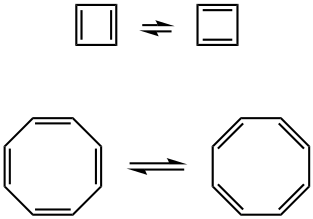
The rather larger blue cluster exhibits much more equal bonds. These arise from the presence of “push-pull” substituents on the ring which serve to delocalise the unfavourable cyclobutadiene ring and hence decrease the unfavourable anti-aromaticity. A typical example is shown below (EACBUT):

The small red cluster shows a long C=C bond and a short C-C bond! I have commented previously on apparently abnormally long C=C bonds, which in fact all turned out to be errors, and I suspect the same is true here. The bond orders in the indexing in the CSD data base have probably been mis-assigned, as per below for GANBII;

The Conquest search query is shown (with no disorder, no errors and R < 0.1 specified) for the 8-ring, which further specifies a torsion angle about a C-C bond to determine how planar the ring might be.

The “normal” cluster in the top left exhibits long C-C bonds and short C=C bonds. The colour code indicates how planar the ring is (red-blue spectrum = twisted ⇒ planar). The majority of examples are twisted about the C-C bond(s), but there are a few interesting examples that are not, as shown by the blue dots. There are only a few “bond-equalised” examples in the centre; perhaps “push-pull” induced equalisation is more difficult or perhaps few examples have been made?

The members of the red cluster in the bottom right all reveal short “C-C” bonds and long “C=C” bonds. Intriguingly they all also have low values of the torsion about one C-C bond (although not always about all four C-C bonds). A typical example (BAQVUK, DOI: 10.5517/CC4GWWB ) is shown below. These all need careful inspection and possibly reversal of the C-C and C=C indexing.


It was interesting to discover how many crystalline examples of this archetypal “unstable” cyclobutadiene motif have been made, and the means by which some of them at least have been stabilized. In the more abundant cyclo-octatetraene system, I learnt that one has to be cautious about blindly accepting the bond order designations in the database. Perhaps we might learn here that some of these have indeed been re-assigned in the next release of the database.
References
- L. Watts, J.D. Fitzpatrick, and R. Pettit, "Cyclobutadiene", Journal of the American Chemical Society, vol. 87, pp. 3253-3254, 1965. https://doi.org/10.1021/ja01092a049
Tags:antiaromaticity, Chemistry, cyclobutadiene, Instability, Nature, Physical organic chemistry, Physics, search query
Posted in crystal_structure_mining | 4 Comments »
Sunday, March 5th, 2017
Cyclobutadiene is one of those small iconic molecules, the transience and instability of which was explained theoretically long before it was actually detected in 1965.[1] Given that instability, I was intrigued as to how many crystal structures might have been reported for this ring system, along with the rather more stable congener cyclo-octatetraene. Here is what I found.
The Conquest search query shown (with no disorder, no errors and R < 0.1 also specified). 
There are 23 instances (February 2017 database; see DOI: 10.14469/hpc/2231 for search query) of the supposedly unstable cyclobutadiene motif!

The three clusters deserve explanations. The orange cluster reveals a long C-C bond (rather longer than normal C-C bonds), accompanied by short C=C bonds, as indicated by the valence bond form shown below. Take particular note that the arrow connecting the two forms is NOT a resonance arrow but an equilibrium arrow. The “bond shifting” is not fast but slow, allowing long and short bonds to be measured in a crystal structure.
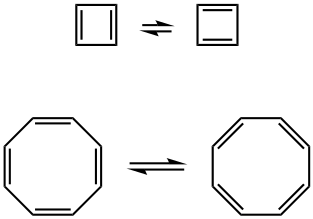
The rather larger blue cluster exhibits much more equal bonds. These arise from the presence of “push-pull” substituents on the ring which serve to delocalise the unfavourable cyclobutadiene ring and hence decrease the unfavourable anti-aromaticity. A typical example is shown below (EACBUT):

The small red cluster shows a long C=C bond and a short C-C bond! I have commented previously on apparently abnormally long C=C bonds, which in fact all turned out to be errors, and I suspect the same is true here. The bond orders in the indexing in the CSD data base have probably been mis-assigned, as per below for GANBII;

The Conquest search query is shown (with no disorder, no errors and R < 0.1 specified) for the 8-ring, which further specifies a torsion angle about a C-C bond to determine how planar the ring might be.

The “normal” cluster in the top left exhibits long C-C bonds and short C=C bonds. The colour code indicates how planar the ring is (red-blue spectrum = twisted ⇒ planar). The majority of examples are twisted about the C-C bond(s), but there are a few interesting examples that are not, as shown by the blue dots. There are only a few “bond-equalised” examples in the centre; perhaps “push-pull” induced equalisation is more difficult or perhaps few examples have been made?

The members of the red cluster in the bottom right all reveal short “C-C” bonds and long “C=C” bonds. Intriguingly they all also have low values of the torsion about one C-C bond (although not always about all four C-C bonds). A typical example (BAQVUK, DOI: 10.5517/CC4GWWB ) is shown below. These all need careful inspection and possibly reversal of the C-C and C=C indexing.


It was interesting to discover how many crystalline examples of this archetypal “unstable” cyclobutadiene motif have been made, and the means by which some of them at least have been stabilized. In the more abundant cyclo-octatetraene system, I learnt that one has to be cautious about blindly accepting the bond order designations in the database. Perhaps we might learn here that some of these have indeed been re-assigned in the next release of the database.
References
- L. Watts, J.D. Fitzpatrick, and R. Pettit, "Cyclobutadiene", Journal of the American Chemical Society, vol. 87, pp. 3253-3254, 1965. https://doi.org/10.1021/ja01092a049
Tags:antiaromaticity, Chemistry, cyclobutadiene, Instability, Nature, Physical organic chemistry, Physics, search query
Posted in crystal_structure_mining | 4 Comments »
Saturday, February 11th, 2017
On February 6th I was alerted to this intriguing article[1] by a phone call, made 55 minutes before the article embargo was due to be released. Gizmodo wanted to know if I could provide an (almost)† instant‡ quote. After a few days, this report of a stable compound of helium and sodium still seems impressive to me and I now impart a few more thoughts here.
The discovery originates from 17 authors based in 17 different institutions, an impressive illustration of global science and cooperation. I illustrate with this diagram, to be found not in the main article body but in its supporting information and for which the caption reads:

Computed charge density (eÅ-3) of Na2He at 300 GPa, plotted in the [110] plane of the conventional cell. The color bar gives the scale.
The nuclei carry of course the greatest charge density, but the density labelled “2e” is not nuclear-centered. This is typical of species known as electrides, where positive cations are associated with just electrons acting as the counter-anion and about which there was an extensive debate earlier on this blog. There is much discussion in the article[1] about the essential role of the He atoms in bringing about the formation of such an electride, an effect that is summarised in a second diagram also found in the supporting information:

I found myself thinking that it would be great to have the first diagram represented as a movie, evolving as the pressure is increased from say ambient to 300 GPa, and presumably showing the “2e” feature (which means diamagnetic electrons) forming as the pressure increases. Would their evolution be abrupt (a step change) or gradual as the pressure increases and the interatomic distances all decrease? As I understand it, this chemical phenomenon is due not so much to the usual coulombic attraction between positive nuclei and negative charge density from the electronic wavefunction leading to e.g. covalent bonds, but to electron repulsions induced by decreasing nuclear separations resulting in electride-like ionisation and hence electron localisation into the “interstitial cavities” of the lattice. Without pressure, you would just have sodium and helium atoms!
The urge to obtain this intriguing electronic wavefunction for myself now appeared (wavefunctions are rarely if ever included in supporting information). To do this you must have atom coordinates available, But such data was not to be found in the supporting information. It was eventually tracked down (by a crystallographer; thanks Andrew!) to the caption in Figure 2.

However, you probably do need to be a crystallographer to convert this data into a set of coordinates. This was done and is here deposited as a CIF file for you to play with if you wish (DOI:10.14469/hpc/2154)[2]. I have reduced the packing of the unit cell obtained from this CIF file (198 atoms) to just 60 and you can enjoy them by clicking on the diagram below. I should point out that if one uses a program that can recognise the periodic lattice such as Crystal (used in the article discussed here), there is no need to make such reductions, but in this instance I wanted to use a program such as Gaussian in discrete (non-periodic) mode, for which the calculation (B3LYP/Def2-SVPD) has DOI: 10.14469/hpc/2156[3] and where you can also find a wavefunction file to play with if you wish.

Click for 3D model
An ELF analysis for this non-periodic wavefunction looks as below. The ELF basins labelled “2e” located in the centre of the cube show an integrated electron population of ~1.9e and correspond to the localised electron pairs noted in the article above.

Click for 3D
The basins on the boundaries of this non-periodic unit show reduced integrations (red arrows below, 0.08 – 1.7e) and are artefacts of the non-periodic approximation introduced.

The ionization into an electride is brought about by the close proximity of the atoms as induced by high pressure. Releasing the pressure would allow the ionized electrons to re-attach themselves to the valence shell of the sodium atoms, thus destroying the unique properties of the system. It is certainly true that this system challenges our normal concepts of what a molecule is. The presence of He is essential and yet its electrons are hardly involved in the re-organised wavefunction. I cannot wait for more examples to be discovered!
†To meet the 55 minute deadline, I was given about 15 minutes thinking time!
‡Instant responses on social media now seem a sine qua non of the political world, so why not the scientific one?!
References
- X. Dong, A.R. Oganov, A.F. Goncharov, E. Stavrou, S. Lobanov, G. Saleh, G. Qian, Q. Zhu, C. Gatti, V.L. Deringer, R. Dronskowski, X. Zhou, V.B. Prakapenka, Z. Konôpková, I.A. Popov, A.I. Boldyrev, and H. Wang, "A stable compound of helium and sodium at high pressure", Nature Chemistry, vol. 9, pp. 440-445, 2017. https://doi.org/10.1038/nchem.2716
- H. Rzepa, "Na2He: a stable compound of helium and sodium at high pressure.", 2017. https://doi.org/10.14469/hpc/2154
- H. Rzepa, "He20Na40", 2017. https://doi.org/10.14469/hpc/2156
Tags:10.1038, Atom, Chemical elements, chemical phenomenon, Chemistry, Company: P. Acucar-CBD, Electride, Electron, Food Retail & Distribution - NEC, helium, Hydrogen, Matter, Oxygen, Physics, social media
Posted in Bond slam, crystal_structure_mining, Interesting chemistry | 11 Comments »
