Posts Tagged ‘energy’

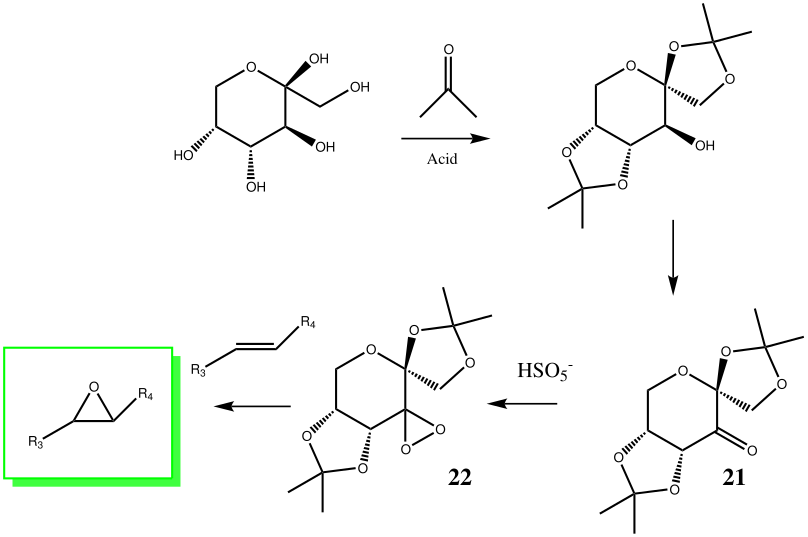
Enantioselective epoxidation of alkenes using the Shi Fructose-based catalyst. An undergraduate experiment.

Tuesday, April 15th, 2014

The journal of chemical education can be a fertile source of ideas for undergraduate student experiments. Take this procedure for asymmetric epoxidation of an alkene.[1] When I first spotted it, I thought not only would it be interesting to do in the lab, but could be extended by incorporating some modern computational aspects as well. 

Fructose

Oxygen atom transfer from this chiral dioxirane produces a specific enantiomer of the chiral epoxide in often high enantiomeric excess. For each alkene, there are up to eight possible transition states, arising from the following permutations:

  1. The two oxygen atoms of the oxidant are not equivalent
  2. Either the re or the si face of the alkene can be presented to the oxidant
  3. and the alkene itself can orient endo or exo with respect to the oxidant.

In fact, using the standard ωB97XD/6-311G(d,p)/SCRF=solvent method used on this blog, locating each transition state for any specific alkene can take about 24 hours, and hence doing all eight can take a week or more per alkene. We have groups of around 20 students doing this experiment, and so it was not practical in terms of computing resources to get them all to individually find these transition states. Instead, we give the students access to groups of eight pre-run calculations[2] for four different alkenes and invited them to perform various tasks for their selected alkene. These include: 

  1. Identify the free energy of each of the eight transition states for their alkene, and using these suggest a predicted enantiomeric outcome for the epoxide
  2. Using the energy of the lowest transition state leading to the other enantiomer, work out a predicted enantiomeric excess for the reaction
  3. Produce a non-covalent-interactions isosurface and try to reconcile this with the predicted ee by visual inspection.
  4. Run a QTAIM analysis of the wavefunction for the optimal transition state to inspect various topological critical points, especially the weaker ones that are not normally considered.
  5. Ponder any anomeric or other stereoelectronic interactions that might be present in any selected transition state.
  6. Track down the crystal structures of the catalyst precursor itself (the ketone) and comment on any interesting aspect of its structure.

There are more tasks the students have to perform, and a full description will appear in an article I am writing.

<

p>

References

  1. A. Burke, P. Dillon, K. Martin, and T.W. Hanks, "Catalytic Asymmetric Epoxidation Using a Fructose-Derived Catalyst", Journal of Chemical Education, vol. 77, pp. 271, 2000. https://doi.org/10.1021/ed077p271
  2. H.S. Rzepa, Mii Hii., and E.H. Smith, "Asymmetric epoxidation: a twinned laboratory and molecular modelling experiment", 2014. https://doi.org/10.6084/m9.figshare.988346

Enantioselective epoxidation of alkenes using the Shi Fructose-based catalyst. An undergraduate experiment.

Tuesday, April 15th, 2014

The journal of chemical education can be a fertile source of ideas for undergraduate student experiments. Take this procedure for asymmetric epoxidation of an alkene.[1] When I first spotted it, I thought not only would it be interesting to do in the lab, but could be extended by incorporating some modern computational aspects as well. 

Fructose

Oxygen atom transfer from this chiral dioxirane produces a specific enantiomer of the chiral epoxide in often high enantiomeric excess. For each alkene, there are up to eight possible transition states, arising from the following permutations:

  1. The two oxygen atoms of the oxidant are not equivalent
  2. Either the re or the si face of the alkene can be presented to the oxidant
  3. and the alkene itself can orient endo or exo with respect to the oxidant.

In fact, using the standard ωB97XD/6-311G(d,p)/SCRF=solvent method used on this blog, locating each transition state for any specific alkene can take about 24 hours, and hence doing all eight can take a week or more per alkene. We have groups of around 20 students doing this experiment, and so it was not practical in terms of computing resources to get them all to individually find these transition states. Instead, we give the students access to groups of eight pre-run calculations[2] for four different alkenes and invited them to perform various tasks for their selected alkene. These include: 

  1. Identify the free energy of each of the eight transition states for their alkene, and using these suggest a predicted enantiomeric outcome for the epoxide
  2. Using the energy of the lowest transition state leading to the other enantiomer, work out a predicted enantiomeric excess for the reaction
  3. Produce a non-covalent-interactions isosurface and try to reconcile this with the predicted ee by visual inspection.
  4. Run a QTAIM analysis of the wavefunction for the optimal transition state to inspect various topological critical points, especially the weaker ones that are not normally considered.
  5. Ponder any anomeric or other stereoelectronic interactions that might be present in any selected transition state.
  6. Track down the crystal structures of the catalyst precursor itself (the ketone) and comment on any interesting aspect of its structure.

There are more tasks the students have to perform, and a full description will appear in an article I am writing.

<

p>

References

  1. A. Burke, P. Dillon, K. Martin, and T.W. Hanks, "Catalytic Asymmetric Epoxidation Using a Fructose-Derived Catalyst", Journal of Chemical Education, vol. 77, pp. 271, 2000. https://doi.org/10.1021/ed077p271
  2. H.S. Rzepa, Mii Hii., and E.H. Smith, "Asymmetric epoxidation: a twinned laboratory and molecular modelling experiment", 2014. https://doi.org/10.6084/m9.figshare.988346

What is the best way of folding a straight chain alkane?

Sunday, April 6th, 2014

In the previous post, I showed how modelling of unbranched alkenes depended on dispersion forces. When these are included, a bent (single-hairpin) form of C58H118 becomes lower in free energy than the fully extended linear form. Here I try to optimise these dispersion forces by adding further folds to see what happens.

002

I had noted a small kink in the bent single-hairpin form (above, red circle). What about making a full bend at that point? Such forms have been previously investigated using OPLS-AA mechanics[1], with the finding that such a triple-hairpin conformation (below) was 9.7 kcal/mol higher in energy than the single hairpin (above). OK, its got eight gauche-turns more (four per bend, and which do cost energy), but it also has three rather than just one row of close dispersion-stabilising contacts to compensate. Using quantum rather than molecular mechanics (B3LYP+D3/TZVP), I found that this triple-hairpin folded form was 3.2 kcal/mol higher in free energy than the single hairpin.[2]

Click for  3D

Click for 3D

One folded at a slightly different point (below) was in fact higher 4.7 kcal/mol in energy that the single hairpin,[3] indicating that there is an optimum position for the bend.

Click for  3D

Click for 3D

I was convinced better folds could be found. So how about this double-hairpin, but in three dimensions to form a prism so that each chain has just as many contacts as the triple-hairpin, but is achieved with two-fewer gauche-turns? Its free energy[4] is 1.6 2.5 kcal/mol lower than the single-hairpin. It did not feature in the previous report[1] and hence represents a new lowest-energy folding (the colour indicates three ribbons of attractive non-covalent interactions, using the NCI technique). I would point out that such “manual” searching for better folds is not really sustainable; a statistical method would normally be used (MD or Monte-Carlo).

Click for  3D

Click for 3D

A similarly folded version of the triple-hairpin can be made (below), with more opportunity for five rows of close dispersion contacts. This time however, the free energy is 1.9 kcal/mol higher than the single hairpin[5] (but the position of the fold does need to be optimised and perhaps a better one can be found). This result does imply that there is an optimum balance between the energy penalty of creating four gauche-turns per fold and the additional energy stabilisation of the dispersion. Perhaps the triple hair-pin above is close to that optimum?

Click for  3D

Click for 3D

Unfortunately no crystal structures for the higher linear alkanes have been reported that would give us a reality check on any of these models. Can it really be that difficult to crystallise such molecules?

References

  1. L.L. Thomas, T.J. Christakis, and W.L. Jorgensen, "Conformation of Alkanes in the Gas Phase and Pure Liquids", The Journal of Physical Chemistry B, vol. 110, pp. 21198-21204, 2006. https://doi.org/10.1021/jp064811m
  2. H.S. Rzepa, "Gaussian Job Archive for C58H118", 2014. https://doi.org/10.6084/m9.figshare.988335
  3. H.S. Rzepa, "Gaussian Job Archive for C58H118", 2014. https://doi.org/10.6084/m9.figshare.988334
  4. H.S. Rzepa, "Gaussian Job Archive for C58H118", 2014. https://doi.org/10.6084/m9.figshare.988771
  5. H.S. Rzepa, "Gaussian Job Archive for C58H118", 2014. https://doi.org/10.6084/m9.figshare.988333

Modelling the geometry of unbranched alkanes.

Saturday, March 29th, 2014

By about C17H36, the geometry of “cold-isolated” unbranched saturated alkenes is supposed not to contain any fully anti-periplanar conformations. [1] Indeed, a (co-crystal) of C16H34 shows it to have two-gauche bends.[2]. Surprisingly, the longest linear alkane I was able to find a crystal structure for, C28H58 appears to be fully extended[3],[4] (an early report of a low quality structure for C36H74[5] also appears to show it as linear). Here I explore how standard DFT theories cope with these structures.

I start with noting the use of a TZVP basis set. In a recent article[6] we noted that the basis-set-superposition-errors for this basis were about a quarter of that for the standard Pople-type 6-311G(d,p) basis that I tend to use for modelling in this blog. This matters, since the relative energy of a folded-conformation vs an extended linear one might depend on the quality of the basis set and its inherent BSSE. The DFT method is the classical B3LYP. I also modelled C58H118 as the hydrocarbon as being well beyond the region anticipated above for folding of the chain to have started (no, there is no crystal structure). The geometries of linear and bent forms are shown below.

003001

The relative free energy of the V-shaped bent form[7] emerges as 3.5 kcal/mol higher than the linear form[8]. Now, to add a Grimme-D3 dispersion correction to the energies. The V-shape of the bent form now adopts the hairpin mode,[9] and its energy is now 2.5 kcal/mol lower than the linear form.[10]

002

Note in the above the very slight strange oscillation (kink) that appears about 11 atoms away from the hairpin bend. I repeated this with the wB97XD DFT procedure (in which dispersion is implicit) and found the same result.

As triple-ζ basis quality modelling of molecules with >100 atoms becomes increasingly common, it is worth repeating yet again that the model should always contain dispersion (and solvent if appropriate) corrections as default. Indeed, it is probably also worth re-investigating much early modelling (by this I mean modelling done ten or more years ago) to see if such corrections significantly influence the conclusions.[6]


The searches cannot be carried out according to the formula CnH2n+2, but must be done individually for the value of n. I gave up at C50.

References

  1. N.O.B. Lüttschwager, T.N. Wassermann, R.A. Mata, and M.A. Suhm, "The Last Globally Stable Extended Alkane", Angewandte Chemie International Edition, vol. 52, pp. 463-466, 2012. https://doi.org/10.1002/anie.201202894
  2. N. Cocherel, C. Poriel, J. Rault‐Berthelot, F. Barrière, N. Audebrand, A. Slawin, and L. Vignau, "New 3π‐2Spiro Ladder‐Type Phenylene Materials: Synthesis, Physicochemical Properties and Applications in OLEDs", Chemistry – A European Journal, vol. 14, pp. 11328-11342, 2008. https://doi.org/10.1002/chem.200801428
  3. S.C. Nyburg, and A.R. Gerson, "Crystallography of the even <i>n</i>-alkanes: structure of C<sub>20</sub>H<sub>42</sub>", Acta Crystallographica Section B Structural Science, vol. 48, pp. 103-106, 1992. https://doi.org/10.1107/s0108768191011059
  4. R. Boistelle, B. Simon, and G. Pèpe, "Polytypic structures of n-C28H58 (octacosane) and n-C36H74 (hexatriacontane)", Acta Crystallographica Section B Structural Crystallography and Crystal Chemistry, vol. 32, pp. 1240-1243, 1976. https://doi.org/10.1107/s0567740876005025
  5. H.M.M. Shearer, and V. Vand, "The crystal structure of the monoclinic form of n-hexatriacontant", Acta Crystallographica, vol. 9, pp. 379-384, 1956. https://doi.org/10.1107/s0365110x5600111x
  6. A. Armstrong, R.A. Boto, P. Dingwall, J. Contreras-García, M.J. Harvey, N.J. Mason, and H.S. Rzepa, "The Houk–List transition states for organocatalytic mechanisms revisited", Chem. Sci., vol. 5, pp. 2057-2071, 2014. https://doi.org/10.1039/c3sc53416b
  7. H.S. Rzepa, "Gaussian Job Archive for C58H118", 2014. https://doi.org/10.6084/m9.figshare.978501
  8. H.S. Rzepa, "Gaussian Job Archive for C58H118", 2014. https://doi.org/10.6084/m9.figshare.978502
  9. H.S. Rzepa, "Gaussian Job Archive for C58H118", 2014. https://doi.org/10.6084/m9.figshare.978832
  10. H.S. Rzepa, "Gaussian Job Archive for C58H118", 2014. https://doi.org/10.6084/m9.figshare.978833

Caesium trifluoride: could it be made?

Saturday, November 23rd, 2013

Mercury (IV) tetrafluoride attracted much interest when it was reported in 2007[1] as the first instance of the metal being induced to act as a proper transition element (utilising d-electrons for bonding) rather than a post-transition main group metal (utilising just s-electrons) for which the HgF2 dihalide would be more normal (“Is mercury now a transition element?”[2]). Perhaps this is the modern equivalent of transmutation! Well, now we have new speculation about how to induce the same sort of behaviour for caesium; might it form CsF3 (at high pressures) rather than the CsF we would be more familiar with.[3] Here I report some further calculations inspired by this report.

The argument goes something like this. Xenon difluoride (XeF2) is a well-known stable compound of xenon. Caesium comes immediately after xenon in the periodic table (electron shell properties [Xe].6s1) and so Cs+ would be iso-electronic with Xe. If the latter can form a stable difluoride (and higher), why not Cs? A neutral compound following this line of argument would therefore be CsF3.

So here comes a calculation. I used a large basis set (Def2-QZVPPD basis for Cs), with a pseudopotential describing 46 core electrons (including the two d-shells) and a further 8 in the 5s/p shell to make up the [Xe] core + 1 extra in the 6s shell) using the ωB97XD functional to obtain the geometry, shown below.[4]

Click for 3D

Click for 3D and normal modes

All 3N-6 normal vibrational modes are real, which indicates it is a proper minimum in the potential energy surface. A QTAIM analysis shows that ρ(r) at the bond critical points is pretty respectable for bonds (below). The QTAIM-derived average number of electrons on Cs is 7.4, which gives a charge of 1.6 on the Cs , thus involving the 5p shell as well as the 6s.

CsF3-AIM

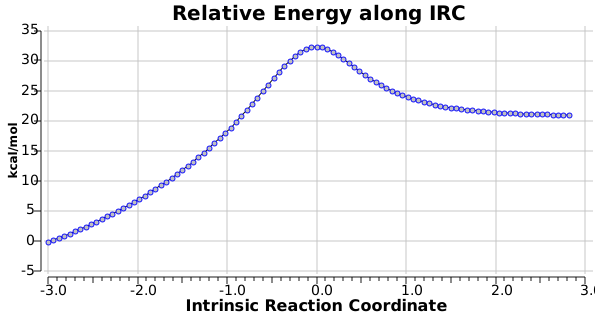
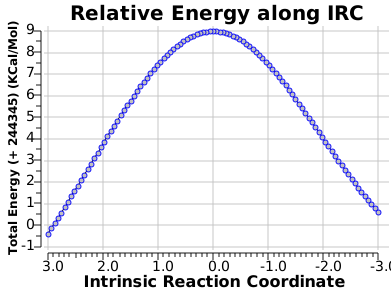
The most obvious question is what is the free energy change when the species dissociates to CsF and F2? This is exo-energic by 25.1 kcal/mol[5], not as large as you might have thought! Well, what about the barrier to such dissociation? The transition state for this process is shown below, delightfully asymmetric![6] and this gives a free energy barrier of 33.9 kcal/mol (the IRC smoothly defines this reaction[7],[8]).

Click for animation

Click for animation

We may conclude from this brief foray that in CsF3 caesium would indeed deserve to be called a p-block element, although this is not quite as good as it sounds. Take a look for example at the highest occupied molecular orbital. It certainly involves the p-block, but this orbital is in fact anti-bonding, and the Cs-F bonds derive their strength from the lower occupied orbitals.

Click for  3D

HOMO. Click for 3D


Click for 3D

HOMO-6. Click for 3D

And the final take-home message. The report of this molecule[3] suggests it could be stable under high pressure. Here, the free energy barrier to dissociation is calculated to be indeed high, which implies that if made it could be kinetically quite stable even under normal pressures (in an inert matrix where it would be prevented from reacting with itself).

POSTSCRIPT: The LUMO below is also antibonding, but is mostly 6s on Cs. If one force-populates this by a double excitation from the  HOMO, the resulting state is higher in energy (the wavefunction is stable to both singlet and triplet excitations). Which shows that Cs utilises (antibonding) 5p rather than (antibonding) 6s in this species.

CsF3-LUMO

References

  1. X. Wang, L. Andrews, S. Riedel, and M. Kaupp, "Mercury Is a Transition Metal: The First Experimental Evidence for HgF<sub>4</sub>", Angewandte Chemie International Edition, vol. 46, pp. 8371-8375, 2007. https://doi.org/10.1002/anie.200703710
  2. M. Miao, "Caesium in high oxidation states and as a p-block element", Nature Chemistry, vol. 5, pp. 846-852, 2013. https://doi.org/10.1038/nchem.1754
  3. H.S. Rzepa, "Gaussian Job Archive for CsF3", 2013. https://doi.org/10.6084/m9.figshare.861029
  4. H.S. Rzepa, "Gaussian Job Archive for CsF3", 2013. https://doi.org/10.6084/m9.figshare.861030
  5. "Cs 1 F 3", 2013. http://hdl.handle.net/10042/26513
  6. H.S. Rzepa, "Gaussian Job Archive for CsF3", 2013. https://doi.org/10.6084/m9.figshare.861038
  7. H.S. Rzepa, "Gaussian Job Archive for CsF3", 2013. https://doi.org/10.6084/m9.figshare.861047

Caesium trifluoride: could it be made?

Saturday, November 23rd, 2013

Mercury (IV) tetrafluoride attracted much interest when it was reported in 2007[1] as the first instance of the metal being induced to act as a proper transition element (utilising d-electrons for bonding) rather than a post-transition main group metal (utilising just s-electrons) for which the HgF2 dihalide would be more normal (“Is mercury now a transition element?”[2]). Perhaps this is the modern equivalent of transmutation! Well, now we have new speculation about how to induce the same sort of behaviour for caesium; might it form CsF3 (at high pressures) rather than the CsF we would be more familiar with.[3] Here I report some further calculations inspired by this report.

The argument goes something like this. Xenon difluoride (XeF2) is a well-known stable compound of xenon. Caesium comes immediately after xenon in the periodic table (electron shell properties [Xe].6s1) and so Cs+ would be iso-electronic with Xe. If the latter can form a stable difluoride (and higher), why not Cs? A neutral compound following this line of argument would therefore be CsF3.

So here comes a calculation. I used a large basis set (Def2-QZVPPD basis for Cs), with a pseudopotential describing 46 core electrons (including the two d-shells) and a further 8 in the 5s/p shell to make up the [Xe] core + 1 extra in the 6s shell) using the ωB97XD functional to obtain the geometry, shown below.[4]

Click for 3D

Click for 3D and normal modes

All 3N-6 normal vibrational modes are real, which indicates it is a proper minimum in the potential energy surface. A QTAIM analysis shows that ρ(r) at the bond critical points is pretty respectable for bonds (below). The QTAIM-derived average number of electrons on Cs is 7.4, which gives a charge of 1.6 on the Cs , thus involving the 5p shell as well as the 6s.

CsF3-AIM

The most obvious question is what is the free energy change when the species dissociates to CsF and F2? This is exo-energic by 25.1 kcal/mol[5], not as large as you might have thought! Well, what about the barrier to such dissociation? The transition state for this process is shown below, delightfully asymmetric![6] and this gives a free energy barrier of 33.9 kcal/mol (the IRC smoothly defines this reaction[7],[8]).

Click for animation

Click for animation

We may conclude from this brief foray that in CsF3 caesium would indeed deserve to be called a p-block element, although this is not quite as good as it sounds. Take a look for example at the highest occupied molecular orbital. It certainly involves the p-block, but this orbital is in fact anti-bonding, and the Cs-F bonds derive their strength from the lower occupied orbitals.

Click for  3D

HOMO. Click for 3D


Click for 3D

HOMO-6. Click for 3D

And the final take-home message. The report of this molecule[3] suggests it could be stable under high pressure. Here, the free energy barrier to dissociation is calculated to be indeed high, which implies that if made it could be kinetically quite stable even under normal pressures (in an inert matrix where it would be prevented from reacting with itself).

POSTSCRIPT: The LUMO below is also antibonding, but is mostly 6s on Cs. If one force-populates this by a double excitation from the  HOMO, the resulting state is higher in energy (the wavefunction is stable to both singlet and triplet excitations). Which shows that Cs utilises (antibonding) 5p rather than (antibonding) 6s in this species.

CsF3-LUMO

References

  1. X. Wang, L. Andrews, S. Riedel, and M. Kaupp, "Mercury Is a Transition Metal: The First Experimental Evidence for HgF<sub>4</sub>", Angewandte Chemie International Edition, vol. 46, pp. 8371-8375, 2007. https://doi.org/10.1002/anie.200703710
  2. M. Miao, "Caesium in high oxidation states and as a p-block element", Nature Chemistry, vol. 5, pp. 846-852, 2013. https://doi.org/10.1038/nchem.1754
  3. H.S. Rzepa, "Gaussian Job Archive for CsF3", 2013. https://doi.org/10.6084/m9.figshare.861029
  4. H.S. Rzepa, "Gaussian Job Archive for CsF3", 2013. https://doi.org/10.6084/m9.figshare.861030
  5. "Cs 1 F 3", 2013. http://hdl.handle.net/10042/26513
  6. H.S. Rzepa, "Gaussian Job Archive for CsF3", 2013. https://doi.org/10.6084/m9.figshare.861038
  7. H.S. Rzepa, "Gaussian Job Archive for CsF3", 2013. https://doi.org/10.6084/m9.figshare.861047

Patterns of behaviour: serendipity in action for enantiomerisation of F-S-S-Cl

Thursday, September 19th, 2013

Paul Schleyer sent me an email about a pattern he had spotted, between my post on F3SSF and some work he and Michael Mauksch had done 13 years ago with the intriguing title “Demonstration of Chiral Enantiomerization in a Four-Atom Molecule“.[1] Let me explain the connection, but also to follow-up further on what I discovered in that post and how a new connection evolved.FSSF3-gen
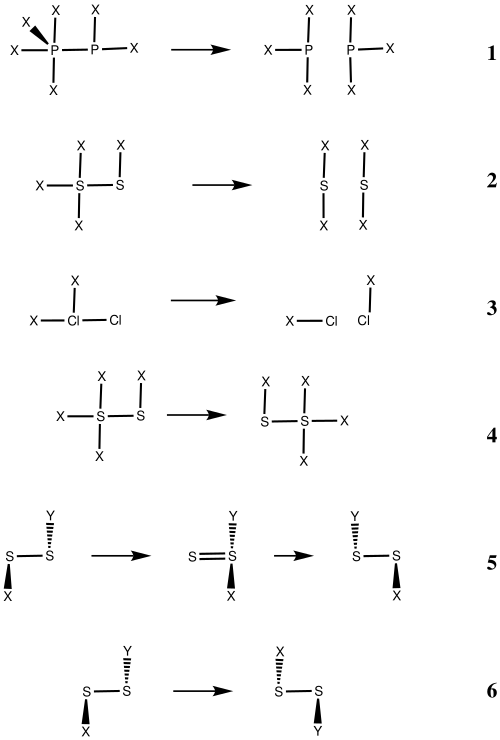
The prologue (or prequel). Reaction 2 is the path for decomposing the dimer of SF2 (X=F) to two monomers. In the previous post I (eventually) found the transition state for this process, with a relatively low energy barrier. As a mechanistic type, it is known as a reductive elimination (the reverse would be a oxidative addition) since the S atom on the left is reduced from a formal oxidation state of S(IV) to S(II) (or vice versa). Analogues of this reaction are 1 and 3. But before I managed to locate the transition state for reaction 2, I accidentally found the transition state for reaction 4. This retains the S-S bond (at the transition state, this bond is actually shorter than in reactant/product), and is what might be called a two-electron pericyclic redox reaction, since the S on the left is reduced to S(II) and the S on the right is oxidised to S(IV). I have not yet found whether this actually represents a new mechanistic type or not; it does not appear to have a name (should it be called periredox? Or redoxocyclic?). The lesson to be learnt here is that nature normally indulges in the (more or less) lowest energy route to a given target, but quantum chemists have the advantage that they can discover “chemistry in the clouds”; patterns of behaviour requiring too much energy to be seen in the real world and hence permanently hidden from us. But that does not mean we cannot learn chemistry from them.

Thus isomeric reaction 4 is very much higher in energy than 2. But it is what triggered Paul’s memory. Reaction 5 is related both to 4 in that it involves a [1,2] hydrogen shift of X (retaining the S-S bond) followed by a second [1,2] shift of Y. It is also related to 2 since it involves in effect an oxidative addition (by a lone pair) to an S-X bond to generate S(IV), followed by a reductive elimination back to S(II) to regenerate the enantiomer of the reactant (it is thus a two-step redox reaction). Thus if X and Y are different in 5, then all three of the species shown above are themselves chiral, and hence the reaction is indeed a “Demonstration of Chiral Enantiomerization in a Four-Atom Molecule”. The point here is that enantiomerisations do not necessarily have to proceed through an achiral transition state, but that the entire enantiomerisation pathway can be continuously chiral.

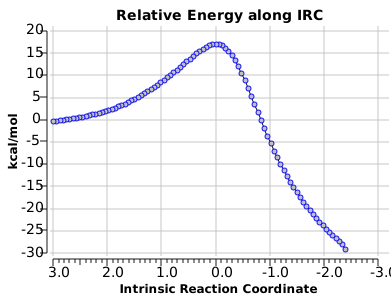
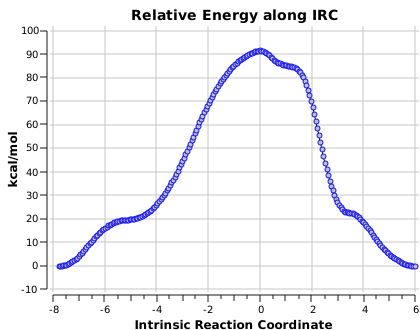
That was the intro! Now follows my calculated intrinsic reaction coordinate (ωB97XD/6-311G(d,p) for reaction 5.[2] My first attempt at the transition state was to use 2 as a template (rather than 4, which was far higher in energy). Well, talk about unexpected! The migration of X=Cl is 16.7 kcal/mol lower than X=F.  No problem there. Next, the IRC for X=F. The overall process certainly enantiomerises the two chiral gauche conformations, but without transposing X and Y, and not involving an intermediate S(IV) species as shown in reaction 5 (i.e. it goes directly, via reaction 6). 

FSSCl

But look at that energy! Way too high (above the clouds in fact). And although the start and end species are identical (apart from being enantiomers) the energy profile is far from being symmetrical. 
FSSClE

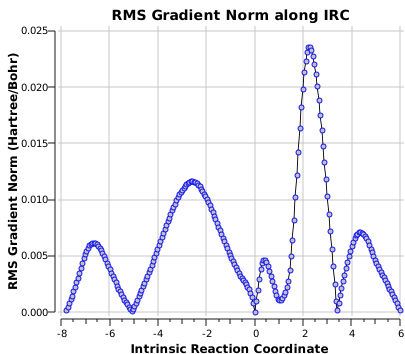
As for the gradient norms, where to begin? The TS as always is at IRC =0.0 But in between it and the start and end points one can see no less than THREE “hidden intermediates“. Two of them are in fact exactly cis (IRC=3.5) and trans (IRC = 5.0) planar forms of F-S-S-Cl. At these points, the pathway is clearly achiral! The third (IRC = 1.0) is a fascinating species in which the S-S bond is largely broken and it is bridged by an F. So this pathway involves S-S cleavage, just like 2. It is entirely serendipitous; no-one in their right mind would actually set out to find it! 
FSSClEG

Well, since 2 as a template led to the above, what happens when 4 is used? For F migrating[3] a barrier 11.6 kcal/mol higher is found than for Cl migrating[4], similar to that previously reported.[1]

FSSClpa

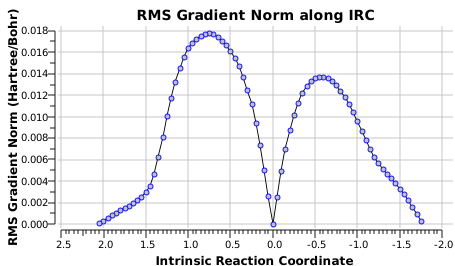
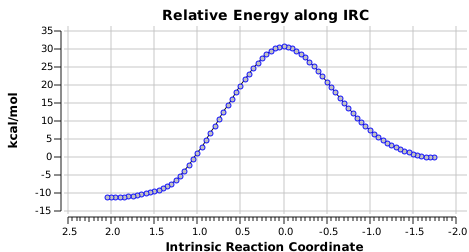
The energy and gradient norm profiles, in comparison to the previous, are uneventful.[5] The S-S bond stays intact throughout, and it is shorter at the transition state (1.846Å) than at  the start (1.950Å) or the end (1.874Å). This reaction has got its feet on the ground, rather than its head in the clouds!
FSSClpaG FSSClpaE

I am reminded of stories our crystallographer here tells. Students bring him synthesized molecules for their structures to be determined, and quite frequently it’s not at all the compound that was desired. For not a few highly focused students, the compound is quickly forgotten, even though it may have turned out to be very unusual. Likely it will not be deposited into a repository. And how many compounds that might otherwise have been the catalyst for new and unusual discoveries are thus lost?  So never throw away an unexpected result (yes, even a calculation).  There is probably something you could learn from it! 

References

  1. P.V.R. Schleyer, and M. Mauksch, "Demonstration of Chiral Enantiomerization in a Four‐Atom Molecule", Angewandte Chemie International Edition, 2000. http://doi.org/d8g2nw
  2. H.S. Rzepa, "Gaussian Job Archive for ClFS2", 2013. https://doi.org/10.6084/m9.figshare.801866
  3. H.S. Rzepa, "Gaussian Job Archive for ClFS2", 2013. https://doi.org/10.6084/m9.figshare.803096
  4. H.S. Rzepa, "Gaussian Job Archive for ClFS2", 2013. https://doi.org/10.6084/m9.figshare.802822
  5. H.S. Rzepa, "Gaussian Job Archive for ClFS2", 2013. https://doi.org/10.6084/m9.figshare.802821
Molecule-sized pixels.

Sunday, August 11th, 2013

The ultimate reduction in size for an engineer is to a single molecule. It’s been done for a car; now it has been reported for the pixel (picture-element).[1]

pixel

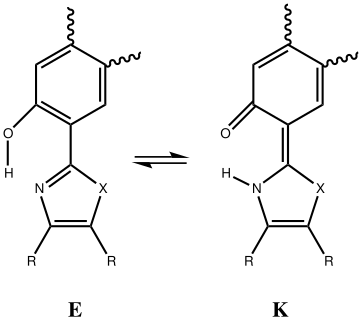
The molecule above (X=O, NR, R=aryl, etc) has been shown to be capable of acting as a molecular pixel. To give some idea of the reduction in size, computer displays currently only squeeze 400 or so pixels into an inch (the archaic, but common units used to measure pixel sizes). The secret to engineering this is to prevent energy transfer occurring between adjacent pixels (= molecules on this scale), and this has been done using quite simple chemistry!pixel-excitation

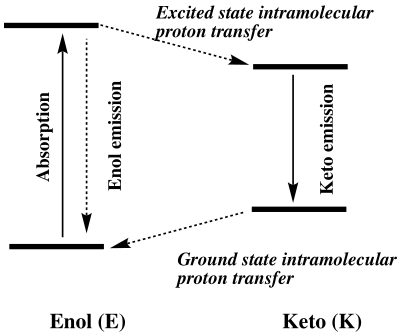
The concept is to allow a molecule to reach an excited state by photon absorption, but to prevent emission from occurring (which would result in energy transfer to adjacent molecules) by inducing a rapid change in the molecular structure of the excited state. This reaction has to be very fast, and one of the fastest reactions is the intramolecular proton transfer. In this example it converts the enol form of the oxazole E to the keto form K. On the ground state surface, prior to excitation, the enol form is the lower in free energy (retaining the aromaticity of the phenyl ring). The basis of the molecular design is to find a molecule where it is the keto form that is lower in energy on the excited state surface, such that the excited state intramolecular proton transfer is both fast and in effect irreversible. In the keto form, any emission down to the ground state is now incapable of energy transfer to adjacent molecules (which are presumed to be still in the ground state and hence the enol form).

This sort of system is perfect for designing with the help of quantum calculations, and to give just a hint of how this could be done, I thought I would illustrate how the energetics of the ground and excited states could be quickly obtained to show that the above energy diagram really does apply to these molecules (R=H, X=O). At the ωB97XD/6-311G(d,p)/SCRF=chloroform level, the enol[2] is 11.4 kcal/mol lower in free energy than the keto form[3]. A vertical (non-adiabatic) excitation to the first excited singlet now produces a system where the enol[4] is 3.9 kcal/mol higher than the keto form[5], which reflects the above diagram exactly.

It is easy to see now that variation in R, X or other parts of the molecule could be rapidly scanned computationally to find out how such variation alters these relative energies. Computational tuning could then be used to e.g. optimize avoidance of energy transfers between adjacent molecules (pixels) and no doubt to also predict the actual absorption energies (i.e. colours) of new candidate molecules.


Here I introduce the use of the so-called “short-doi“. The data citations above refer to the Figshare repository, the first citation of which takes the long form http://dx.doi.org/10.6084/m9.figshare.769259 By invoking http://shortdoi.org/10.6084/m9.figshare.769259 one can obtain the short form http://doi.org/nd9, of which the essential part, nd9, is now just 3-characters long. This form might be an alternative to QR-codes in e.g. lecture slides and other media where the human has to remember the value. In a machine-sense of course, the short form offers no advantage over the long form.

Strictly speaking, one should locate the conical intersection for proton transfer on the excited state, but the above calculations take only minutes literally, whereas locating a conical intersection is a rather more complex task.


References

  1. J.E. Kwon, S. Park, and S.Y. Park, "Realizing Molecular Pixel System for Full-Color Fluorescence Reproduction: RGB-Emitting Molecular Mixture Free from Energy Transfer Crosstalk", Journal of the American Chemical Society, vol. 135, pp. 11239-11246, 2013. https://doi.org/10.1021/ja404256s
  2. H.S. Rzepa, "Gaussian Job Archive for C9H7NO2", 2013. https://doi.org/10.6084/m9.figshare.769259
  3. H.S. Rzepa, "Gaussian Job Archive for C9H7NO2", 2013. https://doi.org/10.6084/m9.figshare.769260
  4. H.S. Rzepa, "Gaussian Job Archive for C9H7NO2", 2013. https://doi.org/10.6084/m9.figshare.769248

Is CLi6 hypervalent?

Friday, July 5th, 2013

A comment made on the previous post on the topic of hexa-coordinate carbon cited an article entitled “Observation of hypervalent CLi6 by Knudsen-effusion mass spectrometry[1] by Kudo as a amongst the earliest of evidence that such species can exist (in the gas phase). It was a spectacular vindication of the earlier theoretical prediction[2],[3] that such 6-coordinate species are stable with respect to dissociation to CLi4 and Li2.

The terminology describes these lithium carbides as effectively hypervalent; Kudo in the abstract of his 1992 article uses the more explicit phrase “carbon can expand its octet of electrons to form this relatively stable molecule“. We are taught early on in chemistry that the carbon octet is due to double occupation of four molecular orbitals formed using linear combinations derived from the relatively low energy 2s/2p carbon atomic orbital basis. Octet expansion on carbon must therefore involve to some degree the next atomic shell (3s/3p), which is normally regarded as too high in energy to be capable of significant population for carbon. But use of the 3s/3p shell seems at first sight inevitable. If one constructs an octahedral complex CLi6 surely ten electrons must be involved in bonding, four from the carbon and six from the equivalent lithiums? The 3s/3p carbon population must therefore be ~2 electrons, and we can truly describe a molecule where carbon has of necessity expanded its octet of electrons to ten as hypervalent. Or can we?

How does a quantitative (ωB97XD/6-311++G(d) ) calculation[4] reveal this effective hypervalency? 

  1. The octahedral geometry is indeed a stable minimum, with the lowest vibrational wavenumber being 194 cm-1.
  2. It also checks out as clearly a closed shell species, stable to open shell perturbations.
  3. An NBO analysis reveals the Rydberg population (those 3s/3p atomic orbitals) to be only 0.09 electrons.
  4. It partitions the electrons into 13.97 for the 1s cores of the seven atoms, 7.67 “valence-Lewis” (i.e. shared covalent) and a mysterious 2.27 (valence, non-Lewis).

We now have a problem. One of the standard methods for partitioning electrons has isolated two of our ten electrons and placed them, with small partial occupancy, into unshared “lone pairs”, located as it happens on the lithium atoms (shown below for one of these partial lone “pairs”). The carbon is NOT hypervalent, and it has NOT expanded its octet.

Click for  3D

Click for 3D

So I tried another procedure, deliberately chosen to be rather different from the orbital-based NBO formalism. This is analysis of the ELF, or electron localisation function, and represents an attempt to derive the result based on a function related to the electron density. The red spheres shown below are the centroids of the twelve ELF basins located:

Click for  3D

Click for 3D

Each of these (equivalent) basins has an electron population of ~0.81, making ~9.7 electrons in total. Each lithium sits on a square arrangement of four of these basins, and so has access to ~3.2 valence electrons. How do we interpret the situation for carbon however? Does its valence shell contain an expanded 9.7 electrons? Well, not necessarily. You can see that each of the basins has a three-centre relationship between the one carbon and TWO lithiums. These electrons contribute not just to C-Li bonding, but also to Li…Li bonding. So these 9.7 electrons contribute in part to bonding that does NOT involve the carbon. We can see this in the (Wiberg) bond orders, 0.254 for the C-Li interaction, and 0.116 for adjacent Li…Li interactions (such an explanation was also suggested for why II7 has no expanded octet at the central iodine). In fact, the origins of this effect were first clearly identified in the theoretical analysis of 1983[3]: “the extra electrons beyond the usual octet are involved with metal-metal bonding rather than with interactions of the metals with the central atoms“.

It is nice to see that despite the passage of 30 years, and despite the introduction of many new ways of analysing the wavefunctions and hence the bonding of molecules, the essential original interpretation[3] remains robustly correct! 

References

  1. H. Kudo, "Observation of hypervalent CLi6 by Knudsen-effusion mass spectrometry", Nature, vol. 355, pp. 432-434, 1992. https://doi.org/10.1038/355432a0
  2. E.D. Jemmis, J. Chandrasekhar, E.U. Wuerthwein, P.V.R. Schleyer, J.W. Chinn, F.J. Landro, R.J. Lagow, B. Luke, and J.A. Pople, "Lithiated carbocations. The generation, structure, and stability of CLi5+", Journal of the American Chemical Society, vol. 104, pp. 4275-4276, 1982. https://doi.org/10.1021/ja00379a051
  3. P.V.R. Schleyer, E.U. Wuerthwein, E. Kaufmann, T. Clark, and J.A. Pople, "Effectively hypervalent molecules. 2. Lithium carbide (CLi5), lithium carbide (CLi6), and the related effectively hypervalent first row molecules, CLi5-nHn and CLi6-nHn", Journal of the American Chemical Society, vol. 105, pp. 5930-5932, 1983. https://doi.org/10.1021/ja00356a045
  4. "C 1 Li 6", 2013. http://hdl.handle.net/10042/24790

Woodward’s symmetry considerations applied to electrocyclic reactions.

Monday, May 20th, 2013

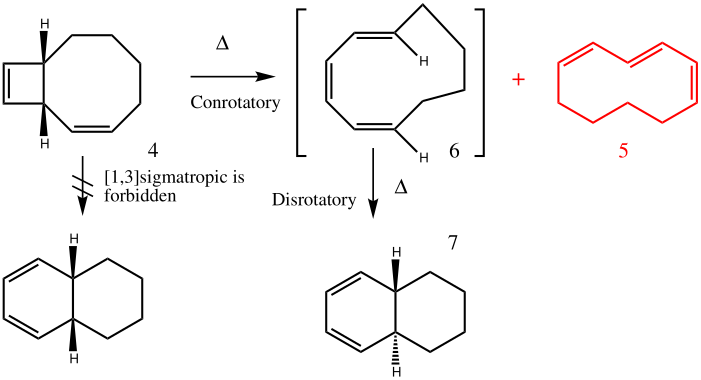
Sometimes the originators of seminal theories in chemistry write a personal and anecdotal account of their work. Niels Bohr[1] was one such and four decades later Robert Woodward wrote “The conservation of orbital symmetry” (Chem. Soc. Special Publications (Aromaticity), 1967, 21, 217-249; it is not online and so no doi can be given). Much interesting chemistry is described there, but (like Bohr in his article), Woodward lists no citations at the end, merely giving attributions by name. Thus the following chemistry (p 236 of this article) is attributed to a Professor Fonken, and goes as follows (excluding the structure in red):

wood

A search of the literature reveals only one published article describing this reaction[2] by Dauben and Haubrich, published some 21 years after Woodward’s description (we might surmise that Gerhard Fonken never published his own results). In fact this more recent study was primarily concerned with 193-nm photochemical transforms (they conclude that “the Woodward-Hoffmann rules of orbital symmetry are not followed”) but you also find that the thermal outcome of heating 4 is a 3:2 mixture of compounds 5 and 6, and that only 6 goes on to give the final product 7. It does look like a classic and uncomplicated example of Woodward-Hoffmann rules.

 So let us subject this system to the “reality check”. The transform of 4 → 5 rotates the two termini of the cleaving bond in a direction that produces the stereoisomer 5, with a trans alkene straddled by two cis-alkenes[3]. The two carbon atoms that define the termini of the newly formed hexatriene are ~ 4.7Å apart; too far to be able to close to form 7.

 4 → 5  4 → 6
8 8

But with any electrocyclic reaction, two directions of rotation are always possible, and it is a rotation in the other direction that gives 4 → 6[4], ending up with a hexatriene with the trans-alkene at one end and not the middle (for which the free energy of activation is 3.1 kcal/mol higher in energy). Now the two termini of the hexatriene end up ~3.0Å apart, much more amenable to forming a bond between them to form 7.

It is at this point that the apparently uncomplicated nature of this example starts to unravel. If one starts from the 3.0Å end-point of the above reaction coordinate and systematically contracts the bond between these two termini, a transition state is found leading not to 7 but to the (endothermic) isomer 8.[5]This form has a six-membered ring with a trans-alkene motif (which explains why it is so endothermic). 

wood1
6 ↠ 8
8 wood2

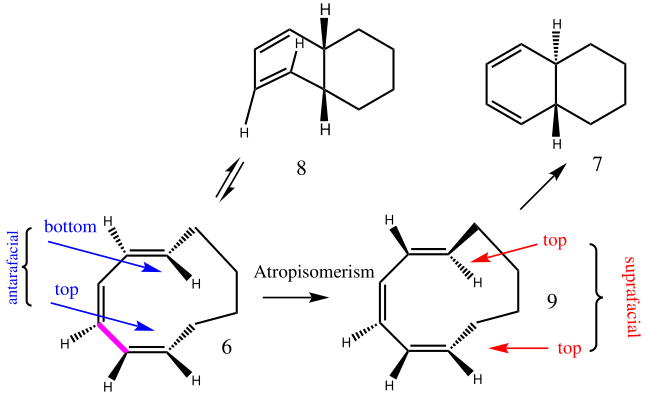
Before discussing the implications of this transition state, I illustrate another isomerism that 6 can undertake; a low-barrier atropisomerism[6] to form 9, followed by another reaction with a relatively low barrier, 9 ↠  7[7]to give the product that Woodward gives in his essay.

6 ↠ 9
6-atrop 6-atrop
9 ↠ 7
9to7a 9to7a

 We can now analyse the two transformations 6 ↠ 8 and 9 ↠  7. The first involves antarafacial bond formation (blue arrows) at the termini and an accompanying 180° twisting about the magenta bond which creates a second antarafacial component[8]. So this is a thermally allowed six-electron (4n+2) electrocyclisation with a double-Möbius twist[9]. The second reaction is a more conventional purely suprafacial version[10] (red arrows) of the type Woodward was certainly thinking of; it is 18.0 kcal/mol lower in free energy than the first (the transition state for 6 ↠ 9 is 10.8 kcal/mol lower than that for 9 ↠ 7).

I hope that this detailed exploration of what seems like a pretty simple example at first sight shows how applying a “reality-check” of computational quantum mechanics can cast (some unexpected?) new light on an old problem. We may of course speculate on how to inhibit the pathway 6 ↠ 9 ↠ 7 to allow only 6 ↠ 8 to proceed (the reverse barrier from 8 is quite low, so 8 would have to be trapped at very low temperatures). 

References

  1. N. Bohr, "Der Bau der Atome und die physikalischen und chemischen Eigenschaften der Elemente", Zeitschrift f�r Physik, vol. 9, pp. 1-67, 1922. https://doi.org/10.1007/bf01326955
  2. W.G. Dauben, and J.E. Haubrich, "The 193-nm photochemistry of some fused-ring cyclobutenes. Absence of orbital symmetry control", The Journal of Organic Chemistry, vol. 53, pp. 600-606, 1988. https://doi.org/10.1021/jo00238a023
  3. H.S. Rzepa, "Gaussian Job Archive for C10H14", 2013. https://doi.org/10.6084/m9.figshare.704833
  4. H.S. Rzepa, "Gaussian Job Archive for C10H14", 2013. https://doi.org/10.6084/m9.figshare.704834
  5. H.S. Rzepa, "Gaussian Job Archive for C10H14", 2013. https://doi.org/10.6084/m9.figshare.704755
  6. H.S. Rzepa, "Gaussian Job Archive for C10H14", 2013. https://doi.org/10.6084/m9.figshare.704754
  7. H.S. Rzepa, "Gaussian Job Archive for C10H14", 2013. https://doi.org/10.6084/m9.figshare.704844
  8. H.S. Rzepa, "Gaussian Job Archive for C10H14", 2013. https://doi.org/10.6084/m9.figshare.704841
  9. H.S. Rzepa, "Double-twist Möbius aromaticity in a 4n+ 2 electron electrocyclic reaction", Chemical Communications, pp. 5220, 2005. https://doi.org/10.1039/b510508k
  10. H.S. Rzepa, "Gaussian Job Archive for C10H14", 2013. https://doi.org/10.6084/m9.figshare.704995