Posts Tagged ‘Reaction Mechanism’

Joining up the pieces. Peroxidation of ethyne.

Monday, July 9th, 2012

Sometimes, connections between different areas of chemistry just pop out (without the help of semantic web tools, this is called serendipity). So here, I will try to join up some threads which emerge from previous posts.

  1. I had noted that antiaromaticity in cyclopropenium anion is lessened by the system adopting gross geometric distortions, which take the anionic lone pair out of conjugation from the ring.
  2. Similarly, cyclobutadiene can form a complex with the guanidinium cation in which the anti-aromaticity is reduced by the formation of strong C…H-N hydrogen bonds.
  3. Unhappy with modelling a cation without a counter-ion, I added one. I noted that the cyclobutadiene+ ion pair was more stable in this more complete form.
  4. My next connection is to a post on how ethyne reacts with peracetic acid. The initial product of this reaction is oxirene, which like cyclobutadiene or cyclopropenium anion is anti-aromatic. This time, the liberated acetic acid forms a remarkably strong hydrogen bond to the oxygen of the antiaromatic ring as a way of reducing the antiaromaticity. 
  5. Particularly noteworthy was that the initial attack of oxygen on the alkyne was very asymmetric. This reminded of another post on the reaction of dichlorocarbene with ethene, which too is asymmetric, yet again to avoid an antiaromatic transition state. However, as the hydrogen bond in 4 above get stronger, the antiaromatic oxirene becomes symmetrical again. It is as if the hydrogen bond had replaced the need for asymmetry (as with 2 above).
  6. Another asymmetric example is the 2+2 closed shell cycloaddition of two ethenes, which adopt a different form of distortion.

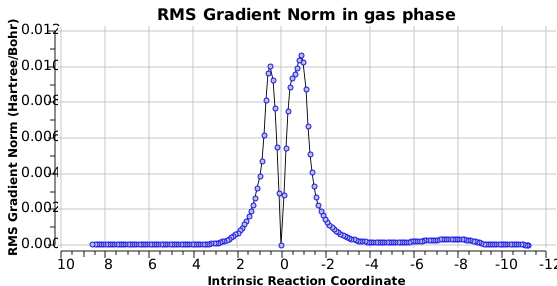
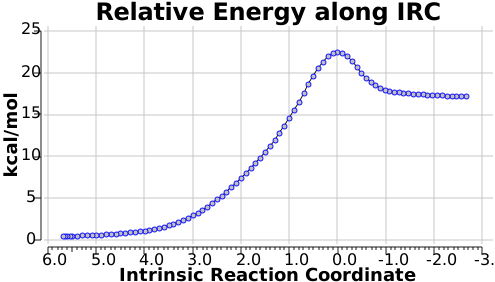
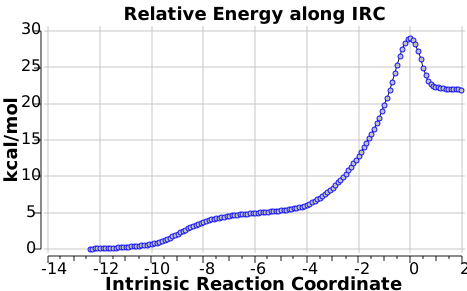
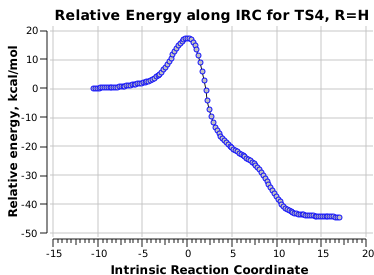
The original alkyne+peracid study was conducted using a gas phase model. I decided to revisit it now, but to change the modelled medium from the gas phase to continuum water. I show the IRC (intrinsic reaction coordinates) for this reaction in continuum water followed by the gas phase below (click on the animations to see the transition state model).

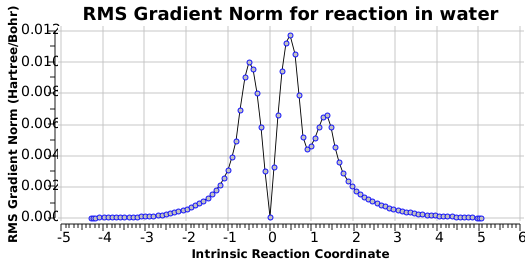
I want to compare the difference that introducing a model solvent (water) has made to the appearance of the reaction path.

  1. In water, the symmetry of the forming antiaromatic oxirene ring is always maintained. There is no distortion; the combination of hydrogen bond, developing ionicity and its stabilization by the model solvent, appears to eliminate the need for such distortion. The free energy barrier, ΔG (ωB97XD/6-311G(d,p) is 32.2 kcal/mol, outside of a room temperature reaction.
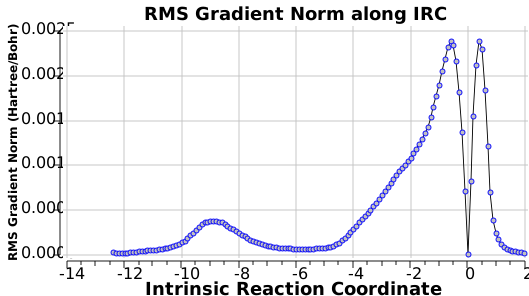
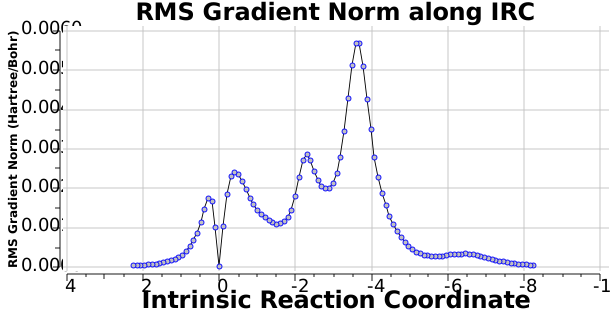
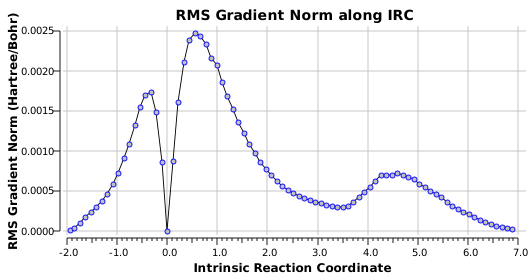
  2. In water, the proton transfer step comes much later, and is visible in the RMS gradient norm at +1.4.
  3. In the gas phase, the IRC is much more complex (as previously noted). Pronounced asymmetry develops, and this only resymmetrises late on, when the hydrogen bond forms.
  4. In the gas phase, the proton transfer occurs relatively early, and it cannot be found as a discrete feature in the RMS gradient norm plot. 
  5. If a more acidic peracid is introduced, say CF3CO3H, and the reaction is again simulated in water, the proton transfer is further delayed (below), and the barrier drops to ΔG 25.9 kcal/mol, an entirely viable thermal reaction. I do not believe this particular variation has ever been tested experimentally; anyone up for it? 
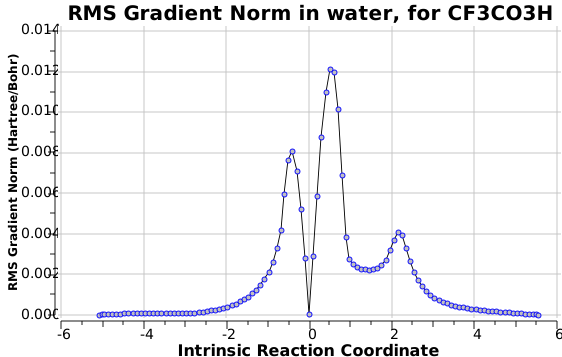
  6. The product of the CF3CO3H reaction is shown below. It has a remarkably short predicted hydrogen bond of 1.55Å between the oxirene and the trifluoracetic acid.

The take home message is that the very nature of a reaction, the geometry (symmetry) of the molecules taking part, and the timing of the changes can be very visibly changed by simulating the event with a solvent. In the past of course, all such computational studies were conducted purely as a gas phase model.

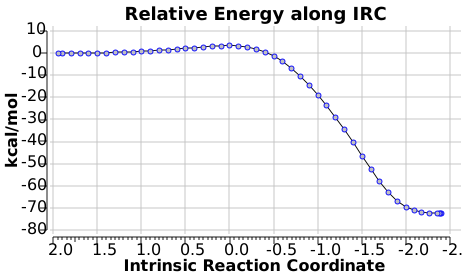
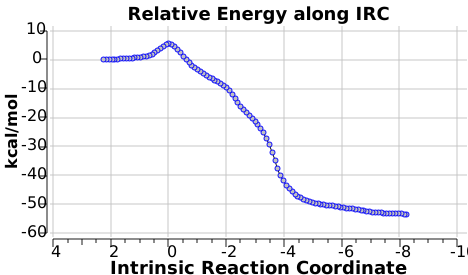
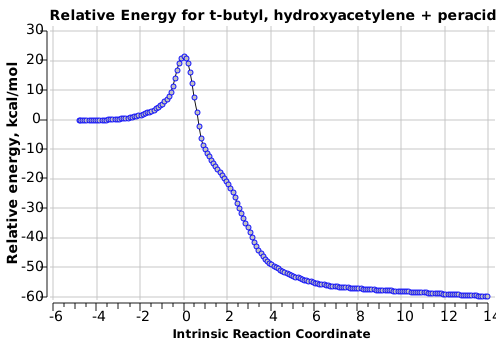
Postscript:The above shows how even a change in continuum solvent can affect the features of the reaction path. A rather greater perturbation is to change e.g. the substituents on the alkyne. I have tried replacing one H with t-butyl, and the other with OH. The rationale for the former is that t-butyl acetylene is actually the substrate that this reaction has been performed on, and for OH that it pushes electrons into the oxirene, making is more anti-aromatic and hence more liable to avoid that antiaromaticity. Animation of the IRC for this combination is shown below. Notice how the reaction now proceeds in a concerted manner directly from the alkyne to the hydroxy-carbene, without any sign of an intervening oxirene. 

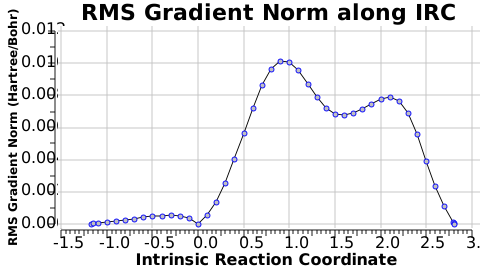
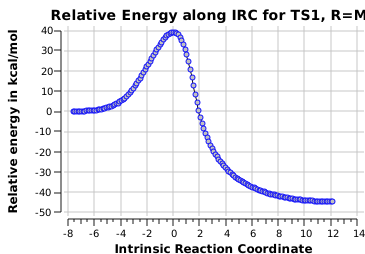
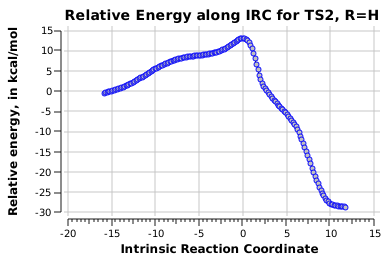
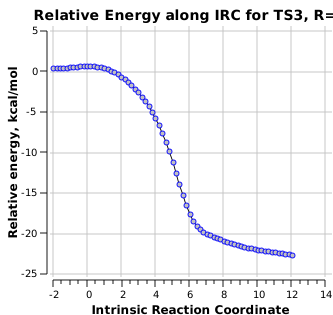
The energy and gradient profiles for this variation are shown below. Notice in particular how the barrier has dropped; it is now a much easier reaction.
The direct approach is not always the best: ethene + dichlorocarbene

Tuesday, June 12th, 2012

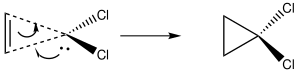
The reaction between a carbene and an alkene to form a cyclopropane is about as simple a reaction as one can get. But I discussed before how simple little molecules (cyclopropenyl anion) can hold surprises. So consider this reaction:

Transition state for reaction between ethene and dichlorocarbene. Click for 4D.

The reaction is a 4-electron pericyclic process, and so is subject to the Woodward-Hoffmann rules, which imply that such a 4n-thermal process should go with one antarafacial component. But there is a (rarely cited or observed) alternative, as was illustrated for the π22 cycloaddition of ethene to itself. There we saw the gymnastics of a limbo dancer, with one ethene sliding up to the other rather than taking a full-frontal approach. But whilst that reaction had an unrealistic activation barrier of ~50 kcal/mol, the reaction between dichlorocarbene and an alkene is known to be a very facile one. And so the calculation shows (below). The barrier to reaction is small, and so this is an example of a low-barrier nominally forbidden reaction which nevertheless achieves a low barrier by avoiding the direct approach of the two molecules and adopting a round-about path!

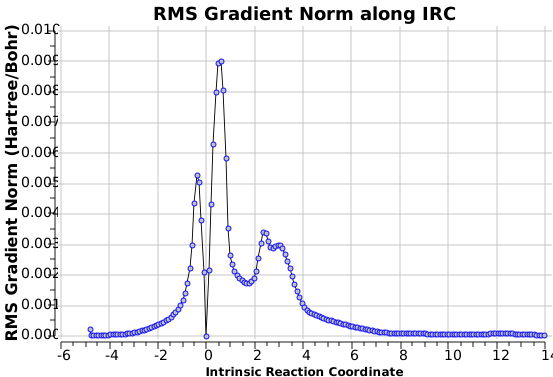
This round-about approach is seen best in the IRC for the addition to dicyano-ethene. Shown above is the gradient norm along the IRC.

  1. From IRC -1.2 to 0.0 (the transition state) the reaction corresponds to the formation of effectively just one C-C bond (a two electron process if you like).
  2. At IRC +2.0 a second distinct feature is seen in the graph, and this now corresponds to the formation of the second C-C bond, involving a sliding motion of the carbene (again, a two-electron process).

So by breaking a four-electron process into two phases, each involving just one electron pair, a lot of the forbidden Woodward-Hoffmann character seems to be avoided. Truly the direct approach not being the best!

Transition state models for Baldwin dig(onal) ring closures.

Sunday, June 10th, 2012

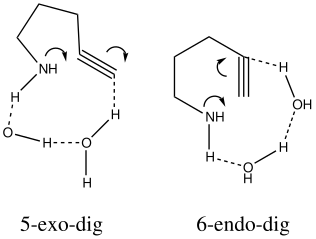
This is a continuation of the previous post exploring the transition state geometries of various types of ring closure as predicted by  Baldwin’s rules. I had dealt with bond formation to a trigonal (sp2) carbon; now I add a digonal (sp) example (see an interesting literature variation). 

As before, I have added two solvent (water) molecules to the model, since the immediate product of the closure is a zwitterionic intermediate, which is likely to be stabilised by the solvent. I also used the same nucleophile as before to facilitate comparison.

5-exo-dig transition state. Click for 4D.

6-endo-dig transition state. Click for 4D.

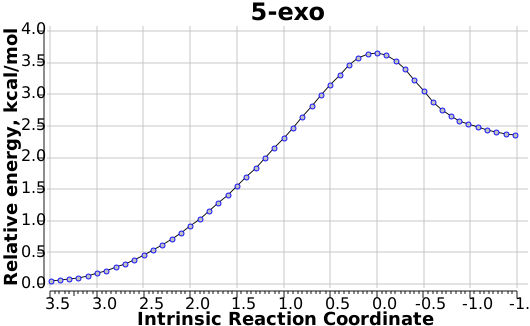
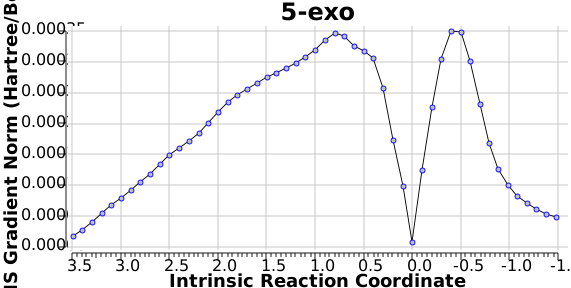
The digonal angle of attack is 121° for the  exo form, and 116° for the endo, both larger than was the case in the trig systems. The relative free energies of the two transition states is 3.6 kcal/mol in favour of the exo isomer. The hydrogen bond network is somewhat strained, since two solvent molecules cannot quite reach the forming carbanion at the optimal angle to form a good hydrogen bond to it. Instead, the water has to content itself with a π-facial hydrogen bond between the alkyne and the H-O. As a result, proton transfer to the carbon requires a separate activation step (or a stronger acid than water). 

5-exo-dig transition state
6-endo-dig transition state

The IRC for the 6-endo-dig pathway has features worth commenting upon.

  1. At IRC -12, the two solvent molecules form a triangular network with the nucleophilic amine.
  2. By IRC -9, one of the water molecules has split itself off from this triangle, and started to move towards the triple bond, which is gradually becoming a better acceptor of a hydrogen bond.
  3. At IRC -3, this water molecule is now forming a  π-facial hydrogen bond to the alkyne, which is still largely in place at the end of this step of the mechanism.

To complete the mechanism, I have added the final step in the reaction, a proton transfer from the amine to the carbon recipient, as facilitated by the bridge of solvent molecules connecting the start and end of the process. The free energy of this transition state is 0.3 kcal/mol higher than the N-C bond forming reaction, making it (just) the rate determining step.

Proton transfer

Transition state for proton transfer. Click for 4D

  1. The feature at IRC = 0.0 (the transition state) is the first proton transfer, from  C to O.
  2. The second feature at  IRC -2.5 is an O to O proton transfer
  3. At IRC -4, the third and final proton transfer can be seen, from O to N.
  4. At IRC -6.5, a weak π-OH hydrogen bond forms.

There is one more common type of cyclisation covered by Baldwin’s rules, this time involving tet(rahedral) or sp3 centres. This turns out to be the most interesting of the lot; reporting on this will have to wait a little!

Transition state models for Baldwin’s rules of ring closure.

Saturday, June 2nd, 2012

The Baldwin rules for ring closure follow the earlier ones by Bürgi and Dunitz in stating the preferred angles of nucleophilic (and electrophilic) attack in bond forming reactions, and are as famous for the interest in their exceptions as for their adherence. Both sets of rules fundamentally explore the geometry of the transition states involved in the reaction, as reflected in the activation free energies. Previous posts exploring the transition states for well-known reactions have revealed that the 4th dimension (the timing of the bond formations/breakings) can often spring surprises. So this post will explore a typical Baldwin ring formation in the same way.

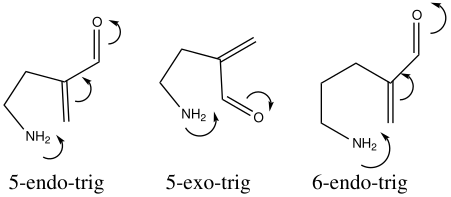
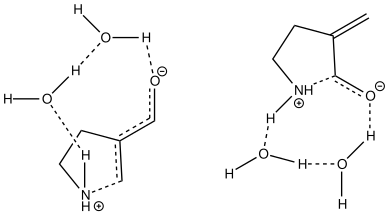
If you study the consequence of the mechanistic arrows shown above, you will see that the immediate product of the cyclisation is an internal ion-pair, a zwitterion. To get a realistic transition state geometry for a reaction where reaction of a neutral molecule creates charge separation, we need to build a slightly more elaborate system. The quantum mechanical model will include a continuum solvent (ωB97XD/6-311G(d,p)/SCRF=water) and because hydrogen bonds to charged donors or acceptors are often 2-3 times stronger than neutral ones, we need to include explicit solvent as well, as below.

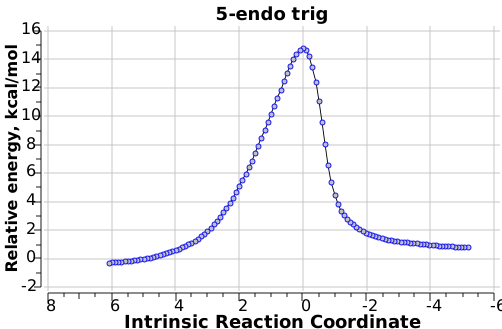
This resembles the strategy used for studying the Baeyer-Villiger reaction I showed previously, and also permits the system to transfer protons as appropriate. The 5-endo-trig transition state does indeed have such strong hydrogen bonds across the solvent bridge connecting the ionic centres. The angle of attack N-C-C is 92°. The IRC shows a barrier, which as ΔG is 17.8 kcal/mol.

5-endo transition state. Click for 4D.

The 6-endo transition state, according to Baldwin, makes the transition from unfavourable to favourable, since the angle of attack by the (nitrogen) nucleophile on the double bond can now adopt the more favourable angle of 101° (although rather less than the conventionally assumed angles of 106-109°), and ΔG is reduced to 12.4 kcal/mol, a reduction of 5.4 kcal/mol over the 5-endo analogue, more than enough to turn a dis-allowed into an allowed reaction! The transition state adopts a beautiful chair-like shape.

6-endo transition state. Click for 4D

To complete the comparisons, the 5-exo transition state and its IRC is shown below, revealing again a very strong network of hydrogen bonds connecting the zwitterion. The angle of attack is 112°, quite different from (and more favourable than) the 5-endo isomer, as is the (much lower) free energy barrier of ΔG 5.7 kcal/mol. It is worth noting that this transition state does not exist on the potential energy surface computed without the inclusion of two solvent molecules!

5-exo transition state. Click for 4D

5-exo transition state.

Because Baldwin’s rules are in fact a generalisation of transition state geometry, one might expect that the specific nature of each transition state must be considered, and that exceptions therefore could easily be contrived. What I wanted to show here is that constructing a realistic transition state for any specific reaction is in fact nowadays not that much more onerous than applying the rule! For a few hours more effort, one can have a much better analysis of any specific system.

Transition state models for Baldwin's rules of ring closure.

Saturday, June 2nd, 2012

The Baldwin rules for ring closure follow the earlier ones by Bürgi and Dunitz in stating the preferred angles of nucleophilic (and electrophilic) attack in bond forming reactions, and are as famous for the interest in their exceptions as for their adherence. Both sets of rules fundamentally explore the geometry of the transition states involved in the reaction, as reflected in the activation free energies. Previous posts exploring the transition states for well-known reactions have revealed that the 4th dimension (the timing of the bond formations/breakings) can often spring surprises. So this post will explore a typical Baldwin ring formation in the same way.

If you study the consequence of the mechanistic arrows shown above, you will see that the immediate product of the cyclisation is an internal ion-pair, a zwitterion. To get a realistic transition state geometry for a reaction where reaction of a neutral molecule creates charge separation, we need to build a slightly more elaborate system. The quantum mechanical model will include a continuum solvent (ωB97XD/6-311G(d,p)/SCRF=water) and because hydrogen bonds to charged donors or acceptors are often 2-3 times stronger than neutral ones, we need to include explicit solvent as well, as below.

This resembles the strategy used for studying the Baeyer-Villiger reaction I showed previously, and also permits the system to transfer protons as appropriate. The 5-endo-trig transition state does indeed have such strong hydrogen bonds across the solvent bridge connecting the ionic centres. The angle of attack N-C-C is 92°. The IRC shows a barrier, which as ΔG is 17.8 kcal/mol.

5-endo transition state. Click for 4D.

The 6-endo transition state, according to Baldwin, makes the transition from unfavourable to favourable, since the angle of attack by the (nitrogen) nucleophile on the double bond can now adopt the more favourable angle of 101° (although rather less than the conventionally assumed angles of 106-109°), and ΔG is reduced to 12.4 kcal/mol, a reduction of 5.4 kcal/mol over the 5-endo analogue, more than enough to turn a dis-allowed into an allowed reaction! The transition state adopts a beautiful chair-like shape.

6-endo transition state. Click for 4D

To complete the comparisons, the 5-exo transition state and its IRC is shown below, revealing again a very strong network of hydrogen bonds connecting the zwitterion. The angle of attack is 112°, quite different from (and more favourable than) the 5-endo isomer, as is the (much lower) free energy barrier of ΔG 5.7 kcal/mol. It is worth noting that this transition state does not exist on the potential energy surface computed without the inclusion of two solvent molecules!

5-exo transition state. Click for 4D

5-exo transition state.

Because Baldwin’s rules are in fact a generalisation of transition state geometry, one might expect that the specific nature of each transition state must be considered, and that exceptions therefore could easily be contrived. What I wanted to show here is that constructing a realistic transition state for any specific reaction is in fact nowadays not that much more onerous than applying the rule! For a few hours more effort, one can have a much better analysis of any specific system.

The mechanism (in 4D) of the reaction between thionyl chloride and a carboxylic acid.

Friday, May 25th, 2012

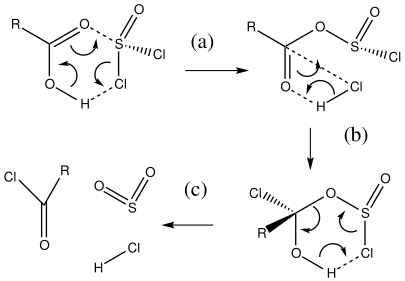
If you have not previously visited, take a look at Nick Greeves’ ChemTube3D , an ever-expanding gallery of reactions and their mechanisms. The 3D is because all molecules are offered with X, Y and z coordinates. You also get arrow pushing in 3D. Here, I argue that we should adopt Einstein, and go to the space-time continuum! By this, I mean one must also include the order in which things happen. To my knowledge, no compendium of (organic) reaction mechanisms incorporates this 4th dimension. My prelude to this post nicely illustrated this latter aspect. Here I continue with an exploration of the mechanism of forming an acyl chloride from a carboxylic acid using thionyl chloride. The mechanism shown at ChemTube3D is as below and will now be tested for its reasonableness using quantum mechanics.

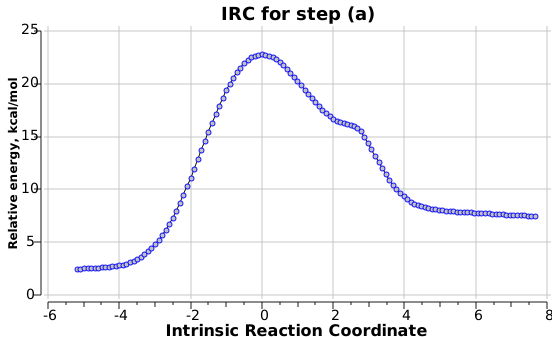
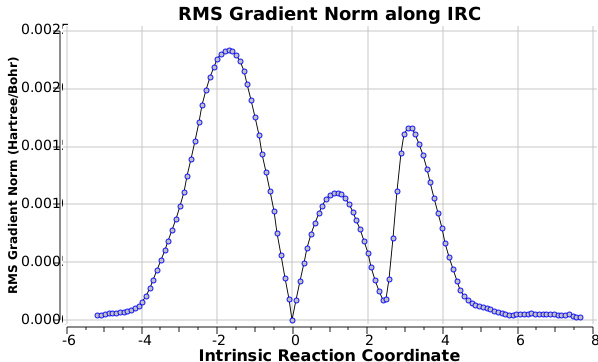
Step (a, R=Me) is shown below (ωB97XD/6-311G(d,p)/SCRF=acetic acid);

  1. From IRC -6 to -2, the oxygen of the acid carbonyl approaches the sulfur. 
  2. IRC -2 then shows one chlorine to start move towards the OH, and the sulfur now adopts a “figure T” coordination.
  3. By IRC +2, the O…H…Cl angle has become almost linear, which is the optimum geometry for a proton transfer
  4. At IRC +3, the proton transfer from O to Cl is about half complete…
  5. A process largely complete by IRC +4.5
  6. Some residual activity takes place on the methyl group, which reorients itself with respect to the adjacent C-O bonds.
  7. The free energy barrier ΔG is 21.9 kcal/mol, which perhaps might be lowered if a solvation model including explicit hydrogen bonds were to be used.
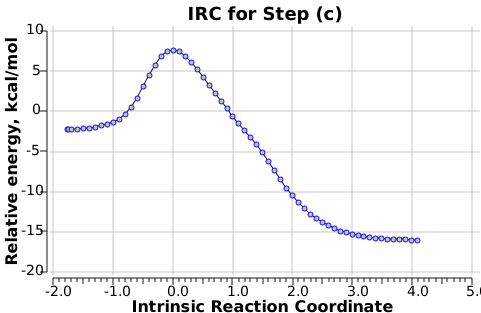
Step (b) is related to the mechanism shown in the previous post, differing only in one aspect. Step (c, R=Me) completes the reaction:
  1. The initial feature (IRC -2 to 0.0) is the cleavage of the C-O bond (1.862Å at the transition state)
  2. This point is 28.7 kcal higher in ΔG than the initial reactants, and is the highest energy point in the mechanism. As noted earlier, additional solvation-stabilisation involving discrete hydrogen bonds from e.g. acetic acid, is likely to lower this energy.
  3. This is followed (IRC +1.0 to +2.0) by a proton transfer from oxygen to chlorine.
Overall then, the scheme shown in ChemTube3D is reflected in reasonable energies calculated using quantum mechanics. The latter of course adds that fourth dimension, and gives us more insight into the order in which things happen. And I should add of course that simply because the mechanism shown here is reasonable, it does not exclude pathways which might be even lower in energy; it is indeed difficult to prove there is no other mechanism of (global) lower energy.

I have discussed elsewhere the conventions used in arrow pushing. Nick uses the “American system” , whereas in this blog, I use a system I will call the Charles Rees method. I prefer this one, since it nicely maps onto more elaborate ways of identifying electron pairs in molecules, such as ELF and QTAIM, which themselves are based on quantum mechanics. Nick’s system differs mostly in the end-point for the arrows which he directs towards atoms whereas I direct them towards bonds. It might also be an interesting discussion point as to what criteria should be used to define three-dimensional arrow pushing; in effect the path that the arrow takes and what (pedagogic) meaning this might have.

Following the initial proton transfer from Cl to oxygen, a very shallow minimum ion-pair is formed as a prelude to forming the C-Cl bond in a second step. This is because the additional oxygen present in a carboxylic acid stabilises the intermediate oxenium cation.

Secrets of a university tutor: dissection of a reaction mechanism.

Wednesday, January 25th, 2012

Its a bit like a jigsaw puzzle in reverse, finding out to disassemble a chemical reaction into the pieces it is made from, and learning the rules that such reaction jigsaws follow. The following takes about 45-50 minutes to follow through with a group of students.

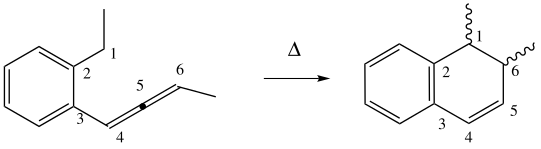
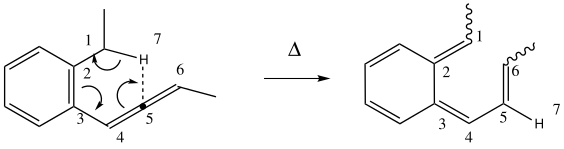
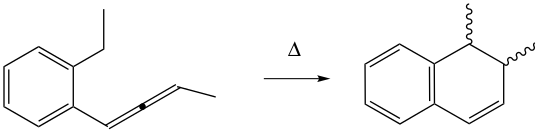
The problem is initially posed as the above (ignore the wavy bonds for now). The challenge is to identify the basic components that the reaction is built from and the rules these follow. It can be usefully salami-sliced as follows

  1. You are told the puzzle may consist of one or more (consecutive) pericyclic reactions. This should load up in your mind (from lecture notes) the various basic types of such reactions (the basic shapes of the jigsaw puzzle if you like).
  2. Rules from other areas of chemistry may be needed. Thus from your knowledge of the chemistry of benzene and its aromaticity, you need to remind yourself that there are two resonance forms (the Kekule forms) which are entirely equivalent. Problems such as the above may however be posed using either one or both of these forms. We will find out if this matters or not shortly.
  3. We need to clearly identify exactly what changes when the reaction occurs. To do this, it is useful to number what you think might be the key atoms.
  4. Notice that some atoms are not numbered. It keeps things simple, but in fact numbering them all will not do any damage. The atoms not numbered are the methyl groups (it does seem as if they emerge from the reaction unchanged) and the benzo group on the left. Only time will tell if this scheme needs changing.
  5. And now we are in a position to create a checklist of changes that occur during the reaction.
    1. A σ-bond between 1-6 clearly forms
    2. A π-bond between 5-6 decreases to a σ
    3. The π-bonds in the (un-numbered) benzo group rotate. We recognise this as a benzene resonance rather than a (pericyclic) reaction.
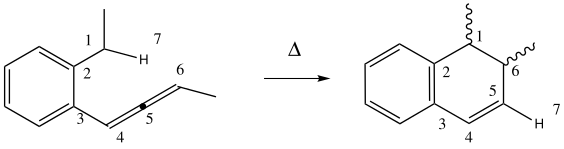
    4. And now for the elephant in the room, the atoms that we (as chemists) know are there, but which are not explicitly shown. These are the hydrogens. We know a rule for this, which is that any structure shown without hydrogens is assumed to have as many attached as are required to achieve a four valent carbon. This is in fact a fuzzy rule, because some carbons can be divalent (carbenes) and some trivalent (carbocations). Normally the former have a : glyph appended to them, and the latter a + charge, and we can see neither here so our rule stands. Time to count the elephants, and to draw the significant hydrogens explicitly (drawing them all would only clutter). We only select those hydrogens that appear to have moved during the reaction. Thus:
    5. A σ-bond between 5-7 clearly forms
    6. A σ-bond between 1-7 clearly breaks
  6. We have four significant bonds that change, 1-6, 5-6, 5-7 and 1-7. The task now is to partition them into groups that might correspond to one of the basic types of pericyclic reaction, and these tend to be defined by how many σ-bonds make or break during the reaction
    1. Thus an electrocyclic reaction either forms or breaks just one σ-bond
    2. A cycloaddition forms two (or more) σ-bonds and its reverse, a cyclo-elimination breaks two (or more) σ-bonds
    3. A sigmatropic reaction forms one σ-bond and breaks another.
    4. Ene reactions break at least one σ-bond and form at least one other, but in unequal numbers that distinguish them from a sigmatropic reaction.
  7. Juggling with these pieces soon reveals that items 5.5 and 5.6 above can comprise a sigmatropic reaction, and that item 5.1 above constitutes an electrocyclic reaction. Item 5.2 above, involving only a π-bond is not counted.
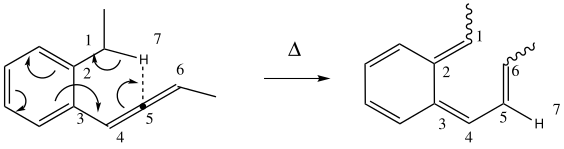
  8. The next task is to decide which comes first! To do this, we need to again recollect carbon tetravalency, and the sacrosanct need not to exceed it. Clearly forming the 1-6 bond as our first action would violate this rule by creating a pentavalent carbon atom. So this leaves 5-7/1-7 as our first action, which is going to be a sigma tropic reaction.
  9. We might recognise at this point that 5-7/1-7 share a common atom (7). We can probably pencil in that this sigma tropic reaction is going to be of the type [1,?] from this observation. From the numbering above (which in fact was deliberately chosen to achieve this effect) we infer that hydrogen 7 moves along a chain of 5 carbon atoms, and so our nomenclature is complete; it is going to be a [1,5] hydrogen migration or sigmatropic shift. Had the numbering been different, we would have had to spot that the non-common bonds differed by five atoms.
  10. The arrow pushing to achieve this transformation is shown below. Notice that the arrows rotate anti-clockwise. It is a feature of pericyclic reactions that it does not matter which clock-direction they rotate in (mostly). Hence pushing them the other way would achieve exactly the same result.
  11. This brings a surprise; we needed five arrows, or ten electrons. Is that a unique solution? Well no. Had we remembered point 5.3 above, then another initial resonance form for the benzo-ring is possible, and this form requires us to push only three arrows, or six electrons.
  12. Is there a common factor between 6 and 10 electrons? Yes, it is the famous Hückel aromaticity 4n+2 rule, for which n =1 or 2. So we get the result we really wanted, which is does not matter which of the two resonance forms for the benzo group we start with, we end up with arrow pushing that either way merely conforms to the 4n+2 rule. In other words, the transition state for this first reaction is aromatic. The stereochemistry implied by this result is going to be deferred to a second tutorial on this topic (and this is where the wavy lines will also come in).
  13. There is another observation we can make. The product of the [1,5] sigmatropic hydrogen shift no longer carries an aromatic ring on the left. We might infer that it will only be a transient intermediate, and will be very inclined to restore the aromaticity at the first opportunity.
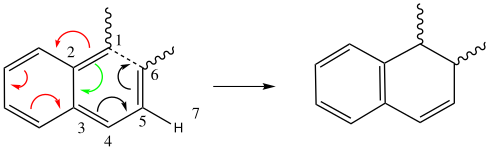
  14. We are now in a position to create the 1-6 bond without violating the valency of either atom.
  15. The arrows shown above are two (black) to which can be followed either one more (green) or three more (red), making two possibilities carrying either 6 or 10 electrons. Again, both conform to the 4n+2 rule and so it does not matter which set is followed; the electrocyclic reaction will have an aromatic transition state (again we ignore stereochemistry for the time being).
  16. And hey, we have also recovered the aromaticity of our benzo group on the left.
Well, it is now time to finish up this first tutorial on the topic. In the follow up, I will show these aromatic transition state I have referred to here, and also include discussion of the stereochemistry.


Mechanism of the reduction of a carboxylic acid by borane: revisited and revised.

Sunday, October 16th, 2011

I asked a while back whether blogs could be considered a serious form of scholarly scientific communication (and so has Peter Murray-Rust more recently). A case for doing so might be my post of about a year ago, addressing why borane reduces a carboxylic acid, but not its ester, where I suggested a possible mechanism. Well, colleagues have raised some interesting questions, both on the blog itself and more silently by email to me. As a result, I have tried to address some of these questions, and accordingly my original scheme needs some revision! This sort of iterative process of getting to the truth with the help of the community (a kind of crowd-sourced chemistry) is where I feel blogs do have a genuine role to play.

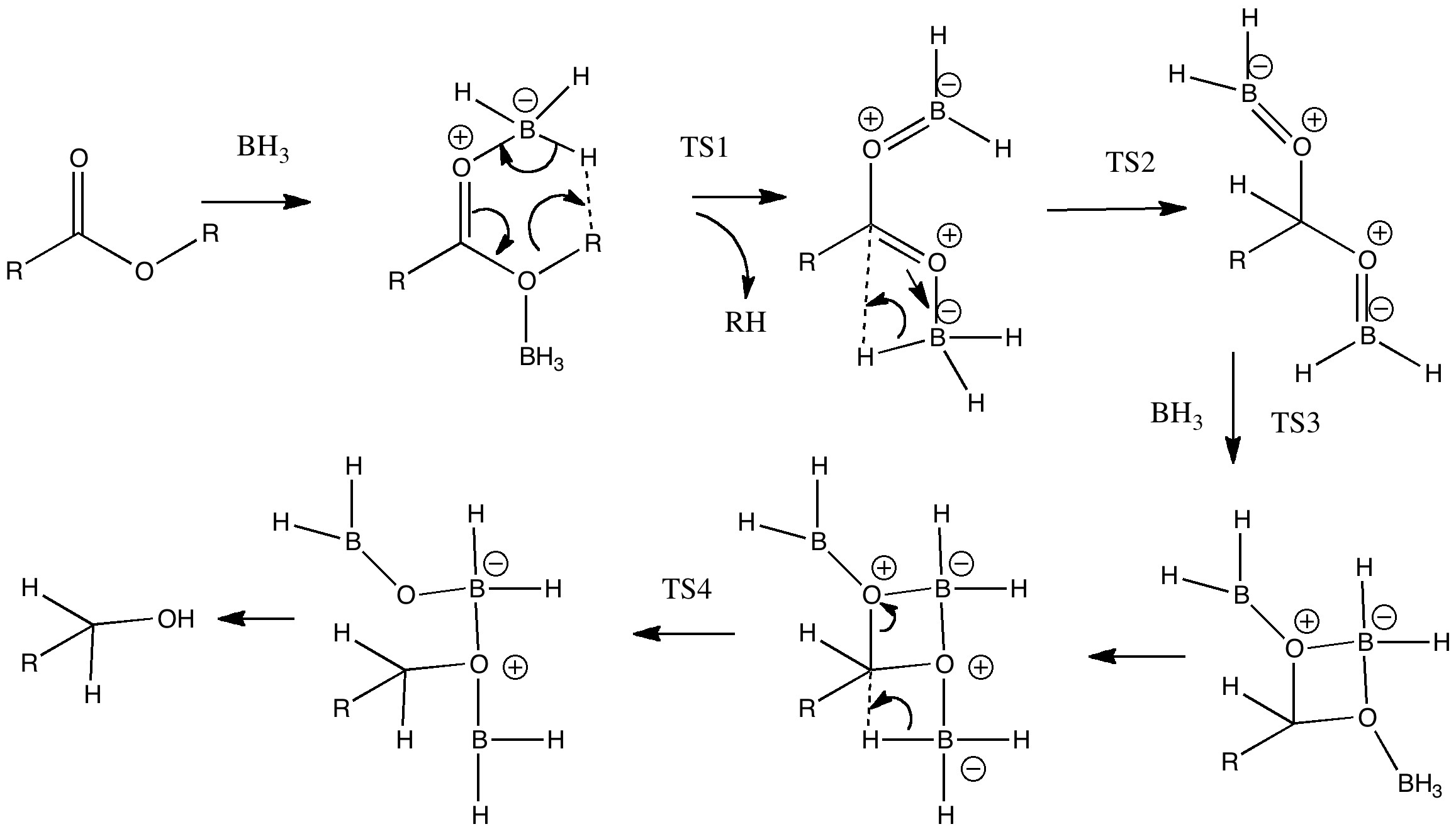
The reduction of a carboxylic acid by borane

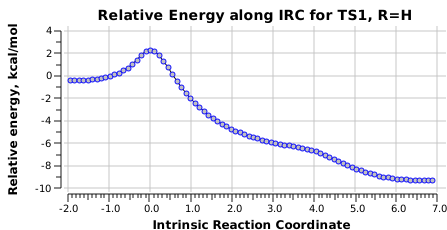
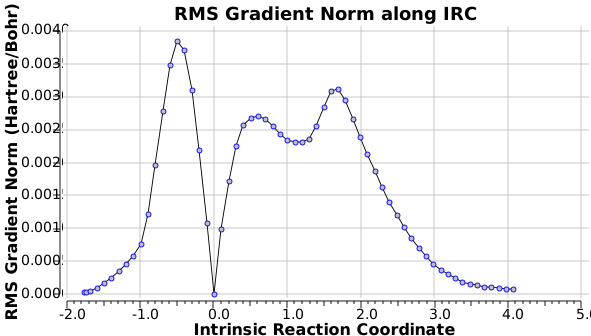
TS1 in this scheme is modified from before to include an extra borane coordinating to the oxygen of the O-R group. I will include here the intrinsic reaction coordinate [computed at ωB97XD/6-311G(d,p)], since it shows some fascinating features.

One notes that the barrier for extrusion (R=H) is lower than before, due to the effect of the extra coordinated BH3 group. But notice the “bump” at an IRC value of ~4.0. If one inspects the gradients along the IRC, they reveal that the ejecting H-H molecule is tempted to coordinate to the boron to form a 5-coordinate species (a “hidden intermediate”) before abruptly changing direction and flying off into space!

You can see an animation by invoking this link  or below:

acyloxy+bh3-irc

What happens if R=Me (an ester)? Well, the activation energy is now closer to 40 kcal/mol, which means the rate of the reaction would be very slow. Notice the bump corresponding to 5-coordinate boron has now vanished!

Again, a link for IRC animation of the reaction (it is rather nice, even if a say so myself). QED? Well, not quite. One still has to show that TS2 – TS4 do not control things! The IRC for TS2 (the first addition of a hydrogen to the carbon) is shown below, again with fascinating bumps along the way. The TS2 animation is here. The free energy of TS2 is 6.9 kcal/mol lower than TS1 (even though the actual activation barrier is higher), which makes the latter the rate determining step. Note the bumps at  IRC = -8 and +5. These are due to rotations setting up the reaction.
TS3, a ring closing reaction (animation) shows an unexpected feature which I leave you to discover for yourself. TS4 is the second and final addition of a hydrogen to the carbon, with animation and resembling an SN2 inversion. The reaction is completed by hydrolysis.
The relative free energies of TS1, 2, 3 and 4 are respectively 0.0, -6.9, -35.0 and -19.4 kcal/mol, which makes the overall rate limiting step TS1. If that is the case, then this explains why borane reduces only a carboxylic acid and not an ester.

Now all I have to do is explain all of this to my tutorial group! Mind you, this is a deceptively complex mechanism, and who knows if it may yet spring surprises.

Secrets of a university tutor: (curly) arrow pushing

Thursday, October 28th, 2010

Curly arrows are something most students of chemistry meet fairly early on. They rapidly become hard-wired into the chemists brain. They are also uncontroversial! Or are they? Consider the following very simple scheme.

Curly arrow pushing

It represents protonation of an alkene by an acid. Two products are of course possible, leading to either a tertiary carbocation as shown in (a), or a primary one (not shown). Either involves two arrows, but how to illustrate this (important) difference in the outcome using the arrows. Most textbooks show (a). The lhs arrow starts at the middle of the bond, and ends at the atom of hydrogen. This unfortunately leads to an ambiguity. It does not define which carbon is involved in forming the new C-H bond.

In recognition of this problem an article has recently appeared (DOI: 10.1021/ed086p1389) which attempts to improve model (a) by using what they call bouncing arrows, as in (b). The arrow starts at the mid point of the C=C bond, but then bounces to one end, before heading off to again to end at the H atom. The idea is that the direction of bounce informs which of the two possible bonds will be formed. Leaving aside the (non-trivial) issue of how to persuade e.g. ChemDraw to produce a bouncing arrow, I note that an alternative system has been in use where I teach for many years; (c).

  1. This starts by addressing the problem of which bond to form by immediately drawing a dotted line where you want the bond to go.
  2. The arrow starts as before, at the mid point of a bond, but this time it ends at the mid-point of the dotted line. If nothing else, Chemdraw has no problem with this notation!
  3. Are there any other advantages? Consider (d). The green dots indicate the results of a QTAIM analysis, revealing bond-critical points (BCP) in either the reactants or the products. The first arrow both starts and ends at such a BCP. The second arrow starts at a BCP, and ends at a lone pair (these are not revealed using QTAIM. If instead, ELF synaptic basin centroids were to be used, then all arrows would start or end at such a basin). This therefore gives (c)/(d) some quantum mechanical reality.
  4. Another advantage is that one can formulate check-sumrules. By this I mean extra rules that can be used to check you have gotten things correct. Take a look at the red dots, one on the oxygen, another on the bromine. The metaphor is that these can be regarded as hinges, about which the bond swivels, the course of the swivel following that of the trajectory of the arrow.
    1. For heterolytic (electron pair) arrow pushing in which none of the centres involved changes its valency, the red dots must be located on alternating atoms.
    2. For heterolytic (electron pair) arrow pushing in which a valency change does occur (e.g. formation of a carbene), two red dots must be on adjacent atoms.
    3. In general, no more than one arrow either starts, or ends, at a bond. This used to be thought of as a fairly hard rule, but in fact its not difficult to come up with reactions which break it. For example, this one, where as many as three arrows either start or end at a given bond. And, as a challenge, can you break the rule by formulating arrow pushing for the (concerted) reaction between an alkyne and a per-acid (avoiding the anti-aromatic oxirene, the ring opening of which may conflate with the peroxidation).
    4. One can interrupt the concerted flow of arrows to form intermediates along the way. One famous example of such interruption is aromatic electrophilic substitution, which can however be persuaded to move all of its arrows more or less synchronously.
  5. The metaphor now is one of doors opening and closing, rather than bouncing arrows.

There must be thousands of tutors around the world, teaching tens of thousands of students the arcane art of arrow pushing. If anyone has yet another schema for doing so, I would be delighted to hear from them.

A Disrotatory 4n+2 electron anti-aromatic Möbius transition state for a thermal electrocyclic reaction.

Thursday, April 2nd, 2009

Mauksch and Tsogoeva have recently published an article illustrating how a thermal electrocyclic reaction can proceed with distoratory ring closure, whilst simultaneously also exhibiting 4n electron Möbius-aromatic character (DOI 10.1002/anie.200806009). Why is this remarkable? Because the simple Woodward-Hoffmann rules state that a disrotatory thermal electrocyclic reaction should proceed via a Hückel-aromatic 4n+2 electron transition state. Famously, Woodward and Hoffmann stated there were no exceptions to this rule. Yet here we apparently have one! So what is the more fundamental? The disrotatory character, or the 4n/Möbius character in the example above? Mauksch and Tsogoeva are in no doubt; it is the former that gives, and the latter is correct.

So inevitably one has to ask; are there other examples? Well, during the annual updating of my own lecture notes on pericyclic reactions, I had decided to revisit a fascinating reaction, which we had first looked at years ago (below).

Electrocylization of [14] annulene

Electrocylization of 14 annulene. Click above to obtain model

Let us focus specifically on the last reaction, which involves cyclization of a [14] annulene. The pedagogic interest was to challenge the students as to whether this was a π4+π2 cycloaddition, or two 6-electron electrocyclizations. The answer of course was that either way of considering this reaction was equally valid, and both modes were presumed to proceed via Hückel-aromatic transition states. I had said as such in my lectures for many years. This year, I finally decided to evaluate the NICS index to verify this long stated hypothesis. NICS is a magnetic index which yields a negative value (of -10 to -16 ppm) for aromatic rings, and positive values for antiaromatic rings. I was fully expecting to get negative values for all three rings at the transition state. Of course, this result was not obtained! Instead, whilst the central ring did have a negative value (of -16.4 ppm), the two outer rings had the initially mystifying value of +4.8! In other words they were antiaromatic. The electron count was in no doubt, ie 4n+2 (six). The transition state stereochemistry was clearly disrotatory. But the resulting transition state ring was antiaromatic and not aromatic! Well, close (and this is why it helps to have models) inspection reveals that despite the disrotation, the bond which is being formed actually does so antarafacially, and that the topology of this transition state is actually Möbius and not  Hückel. A little more thought reveals that a thermal Möbius transition state with 4n+2 electrons must be antiaromatic. So we conclude by saying that a second example of how a disrotatory reaction can actually have Möbius character has now been revealed. Unlike the example shown by Mauksch and Tsogoeva, this Möbius transition state is actually anti-aromatic, the first example of such which has been postulated.

That the disrotatory mode is not the fundamental here is shown by the alternative exo isomer of this transition state. The antarafacial nature of the bond formation is retained, but now the disrotation is replaced by conrotation. The two electrocyclic rings however retain their anti-aromaticity. Notice also how for both the examples, the bond lengths in the aromatic central ring are fully delocalized (equalized), whereas for the two outside rings, they are full localized (with long and short bond lengths). These two properties are of course characteristic for aromatic and antiaromatic rings.

Let’s also take a look at the example preceeding the  [14] annulene, which is the analogous reaction of a  [16] annulene.  This reaction takes the phenomenon one stage further. The central ring is formed by a π4a + π4s cycloaddition via a Möbius aromatic transition state, whilst the two outer rings are again Möbius antiaromatic transition states, but now with conventional conrotation rather than disrotation.

Oh, there are other reactions in the above scheme. They, it turns out, are equally fascinating. But I will leave analysis of that to another day.

(See also Steve Bachrach’s blog)